

Table of Contents
- What Is a Maker's Mark and Why It Matters
- Jewelry Hallmark Identification Guide: Reading Stamps Like a Pro
- The Difference Between a Hallmark and a Maker's Mark
- How Maker's Marks Determine Jewelry Authenticity and Value
- Tracing Provenance: From Stamps to Story
- Vintage Jewelry Appraisal Tips: Using Marks for Accurate Valuation
- Common Mistakes When Checking Maker's Marks
- Where to See Marks in Practice
- Frequently Asked Questions
Last Updated: September 22, 2026
What Is a Maker's Mark and Why It Matters
A maker's mark is the stamped signature a jeweler or silversmith presses into a piece to identify who created it. That tiny stamp ties the object to a specific workshop, era, and standard of metal purity. For anyone buying antique or vintage jewelry, understanding why maker's marks matter for jewelry authenticity is the difference between a sound investment and an expensive mistake.
Most buyers get this wrong: they treat a stamp as a decorative detail. It is the closest thing the jewelry world has to a birth certificate, and the fastest way to separate a genuine antique from a modern reproduction.
Jewelry Hallmark Identification Guide: Reading Stamps Like a Pro
A jewelry hallmark identification guide is only useful if you know where to look and what tools to use. Start with a 10x jeweler's loupe and a bright, angled light source. Stamps hide inside ring bands, on necklace clasps, along brooch rims, or under pedestal bases.
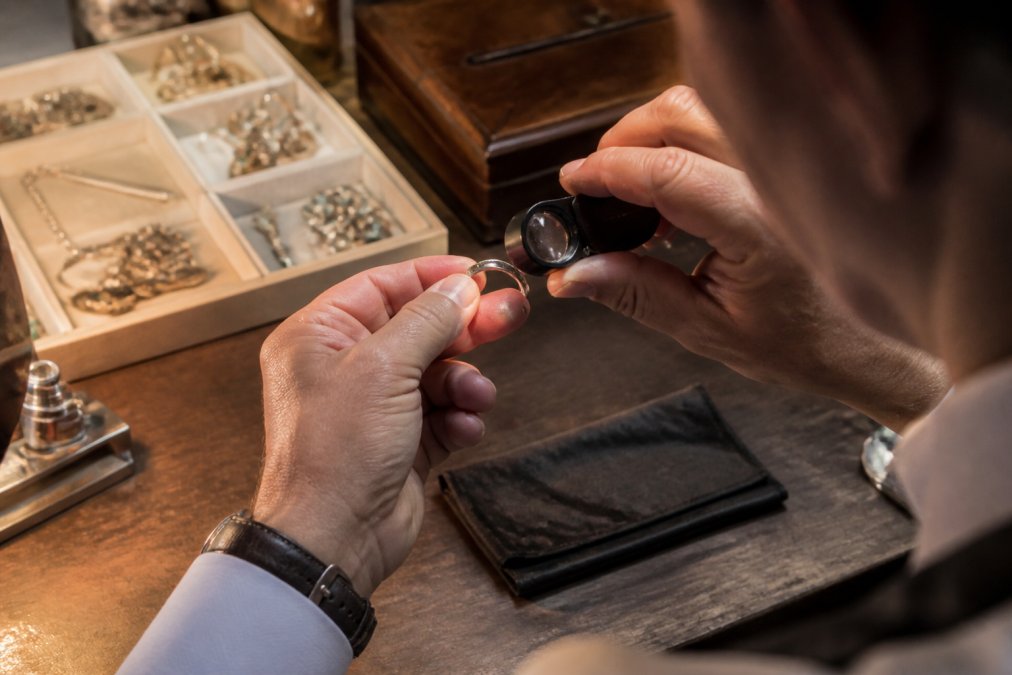
Work through these steps in order:
- Clean the surface gently with a soft cloth. Dirt fills the recesses of a stamp and makes lettering unreadable.
- Position the loupe directly over the suspected area and tilt the piece until light rakes across the metal.
- Photograph the mark with your phone through the loupe if you need a second opinion.
- Record every symbol, letter, and number exactly as it appears before you interpret anything.
A common mistake is reading a stamp at a glance and assuming the first plausible interpretation is correct. Struck marks are often shallow and worn: what looks like an "8" may be a "3," and that digit changes the metal content entirely.
Macro-Photography Techniques for Worn Marks
The biggest obstacle to remote identification is that the mark is too small, shallow, or worn for a casual phone snapshot. Appraisers and online authentication services routinely reject unclear photos.
A few techniques make the difference:
- Use raking light, not flat light. Position a small LED or phone flashlight at a 15- to 30-degree angle so the beam skims across the stamp. Shadows fall into the recesses and the lettering pops; straight-on light flattens the mark.
- Stabilize the camera. A phone clamped to a tripod or propped on books beats a handheld shot; at macro distances, slight movement blurs the lettering.
- Get close, then crop. Shoot as close as the lens allows, then crop to fill the frame with the mark. A cropped sharp image beats a full-frame soft one.
- Shoot a scale reference. Place a coin or ruler beside the mark. Appraisers use it to judge lettering size and spacing, which helps distinguish a period stamp from a modern one.
- Capture multiple angles. Shoot straight on, then at 45 degrees from two directions. A mark that reads as one letter straight on may resolve differently under angled light.
- Include the surrounding surface. One wider shot showing where the mark sits helps an appraiser judge whether the location is period-correct.
Collectors often photograph a mark once, in poor light, then ask for an opinion, usually a guess. Two minutes of setup produces a photo an appraiser can work from.
Common Purity Stamps and What They Mean
Purity stamps tell you the metal fineness of a piece. Gold carries karat stamps such as 10K, 14K, 18K, or 22K; silver shows "sterling," "925," or "coin"; platinum typically carries "950" or "plat."
A karat stamp is a claim about metal fineness, not a guarantee of origin, age, or value. A 14K stamp tells you gold content, nothing about who made it or when. You need the maker's mark alongside it to build a complete picture.
One practical check: a purity stamp deeper, sharper, or in a different style than the maker's mark on the same piece is a warning sign. Genuine marks are struck with comparable force and wear at similar rates, so a crisp stamp beside a worn one suggests one was added later.
The Difference Between a Hallmark and a Maker's Mark
The difference between a hallmark and a maker's mark comes down to what each one identifies. A hallmark certifies the metal: its fineness and, in some systems, the date and place of testing. A maker's mark identifies the person or firm responsible for the piece.
Think of it this way:
- Hallmark = what the metal is
- Maker's mark = who made it
- Date letter = when it was assayed
- Assay office mark = where it was tested
A genuine antique often carries all four. A reproduction frequently carries one, or carries marks that imitate the real thing without matching the correct combinations for the period. That mismatch is exactly where forgery detection begins.
How Maker's Marks Determine Jewelry Authenticity and Value
Maker's marks determine jewelry authenticity because they link an object to a documented body of work. When a mark matches a known silversmith or jewelry house, appraisers can compare the piece against that maker's techniques, alloys, and design vocabulary.
Antique Silver-Plated Claret Jug Ewer →
This is where value gets decided. Two identical-looking silver pitchers can differ enormously in price if one carries a documented maker's stamp and the other carries nothing.
Our own collection reflects this. The Antique Silver-Plated Claret Jug Ewer Pitcher Engraved Armorial Crest Hallmark carries a stamped hallmark or serial number on the underside of its pedestal base, and that stamp is precisely what lets us present it as a documented antique rather than an unattributed decorative piece.

Tracing Provenance: From Stamps to Story
Provenance is the documented history of an object's ownership and origin, and marks anchor it. A stamp gives you a starting thread, a maker, a region, an approximate date, and provenance grows from there through auction records, dealer catalogs, family documentation, and museum comparables.
For collectors, this matters more than appearance.
Vintage Jewelry Appraisal Tips: Using Marks for Accurate Valuation
Vintage jewelry appraisal tips almost always start the same way: document the marks before anything else. An appraiser who cannot read the stamp is working blind, and a blind appraisal is a guess.
Bring the following to any appraisal:
- Clear macro photographs of every stamp on the piece
- The exact location of each mark on the object
- Any paperwork, receipts, or family history you have
- A note of any repairs, resizing, or restoration you know about
Common Mistakes When Checking Maker's Marks
The most common mistake is assuming every stamp is a maker's mark. Many pieces carry pseudo-hallmarks: imitation stamps suggesting a prestigious origin without being one. English-style pseudo-hallmarks appear frequently on silver-plated wares and are a legitimate part of a piece's history, not necessarily fraud.
Other frequent errors:
- Reading a worn mark and forcing it to match a famous maker
- Ignoring the absence of a mark entirely
- Confusing a reproduction trademark with a period maker's stamp
- Assuming a mark proves age rather than simply claiming it
- Trusting a single stamp in isolation instead of cross-checking it against style, construction, and period-appropriate tooling marks
The Legal Side of Forged Marks
The Federal Trade Commission's guidance on jewelry advertising and marking is also useful context when a listing's language feels inflated, because it defines the line between puffery and a prohibited misrepresentation.
Where to See Marks in Practice
Nothing teaches mark-reading faster than handling real pieces. Our Vintage Embossed Dutch Scene Pedestal Bowl displays its original maker's hallmark on the underside, reading "DUTCH TRADEMARK REPRODUCTION HOLLAND." That single line tells you the origin, the tradition, and that it is a reproduction rather than an original Dutch antique, exactly the job the mark was designed to do.

Frequently Asked Questions
What is the difference between a hallmark and a maker's mark?
A hallmark indicates the metal's purity and origin, while a maker's mark identifies the artisan or company that created the piece. Hallmarks are applied by an assay office to certify metal fineness, such as sterling silver or 18K gold. Maker's marks are the individual signature of the craftsman or brand, often stamped as initials or a logo. Both are crucial for jewelry authentication because they provide separate layers of verification.
How can I tell if a piece of jewelry has a maker's mark?
Inspect the piece under good lighting with a 10x jeweler's loupe. Check the inside of ring bands, the clasp of necklaces, the back of pendants, and the posts of earrings. Maker's marks are often small and may be worn from age. Look for initials, symbols, or full names stamped into the metal. If you cannot find a mark, a jeweler or appraiser can examine it with magnification.
Can a piece of jewelry be authentic without a maker's mark?
Yes, some authentic vintage and antique pieces lack a maker's mark due to wear, resizing, or regional practices. However, the absence of a mark makes authentication harder and often lowers value. In these cases, experts rely on craftsmanship details, metal testing, and provenance documents. For high-value purchases, always request a certificate or appraisal that confirms authenticity through multiple methods.
Why is a maker's mark important for the value of vintage jewelry?
A maker's mark connects a piece to a specific designer or manufacturer, which can significantly increase value if the maker is renowned. It also helps date the piece and verify its origin. For vintage jewelry appraisal tips, appraisers use maker's marks to confirm authenticity and compare recent auction results. Pieces with clear, documented marks typically sell for more than identical unmarked items.


