

Table of Contents
- Tip 1: Understand What Makes a Kilim Different From a Pile Rug
- Tip 2: How to Tell If a Kilim Is Handmade (Visual Markers That Don't Lie)
- Tip 3: Judge Material Quality by Fiber, Dye, and Weave Density
- Tip 4: Get the Size Right Before You Commit
- Tip 5: Place and Style Your Kilim Without Flattening the Room
- Tip 6: Kilim Rug Maintenance Tips for the First Year and Beyond
- Tip 7: Buy for Value, Not Just Looks: Resale, Sourcing, and Regional Style
- Conclusion
- Frequently Asked Questions
Last Updated: September 14, 2026
Tip 1: Understand What Makes a Kilim Different From a Pile Rug
A kilim rug is a flatweave textile with no pile, created by tightly interweaving warp and weft threads rather than knotting fibers through a foundation (britannica.com). That structural difference changes how it feels, wears, and fits into a room.
At ABC Rugs Kilims & Jewelry, we handle both pile rugs and kilims daily, and the confusion between them is the most common mistake first-time buyers make. Pile rugs, like most Persian city rugs, have a plush surface of thousands of knots tied onto a foundation. Kilims skip that step: the pattern is woven directly into the fabric, making them lighter, reversible, and easier to move.
That flat, pileless construction gives kilims distinct advantages: they lie flat without a thick underlay, work in high-traffic areas, and hang beautifully on a wall. Many buyers find a kilim reads as more casual and modern than a traditional pile rug, which is why designers reach for them in overstuffed spaces.
The trade-off is cushioning. If you want a rug you can sink your toes into, a kilim is not it. If you want a durable, graphic, hand-woven textile that ages gracefully, keep reading.
Tip 2: How to Tell If a Kilim Is Handmade (Visual Markers That Don't Lie)
Knowing how to tell if a kilim is handmade comes down to three checks you can do in under a minute: the back, the selvage, and the fringe. Machine-made kilims are woven with mechanical precision, and that precision gives them away.
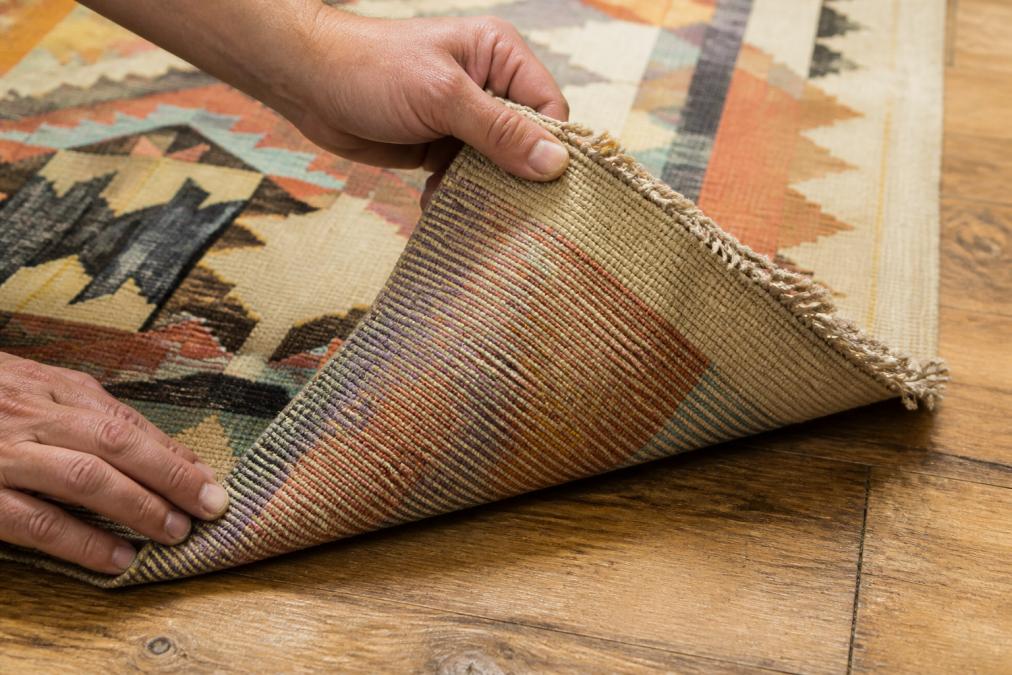
Check the Back, Selvage, and Fringe
Flip the rug over. On a genuine hand-woven kilim, the reverse is nearly as clean as the front, with the same pattern in slightly muted colors. Machine-made versions often have a stiff backing, glued edges, or a pattern that stops at the border. The selvage should look hand-finished, and fringe on a handmade piece is usually the warp threads themselves, tied or braided, not sewn-on trim.
Read the Abrash and Dye Irregularities
Abrash is the subtle horizontal banding that appears when hand-dyed wool is used in small batches. It is not a defect but one of the clearest signs of authentic craftsmanship, because machine-applied synthetic dyes produce perfectly uniform color. Look for slight shifts in tone across the width and small irregularities in the geometric patterns, the fingerprint of a human weaver.

Tip 3: Judge Material Quality by Fiber, Dye, and Weave Density
Fiber content, dye type, and weave density determine how a kilim looks in five years, not just today. Most traditional kilims are woven from wool, sometimes blended with cotton in the warp. Wool holds natural dyes well, resists soiling, and develops a soft patina with age.
Natural dyes, derived from plants, insects, and minerals, tend to mellow rather than fade (Making Color). Synthetic dyes can be colorfast but often look flatter and can bleed if the rug gets wet. Ask the seller directly whether the dyes are natural or synthetic, and be wary of any answer that dodges the question.
Weave density is the third check. A tightly woven kilim feels firm and holds its shape. A loose weave feels flimsy and will distort under furniture. Press your thumb into the fabric. If it gives easily and the threads shift, the density is low.
Tip 4: Get the Size Right Before You Commit
Sizing is where first-time buyers lose the most money. A kilim a few inches off can look wrong no matter how beautiful it is. Measure your space first, then shop.
| Room | Typical Kilim Size | Placement Rule |
|---|---|---|
| Living room (sofa + coffee table) | 8x10 ft or larger | Front legs of all seating on the rug |
| Dining room | 8x10 ft or larger | Rug extends 24 in past every chair |
| Bedroom (queen) | 6x9 ft or larger | Rug extends 18-24 in on both sides |
| Entryway or hallway | 2x6 ft to 3x5 ft | Leave 4-6 in of floor visible on each side |
| Kitchen or small nook | 3x5 ft | Rug sits fully under the work zone |
For reference, our One Of The Kind Persian Torkman Rug #02, a hand-woven piece at 290 x 208 cm, fits the living room category comfortably. Measure twice. Kilims cannot be trimmed without destroying the selvage and the value.
Tip 5: Place and Style Your Kilim Without Flattening the Room
Placement decides whether a kilim looks like a design choice or an afterthought. The most common error is treating a kilim like wall-to-wall carpet. These are graphic, hand-woven textiles, and they want to be seen.
The single most useful placement rule for a flatweave is the furniture-leg test. On a pile rug, you can cheat the size because the pile hides the transition; on a kilim, the flat plane makes every edge visible. If the front legs of a sofa and two chairs are not all on the kilim, the rug reads as a mat, not an anchor. Aim for at least 6 inches of kilim extending past each front leg.
Layer, Hang, or Float: Three Placement Modes
Layering. A kilim over a neutral jute or sisal base adds cushioning that a flatweave lacks, but two flat surfaces slide against each other. Use a felt-and-rubber pad between the layers, not a thin PVC grid, which can off-gas and discolor wool. A common pattern is a 5x8 kilim over an 8x10 jute base, offset so the jute frames the kilim on all four sides.
Wall hanging. A kilim with an exceptional pattern is often worth more on a wall than underfoot, because it avoids foot traffic entirely. Use a velcro hanging strip sewn to a fabric sleeve, not nails through the weave. Nails create rust stains and tear warp threads. Keep hung kilims out of direct sun; even natural dyes fade over years of UV exposure.
Floating. In a modern room, a single bold kilim anchors the seating area and everything else stays quiet; in a traditional room, a vintage kilim adds texture without competing with upholstery. Let the kilim be the loudest textile in the room, and keep the sofa, curtains, and pillows in solid, muted tones.
The Underlay Is Not Optional
Always use a rug pad. A quality underlay keeps the kilim from sliding, protects the weave from abrasion, and adds cushioning flatweaves lack, the difference between a rug that lasts a decade and one that wears through in three years. Look for a pad labeled for flatweave or kilim use, typically 1/4 to 1/2 inch thick, and trim it 1 inch inside the rug's edge so it never peeks out.
Tip 6: Kilim Rug Maintenance Tips for the First Year and Beyond
Kilim rug maintenance tips are simpler than most people expect, but not optional. A flatweave has no pile to hide dirt, so what you see is what is there.
Vacuum weekly on low suction with the beater bar off; high suction or a spinning brush can pull the weft threads and distort the pattern (Home). Rotate the rug every six months so foot traffic and sunlight hit it evenly. For spills, blot immediately with a clean cloth and cool water, never rub, and never wet-shampoo a kilim unless you know the dyes are colorfast.
For deeper cleaning, take the rug to a professional who works with flatweaves. Treating a kilim like a pile rug in a washing machine can shrink it and bleed every dye in the pattern.
Tip 7: Buy for Value, Not Just Looks: Resale, Sourcing, and Regional Style
A kilim is a textile you can resell, which changes how you should shop. Buyers who treat the purchase as an investment rather than a one-time decoration consistently end up with better pieces. The three levers that move resale value most are regional origin, condition, and documented sourcing. High-quality textiles anchor a room with lasting character, providing a versatile foundation for styling eclectic decor that remains visually cohesive as your collection evolves.
Regional Styles Worth Knowing
Region is the fastest way to narrow a search and to sanity-check a seller's claim. Three broad families dominate the market:
Anatolian (Turkish highlands). Bold geometric medallions, saturated reds and blues, and a wide, flat border. Weavers across central and eastern Anatolia produced these on narrow looms, so many vintage pieces are long and relatively narrow. The warm palette and large-scale geometry are why designers reach for Anatolian kilims in modern and mid-century rooms.
Persian (tribal and village). Finer motifs, more restrained color palettes, and a denser weave than most Anatolian pieces. Tribal Persian kilims often show repeating small-scale patterns rather than one large medallion. The weave density is the giveaway: hold a Persian kilim up to light and less passes through than a comparable Anatolian piece.
Caucasian (Caucasus region). Strong contrast, crisp geometric forms, and a distinct use of white and deep indigo. Caucasian kilims are prized for graphic clarity and often command a premium because the patterns photograph well.
Vintage and distressed. Mid-20th-century kilims with a soft, faded look command strong prices. The fade is usually sun exposure, not dye failure, and cannot be replicated. A genuine vintage fade adds value; a chemically stripped rug does not.
Knowing the region helps you judge whether a price is fair and whether the pattern matches the seller's claim. If a seller calls a piece "Persian" but the geometry is large-scale Anatolian, walk away.
Troubleshooting Common Defects Before You Buy
The line between character and damage is the most expensive judgment call a first-time buyer makes. Here is the checklist:
Character (does not reduce value, often adds it):
- Abrash, horizontal color banding from hand-dyed wool. Expected on any genuine hand-woven kilim.
- Minor irregularity in the pattern, a slightly off-kilter motif where a weaver improvised. This is a fingerprint, not a flaw.
- Even, soft wear across the field, the patina of a well-loved rug. It reads as age, not neglect.
Damage (reduces value, sometimes sharply):
- Dry rot in the foundation, the warp or weft feels brittle and powdery, and fibers snap when you bend them. This is structural and expensive to fix. Walk away.
- Moth damage, small holes, thinning in the wool, or a gritty residue. Check the folds and the underside, where moths prefer to feed. Isolated small holes are repairable; widespread thinning is not.
- Over-restoration, a dealer has replaced large sections of the original weave with new wool. Look for a patch that is brighter, stiffer, or a slightly different shade than the surrounding field. Some restoration is normal on a vintage piece; a rug that is 40% new wool is a different rug.
- Machine-stitched edges, a repair that looks fine in photos but often fails within a season and can reduce resale value significantly.
Sourcing and the Investment Case
Sustainable sourcing matters here too. Ask where the wool came from, whether the dyes are natural, and whether the weaver was paid fairly. Those answers separate a collectible from a commodity. A kilim with documented regional origin, natural dyes, and a named weaving workshop holds value better than an anonymous piece of the same size and pattern.

For buyers who want a verified piece without the guesswork, One Of The Kind Persian Torkman Rug #01 is a hand-woven tribal example with documented regional origin. Treat the purchase as a five-to-ten-year hold, not a flip. The kilim market rewards buyers who know what they own, and the checks in this section are how you get there.
Conclusion
Buying your first kilim is a decision you will live with for years, and the difference between a good purchase and a regret comes down to the checks in this guide. Verify the weave, read the abrash, measure the room, and buy from a source that stands behind what it sells.
At ABC Rugs Kilims & Jewelry, every piece is reviewed and trusted, from hand-woven kilims to Persian antique rugs and vintage treasures. Whether you are furnishing a single room or sourcing wholesale inventory, our curated collection gives you authentic craftsmanship you can verify before you buy. Get started with ABC Rugs Kilims & Jewelry and find the kilim that earns its place in your home.
Frequently Asked Questions
How can I tell if a kilim rug is authentic and not a machine-made reproduction?
Flip the rug over. A handmade kilim shows slightly uneven weft lines, visible abrash (natural color shifts), and a selvage with irregular hand-finished edges. Machine-made versions have perfectly uniform rows, identical color saturation, and a glued or serged backing. Check the fringe too: hand-woven fringe is part of the warp threads, while machine fringe is sewn on separately. Look for fiber content labels and ask the seller for weaving region details.
Are kilim rugs durable enough for high-traffic areas like living rooms and hallways?
Yes, but with a caveat. Flatweave kilims have no wool pile, so they sit closer to the floor and take direct foot traffic. A tightly woven kilim with dense warp and weft holds up well in entryways and living rooms. The bigger risk is sliding, not wear. Use a quality rug pad or underlay to keep it in place and reduce friction on the fibers. Rotate the rug every six months to even out traffic patterns.
What is the 18-inch rule for rug placement, and does it apply to kilims?
The 18-inch rule says a rug should extend at least 18 inches beyond the edges of your furniture, or leave 18 inches of bare floor visible around the room's perimeter. It applies to kilims the same way it applies to pile rugs. For a living room, that means the kilim should sit under the front legs of your sofa and chairs. In a dining room, allow 24 inches beyond the table edge so chairs stay on the rug when pulled out.
How do I clean and maintain a kilim rug without damaging the fibers?
Vacuum weekly on low suction without a beater bar. For spot cleaning, blot spills immediately with a clean cloth and use a mild wool-safe detergent diluted in cool water. Never saturate the rug or scrub aggressively. For deeper cleaning, hand wash or hire a professional who works with flatweaves. Rotate the rug every six months, keep it out of direct sunlight to prevent fading, and use a rug pad to reduce sliding and fiber stress.


