

Table of Contents
- Why Handmade Wool Rugs Age Differently Than Machine-Made
- How to Tell If a Wool Rug Is Real: Fiber and Lanolin Checks
- How to Tell If a Rug Is Good Quality: 8 Signs to Check in Person
- Hand-Knotted Rug Quality vs. Hand-Tufted and Machine-Made
- Rug Knot Density: What KPSI Really Tells You
- Dye Quality and Colorfastness: Safe At-Home Checks
- What Handmade Wool Rugs Cost and What That Price Buys
- Red Flags, Seller Questions, and Documentation to Request
- Frequently Asked Questions
Last Updated: October 8, 2026
Why Handmade Wool Rugs Age Differently Than Machine-Made
Machine-made rugs are glued, not tied: the pile is punched through a backing and held with latex adhesive that dries out, causing shedding and delamination.
Handmade construction locks each knot or weft into the foundation, so there is no adhesive to fail.
Natural wool fibers have a crimp and spring synthetic yarns cannot copy, so the pile bounces back instead of flattening.
Quality in handmade wool rugs starts with construction; fiber, dye, and density follow from how the rug was built.

How to Tell If a Wool Rug Is Real: Fiber and Lanolin Checks
Real wool feels slightly oily and cool and springs back when pressed; synthetics feel slick, warm, and stay compressed.
Here is how to tell if a wool rug is real in under a minute:
- Rub your palm across the pile. Real wool warms slowly and leaves a faint residue.
- Press a thumb into the pile. Wool bounces back. Synthetics stay dented.
- Pull a single fiber. Wool stretches and breaks with a curl. Synthetic snaps straight.
Lanolin, the natural oil that keeps wool soft and resists soil, matters more than most buyers realize. Harsh chemical washing strips it out, leaving brittle fiber.
Fiber length matters too: longer staple wool spins into stronger yarn, while short fiber sheds and pills sooner.
How to Tell If a Rug Is Good Quality: 8 Signs to Check in Person
You can judge a rug's quality in about ten minutes with your hands and eyes. Here are the eight signs that matter.
- Knot density. Look at the back. Tighter, more numerous knots signal a finer rug.
- Pile resilience. Press down. Good wool springs back fast.
- Back construction. Hand-knotted backs show individual knots, not a glued grid.
- Edge finish. Selvedges should be wrapped and tight, not fraying.
- Fringe. Real fringe is part of the foundation warp, not sewn on.
- Color depth. Natural dyes shift tone across the pile. Flat color suggests synthetics.
- Shape. Slight irregularity is normal in handmade pieces. Perfect symmetry can signal machine work.
- Weight. A dense wool rug feels heavier than its size suggests.
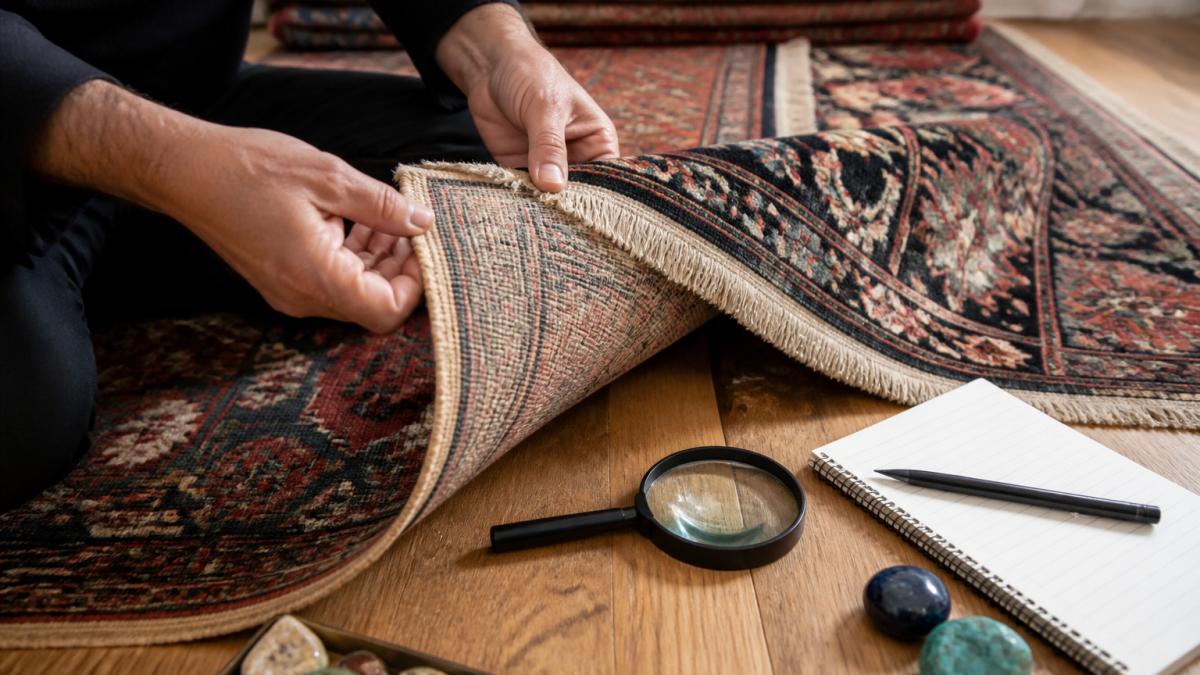
Front, Back, Edges, and Fringe: A Room-by-Room Inspection Checklist
Use this checklist when viewing a rug in person.
- Front: Run your hand against the pile. Shedding should be minimal.
- Back: Flip it. Count knots in a one-inch square.
- Edges: Check both selvedges for loose threads or glue.
If a seller will not let you flip the rug, that is your answer.
Hand-Knotted Rug Quality vs. Hand-Tufted and Machine-Made
Hand-knotted rug quality sits at the top of the construction ladder, and the difference shows the moment you flip the rug over.
| Construction | How It's Made | Back Appearance | Durability |
|---|---|---|---|
| Hand-knotted | Knots tied by hand to a warp | Individual knots, no glue | Highest, decades |
| Hand-tufted | Yarn punched through canvas, glued | Flat fabric with latex | Moderate |
| Hand-woven (kilim) | Flat weave, no pile | Tight interlocking weave | High, but flat |
| Machine-made | Power loom, glued backing | Uniform grid, adhesive | Lowest |
Hand-tufted rugs are often sold as handmade, but the construction is glued, and that glue is the weak point.
A kilim is flat-woven with no pile, so judge it by weave tightness, not knots.
Rug Knot Density: What KPSI Really Tells You
Rug knot density is the number of knots packed into one square inch, measured as KPSI. Higher KPSI means a finer, more detailed rug, but treating it as the only mark of quality is the fastest way to overpay.
To measure it yourself, flip the rug and count the knots along one inch, then the rows in the same inch. Multiply the two numbers for your KPSI.
Here is what different ranges usually mean:
- Under 60 KPSI: Coarser weave, often tribal or village rugs.
- 60 to 150 KPSI: Standard city workshop rugs with clear patterns.
- 150 to 300 KPSI: Fine rugs with detailed floral or medallion designs.
Why KPSI Alone Does Not Make a Rug Better
Density is a tool, not a verdict. Three things determine whether high KPSI means quality:
- Construction type. KPSI only applies to hand-knotted rugs. A hand-tufted rug can have a dense pile, but the yarn is punched through canvas and held with latex adhesive, not tied to a warp, so counting "knots" on a tufted back is meaningless. A kilim is flat-woven with no pile, so judge it by weave tightness instead.
- Design complexity. A complex motif needs more knots to hold its detail; a simple geometric pattern does not. A 90 KPSI rug with a bold tribal design can be better made than a 250 KPSI rug whose fine pattern was forced onto wool too coarse to hold it. Density should match the design, not exceed it.
- Wool and dye underneath. A tightly knotted rug with short, harshly washed wool will still shed and pill, and one with unstable dye will still bleed. Knot count cannot rescue bad fiber or dye.
How Density, Construction, and Design Interlock
Think of KPSI as the resolution of the rug: a high-resolution image printed on cheap paper still looks cheap.
- Tribal and village rugs are often 40 to 80 KPSI. The lower count is not a defect, the design is bold and geometric, and the coarser weave is part of the aesthetic and the durability.
- City workshop rugs typically run 100 to 250 KPSI, which is enough resolution for curvilinear florals and medallions.
- Master-weaver and silk-blend pieces can exceed 300 KPSI, where the knot count supports intricate pictorial or highly detailed curvilinear work.
Experienced buyers check density last, after confirming construction, fiber, and dye. If the back shows individual knots and no glue, the wool springs back with a faint lanolin scent, and the color has depth, KPSI becomes a useful tiebreaker.
Dye Quality and Colorfastness: Safe At-Home Checks
Natural dyes age gracefully, softening and blending over time, while synthetic dyes stay flat or bleed when wet. Unstable dye is also a durability problem: a bleeding rug fades unevenly and can stain floors, furniture, and other textiles.
The most common colorfastness test, rubbing a wet cloth on the pile, can itself damage a rug if the dye is unstable. Here is how to check safely, from least to most invasive.
One Of The Kind Hand-Knotted Persian Wool Rug _ Luxurious Vintage Design, 10'7" →
Start With Your Eyes, Not Water
Before you touch a rug with anything wet, inspect it dry:
- Tilt the rug toward a window. Natural dyes show depth and variation across the pile. Synthetic dyes often read as flat and uniform.
- Look for abrupt color changes. A sharp line where one section shifts tone can signal a repaired or redyed area, not natural variation.
- Check the fringe and edges. On a genuinely old rug, the fringe often shows more color migration than the field. Uniformly bright fringe on an otherwise aged rug is a red flag.
Safe Colorfastness Checks, In Order
If the dry inspection raises no red flags, move to these checks. Stop at the first sign of trouble.
- The white-cloth blot, on an inconspicuous corner only. Dampen a white cotton cloth with cool water, not hot, not soapy, and press it firmly against a corner of the pile for a few seconds. Do not rub. If color transfers, the dye is unstable; rubbing spreads the dye and can permanently lighten the spot.
- The paper-towel test on the back. Fold a damp paper towel and press it against the back, where the knots and foundation are exposed. Dye that has migrated through the foundation is a stronger warning sign than surface transfer.
- The pH check, if you are serious. A drop of pH-neutral water on a hidden area, left for 30 seconds, then blotted, tells you whether the dye is water-soluble. Natural vegetable dyes release little or no color with plain water; some synthetic dyes release noticeably.
What the Results Actually Mean
Color transfer on a damp cloth does not automatically mean low quality, some natural dyes, especially indigo and madder, release a little color when new. The question is degree and pattern:
- A faint tint on the cloth, with no change to the rug's appearance: common in newer natural-dye rugs. Usually not a problem.
- A strong color transfer, or a visible light spot left on the rug: unstable dye. Avoid wet-cleaning this rug, and expect uneven fading over time.
- Color that transfers from the back but not the front: dye has penetrated the foundation, which can indicate over-dyeing or a redyed repair.
Why Dye Quality Ties Back to Fiber and Construction
Dye does not exist in isolation. Wool's natural crimp and lanolin coating affect how dye bonds, and harsh chemical washing strips lanolin so fiber accepts dye unevenly, which is why over-processed rugs look flat even with complex patterns.
According to the American Chemical Society's overview of natural dye chemistry, plant-based dyes bond differently to wool fiber than synthetic dyes do, which is why they often age with more depth and variation.
Judge dye quality by depth, variation, and stability, not by whether the color is uniform. Slight unevenness is a sign of natural dye. Flat, uniform color with a chemical smell is a sign of synthetic dye. And always test on a hidden corner, never the field.
What Handmade Wool Rugs Cost and What That Price Buys
Price tracks three things: knot density, wool quality, and age. A coarser village rug costs far less than a fine city workshop piece of the same size.
At ABC Rugs Kilims & Jewelry, our hand-knotted Persian wool rugs range from $4,672 for a 10'7" x 7' vintage Tabriz-style piece to $8,496 for a 12'7" x 9'5" Mashad rug.

That money buys a rug with over 60 years of history in some cases, natural wool and cotton, and knots tied by hand, decades of use, not a five-year disposable.
Cheap "handmade" rugs usually cut corners on wool, dye, or knots. The price gap is real, and so is the quality gap.
Red Flags, Seller Questions, and Documentation to Request
Certain warning signs should stop a purchase cold. Others just mean you need to ask better questions.
Red flags to watch for:
- Seller refuses to let you flip the rug
- Fringe that is sewn on rather than woven in
- A strong chemical or glue smell
Questions worth asking every seller:
- Where was this rug made, and when?
- Is it hand-knotted, hand-tufted, or hand-woven?
- What are the fiber and dye types?
Documentation to request includes a written description of origin, fiber, and construction.
According to the Federal Trade Commission's guidance on textile labeling, sellers must disclose fiber content and country of origin for textile products.
For collectors, the Textile Society of America's resources on textile care and study offers background on regional weaving traditions that can help you spot a rug that does not match its claimed origin.
Judging a handmade wool rug comes down to construction, fiber, density, and dye, checked in person with your own hands.
Frequently Asked Questions
How can you tell if a wool rug is real and not synthetic?
Pull a single fiber and burn it. Real wool smells like burnt hair and crumbles to ash; synthetic fibers melt into a hard bead and smell like plastic. You can also rub the pile briskly and check for static, which builds on synthetics but not on wool. Look for lanolin, the natural oil that gives genuine wool a faint sheep-like scent and a slightly waxy feel. A handmade wool rug also shows slight color and texture variation across the field, while synthetic yarn stays uniform.
Does a higher knot count always mean a better rug?
No. Rug knot density matters, but it is one variable among several. A rug with 400 KPSI and poorly spun wool will not outlast a 120 KPSI rug with long-staple fiber and tight finishing. High knot counts support finer curvilinear designs and tighter detail, while lower counts suit geometric tribal patterns. Judge KPSI alongside wool quality, dye fastness, foundation strength, and how evenly the knots sit across the back.
What should I look for on the back of a handmade rug?
Flip the rug over. A hand-knotted rug shows individual knots tied around warp threads, with slight variation in size and spacing. You should see the pattern clearly, though slightly blurred compared to the front. Hand-tufted rugs show a glued canvas backing with no visible knots. Check that the foundation threads feel firm, not brittle or powdery, and that no latex or glue is peeling. Loose or shifting knots on the back signal a rug that will shed and wear early.
How do I know if a handmade rug has a sturdy finish?
Run your fingers along the edges and fringe. Selvedges should be tightly bound with no exposed warp threads, and fringe should be an extension of the foundation, not sewn on afterward. Fold a corner and check that the pile springs back without leaving a crease. Ask the seller whether the rug has been professionally washed and blocked, since a true handmade wool rug holds its shape after decades of use when the finishing was done correctly.


