

Last Updated: November 5, 2026
Quick Summary
To verify antique rug age, inspect the pile for uneven wear in traffic lanes, flip the rug to check for irregular hand-knotted knots and hand-spun fibers, and examine the fringe and selvage for thinning or replacement. An antique rug is generally 100 years old or more, so confirm the evidence against that benchmark.
- An antique rug is generally 100 years old or more, while vintage rugs are roughly 50 to 80 years old.
- Real wear transitions gradually from center to edge, while artificial distressing stops abruptly.
- Compare fringe color, thickness, and twist against the pile to spot replaced fringe.
- A rug identification app can suggest a style but cannot confirm antique rug age.
- Hire a professional appraiser when value matters, and ask for a written report.
Table of Contents
- How to Tell If a Rug Is Antique: The First Clues
- A Repeatable Inspection Workflow with Photos and Measurements
- Persian Rug Age Guide: Antique, Semi-Antique, and Vintage Defined
- Rug Identification Apps: What They Can and Cannot Tell You
- Antique Rug Appraisal: When to Call an Expert and What to Ask
- How to Spot Artificial Aging, Repairs, and Replacement Components
- Shop Verified Antique Rugs at ABC Rugs Kilims & Jewelry
- Frequently Asked Questions
How to Tell If a Rug Is Antique: The First Clues
Learning how to verify antique rug age starts with your eyes, not an app. An antique rug is a hand-knotted piece generally 80 to 100 years old or more, and the physical evidence of that time sits in the pile, the foundation, and the edges. Here is a process you can use to inspect a rug yourself.
Start with the pile. Worn areas tell you where feet walked for decades.
Pile Height, Wear, and the Patterns of Use
Uneven pile is the clearest early sign of age. A new rug has consistent height across the whole field. An old one shows low pile in traffic lanes and full pile near the walls.
Look at the wear pattern itself:
- Traffic lanes run between doorways and seating areas
- Medallions wear first at their highest points
- Edges and corners take the most abrasion
Even wear across the whole rug suggests heavy use over a long period. Sharp, isolated wear patches often mean a young rug was distressed on purpose.
The Rug's Back and Foundation: Warp, Weft, and Knot Density
Flip the rug over. The back shows the weave structure, and the weave does not lie.
Hand-knotted rugs have visible, slightly irregular knots. Machine-made rugs show a perfectly uniform grid. Check the warp and weft threads, too.
Knot density also helps. Finer knotting takes more time, and older workshop pieces often show dense, tight rows. Count knots in one square inch and note the number.
Fringe, Selvage, and Edge Construction
Original fringe is a strong age marker. On an old rug, fringe fibers thin, taper, and sometimes break.
Then inspect the selvage, the bound side edge. Hand-finished edges show slight irregularity. A crisp, machine-bound edge on an otherwise "old" rug is a red flag.
Watch out: sellers sometimes trim damaged fringe and add new fringe to look original. Compare fiber color and thickness against the pile before you trust it.
A Repeatable Inspection Workflow with Photos and Measurements
A consistent workflow beats guesswork. Photograph and measure the same way every time, and you build a record you can compare across rugs.
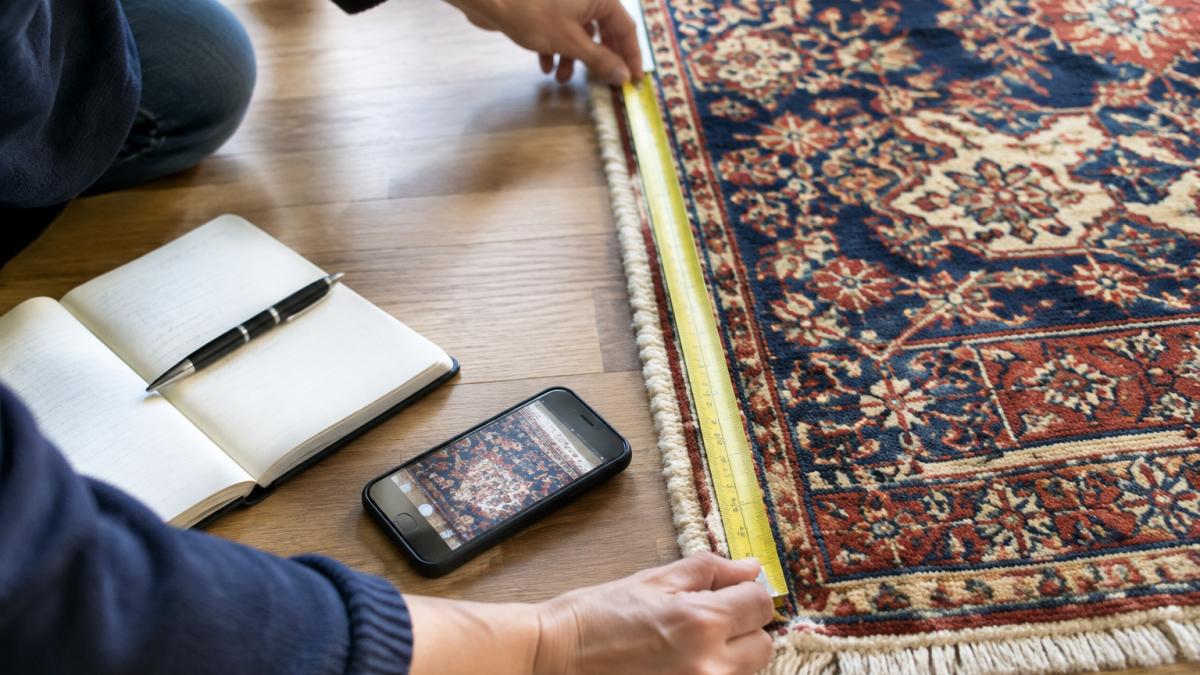
Follow these steps in order:
- Lay the rug flat in even daylight
- Measure length and width at three points each; note any variance
- Photograph the full front and full back
- Take close-ups of pile, knots, fringe, and selvage
- Record wear patterns and any repairs
- Note colors in natural light, not under lamps
Keep the photos and numbers together. A rug that measures slightly uneven is normal for hand work. A rug that measures perfectly square, every time, deserves a closer look.
Persian Rug Age Guide: Antique, Semi-Antique, and Vintage Defined
Age labels get used loosely in listings, so pin down the definitions first and then attach each label to physical evidence. A vintage rug is roughly 50 to 80 years old. A semi-antique rug sits around 75 to 80 years. An antique rug is generally 100 years old or more. These ranges are trade conventions, not laws, and they vary by dealer and by region of origin, so treat them as guides rather than certificates.
| Category | Approximate Age | Typical Clues |
|---|---|---|
| Vintage | 50-80 years | Moderate wear, stable dyes, original edges, often mid-century workshop production |
| Semi-antique | 75-80 years | Visible patina, some restoration common, transitional design vocabulary |
| Antique | 100+ years | Deep patina, fine knots, historic design, hand-spun wool and natural dyes more likely |
Dyes, Color Fading, and Patina
Natural dyes age gracefully. Vegetable dyes soften and shift over decades, and abrash, the subtle color variation across a field, is normal in older pieces. Abrash appears because dye lots varied and because hand-spun wool absorbs dye unevenly; it is a construction signature, not a defect.
Synthetic dyes behave differently. Some stay flat and bright for a long time; others bleed or fade unevenly. Look for color that has settled into the wool rather than sitting on top of it.
Materials: Wool, Cotton, and Silk
Fiber tells its own story. Older rugs commonly use hand-spun wool for the pile and cotton for the foundation. Silk appears in finer pieces and in highlights. Feel the wool: aged wool is often softer and slightly drier than new wool, and cotton foundations darken with time. None of these clues proves age alone, but together they build a case.
One Of The Kind Persian Bidjar Rug#12 Size 525x318 cm →
Persian Indicators Are Not Universal
The Persian rug is the reference point for most age guides, but its indicators do not transfer cleanly to every tradition. Before you apply Persian benchmarks, identify the tradition: Once you have identified a Persian rug’s tradition, keep its age assessment separate from its care, since the methods used to clean antique Persian rugs should respect the same differences in weave and foundation.
- City workshop rugs (Tabriz, Kashan, Isfahan) tend to show fine, tight knotting, curvilinear design, and silk highlights; age often shows as precise but softened drawing.
- Tribal and village rugs (Heriz, Hamadan, Shiraz) tend to show coarser knotting, geometric drawing, and more abrash; age often shows as heavier, more localized wear.
- Flatweaves and kilims lack pile entirely, so pile-wear tests do not apply; look instead at selvage, dye migration, and foundation condition.
A common mistake is grading a tribal rug against city-workshop standards and calling it young because the knots are coarse. Knot count is a tradition marker as much as an age marker. Use the tradition to set the baseline, then judge wear, dye, and construction against that baseline.
Rug Identification Apps: What They Can and Cannot Tell You
A rug identification app can suggest a regional style or design family from a photo. It cannot confirm antique rug age. Apps match patterns, and patterns get copied across generations.
Use an app as a starting point, not a verdict. It may help you name a design or narrow a region. It will not read knot density, detect replaced fringe, or spot artificial distressing.
Antique Rug Appraisal: When to Call an Expert and What to Ask
Bring in a professional appraiser when value matters, not just curiosity. An appraiser can examine knot structure, dyes, and provenance in person, which photos cannot replace.
Ask these questions before you hire one:
- What is your background and training?
- Will you provide a written report?
- Do you separate age from value in your findings?
Get the report in writing. A verbal guess is not an appraisal.
How to Spot Artificial Aging, Repairs, and Replacement Components
Artificial aging is common, and it is designed to fool a quick look. A genuinely old rug wears unevenly; a distressed one often shows wear in places feet never reached. The reliable approach is to check each alteration against the physics of real use, then record what you find so the evidence is comparable across rugs.
How Artificial Distressing Is Done
Distressing is often mechanical or chemical. Mechanical methods include sanding or shearing the pile in patches, tumbling the rug with abrasives, and cutting or fraying the fringe by hand. Chemical methods include washing with oxidizing agents to shift color and applying acids to soften or bleach areas of pile. Each method leaves a signature:
- Sanded or sheared pile feels uniformly short and slightly stiff, with a flat, even surface where real traffic would leave a gradient.
- Tumbled rugs show abrasion on the face but not the corresponding foundation wear on the back.
- Chemically faded fields often look pale overall while the edges and selvage stay saturated.
Watch out: a rug that looks 100 years old on the face but has a bright, clean back and crisp selvage is a strong candidate for artificial aging.
Practical Checks for Altered Rugs
Work through these checks in order and photograph each one:
- Pile gradient. Run your hand from the center to the edge. Real wear transitions gradually; distressed wear stops abruptly.
- Back-versus-face wear. Flip the rug. Foundation wear, darkened knots, and dirt in the weave should roughly match the face wear. A mismatch is a red flag.
- Re-dyed areas. Look for color that sits on top of the fiber, feels stiff, or shifts abruptly at a patch boundary. Re-dyeing often shows as a halo around a repaired area.
- Replaced fringe. Compare fiber color, thickness, and twist against the pile. New fringe is usually thicker, more even, and brighter; original fringe thins and tapers.
- Rewoven patches. Check for a grid or block of knots that differs in density or direction from the surrounding field.
- Modern selvage. A crisp, machine-bound edge on an otherwise old rug suggests the edge was rebound with modern thread.
- Color under the selvage. Lift the edge and look at protected color; it should be closer to the original than the exposed field.
Repairs Are Not Disqualifiers
A repaired rug is not automatically a young rug. Restoration is normal in antique pieces, and a well-documented repair can even support age. The question is whether the repair distorts the age evidence. Ask what was replaced, when, and by whom; a written restoration record is stronger evidence than any single visual clue.
Confidence Levels, Not Verdicts
Visual inspection yields a range, not a date. Physical clues can often support a rough age band (for example, "late 19th to early 20th century") but usually cannot confirm a specific year. Repairs, cleaning, and re-dyeing can all mislead. State your confidence honestly: high confidence for construction and wear patterns, lower confidence for exact dating. When a precise date matters, pair the visual inspection with provenance records and, where warranted, a conservator's examination.
Shop Verified Antique Rugs at ABC Rugs Kilims & Jewelry
Browse our current selection of Persian rugs, like our antique hand-knotted Persian Tabriz rug or a verified antique Heriz rug. You can also compare a medallion rug listing or a Mahal antique rug against the inspection steps above, or view a second Tabriz example to see how age markers show up in real listings.


Frequently Asked Questions
How can I tell how old my rug is?
Start by examining the pile for wear patterns and the back for knot density and foundation materials. Look at the dyes for natural fading and the fringe for hand-knotted construction. Compare the design motifs to known regional styles. These visual clues give you an age range, but only a hands-on inspection by an expert can confirm antique rug age with confidence. Photograph and measure the rug before seeking a professional opinion.
How old does a rug have to be to be considered an antique?
Most dealers and collectors define an antique rug as at least 100 years old. Semi-antique rugs are typically 50 to 80 years old, and vintage rugs generally fall in the 20 to 50 year range. These categories are conventions, not legal standards, so always ask for provenance and documentation when a seller uses the word antique. A Persian rug age guide can help you place a piece in the right category before you buy.
Can a rug identification app verify a rug's age?
A rug identification app can help you recognize patterns, regional styles, and probable origins by comparing photos against a database. It cannot verify age on its own because apps do not examine knot structure, dye chemistry, or wear patterns in person. Use an app as a starting point for research, then confirm findings through physical inspection or an antique rug appraisal from a qualified expert.
When should I ask a rug expert to assess an antique rug?
Ask for a professional assessment when the rug is a significant financial investment, when you need documentation for insurance or resale, or when visual clues conflict. An expert can examine knot density, dye composition, and restoration history that photos cannot reveal. For high-value pieces, request a written antique rug appraisal that separates age verification from valuation and authentication.
Verifying antique rug age takes patience, good light, and a consistent process. If you would rather skip the guesswork, ABC Rugs Kilims & Jewelry offers a curated collection of reviewed, hand-knotted Persian antique and vintage pieces, with wholesale and retail options and a selection built for collectors and designers. Get started with ABC Rugs Kilims & Jewelry and buy with confidence in what you bring home.


