

Last Updated: October 22, 2026
Quick Summary
How to identify quality sterling silver jewelry starts with finding the 925 hallmark stamped into the metal, which certifies 92.5% pure silver content. Combine this with weight and density checks, magnet testing, visual inspection for construction quality, and maker's marks to confirm authenticity and craftsmanship.
- The 925 mark is the international standard for sterling silver and appears inside rings, on clasps, or on pendant backs.
- Sterling silver feels substantially heavier than costume jewelry of similar size due to its specific gravity of about 10.5.
- Quality construction shows smooth joints, secure stone settings, even soldering, and balanced weight distribution.
- Professional appraisal with XRF testing costs $350 to $1,500 and provides definitive authentication for valuable pieces.
- Vintage sterling silver may lack modern hallmarks but should still feel substantial and show era-specific maker's marks or regional hallmarks.
Table of Contents
- Understanding Sterling Silver Versus Other Silver Products
- Reading Sterling Silver Hallmarks and Stamps
- How to Test Sterling Silver at Home
- Evaluating Construction Quality and Durability
- Vintage Sterling Silver Jewelry Identification
- Limits of At-Home Testing and When to Seek Professional Appraisal
- Limits of At-Home Testing and When to Seek Professional Appraisal
- Frequently Asked Questions
Understanding Sterling Silver Versus Other Silver Products
Sterling silver is an alloy of 92.5% silver and 7.5% other metals, usually copper, added for strength. Pure silver is too soft for daily-wear jewelry; the alloy keeps the precious metal content high enough to hold real value.
The key distinction separates sterling silver from silver-plated and costume jewelry. Silver-plated items have only a thin silver coating over base metal like brass or nickel, which wears away over time. Costume jewelry contains no real silver at all.
At ABC Rugs Kilims & Jewelry, we work with collectors and designers who need to know how to identify quality sterling silver jewelry and distinguish it from imitations.

Here's what separates quality sterling silver from the rest:
- Real silver content (92.5% minimum) versus plating or costume materials
- Proper hallmarks and maker's marks stamped into the metal
- Weight and density that feel substantial in your hand
- Construction quality that shows careful craftsmanship
- Durability that improves with age rather than deteriorating
Reading Sterling Silver Hallmarks and Stamps
The most reliable way to identify quality sterling silver jewelry is to look for official hallmarks stamped directly into the metal. These tiny stamps tell you exactly what you're holding.

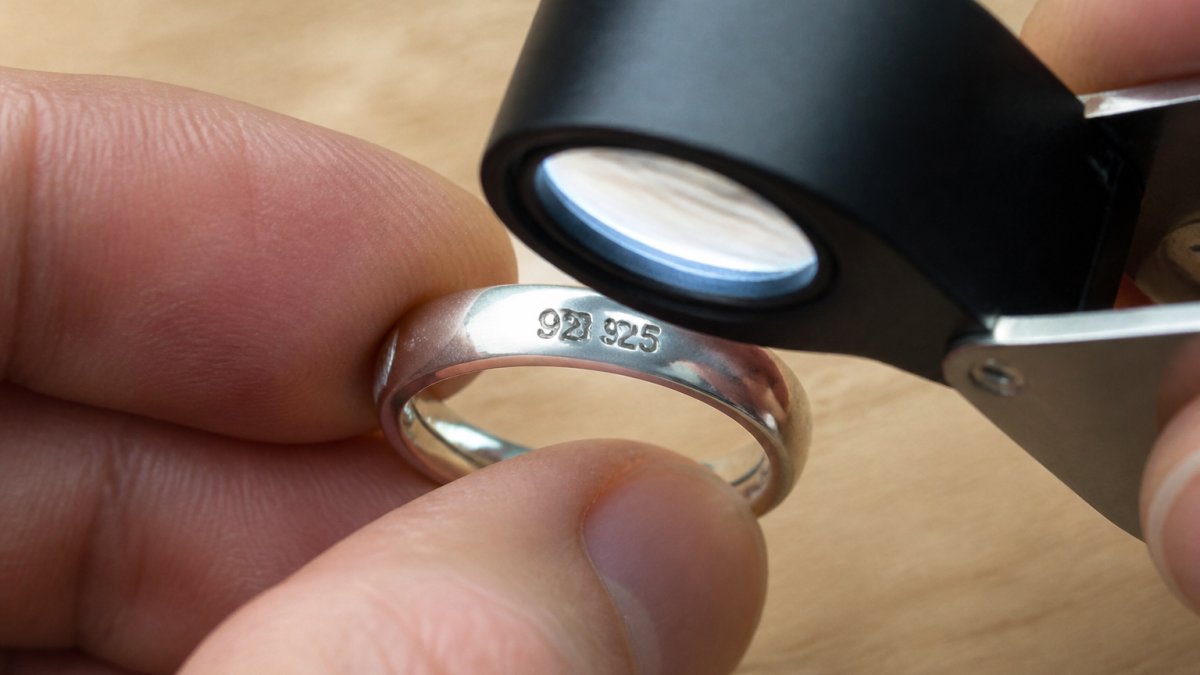
The 925 Mark Explained
The "925" stamp is the international standard marking for sterling silver. It means the piece contains 92.5% pure silver. This mark appears on legitimate sterling silver jewelry sold anywhere in the world.
Some pieces spell out "sterling" instead of "925"; both mean the same thing. Older pieces may show "ster" or regional variations, but 925 is the most common and universally recognized mark.
Look for the 925 mark in these locations:
- Inside the band of rings
- On the clasp or back of bracelets and necklaces
- On the reverse side of pendants or charms
- On the post of earrings
- Inside the hinge of brooches or lockets
If a piece claims to be sterling silver but has no 925 mark, it's likely not authentic. Legitimate manufacturers stamp this mark on all their sterling silver work. The absence of a hallmark is a red flag, though not absolute proof of fakery, some very old or handmade pieces lack marks.
Maker's Marks and Signatures
Beyond the 925 mark, quality sterling silver often carries a maker's mark or signature. This is the jeweler's or manufacturer's identifying stamp. It serves as proof of origin and accountability.
Maker's marks vary widely: initials, full names, or company logos. Identifying the maker can help determine age, craftsmanship level, and historical significance.
Common maker's mark formats include:
- Initials in a geometric shape (rectangle, circle, or shield)
- Full name or company name
- Hallmark symbols specific to the country of origin
- Date marks or assay office symbols (common in European jewelry)
- Pictorial symbols or emblems representing the maker
If you find a maker's mark, research it online. Many jewelry makers and manufacturers maintain registries of their marks. Knowing the maker can reveal whether the piece comes from a respected artisan or established company, which directly affects its value and desirability.
How to Test Sterling Silver at Home
Professional appraisers use specialized equipment, but several reliable at-home tests can confirm sterling silver before you invest in professional verification.
Weight and Density Check
Sterling silver feels heavier than costume jewelry of similar size. Silver has a specific gravity of about 10.5, significantly denser than most base metals used in cheap jewelry.
Hold the piece and compare it to a similar item you know is costume jewelry. Quality sterling silver should feel noticeably substantial, never light or flimsy.

If you have a scale, weigh the piece: a small sterling silver ring typically weighs 2-4 grams, while costume jewelry of the same size often weighs half that.
This test isn't foolproof, some base metals are dense, but combined with other checks, weight gives you valuable information.
Magnet Test and Visual Inspection
Sterling silver is not magnetic. If a strong magnet pulls the piece, it's costume jewelry or silver-plated over a magnetic base metal.
Use a neodymium magnet, the strongest type available, held near the jewelry without touching it. If the piece moves toward the magnet, it contains iron or another ferrous metal; sterling silver won't react.
Visual inspection catches obvious fakes immediately:
- Look for discoloration or color variation (sterling silver has a consistent white-gray tone)
- Check for corrosion, rust, or heavy oxidation that suggests base metal exposure
- Examine the clasp and joints, quality construction shows precise, even soldering
- Notice whether the piece feels smooth or rough; poor craftsmanship leaves visible flaws
- Look for plating wear that reveals different-colored metal underneath
Run your fingernail gently along the surface. Sterling silver feels smooth and uniform; cheap jewelry often has rough edges or peeling plating.
Exceptional Quality Silver - 925, Weight 4.2 grams., GemCZ Fashion, ABC-SR-5 →
Evaluating Construction Quality and Durability
Beyond material composition, quality sterling silver jewelry shows expert craftsmanship.
Examine the joints and connections. Prongs should be secure and evenly spaced, solder joints clean and invisible, clasps smooth and secure, and hinges free of wobble.
Quality sterling silver feels balanced in the hand; poorly made pieces feel uneven or top-heavy, indicating uneven metal distribution or cheap fillers.
If gemstones are present, they should sit firmly in their mounts. Wiggle them gently; loose stones suggest rushed work or low-quality assembly.
Inspect the backs and undersides, where true craftsmanship shows.
Run your finger across the surface; it should feel smooth and polished. Scratches and rough patches suggest improper finishing or heavy wear without maintenance.
| Quality Indicator | What to Look For | What It Means |
|---|---|---|
| Hallmarks | Clear 925 mark and maker's mark | Authentic sterling silver from established maker |
| Weight | Substantial feel for size | Genuine silver content |
| Construction | Smooth joints, secure settings, balanced feel | Expert craftsmanship and durability |
| Clasp/Closure | Smooth operation, secure fit | Quality materials and assembly |
| Surface Finish | Uniform polish, smooth texture | Professional finishing and care |
| Prongs/Settings | Tight, even spacing, secure stones | Attention to detail and longevity |
Vintage Sterling Silver Jewelry Identification
Vintage sterling silver pieces present unique challenges because hallmarking standards have changed over time. Older jewelry sometimes lacks marks that modern pieces carry, yet remains authentic and valuable.
Vintage sterling silver develops a natural patina, a subtle darkening that signals authenticity and age rather than damage. Some collectors prefer the patina; others polish it away. Either choice is valid.
Vintage pieces often show hand-finishing marks that machine-made modern jewelry lacks.
Older sterling silver may feel different because manufacturing techniques varied, but it should still feel substantial and solid, not light or flimsy.
Check for repairs or alterations. Replaced clasps, soldered repairs, or restrung beads are common on vintage jewelry; they don't diminish authenticity but should be visible and well-executed.
Limits of At-Home Testing and When to Seek Professional Appraisal
At-home tests give useful information but have real limits. No single test proves authenticity beyond doubt, and sophisticated counterfeits can pass multiple home tests.
The magnet test fails if base metal is non-ferrous (like brass or aluminum). The weight test fails if someone filled a piece with lead or other dense materials. Visual inspection misses internal structure. Even the 925 mark can be faked on high-end counterfeits.
Professional appraisers use equipment you don't have access to:
- X-ray fluorescence (XRF) testing measures exact metal composition without damaging the piece
- Acid testing confirms silver content (though it leaves a small mark)
- Precise scales measure weight to the gram
- Magnification reveals construction details invisible to the naked eye
- Experience recognizing maker's marks and dating techniques
Seek professional appraisal when:
- The piece represents significant monetary value
- You're considering it as an investment or for resale
- You need documentation for insurance purposes
- You inherited vintage jewelry and want to know its history and value
- You're uncertain after performing home tests
- The piece lacks hallmarks but claims to be sterling silver
At ABC Rugs Kilims & Jewelry, we can arrange professional GIA certification and verification for vintage jewelry, diamonds, and gemstones. The cost of GIA certification ranges from $350 to $1,500, depending on the item and the services requested. All GIA certification fees are paid directly to GIA.
Limits of At-Home Testing and When to Seek Professional Appraisal
Several factors make at-home testing unreliable as a final verdict:
- Magnet tests fail with non-ferrous base metals like brass or aluminum
- Weight tests can be fooled by pieces filled with dense materials
- Visual inspection cannot reveal internal structure or hidden repairs
- Hallmarks themselves can be counterfeited on high-end fakes
- Tarnish patterns alone don't confirm authenticity
Professional appraisers have access to equipment and expertise that transform the identification process. X-ray fluorescence (XRF) testing measures exact metal composition without damaging the piece. Acid testing confirms silver content with scientific precision.
According to the Gemological Institute of America's jewelry authentication standards, professional gemologists and appraisers follow rigorous protocols to verify authenticity and assess quality.
Learning how to identify quality sterling silver jewelry combines knowledge, observation, and practical testing. Start with the hallmarks, the 925 mark and maker's mark tell you immediately whether you're holding authentic sterling silver.
Frequently Asked Questions
How can you tell if jewelry is real sterling silver?
Check for the 925 hallmark stamped on the metal, this indicates 92.5% pure silver content. Examine the weight; sterling silver feels substantial and dense compared to plated pieces. Look for maker's marks or signatures, which suggest authentic craftsmanship. Real sterling silver may show slight tarnish or discoloration over time, which is normal. If marks are absent or illegible, professional appraisal ($350-$1,500 through GIA certification) provides definitive verification.
What's the difference between sterling silver and silver-plated jewelry?
Sterling silver is 92.5% pure silver throughout the piece, offering durability and lasting value. Silver-plated jewelry has a thin layer of silver over a base metal like copper or brass. Plated pieces wear faster, especially on high-contact areas like clasps and prongs. Sterling silver retains its integrity through cleaning and polishing; plating can flake or expose base metal underneath. For investment pieces or heirloom jewelry, sterling silver is the superior choice.
How can you test sterling silver without damaging it?
The magnet test works safely: real sterling silver is not magnetic, so it won't stick to a strong magnet. Weight and density checks are non-destructive, sterling silver feels heavier than plated alternatives of the same size. Visual inspection under magnification reveals hallmarks and wear patterns without harm. Avoid acid tests at home, as they can damage the piece. If you're uncertain after these checks, professional GIA certification ($350-$1,500) provides definitive results without risk.
What should you check before buying vintage sterling silver jewelry?
Verify the 925 hallmark or maker's mark on the piece. Inspect prongs, clasps, and settings for loose stones or damage, these repairs can be costly. Check for significant wear, pitting, or corrosion that affects durability. Examine gemstones under magnification to confirm authenticity. Ask the seller about provenance and condition history. If the piece is unmarked or you're uncertain, budget for professional GIA certification ($350-$1,500) to confirm quality and authenticity before committing to a purchase.


