

Quick Summary
You determine the age of a Persian rug by examining several clues together, including the back and foundation, the fringe, knot density, design, dye colors, and wear patterns. No single clue settles the question, so look for evidence that points the same way. For confident results or valuable rugs, have a qualified appraiser examine fibers and dyes.
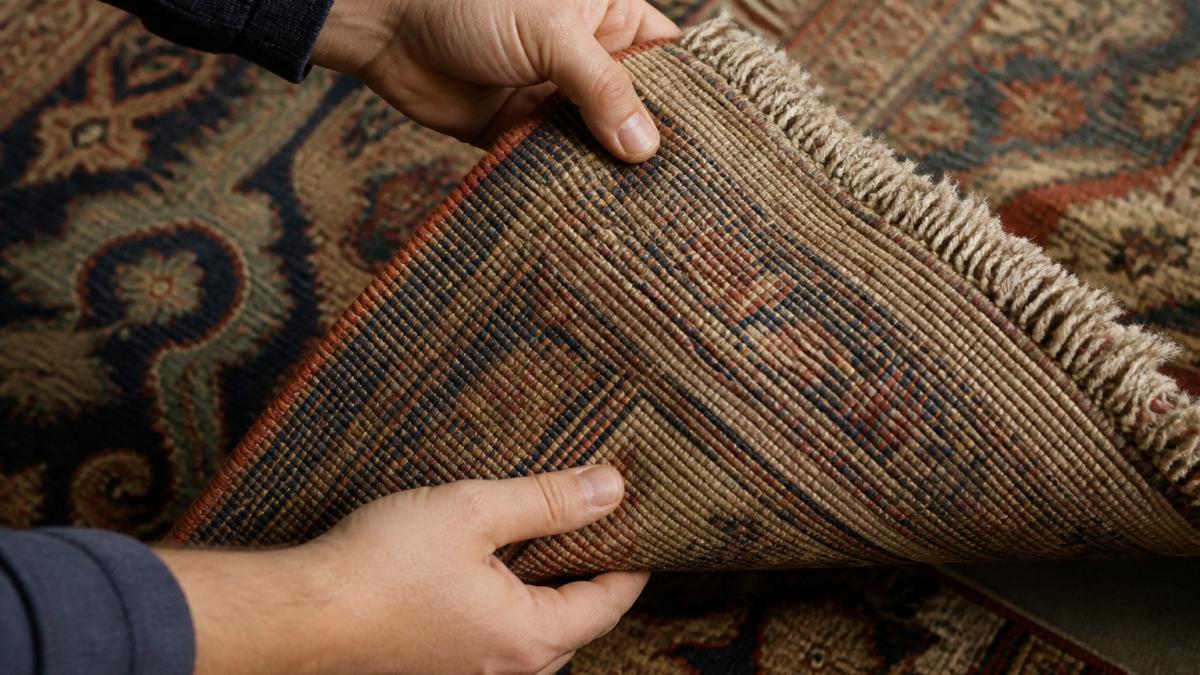
- Turn the rug over and check the foundation, since hand-knotted rugs show slight irregularity in row spacing and knot alignment.
- Original fringe extends from the warp threads, while sewn-on replacement fringe may not match the rest of the rug.
- Two or more independent strong clues pointing the same way justify a confident age estimate.
- Antique generally means 100 years or older, while vintage generally means 25 to 99 years old.
- Real wear is heaviest in traffic zones, while artificial distress is often even or unnaturally placed.
Table of Contents
- How to Identify an Antique Persian Rug Step by Step
- Reading Design, Color and Materials as Age Clues
- Antique vs Vintage Persian Rugs: What the Categories Mean
- Telling Genuine Wear From Tea Washing and Artificial Aging
- Persian Rug Age by Label, Inscription and Date
- When to Get a Persian Rug Appraisal From an Expert
- Frequently Asked Questions
Why the Age of a Persian Rug Changes Its Value
The age of a Persian rug is one of the first things a buyer or appraiser checks, and it can shift a rug's value by a wide margin. For a complete method, see Identifying Age Of Antique Persian Rugs.
A rug's age is not a single fact you can read off a label. It is an estimate built from several clues that point the same way.
Why this matters:
- Age affects market value and collector demand
- Age affects how you should clean and care for the rug
- Age helps you spot reproductions sold as antiques
Two clues are especially useful. The back of the rug, its fringe and its knots tell you about construction. Design, color and materials tell you about the era and region.
How to Identify an Antique Persian Rug Step by Step
Work through the rug in a fixed order, and record what you see at each stage. For a dedicated walkthrough, see how to identify authentic handmade Persian rugs. The goal is not to find one dramatic clue but to build a stack of independent evidence that points the same way.
A Practical Inspection Workflow With Confidence Levels
Use this sequence. At each step, note whether the clue is strong, moderate, or weak. Strong clues are hard to fake and consistent across the rug. Moderate clues narrow a range but can be copied. Weak clues only support a conclusion you have already reached from other evidence.
- Back and foundation (strong). Turn the rug over. Look at knot ends, warp and weft threads, and how the rows align. Hand-knotted rugs show slight irregularity in row spacing and knot alignment; machine-made rugs look perfectly even.
- Fringe (moderate to strong). Original fringe is usually an extension of the warp threads. Replacement fringe is often sewn on separately, and its color or twist may not match the rest of the rug. A sewn-on fringe can be a repair rather than a sign of a new rug, so note it and keep going.
- Knot density and weave (moderate). Count the knots across a square inch on the back. Density tells you about construction tradition more than exact age, so treat it as moderate.
- Design and pattern (weak to moderate). Motifs, borders and patterns shift over decades, and experienced dealers use them to narrow a date range. But modern rugs often copy old patterns on purpose, so a classic design does not guarantee an old rug. Treat design alone as weak.
- Color and dyes (moderate). Natural dyes age in predictable ways. Reds from madder and cochineal can soften over time, and some blues shift. Synthetic dyes introduced in the late 1800s often look brighter and more uniform. Very bright, flat colors deserve a closer look, but dye analysis by a professional is the only reliable test.
- Wear and patina (moderate). Real wear follows use and is heaviest in traffic zones. Patina, the softened surface that comes from decades of light and handling, is hard to reproduce convincingly. See the artificial-aging section below for how to separate real wear from treatment.
- Labels and inscriptions (weak unless verified). Labels can be added later, and dates can be misread or copied. Use them as one piece of evidence and compare them with construction and materials.
How to Combine the Clues Into an Age Estimate
After the inspection, sort your notes into three buckets:
- Consistent strong evidence: for example, an irregular hand-knotted foundation, original warp fringe, and wear patterns that follow traffic zones. This combination supports an antique estimate with reasonable confidence.
- Mixed evidence: an old design on a very uniform foundation, or a worn pile with a sewn-on fringe. Mixed evidence means you should narrow the range rather than commit to a date.
- Contradictory evidence: a date inscription that conflicts with synthetic-looking dyes, or restoration that covers most of the surface. Contradictions are a signal to seek professional examination.
A useful rule of thumb: two or more independent strong clues pointing the same way justify a confident estimate. One strong clue plus several moderate ones justifies a range. Weak clues alone justify only a question, not a conclusion.
What to Record During the Inspection
Write down the rug's dimensions, the knot count per square inch, whether the fringe is original or sewn on, the foundation material, any visible repairs, and any label or inscription text. This record is what turns a visual impression into an age estimate you can defend, and it is the same information a professional appraiser will ask for.
Reading Design, Color and Materials as Age Clues
Design gives strong clues about where and when a rug was made. Motifs, borders and patterns shift over decades, and experienced dealers use them to narrow the date range.
Color is another clue. Discerning the subtle variations in these pigments requires a keen eye for detail, much like the process used to evaluate vintage fabric quality in other antique textiles.
Materials matter too. Wool is the most common pile material. Silk rugs are usually finer and more expensive, and cotton is common in foundations.
Be careful with design alone, since a classic design does not by itself establish age.
Antique vs Vintage Persian Rugs: What the Categories Mean
These terms are used loosely, so it helps to know how the trade usually applies them. Trade usage of these terms varies, so check how a seller defines them before you buy.
These boundaries are conventions, not legal definitions, so check how a seller defines the terms before you buy.
Quick guide:
One Of The Kind Persian Bidjar Rug#12 Size 525x318 cm →
- Antique: generally 100 years or older
- Vintage: generally 25 to 99 years old
- New: recently made, including reproductions of old designs
The trade uses these age terms with the following general boundaries, which are conventions rather than legal definitions.
| Category | Age | Note |
|---|---|---|
| Antique | Generally 100 years or older | Convention, not a legal definition |
| Vintage | Generally 25 to 99 years old | Convention, not a legal definition |
| New | Recently made | Includes reproductions of old designs |
Telling Genuine Wear From Tea Washing and Artificial Aging
Age can be faked, and the treatments used to fake it are common enough that buyers should know the signs. Some rugs are tea washed, a treatment that softens colors and gives a faded look. Others are chemically treated or deliberately distressed with abrasion. Learning to tell these apart from real wear is one of the harder parts of dating a rug, and it is where a systematic checklist beats a quick glance. For more on judging quality beyond age, see signs of quality in traditional Persian rugs.
A Detection Checklist for Artificial Aging
Work through these checks in order. Each one compares what genuine age looks like with what treatment looks like.
- Wear distribution. Real wear follows use. It is heaviest in traffic zones such as paths between doors, in front of seating and near the center of the room, and it is usually uneven. Artificial distress is often even across the whole surface or unnaturally concentrated in odd places, such as the middle of a border or the corners.
- Pile height and texture. Genuine wear thins the pile gradually and leaves a soft, uneven surface. Abrasion treatment can leave a uniformly flattened or fuzzy surface, and the pile may feel thin in a way that real use does not produce.
- Color depth. Tea washing softens colors and can leave a slightly dull or brownish cast. Look at the back of the rug: tea washing often leaves the back looking lighter or uneven compared with the front. Genuine fading usually follows light exposure and is stronger on one side or along folds.
- Dye behavior at the roots. On a genuinely old rug, the color at the base of the pile often differs from the tips because of light exposure and wear. On a treated rug, the color can look uniform from root to tip or oddly saturated at the base.
- Fringe and edges. Treatment often affects the fringe and edges differently from the field. Check whether the fringe color matches the pile, whether the ends look chemically lightened, and whether the binding is worn in a pattern that matches the rest of the rug.
- Smell and hand. A washed rug may retain a faint chemical or damp odor, and the pile can feel stiff or slick rather than soft. This is a weak clue on its own but useful alongside the others.
- Consistency with construction. Artificial aging is usually applied to newer, more uniform rugs. If the foundation looks machine-even but the surface looks heavily worn, treat the wear with suspicion.
How Restoration Can Mislead Visual Inspection
Repairs, replacement fringe and restoration can cover or alter the clues you rely on. A rewoven patch may use newer wool that takes dye differently. A replacement fringe may be sewn on with a twist that does not match the original warp.
When restoration covers much of the surface, visual dating becomes unreliable. Note the repairs, and treat the rug's age estimate as a range rather than a date.
When to Test Dyes and Fibers
When you are unsure, a professional can test the dyes and fibers. That is often the only reliable way to separate genuine age from a convincing imitation. Dye testing can distinguish natural from synthetic colorants, and fiber analysis can confirm whether the pile and foundation materials match the period the rug claims to come from. If a seller's age claim depends on a rug looking older than its construction suggests, ask whether dye or fiber testing has been done.
Persian Rug Age by Label, Inscription and Date
Some rugs carry labels, woven inscriptions or dates that help with dating. To see how documentation supports a rug's age and origin, read Antique Rug Provenance Documentation Explained.
Be cautious with these clues. Labels can be added later, and dates can be misread or copied.
If you find a date, confirm which calendar it uses before you convert it. A date that looks recent may actually be much older, or the reverse.
When to Get a Persian Rug Appraisal From an Expert
Visual inspection has limits. Many rugs fall into gray areas where the clues point in different directions.
Consider a professional appraisal when: (see our antique rug valuation guide for homeowners to understand what your rug may be worth)
- The rug may be valuable and you plan to insure or sell it
- Clues conflict, such as an old design with a very new foundation
- Repairs, replacement fringe or restoration cover much of the surface
Ask for written documentation that states the estimated age, the basis for the estimate and the appraiser's credentials. Keep that paperwork with the rug.
For help with your own rug or to learn more about our collection, reach out to ABC Rugs Kilims & Jewelry.
Frequently Asked Questions
How can you tell how old a Persian rug is?
Start by examining the design, colors, materials and construction, then check the back, fringe and wear. Irregular knotting and natural dye variation can be useful clues, but they do not establish age on their own. No single clue is conclusive, so combine several observations and treat your estimate as a range rather than an exact date.
Does the condition of a Persian rug reveal its age?
Condition offers clues but can be misleading. Genuine age usually shows as gradual, uneven wear in high-traffic areas, softened pile and a natural patina. Look for wear patterns that match how a rug would really be used. Repairs, replacement fringe and restoration can also hide or distort the original age clues.
Can a rug label tell you when a Persian rug was made?
A label can help but should not be trusted alone. Some rugs carry woven inscriptions or dates, sometimes using regional calendar systems, but labels can be added, removed or reproduced. Compare any label with the knotting, materials and design. If the label and the rug's construction disagree, consider the rug's physical evidence first and seek a professional opinion.
When should you get a Persian rug appraised for age?
Get a professional appraisal when a rug may be valuable, when visual clues conflict, when the rug has been heavily repaired or restored, or before buying or selling at a significant price. A qualified appraiser can examine a rug more closely than a visual inspection allows. Ask whether the appraiser is independent and whether the report states the age estimate and the reasoning behind it.
Our team at ABC Rugs Kilims & Jewelry selects and documents each piece we offer, and we are happy to answer questions about age and condition before you buy.


