

Table of Contents
- What Is Antique Rug Provenance and Why It Matters
- Key Elements of Authentic Provenance Documentation
- The Antique Rug Appraisal Process
- Certificate of Authenticity for Rugs: What You Need to Know
- Rug Provenance Documentation Checklist
- How Provenance Affects Market Value and Collectibility
- Archival Research and DIY Verification Methods
- Conclusion
Last Updated: August 9, 2026
What Is Antique Rug Provenance and Why It Matters
Antique rug provenance is the documented history of ownership, origin, and exhibition record of a rug from its creation to the present day. It establishes authenticity, cultural context, and historical integrity through verifiable records, certificates, and archival documentation.
Provenance directly determines market value, collectibility, and investment potential. A hand-woven Persian rug with complete provenance documentation commands a significant premium over an identical-looking rug with no documented history. At ABC Rugs Kilims & Jewelry, we emphasize provenance as the foundation of trust in every piece we curate. The difference between a $3,000 rug and a $15,000 rug often isn't the knot density or dye quality, it's the provenance documentation. Museums, auction houses, and high-end dealers all prioritize provenance as the first checkpoint before authenticating or valuing any textile.

This guide walks through the essential elements of antique rug provenance documentation, how to verify authenticity, and why this matters for your purchase decisions. Understanding provenance separates informed buyers from those who rely on luck.
Key Elements of Authentic Provenance Documentation
Authentic provenance requires multiple supporting records that work together to establish historical integrity. No single document proves provenance; instead, credible evidence emerges from several verified sources.
Certificate of authenticity forms the foundation. This document should state the rug's origin (region and country), estimated production date, materials (wool, cotton, silk), weaving technique (hand-knotted, kilim), and dye type (natural or synthetic). A legitimate certificate includes the appraiser's credentials, assessment date, and specific details about condition and restoration work. Generic certificates lacking these specifics carry minimal weight.
Purchase receipts and sales documentation prove ownership transfer. Original invoices from dealers, auction houses, or private sales establish when and from whom previous owners acquired the rug. These receipts should include the seller's name, date, price, and rug description.
Exhibition catalogs and museum records add significant credibility. If the rug was displayed in a museum exhibition or featured in scholarly study, that documentation establishes expert vetting and public recognition of the piece's importance.
Auction house documentation provides third-party verification. Major auction houses (Christie's, Sotheby's, Bonhams) conduct due diligence before accepting pieces, so their acceptance carries credibility weight.
Condition reports and conservation records document the rug's physical history, detailing repairs, cleaning, restoration work, and dates performed. Transparency about restoration is crucial, honest documentation is far better than hidden restoration work discovered later.
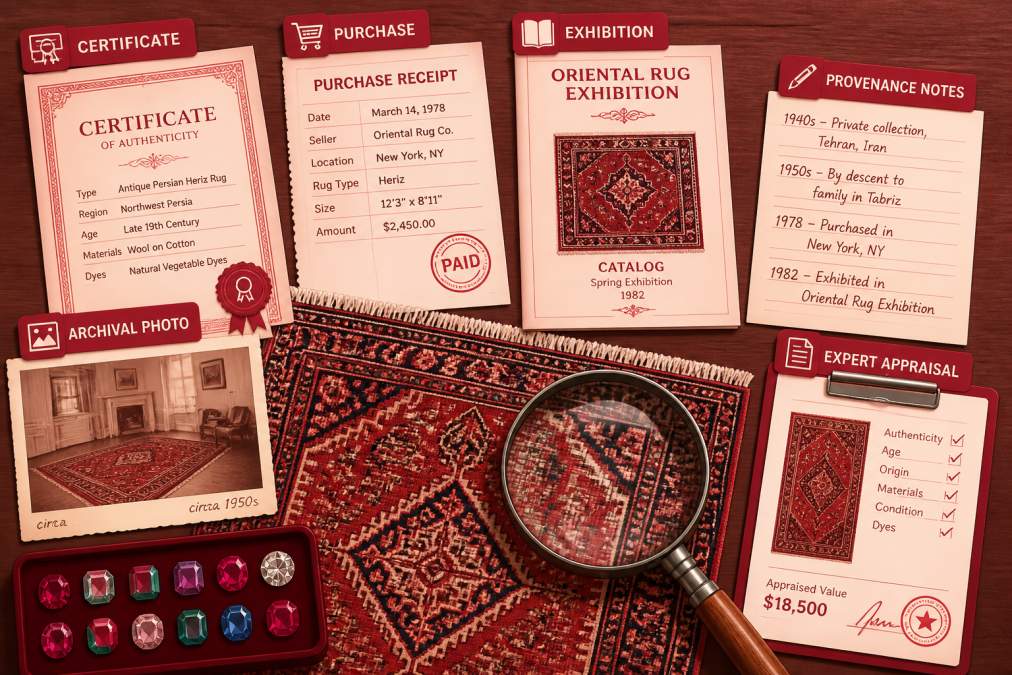
Maker attribution and signature documentation establishes the weaver or workshop responsible for the rug. Documentation should explain how the maker was identified and what evidence supports the attribution.
The strongest provenance files combine at least three of these elements. A rug with only a certificate but no purchase history or exhibition record raises questions. Conversely, a rug with complete ownership receipts, museum exhibition history, and professional appraisal creates a compelling provenance story.
The Antique Rug Appraisal Process
The antique rug appraisal process is a systematic evaluation by a qualified professional who examines the rug's physical characteristics, historical context, and market value to produce a formal assessment document.
A qualified appraiser must hold credentials from recognized organizations such as the American Society of Appraisers (ASA) or the International Society of Appraisers (ISA). Verify their specialization in antique textiles; a general fine arts appraiser may lack the expertise needed for accurate rug assessment.
The appraisal examination typically takes 1-3 hours depending on rug complexity. The appraiser physically inspects the rug under controlled lighting, examining both surfaces. They measure knot density (knots per square inch), assess dye quality and color fastness, identify materials, and document wear, repairs, or restoration work. They photograph the rug from multiple angles and document specific design elements and any maker's marks.
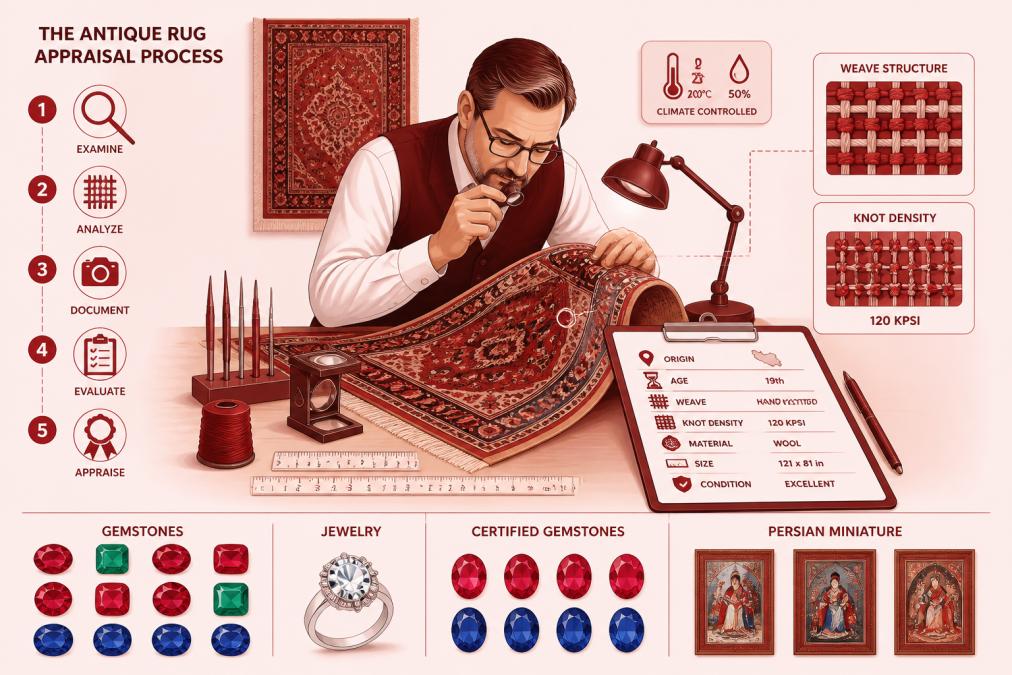
The appraiser researches comparable rugs sold at auction in the past 3-5 years to establish market value, considering region of origin, estimated production date, size, condition, and historical significance. The final report includes detailed description, condition assessment, estimated fair market value, and the appraiser's credentials and signature.
Appraisal costs typically range from $300 to $1,500 depending on the rug's size and complexity. Many collectors view this as essential insurance documentation; appraisal reports are required by insurance companies to establish replacement value.
A critical distinction: appraisals determine fair market value for insurance and tax purposes. They differ from condition reports, which focus on physical state and conservation needs. Both documents strengthen your provenance file.
Certificate of Authenticity for Rugs: What You Need to Know
A certificate of authenticity for rugs is a formal document issued by a qualified appraiser confirming that a rug is genuine, stating its origin, age, materials, and weaving technique. This certificate becomes a key component of your provenance documentation and significantly affects resale value.
Legitimate certificates include specific, verifiable information: the rug's country and region of origin (e.g., "Tabriz, Iran" not simply "Persian"), estimated production date (e.g., "circa 1920-1940"), dimensions, materials (e.g., "hand-knotted wool on cotton foundation"), and weaving technique. The certificate should document condition at assessment, including repairs and restoration work, and note dye type, natural vegetable dyes command higher value than synthetic dyes. The certificate must be signed and dated by the appraiser with credentials and contact information included.
Red flags include certificates lacking specific dates, vague regional attribution, missing material specifications, or no appraiser signature. Generic certificates stating "this rug is authentic" without supporting details carry minimal weight. Certificates issued by the seller rather than an independent third party raise credibility concerns.
The certificate's value depends on the appraiser's reputation and credentials. A certificate from a respected auction house or ASA-certified appraiser carries far more weight than one from an unknown source. When purchasing a rug with an existing certificate, verify the appraiser's credentials independently.
ABC Rugs Kilims & Jewelry provides detailed provenance documentation with every significant piece in our collection. Each rug comes with information about its origin, weaving technique, materials, and known ownership history. For pieces with complete provenance files, we include exhibition records and conservation documentation.
Certificates should be updated periodically, particularly after conservation work. For high-value pieces, many collectors obtain updated appraisals every 5-10 years to maintain current insurance coverage.
Rug Provenance Documentation Checklist
Building a complete provenance file requires systematic documentation. Use this checklist to organize and verify the key elements of your rug's history:
| Documentation Element | What to Include | Priority |
|---|---|---|
| Certificate of Authenticity | Appraiser credentials, origin, date, materials, condition | Essential |
| Purchase Receipt | Seller name, date, price, rug description | Essential |
| Condition Report | Physical state, repairs, restoration work documented | Essential |
| Exhibition Records | Museum catalogs, display dates, institutions | High |
| Auction Documentation | Catalog entry, lot number, sale date, price realized | High |
| Conservation Records | Cleaning, repair work, dates, conservator credentials | High |
| Maker Attribution | Weaver/workshop identification, supporting evidence | Medium |
| Historical Research | Regional characteristics, design period, cultural context | Medium |
| Photographs | High-quality images of front, back, details, signature marks | Essential |
| Insurance Appraisal | Fair market value assessment for coverage purposes | Essential |
Creating your provenance file:
Start by gathering all existing documentation: purchase receipts, certificates, photographs, condition reports. Organize these chronologically to establish the timeline of ownership. Note gaps clearly rather than inventing records.
Obtain a professional appraisal if you lack one. This is the single most important document for establishing current market value and condition.
Photograph your rug professionally if possible. High-quality images showing the front, back, edges, signature marks, and weave pattern details help with future authentication and insurance documentation.
For significant pieces, conduct archival research to document the rug's regional characteristics and design period. This strengthens the provenance narrative by explaining why the rug's design, materials, and construction align with its stated origin and date.
Keep all documentation together in a secure location, either physical or digital with encrypted backup. Include a summary document listing what's included and noting any gaps in the provenance record.
How Provenance Affects Market Value and Collectibility
Provenance directly correlates with market value. A hand-woven antique rug with complete, verified provenance documentation commands 30-50% higher prices than an identical-looking rug with no documented history.
Market premium for documented provenance: Rugs with exhibition history in major museums can command 50-100% premiums over comparable pieces without such recognition. A rug displayed at the Metropolitan Museum of Art carries significantly more value than an equally fine rug with no exhibition record.
Investment-grade status: Collectors pursuing rugs as investments prioritize provenance as the primary authentication tool. A rug without documented ownership history is considered speculative rather than investment-grade. Institutional buyers rarely acquire pieces with incomplete provenance because the lack of documentation creates legal and authenticity risks.
Resale liquidity: A rug with strong provenance documentation sells faster and attracts more qualified buyers. A rug with questionable provenance may sit on the market for months, even if beautiful and well-made.
Insurance and legal protection: Insurance companies require appraisals and provenance documentation to establish replacement value. Documented ownership history protects you legally if provenance questions arise later.
Provenance gaps and their impact: Missing ownership records from certain periods can reduce value. A rug with documented ownership from 1950 to present but no history before that raises questions about earlier acquisition. A rug with a 30-year gap in ownership history might sell for 20-30% less than an otherwise identical rug with continuous documented ownership.
Cultural and historical significance: Rugs with documented connections to significant historical events, notable collections, or cultural movements carry premium value. These rugs become cultural artifacts, and provenance documentation proves the connection.
When evaluating a rug's market value, ask for the complete provenance file before making an offer.
Archival Research and DIY Verification Methods
Serious collectors often conduct their own archival research to strengthen provenance documentation and verify claims made by sellers or appraisers.
Museum collection databases: Major museums maintain searchable databases of their textile collections. The Metropolitan Museum of Art, the Art Institute of Chicago, and the Philadelphia Museum of Art allow public access. Search by region, period, design type, or maker to find comparable pieces with documented provenance.
Auction house archives: Christie's, Sotheby's, and Bonhams publish online catalogs of past sales. Search these archives for rugs with similar characteristics to identify comparable sales prices and provenance patterns.
Textile conservation literature: Academic journals and conservation publications document rug construction techniques, dye analysis, and regional characteristics. Publications like the Journal of the American Institute for Conservation provide scholarly frameworks for understanding a rug's origin and age.
Maker and weaver research: If your rug has a documented maker or workshop attribution, research that weaver's known works. Finding your rug referenced in scholarly work strengthens its provenance significantly.
Regional design databases: Specialized rug organizations maintain databases of regional design patterns, color palettes, and weaving techniques. These resources help verify whether a rug's design aligns with its stated origin and period.
DIY verification checklist:
- Compare your rug's knot density, materials, and dye characteristics against documented examples from the same region and period
- Search museum and auction databases for similar rugs to establish comparable provenance patterns
- Document any maker's marks or signatures and research their origins
- Consult regional rug studies and scholarly publications to verify design authenticity
- Contact rug scholars at major museums; many respond to inquiries about specific pieces
- Photograph your rug's details and compare against published examples
This research strengthens your provenance file by adding independent verification. Even if you don't uncover new historical information, documenting your research process demonstrates due diligence.
Legal and ethical considerations: When conducting archival research, respect copyright and institutional policies. If your research uncovers information suggesting a rug may be stolen or illegally exported, report this to the appropriate authorities.
ABC Rugs Kilims & Jewelry supports collector research by providing detailed documentation with every piece. We're happy to discuss a rug's characteristics, known exhibition history, and research sources that informed our acquisition and authentication decisions.
Understanding antique rug provenance documentation separates discerning collectors from casual buyers. Complete, verified provenance transforms a beautiful rug into an investment-grade piece with lasting value and authenticity assurance. When acquiring an antique rug, prioritize provenance documentation as your first evaluation criterion. At ABC Rugs Kilims & Jewelry, every significant piece in our collection comes with detailed provenance information, professional appraisals, and transparent documentation of origin and ownership history. Our curated inventory ensures you acquire authentic, investment-quality pieces backed by verifiable evidence of authenticity and historical integrity. Explore our collection of hand-knotted Persian antique rugs and kilims to find pieces with complete provenance documentation that elevate both your space and your collection.
Frequently Asked Questions
What is considered provenance for an antique rug?
Provenance is the documented ownership history and chain of custody of an antique rug. It includes purchase receipts, exhibition records, previous owner names, acquisition dates, and any historical documentation that traces the rug from creation through each owner. Strong provenance establishes authenticity, cultural context, and historical integrity. Gaps in provenance can lower value and raise questions about a rug's legitimacy, especially for high-value pieces.
How does provenance affect the resale value of an antique rug?
Rugs with complete, documented provenance command significantly higher market premiums than those without clear ownership history. Collectors and interior designers pay more for investment-grade rugs with proven authenticity and exhibition records. A rug with gaps in provenance may sell at 20-40% below market value. Documented provenance also makes resale easier because buyers trust the piece's authenticity and cultural significance.
Does an antique rug need a certificate of authenticity?
While not legally required, a certificate of authenticity from a qualified appraiser strengthens your rug's market position and protects your investment. Certificates document the rug's origin, age, materials, weaving technique, and condition. They're especially important for high-value pieces over $5,000 or rugs being purchased as collectibles. ABC Rugs Kilims & Jewelry provides detailed documentation with each piece to ensure you have the provenance records needed.
How can I tell if an old rug is valuable based on provenance?
Value depends on several provenance factors: documented origin (Persian, Safavid-era, or tribal pieces command higher prices), exhibition history in museums or galleries, maker attribution, use of natural dyes, hand-knotted construction, and rarity. A rug with complete provenance showing museum display, notable collections, or documented age typically has 30-50% higher value than an undocumented piece of similar size and condition. Professional appraisal confirms these factors.
What documents should I keep when buying an antique rug?
Maintain a complete provenance file including the purchase invoice, seller's contact information, any appraisal certificates, photographs (both overall and detail shots), condition reports, conservation records, exhibition catalogs mentioning the rug, and insurance documentation. Store originals in acid-free folders and keep digital copies. This documentation protects your investment, supports insurance claims, and preserves the rug's historical record for future owners.
Can an antique rug be appraised without provenance?
Yes, an appraiser can evaluate a rug's age, origin, materials, and condition through physical examination and technical analysis. However, the absence of documented provenance limits the appraisal's scope and typically results in a lower valuation. Appraisers will note provenance gaps in their report, which affects market credibility. For high-value pieces, archival research or authentication testing may help establish missing provenance elements.
This article was written using GrandRanker


