

Table of Contents
- Understanding Kilim Provenance and Why It Matters
- Antique Kilim Identification Guide: Visual Inspection Techniques
- How to Date a Vintage Kilim: Age Assessment Methods
- The Role of Documentation and Authentication Certificates
- Documenting Rug History for Collectors: Building Your Provenance Record
- Red Flags of Kilim Forgery and What to Avoid
- Insurance and Legal Documentation for Antique Kilim Ownership
- Frequently Asked Questions
Last Updated: October 1, 2026
Understanding Kilim Provenance and Why It Matters
Kilim provenance refers to the documented history and origin of a rug, tracing its creation, ownership, and journey through time. For collectors, verifying antique kilim provenance is essential to confirm authenticity, establish value, and protect your investment.
A kilim without clear provenance is like a painting with no signature. Learning to verify antique kilim provenance yourself gives you confidence in every purchase.
Provenance matters for three concrete reasons:
- Authentication: Proves the rug is genuinely handwoven and not a modern reproduction
- Value: Documented history increases market value significantly
- Insurance: Insurers require provenance documentation for high-value textiles
Antique Kilim Identification Guide: Visual Inspection Techniques
Visual inspection is your first line of defense when verifying antique kilim provenance. A genuine handwoven kilim displays characteristics machines cannot replicate. Examine the rug in natural light to reveal texture and depth.
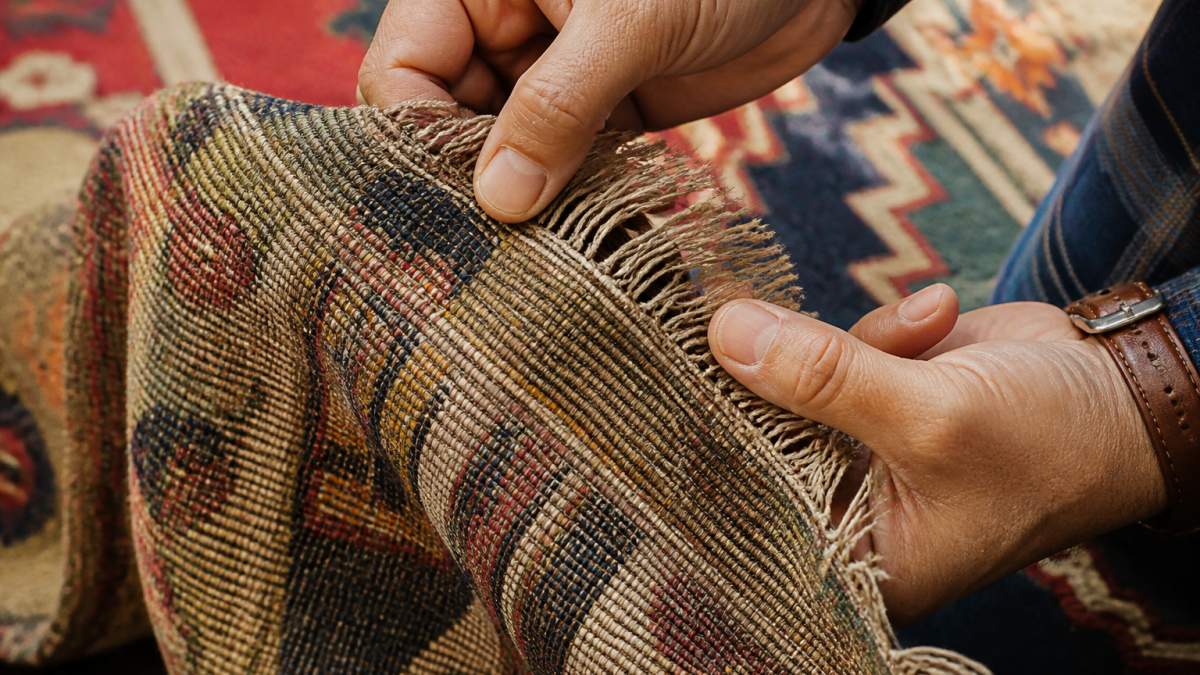
Examining Weave Structure and Knot Count
Traditional kilims are flat-woven textiles with no knots, weft threads pass over and under warp threads in an interlocking pattern, creating a reversible fabric with identical patterns on both sides.
Count the knots per inch if you suspect a piece is actually a knotted rug masquerading as a kilim. Handwoven kilims typically show:
- Visible warp and weft threads on the backside
- Irregular knot spacing (if knotted at all)
- Natural fiber variations that create subtle texture changes
- No perfectly uniform grid pattern
Real handwoven pieces show variation because human hands don't work like machines. This inconsistency is proof of authenticity when verifying antique kilim provenance.
Handwoven kilims have selvage edges wrapped by hand with slight irregularities; machine-made rugs have perfectly straight, uniform edges.
Analyzing Natural vs. Synthetic Dyes
Natural dyes come from plants, insects, and minerals; they fade predictably and create subtle color variations. Synthetic dyes were invented in the mid-1800s, so any kilim claiming to be older than 1850 should show natural dye characteristics.
Look for these natural dye markers:
- Color variations within a single color zone (not uniform)
- Fading that follows a logical pattern (typically lighter near windows or high-traffic areas)
- Soft, warm tones rather than bright, chemical-looking hues
- Slight color shifts where different dyes meet
Dampen a white cotton cloth and rub it gently on the back of the rug in an inconspicuous area. Natural dyes may bleed slightly; synthetic dyes typically don't. This is one data point when verifying antique kilim provenance.
Identifying Regional Motifs and Tribal Patterns
Every weaving region developed distinct regional motifs and tribal patterns. Learning these patterns helps verify antique kilim provenance by confirming where a rug came from.
Common regional patterns include:
- Geometric medallions: Typical of Persian and Turkish kilims
- All-over diamond patterns: Common in Caucasian kilims
- Tribal stripes and bands: Characteristic of nomadic weaving traditions
- Symbolic animal and plant motifs: Often found in Kurdish and Anatolian kilims
Certain designs fell out of favor decades ago. A pattern popular only in the 1950s proves the kilim cannot be from the 1920s.
Study museum collections and academic textile resources to recognize patterns and understand regional weaving traditions.
How to Date a Vintage Kilim: Age Assessment Methods
Dating a kilim requires combining multiple clues: fiber analysis, dye characteristics, wear patterns, and historical research.
Distinguishing Vintage from Antique
Antique means at least 100 years old; vintage refers to pieces 20-99 years old. This distinction matters when verifying antique kilim provenance because documentation standards differ.
An antique kilim should show significant wear in high-traffic areas, fading from decades of light exposure, soft fibers, original aged fringe, and evidence of period-appropriate repairs. A vintage kilim may show less wear but should still display authentic aging.
Evaluating Patina and Fiber Condition
Patina is the accumulated effect of age and use, the softness of old wool, subtle color shifts, worn spots. It cannot be faked convincingly because it develops over decades of actual use.
One Of The Kind Persian Bidjar Rug#12 Size 525x318 cm →
Examine the fibers closely:
- Old wool feels softer and has a slight sheen from age
- New wool feels stiff and uniform
- Worn areas show fiber damage that's consistent with the rug's claimed age
- Repairs should match the age of surrounding fibers
Run your hand across the rug, genuine patina creates subtle texture change. Wear patterns follow foot traffic: living room kilims show wear near entryways and seating areas; bedroom pieces show wear in the center.
The Role of Documentation and Authentication Certificates
Documentation is your paper trail, the proof that separates a valuable antique from an expensive guess. When verifying antique kilim provenance, it can mean the difference between a piece worth thousands and one worth a fraction of that.
Legitimate documentation includes:
- Appraisal certificates from qualified textile experts
- Purchase receipts from reputable dealers
- Auction house records with detailed descriptions
- Provenance letters describing previous ownership
- Conservation reports documenting repairs and condition
Ask the seller for documentation. If they cannot produce any, ask why. Lack of documentation should lower your offer significantly.
An authenticity certificate from a qualified appraiser carries weight.
Documenting Rug History for Collectors: Building Your Provenance Record
Create a provenance record with: purchase date and source, price, condition photos, measurements, fiber content, dye analysis, regional origin, repairs, and insurance documentation. Keep records in a safe place with digital backups.
Red Flags of Kilim Forgery and What to Avoid
Modern forgery is sophisticated: deliberate aging, pattern copying, and strategic documentation manipulation. Understanding these methods protects you from expensive mistakes.
How Kilim Forgeries Are Actually Made
Most kilim forgeries follow a predictable production chain:
Forgers photograph authentic kilims from museums, auctions, or dealers, then commission weavers to recreate patterns exactly. Perfect replication is the first red flag.
Mechanical Red Flags That Reveal Forgery
Real handwoven kilims show minor irregularities; patterns may shift slightly, knots may be off-center. Perfect symmetry is a sign of modern production.
Documentation Red Flags
Appraisal Certificates from Unknown Appraisers: Legitimate appraisers are credentialed through organizations like the American Society of Appraisers or have verifiable museum or conservation backgrounds (Start Here! ASA's Professional Credentials). If the appraisal certificate lists an appraiser you cannot verify through independent research, it's likely fabricated. Call the appraiser directly to confirm they issued the certificate.
Behavioral Red Flags from the Seller
Seller Cannot Explain the Pattern or Origin: Legitimate dealers know their inventory. They can explain the regional origin, the pattern meaning, and the weaving technique. If a seller cannot answer basic questions about the kilim, they may not have verified it themselves, or they may be hiding something.
Insurance and Legal Documentation for Antique Kilim Ownership
High-value kilims require proper insurance. Standard homeowner policies often don't cover the full value of significant textiles. You need specialized coverage.
Contact your insurance agent about:
- Scheduled personal property coverage: Lists the kilim separately with documented value
- Appraisal requirements: Most insurers require professional appraisal for items over a certain value
- Replacement cost vs. actual cash value: Understand what your policy actually covers
- Special conditions: Some policies exclude certain types of damage
Frequently Asked Questions
How can you tell if a kilim rug is authentic?
Authentic kilims show consistent handwoven characteristics: irregular knot patterns, natural dye variations, and visible warp and weft structure on the backside. Examine the fringe attachment, handwoven kilims have fringes that are integral to the weave, not sewn on. Check for natural dyes that fade unevenly with age, regional motifs consistent with tribal traditions, and a dense, flexible weave. Synthetic dyes appear unnaturally uniform, and machine-made pieces have perfectly regular patterns. Request an authenticity certificate documenting the kilim's origin, age, and weaving technique.
What documentation is required to prove antique kilim provenance?
Comprehensive provenance documentation includes a detailed authenticity certificate listing the kilim's origin region, estimated age, weaving tradition, and materials used. Include acquisition records, previous ownership history, and any appraisals by textile experts. Photographs documenting condition at purchase, conservation reports if applicable, and correspondence with dealers or collectors establish the chain of custody. For high-value pieces, professional textile appraisals from recognized experts strengthen the provenance record. This documentation supports insurance claims, resale value, and establishes the kilim's historical and cultural significance in your collection.
How does age affect the value and provenance of a kilim?
Age significantly impacts kilim value when authenticated through provenance verification. Antique kilims (over 100 years old) command premium prices due to their rarity, historical significance, and the artisan craftsmanship of earlier weaving traditions. The patina developed over decades, subtle color shifts, fiber softening, and wear patterns, adds authenticity and collectible appeal. However, age alone doesn't guarantee value; condition, regional origin, design complexity, and documented history matter equally. A well-preserved antique kilim with clear provenance documentation and textile appraisal will retain or appreciate in value, while undocumented pieces of unknown origin may struggle to sell despite age.
What are the signs of a genuine hand-woven antique kilim?
Genuine hand-woven antique kilims display irregular knot spacing, slight asymmetries in pattern alignment, and visible variations in color saturation that indicate natural dyes and individual artisan work. The backside reveals the warp and weft structure clearly, with knots that vary slightly in tension. Fringes are original and integrated into the weave structure, not attached afterward. Examine the selvage edges, handwoven kilims show subtle irregularities and color variations along these edges. Weight and density should feel substantial; antique kilims are heavier than modern reproductions due to tightly packed knots. Professional fiber analysis and textile appraisal can confirm age and authenticity when visual inspection alone is inconclusive.


