

Table of Contents
- The Difference Between Antique and Vintage Jewelry
- How to Identify Vintage Jewelry Hallmarks and Signatures
- Material Quality: Precious Metals and Gemstones That Drive Vintage Jewelry Value
- Craftsmanship, Rarity, and Historical Significance
- Condition, Patina, and Restoration: What Helps or Hurts Vintage Jewelry Value
- Condition, Patina, and Restoration: What Helps or Hurts Vintage Jewelry Value
- How to Clean Vintage Antique Jewelry Safely
- Digital Authentication Tools, Appraisals, and Insurance Logistics
- Digital Authentication Tools, Appraisals, and Insurance Logistics
- Frequently Asked Questions
Last Updated: September 26, 2026
The Difference Between Antique and Vintage Jewelry
Vintage jewelry is generally defined as jewelry made between roughly 20 and 100 years ago, while antique jewelry refers to pieces more than 100 years old. That single distinction drives much of what makes vintage jewelry valuable, because age determines which era's craftsmanship, materials, and design language you're actually buying.
The terms get used interchangeably in casual conversation, and that's a mistake. An Art Deco brooch from the 1920s is antique. A mid-century modern cocktail ring from the 1950s is vintage. The difference affects pricing, insurance, and how a piece should be cared for.
At ABC Rugs Kilims & Jewelry, we see this confusion constantly from first-time buyers. Here's how the eras typically break down:
- Antique: Pre-1920s, including Victorian, Edwardian, and Art Nouveau periods
- Vintage: Roughly 1920s through the 1990s, covering Art Deco, Retro, and mid-century modern
- Estate jewelry: A catch-all term for previously owned pieces, regardless of age
The distinction matters because a genuine antique carries a different market demand profile than a vintage piece from the 1970s. Neither is automatically more valuable. Rarity, craftsmanship, and condition do the heavy lifting.
How to Identify Vintage Jewelry Hallmarks and Signatures
Hallmarks and maker's marks are the fastest way to identify vintage jewelry and confirm its origin. A hallmark is a stamped mark indicating metal purity, while a maker's mark identifies the workshop or designer.
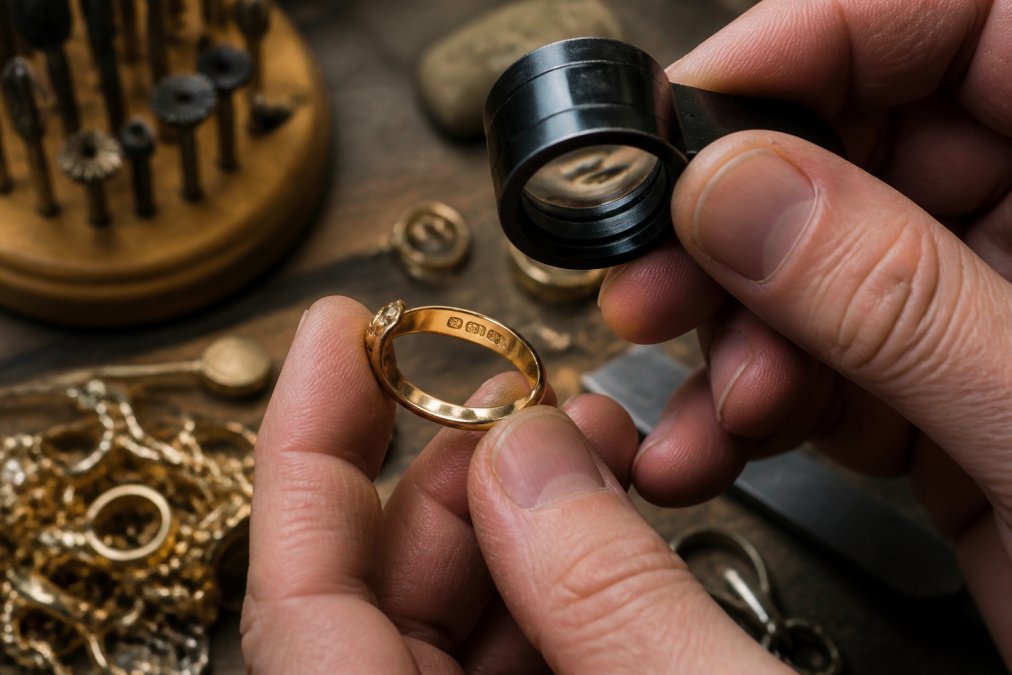
Look inside the band, on the clasp, or along the edge of a pendant. You'll typically find:
- Purity stamps: "14K," "18K," "925" for sterling silver, or "PLAT" for platinum
- Maker's marks: A symbol, initials, or full signature from the designer
- Country or assay marks: Often a tiny symbol indicating where the piece was tested
A common mistake is assuming any stamp means authenticity. Reproduction pieces frequently carry copied marks. Cross-reference the stamp against known designer signatures before trusting it.
Material Quality: Precious Metals and Gemstones That Drive Vintage Jewelry Value
Material quality is the foundation of vintage jewelry value. Precious metals and gemstone quality determine both the floor price and the ceiling.
Precious metals matter first. Gold content, platinum purity, and silver fineness set a base value that holds even if the design falls out of fashion. A 22K gold antique piece contains more raw metal than an 18K piece of similar size.
Gemstone quality adds the next layer. For diamonds, the cut is the most important factor. Older stones often feature a rose cut or old mine cut, which have larger facets and softer sparkle than modern brilliant cuts. Collectors pay premiums for well-preserved old cuts because they can't be reproduced.
Precious stones like emeralds, rubies, and sapphires carry more weight than semi-precious options. But origin and treatment history matter just as much as the stone type.
Craftsmanship, Rarity, and Historical Significance
Craftsmanship and rarity separate a $200 vintage brooch from a $20,000 one, but the gap is built from specific, checkable details rather than a vague sense of "quality." Knowing which techniques to look for lets you judge a piece the way a dealer does.
Craftsmanship signals worth identifying:
- Hand-fabricated settings. Before mass casting became standard, jewelers built settings from sheet and wire. Look for slightly irregular prongs, solder seams visible under a loupe, and a back that shows tool marks rather than a smooth, uniform casting.
- Filigree and hand-engraving. Fine twisted-wire filigree and hand-cut engraving (as opposed to stamped or die-rolled patterns) require hours of skilled labor that cannot be reproduced cheaply. Die-struck or stamped repeats are a sign of later, more automated production.
- Enamel work. Guilloché and plique-à-jour enamel are technically demanding and fragile, so surviving examples in good condition command premiums.
- Calibrated versus custom-cut stones. A piece built around custom-cut stones sized to its setting signals a bespoke commission rather than a catalog item.
Rarity works on two fronts. The first is production volume: small workshops and limited runs leave fewer pieces in existence than a large manufacturer's catalog line.
Exceptional Quality Oval Shape 695.00 →
- Art Deco (roughly 1920s-1930s): geometric precision, bold color contrasts, platinum and diamond combinations, and jade or onyx accents.
- Art Nouveau (roughly 1890-1910): flowing botanical and female-form lines, often in enamel and gold.
- Retro (roughly 1940s): chunky, sculptural gold in rose and yellow tones, driven by wartime metal restrictions that pushed designers toward volume over gemstone weight.
- Mid-century modern (roughly 1950s-1960s): clean lines, textured gold, and abstract forms.
- Victorian mourning jewelry: jet, onyx, and hairwork pieces tied to specific cultural rituals, a narrower, more specialized collector base.
Condition, Patina, and Restoration: What Helps or Hurts Vintage Jewelry Value
Condition, Patina, and Restoration: What Helps or Hurts Vintage Jewelry Value
Condition is where vintage jewelry valuation gets genuinely tricky. Original patina, the soft surface oxidation that develops with age, is often desirable and should be preserved. Over-polishing can strip it away and reduce value.
How to Clean Vintage Antique Jewelry Safely
Learning how to clean vintage antique jewelry safely protects both appearance and value, but the real question collectors face is not just how to clean, it is whether cleaning helps or hurts the piece's worth. The answer depends on the material and the market.
The safe baseline method for most pieces:
- Inspect the piece for loose stones, cracks, or previous repairs before any cleaning.
- Mix warm water with a small amount of mild dish soap.
- Dip a soft-bristle brush and gently scrub the metal, avoiding gemstone surfaces.
- Rinse with clean warm water and pat dry with a lint-free cloth.
- Store separately in a soft pouch to prevent scratching.
Where cleaning crosses into value risk:
- Patina is often an asset, not dirt. The soft surface oxidation that develops with age is frequently desirable and should be preserved. Over-polishing strips it away and can reduce value, especially on silver and on pieces where the patina highlights engraved detail.
- Plating is fragile. Re-plating a worn gold surface may look better but can hurt value on collectible designer pieces, because it alters the original finish.
- Aggressive resizing hurts. Resizing a ring aggressively can thin the band, disturb hallmarks, and signal alteration to a future buyer.
Materials that should never touch water:
- Pearls: wipe with a dry soft cloth only; water and chemicals degrade nacre.
- Opals: porous and heat-sensitive; avoid water, ultrasonic, and steam.
- Emeralds: typically oiled or resin-treated to improve clarity; ultrasonic and steam can remove the treatment and cause damage.
- Glued settings and pieces with visible cracks: vibration from ultrasonic cleaners can loosen stones and cause permanent damage.
The 'wearability' factor, the angle most guides skip.
- Stacking and layering have driven demand for thin bands, signet rings, and delicate chain necklaces that pair well in multiples.
- Statement gold, chunky Retro and mid-century pieces, benefits when bold gold is in style.
- Brooches and pins tend to be less wearable in current fashion, which can hold their prices down even when craftsmanship is high.
Bridging value to money: appraisals and insurance.
- For insurance: you need a formal appraisal documenting identity, materials, and replacement value. Insurers generally require this to cover a loss.
- For resale: you want a fair market or liquidation value, which is typically lower than replacement value. The two figures serve different purposes and are not interchangeable.
- Documentation logistics: photograph the piece from multiple angles, store the paperwork separately from the jewelry, and update the appraisal every few years as market values shift.
Clean to preserve, not to transform. Protect patina, avoid water on porous stones, and remember that wearability and proper documentation often matter more to final value than a spotless surface.
Digital Authentication Tools, Appraisals, and Insurance Logistics
Digital Authentication Tools, Appraisals, and Insurance Logistics
Digital authentication tools now supplement traditional appraisal methods. High-resolution photography, gemological databases, and AI-assisted hallmark matching let appraisers verify pieces faster and with more confidence than a decade ago.
Frequently Asked Questions
What is the most sought after vintage jewelry?
Signed pieces from Art Deco and Art Nouveau eras command the strongest prices, especially from houses like Cartier, Tiffany & Co., and Van Cleef & Arpels. Rings and necklaces featuring old mine cut or rose cut diamonds also draw heavy collector interest. Rarity matters as much as the name: a one-of-a-kind design in excellent condition will outperform a common mass-produced piece from the same decade.
Does the brand name significantly impact vintage jewelry value?
A designer signature can multiply value several times over, but only when the hallmark is verified as authentic. An unsigned Art Deco brooch with fine sapphires may still be worth thousands based on materials and craftsmanship alone. The signature adds a premium on top of that baseline, it does not replace it. Always confirm maker's marks with a jeweler or gemologist before paying a signature premium.
How can you tell the difference between vintage and costume jewelry?
Check the metal first. Fine vintage jewelry uses precious metals stamped with hallmarks like 14K, 18K, or 925, while costume pieces rely on base metals, brass, or plated finishes. Next, examine the stones: real gemstones have visible inclusions and depth under light, whereas glass or paste stones look flat and uniform. Weight is another clue, since solid gold and platinum feel noticeably heavier than costume alternatives of the same size.
What role does gemstone quality play in vintage jewelry appraisal?
Gemstone quality often drives the majority of a vintage piece's value. Appraisers assess diamond cut, color, clarity, and carat weight, with older cuts like old mine and rose cut valued for their historical character rather than modern brilliance standards. Colored stones are graded on saturation and origin. A certified GIA report removes ambiguity, and certification through ABC Rugs Kilims & Jewelry costs between $350 and $1,500 depending on the item.


