

Table of Contents
- Why Authentication Matters for Antique Silver Jewelry
- Quick Comparison: Sterling Silver vs. Silver Plated
- Tip 1: Use the Antique Silver Hallmark Identification Guide
- Tip 2: How to Test Sterling Silver at Home
- Tip 3: Examine Wear Patterns and Patina
- Tip 4: Analyze Gemstone Setting and Clasp Mechanism
- Tip 5: Date the Jewelry by Design Style
- Tip 6: Spot Modern Fakes and Counterfeit Marks
- Putting Authentication Into Practice
- Frequently Asked Questions
Last Updated: September 4, 2026
Why Authentication Matters for Antique Silver Jewelry
The difference between a genuine heirloom and a clever reproduction can amount to hundreds of dollars, and the distinction is rarely obvious at first glance. Authenticating antique silver jewelry protects your investment and deepens your appreciation for the piece, since a verified history adds context that a mere trinket lacks. At ABC Rugs Kilims & Jewelry, we handle vintage treasures daily, and we have seen how a few simple checks separate authentic craftsmanship from modern imitation.
Antique silver jewelry is defined by its materials, its construction methods, and the traces of time left on its surface. Sterling silver, an alloy of 92.5% pure silver and 7.5% other metals, has been the standard for quality pieces for centuries. Before you spend money or fall in love with a piece, working through these 7 tips for authenticating antique silver jewelry will tell you whether you are holding a genuine antique or a well-made fake.
Most guides stop at the magnet test and call it done. That approach misses the nuance of patina, hallmark variation, and period construction that separates true antiques from reproductions. Below, we will show you exactly how to examine a piece like a professional, from the stamp on the clasp to the wear on the band.
Quick Comparison: Sterling Silver vs. Silver Plated
Silver plating involves a thin layer of silver applied over a base metal, typically copper or brass. Solid sterling silver runs through the entire piece, which changes both its weight and its long-term behavior. Understanding this distinction is the foundation of every authentication method that follows.
| Feature | Sterling Silver | Silver Plated (EPNS) |
|---|---|---|
| Composition | 92.5% silver alloy | Silver layer over base metal |
| Hallmark | 925, STERLING, or assay mark | EPNS, Silver on Copper, or none |
| Magnet Response | Non-magnetic | Often magnetic at core |
| Wear Pattern | Even, soft wear | Flaking or peeling surface |
| Patina | Rich, even tarnish | Patchy or rust-colored spots |
Magnet Test and Density Check
Silver is non-magnetic, so a strong neodymium magnet is a useful first filter. If the piece snaps to the magnet, you are almost certainly holding a base metal with a silver-colored finish, not sterling.
The magnet test only rules out fakes; it does not confirm authenticity. A density check adds confidence. Sterling silver has a specific gravity near 10.5, noticeably heavier than copper or nickel alloys of the same size. Hold the piece in your palm and feel the weight. A substantial ring or pendant that feels too light for its size deserves extra scrutiny.
Tip 1: Use the Antique Silver Hallmark Identification Guide
Hallmarks are the most direct evidence of age and origin, and every serious collector learns to read them. A genuine antique silver hallmark identification guide will help you decode the system of stamps that indicates purity, assay office, and maker. However, the most common mistake new collectors make is assuming a single system applies everywhere. The rules differ dramatically by country, and knowing which system you are looking at is the first step.
British Hallmarks: The Gold Standard
British silver has been assayed since the 14th century, and its hallmarking system is the most rigorous in the world. A full British hallmark from 1544 onward consists of up to five marks: the maker's mark, the assay office mark, the standard mark (lion passant for sterling), the date letter, and sometimes a sovereign's head duty mark. The date letter is a letter of the alphabet in a specific font and shield shape that changes every year, allowing you to pin the piece to a single year. For example, a lowercase 'h' in a plain shield on a piece from the Birmingham assay office indicates 1905, while the same letter in a different font could mean 1930 in London. The Online Encyclopedia of Silver Marks, Hallmarks & Makers' Marks is an indispensable free resource for cross-referencing these letters.
Mexican Silver: The Eagle and the Number
Mexican silver, particularly from the Taxco region, uses a different system that is often misread by American buyers. Since 1948, Mexican silver has been marked with a crescent moon, a number indicating the silver content (usually 925), and a letter 'M' for Mexico. The maker's mark is typically a stylized eagle or an abbreviation of the silversmith's name. The most famous maker, William Spratling, used a distinctive 'W' with a stylized eagle, while Hector Aguilar used a circular mark with his initials. Knowing these specific marks is critical because Mexican silver from the 1940s and 1950s is highly collectible, and modern reproductions often copy the eagle mark but get the proportions or placement wrong.
European and American Marks
European marks vary widely. French silver uses a boar's head for Paris and a crab for provincial assay offices, while German silver often uses a crescent moon and crown with a fineness number like '800' or '925'. American silver before the 1860s was rarely hallmarked with a standard mark; instead, it typically carries only the maker's name or initials, such as 'Tiffany & Co.' or 'Gorham'. The absence of a standard mark on an American piece from 1850 is not a red flag; it is the norm. Knowing this prevents you from rejecting a genuine piece simply because it lacks a '925' stamp.
The Problem with Fake Marks
The presence of a hallmark does not guarantee authenticity, since counterfeiters can stamp fake marks. However, the style and placement of the mark tell a story. Genuine antique hallmarks are often slightly uneven, punched by hand, and worn smooth from handling. Modern fakes frequently have crisp, uniform stamps that sit too perfectly on the surface. A hallmark that is laser-etched rather than punched is a modern reproduction, since laser engraving was not available before the late 20th century. Look at the edges of the stamp: a punched mark displaces metal, creating a slight raised edge around the impression, while a laser mark is flat and smooth.
Regional hallmark databases are an underused resource. Many countries maintain searchable records of historical assay marks, and a quick lookup can confirm whether a mark matches the period claimed. The International Hallmark Database and reference guides offers a practical starting point for identifying marks from British, European, and American silversmiths. Cross-referencing the maker's mark with the date letter narrows the piece's origin to a specific year. For American pieces, the Online Encyclopedia of Silver Marks is a comprehensive database of maker's marks from the 19th and early 20th centuries.
Tip 2: How to Test Sterling Silver at Home
Learning how to test sterling silver at home requires no special equipment, only careful observation and a few household items. These methods are non-destructive, which matters when you are evaluating a piece you may want to keep or resell.
Start with a soft white cloth. Rub the surface gently; genuine silver leaves a faint dark smudge, a result of oxidation. Base metals and plated surfaces do not produce this mark. This test works because silver tarnishes on contact with sulfur compounds in the air, and the cloth picks up that microscopic layer.
The Ice Test and Vinegar Test Explained
The ice test uses silver's thermal conductivity. Place an ice cube on the piece and a second cube on a flat surface. Silver conducts heat faster than almost any common metal, so the cube on the silver will melt noticeably quicker. This test is not definitive, but a slow melt suggests the piece is not solid silver.
Vinegar testing is best reserved for small, inconspicuous areas. Apply a drop of white vinegar and watch for a reaction. Genuine silver does not react to mild acid, while base metals may show discoloration or bubbling. Never use this test on a piece you cannot afford to damage, and always rinse the area thoroughly afterward.
Tip 3: Examine Wear Patterns and Patina
Time leaves honest evidence on genuine silver, and learning to read that evidence is a core authentication skill. Antique pieces show wear where hands and clothing have made contact over decades: the high points of a ring band, the edges of a clasp, the corners of a pendant. identifying hallmark symbols.
Genuine patina develops evenly across the surface, a soft darkening that settles into crevices and detailed work. This is not dirt; it is oxidized silver that has formed a stable layer over many years. The patina on antique silver jewelry is part of its value and its charm, and aggressive cleaning destroys both.
Look for wear that matches the piece's claimed age. A Victorian brooch with crisp, untouched engraving and no softening on the edges is suspicious, since 150 years of handling would leave some trace. Conversely, a supposedly new piece with artificially darkened crevices may have been treated with chemicals to fake age.
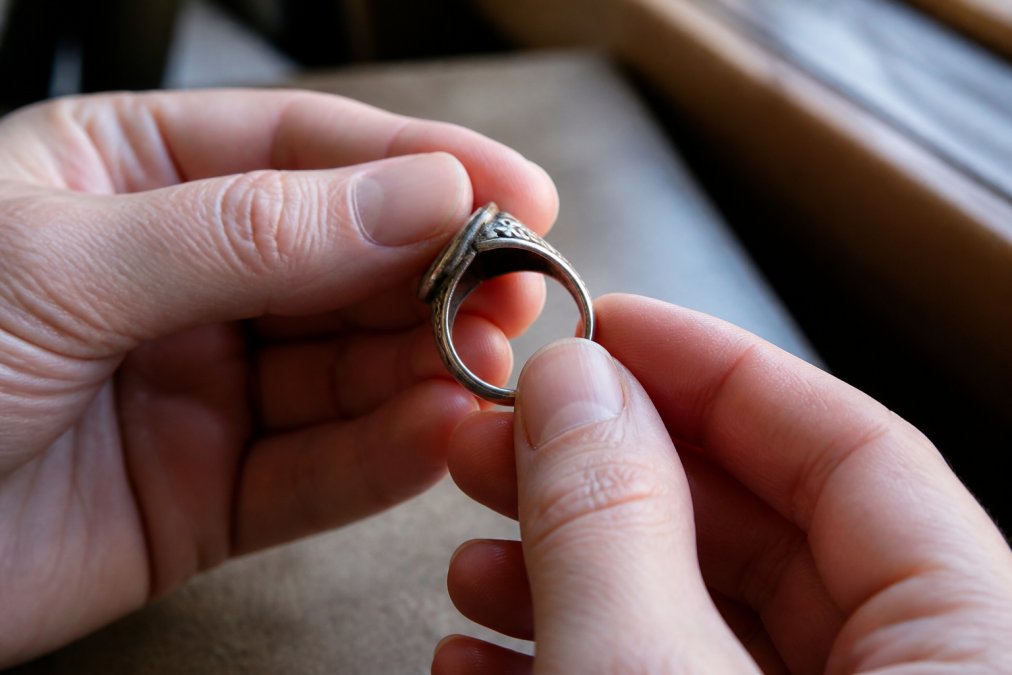
Tip 4: Analyze Gemstone Setting and Clasp Mechanism
The way a piece is constructed reveals its era more reliably than its surface finish. Antique settings were built by hand, and they show the small irregularities of human workmanship.
Check how gemstones are held in place. Antique pieces typically use prong settings that are visibly hand-finished, or bezel settings where the metal collar is hammered down around the stone. Modern reproductions often use machine-cut settings with perfectly uniform prongs. Look underneath the stone if possible; genuine antique settings usually have an open back that lets light through.
The clasp mechanism is equally telling. Antique clasps include box clasps, hook-and-eye closures, and barrel clasps, each with distinctive construction details. A genuine antique clasp operates smoothly but shows wear at the friction points. A modern fake may have a clasp that is stamped, hollow, or marked with a contemporary maker's name.
:::pro-tip Bring a jeweler's loupe with 10x magnification when shopping. Under magnification, hand-finishing marks appear as fine parallel scratches, while machine finishing shows uniform, directional lines. This single tool reveals more than any other test. :::
Tip 5: Date the Jewelry by Design Style
Every era produced jewelry with identifiable design vocabulary, and matching a piece to its period is a powerful authentication tool. The design style of antique silver jewelry changed with fashion, technology, and available materials.
Key periods to recognize:
- Georgian (1714-1837): Handcrafted, often featuring repousse work and foil-backed gemstones
- Victorian (1837-1901): Romantic motifs, cameos, and intricate filigree
- Edwardian (1901-1915): Delicate, lace-like silver work with platinum accents
- Art Nouveau (1890-1910): Flowing organic lines, nature-inspired motifs
- Art Deco (1920-1935): Geometric patterns, bold contrasts, machine-precision lines
A piece claiming to be Art Deco should show the geometric symmetry and clean lines of that period, not the flowing curves of Art Nouveau. The craftsmanship of antique silver jewelry reflects the tools available at the time, and anachronistic construction details are a red flag that should not be ignored.
Tip 6: Spot Modern Fakes and Counterfeit Marks
The market for antique silver jewelry has grown, and so has the sophistication of counterfeiters. Modern fakes range from crude castings with stamped hallmarks to skilled reproductions that deceive even experienced buyers.
The most common counterfeit technique involves taking a genuine but damaged antique, repairing it with modern methods, and reselling it as original. Look for solder joints that appear too clean, replacement clasps that do not match the period, or stones that have been re-cut to hide damage. These alterations do not make a piece fake, but they do affect its value and should be disclosed.
Fully fake pieces often fail on hallmark examination. Counterfeiters may stamp a believable 925 mark but omit the maker's mark or assay office stamp, since those require specific knowledge to reproduce. The FTC guidelines on jewelry industry practices require accurate disclosure of metal content, and legitimate dealers follow these standards when describing their inventory.
Modern fakes also tend to be heavier or lighter than the originals they imitate. Cast reproductions often lack the crisp detail of hand-finished originals, particularly in filigree work where the metal appears soft or rounded. Compare the piece against known examples from the period, either in person or through museum collection databases and antique reference archives, to calibrate your eye.
Putting Authentication Into Practice
Authentication is a skill that improves with repetition. Start with the hallmark, move through the physical tests, and finish with a careful study of construction and design. Each check builds on the last, and a piece that passes all of them deserves your confidence.
When you buy antique silver jewelry, choose a source that stands behind its pieces. At ABC Rugs Kilims & Jewelry, every item is reviewed and selected for authenticity before it reaches the shop. Our Handmade Stone Gemstone Rings pair natural stones with copper and silver in vintage-inspired settings, offering the character of antique design with clear material disclosure. Each ring is priced at $99.00, and the craftsmanship is visible in the stone-setting details you have learned to examine.

Frequently Asked Questions
What is the quick test for silver?
The quickest test is the magnet test. Sterling silver is non-magnetic, so a strong magnet will not stick to it. If the magnet sticks firmly, the piece is not solid silver and likely has a steel or iron core. This test works best with a strong neodymium magnet. Remember that some clasps may contain a small spring, so test the main body of the piece, not just the closure.
What is the difference between sterling silver and silver-plated jewelry?
Sterling silver is an alloy containing 92.5% pure silver and 7.5% other metals, usually copper. Silver-plated jewelry has a thin layer of silver over a base metal like copper or brass. You can spot the difference by looking for a 925 stamp on sterling pieces, while plated items often say EPNS or have no mark at all. Wear patterns also reveal the truth, since plating wears away to show the base metal underneath.
How can you identify authentic antique silver hallmarks?
Authentic antique silver hallmarks include a standard mark, like 925 or the lion passant for British silver, an assay office mark, and a maker's mark. Look closely with a loupe for crisp, well-defined stamps. Genuine hallmarks are punched into the metal, so they have slightly indented edges. Fakes often have shallow or blurry marks. Use online hallmark databases to cross-reference the symbols and letters you find.
How do you safely clean antique silver jewelry without damaging it?
For antique silver, skip the harsh dips and abrasive polishes. Start by washing with mild dish soap and warm water using a soft baby toothbrush. Rinse and dry completely with a soft cloth. For tarnish, use a gentle silver polishing cloth designed for jewelry. Never soak pieces with porous gemstones like turquoise or opals. When in doubt, leave the patina and consult a professional.
Can you test real silver with vinegar?
Vinegar is not a reliable test for real silver. Silver does not react quickly to vinegar, but neither do many other metals. A drop of vinegar will not harm sterling silver, but it will not confirm authenticity either. For a more accurate home test, use the ice test, where real silver conducts heat rapidly and melts ice quickly. For certainty, rely on hallmarks and professional testing.
Authenticating antique silver jewelry takes patience, but the payoff is the confidence to buy and wear pieces with real history. The methods covered here, from hallmark reading to patina analysis, give you a repeatable process for evaluating any piece you encounter. When you want a trusted source for vintage and handmade jewelry, explore the ABC Rugs Kilims & Jewelry collection and find pieces that have already passed the scrutiny you now know how to apply.
This article was written using GrandRanker


