

Table of Contents
- Understanding Different Types of Antique Rug Dealers
- How to Identify Antique Rug Quality and Authenticity
- Vetting Dealer Ethics and Transparency
- Best Practices for Buying Vintage Rugs Online vs. In Person
- Authentic Kilim Rugs: Regional Distinctions and Value
- Hidden Costs of Ownership and Resale Liquidity
- Conclusion
Last Updated: August 27, 2026
Understanding Different Types of Antique Rug Dealers
Buying an antique rug differs fundamentally from purchasing mass-produced carpet. Dealer selection determines whether you acquire an investment-grade textile or an overpriced reproduction. At ABC Rugs Kilims & Jewelry, we ensure authentication accuracy, fair pricing, and long-term resale potential.
Antique rug dealers fall into distinct categories with different business models, expertise levels, and incentive structures.
Brick-and-mortar specialty dealers operate physical showrooms with carefully curated inventories, often specializing in specific regions like Persian rugs, Turkish kilims, or Caucasian textiles. They offer tangible inspection and personalized guidance but face limited selection, higher overhead costs passed to customers, and geographic constraints.
Online-only dealers operate with lower overhead and broader inventory reach, providing extensive photography and detailed condition reports. This works well for knowledgeable buyers but eliminates physical inspection before purchase, and return policies vary significantly.
Auction houses provide third-party authentication and competitive pricing through bidding, creating public price discovery. However, their rug expertise may be secondary to their overall business.
Wholesale importers and distributors sell directly to designers and serious collectors with deep connections to weaving communities and lower pricing, but require minimum orders and bulk purchases.
Marketplace platforms connect individual sellers with buyers, but quality and authenticity vary wildly depending on seller expertise and platform protections.
The critical distinction: not all dealers authenticate, price fairly, or stand behind inventory equally. Your job is identifying which dealer type matches your needs, then vetting individual operators within that category.
How to Identify Antique Rug Quality and Authenticity
Smart antique rug buying requires understanding what separates investment-grade pieces from lower-quality or misrepresented inventory through construction method, materials, age markers, and condition.
Hand-Knotted Construction and Knot Count
Hand-knotted rugs are the only textiles worth collecting as antiques. Machine-made rugs lack the craftsmanship, durability, and value retention that define investment-grade textiles.
Hand-knotted rugs are constructed by tying individual knots onto vertical warp threads, one row at a time. The knot count (knots per square inch) is a primary quality indicator. Higher knot counts require finer yarn and more precise weaving, resulting in sharper pattern definition and greater durability. Persian rugs typically range from 100 to 400+ knots per square inch, while Turkish and Caucasian rugs often fall between 80 and 250. Fine silk rugs can exceed 500 knots per square inch. Dealers should provide knot count information; if they can't or won't, that's a red flag.
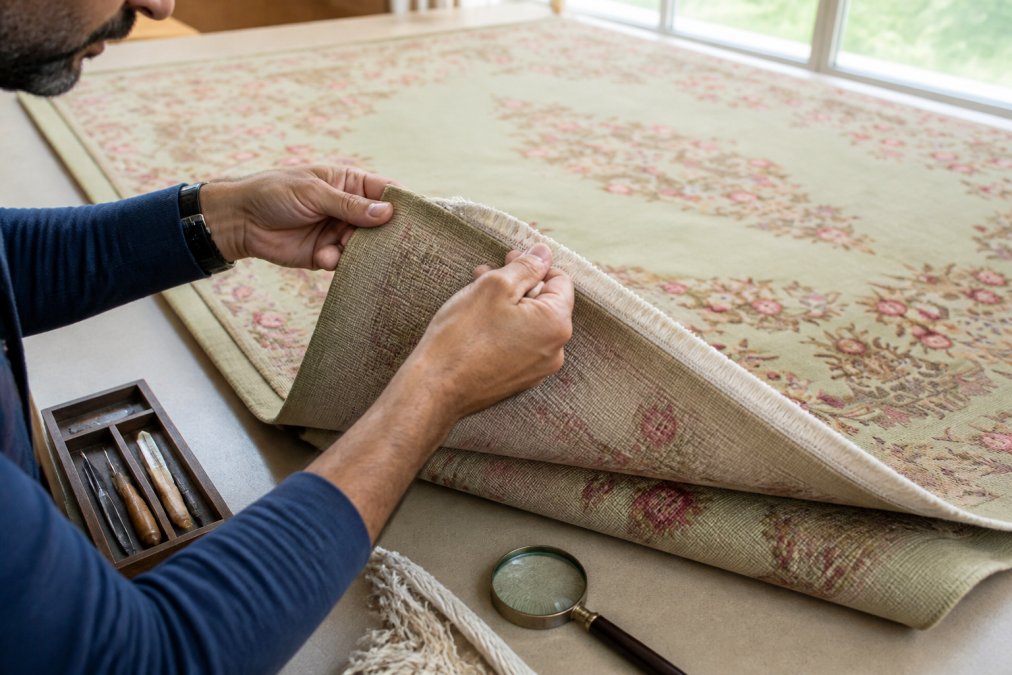
To verify hand-knotted construction, examine the rug's back. You should see individual knots with the pattern visible in reverse. Machine-made rugs show uniform backing with no visible knot structure. The warp and weft threads should display irregularities and variations indicating hand labor, not mechanical precision.
Natural Dyes vs. Synthetic Dyes
Antique rugs made before the 1920s typically used natural dyes derived from plants, insects, and minerals, indigo for blues, madder root for reds, pomegranate for yellows, walnut for browns (si.edu).
Natural dyes display distinctive characteristics. Colors shift subtly across the rug due to variations in dyeing conditions and material sources. Reds may fade to salmon tones; blues can shift toward purple. This variation, called abrash, proves authenticity in older pieces by demonstrating the dyes weren't uniform industrial products.
Synthetic dyes (aniline dyes introduced in the 1860s, then chrome dyes in the early 1900s) produce uniform, consistent colors (peer-reviewed research). Early synthetic dyes sometimes faded unpredictably or shifted toward garish tones, telltale signs of age and lower quality. Reputable dealers should discuss dye composition and may provide laboratory analysis for high-value rugs. If a dealer claims a rug is antique but shows uniform, intensely saturated colors with no variation, question whether it's been overdyed or restored.
Condition, Patina, and Wear Patterns
An antique rug's condition reveals its history. Authentic wear patterns develop naturally over decades of use, with high-traffic areas showing more pile loss and edges fraying predictably.
Patina is the subtle color shift and surface texture developing through age and use, different from fading. A rug with good patina shows a soft, lived-in appearance where colors have mellowed but not deteriorated, proving age and authenticity.
Condition assessment requires honesty about what you're buying. "Excellent condition" means minimal pile loss, intact fringe, and no structural damage. "Good condition" shows some wear in high-traffic areas but remains structurally sound. "Fair condition" shows significant wear but is still usable with a rug pad.
Many dealers buy damaged rugs cheaply, have them professionally restored, and resell them at higher prices. Professional restoration can cost thousands of dollars. You need to know whether a rug has been restored and what that involved. Overly aggressive restoration, replacing large sections of pile, re-fringing, or heavy chemical cleaning, can reduce a rug's value despite improving appearance.
Examine the selvage (finished edge) and fringe carefully. Original fringe should show wear consistent with the rug's age. Replaced fringe indicates restoration. The selvage should show original weaving technique; rewoven selvage signals restoration work. assessing decor quality.
Vetting Dealer Ethics and Transparency
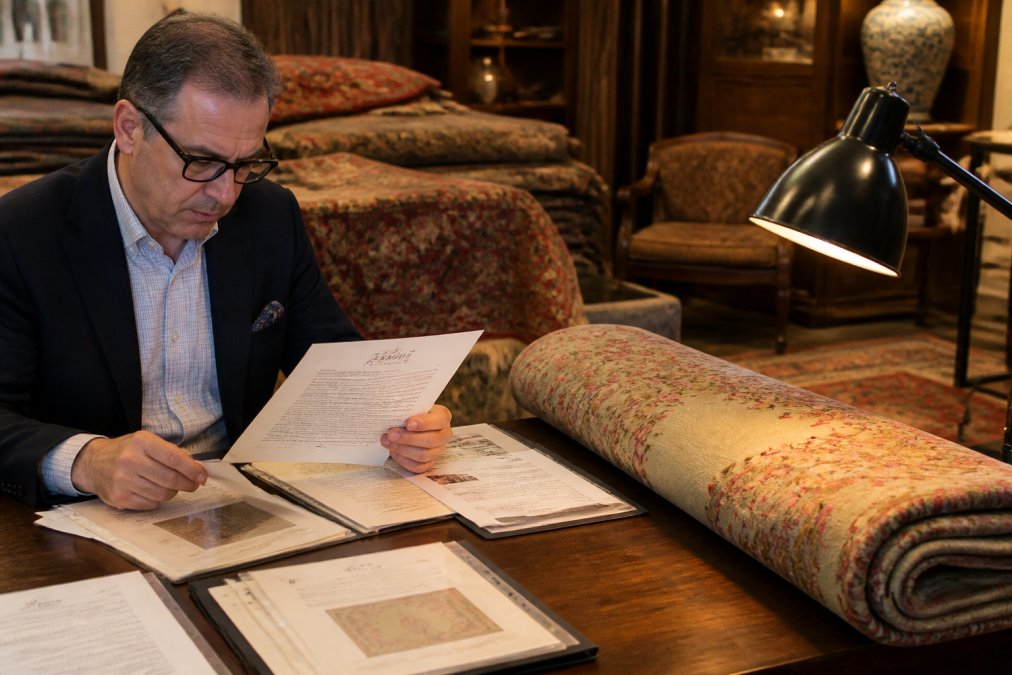
A dealer's willingness to provide detailed, verifiable information is the strongest predictor of trustworthiness.
Ethical dealers should provide:
-
Detailed provenance documentation - Where did the rug come from? What region and age? For truly antique pieces, complete provenance is rare, but dealers should acknowledge gaps honestly rather than inventing stories.
-
Condition reports - Written assessments of the rug's condition, including damage, restoration work, and maintenance needs. This should be specific: "Pile loss in the center field, approximately 15% coverage" rather than vague descriptions.

One Of The Kind Antique Persian Kerman Rug 13'2 x 9'9" -
Authentication information - How does the dealer determine authenticity? Do they examine construction, dyes, and wear patterns? For high-value pieces, do they use laboratory analysis? Reputable dealers explain their authentication process and may provide certificates from recognized textile experts.
-
Transparent pricing - The dealer should explain what factors determine price: age, rarity, size, condition, or market comparables. A dealer who justifies pricing is more trustworthy than one who quotes a price without discussion.
-
Clear return and guarantee policies - What happens if you discover the rug isn't what was represented? Ethical dealers offer return windows (typically 14-30 days) and refunds if authenticity claims prove false. Some offer lifetime authenticity guarantees.
Large inventory doesn't equal expertise. Some dealers buy rugs speculatively without deep knowledge of construction, materials, or regional characteristics, relying on attractive photography and aggressive marketing. Ask dealers specific questions about their inventory: where does the knot count come from? What natural dyes were used? How did they verify the age? Their answers reveal whether they actually know their inventory.
Another red flag: pressure to buy quickly. Ethical dealers understand antique rug purchases are significant decisions and won't rush you or create artificial scarcity.
Best Practices for Buying Vintage Rugs Online vs. In Person
In-person buying lets you evaluate color accuracy, texture, and condition directly. You can examine knot structure, feel the pile, assess wear patterns, and judge how colors work with your space's lighting. The downside: you're limited to dealers within reasonable travel distance and may feel pressure to decide immediately.
Online buying expands your options to dealers nationwide and internationally. You can research multiple options, compare prices, and take time deciding. Good online dealers provide extensive photography from multiple angles, detailed measurements, and condition documentation. The risk: color photography varies by camera and lighting, and you can't physically inspect before purchase.
If buying online, prioritize dealers who:
- Provide multiple high-resolution photos from different angles, including close-ups of the back, fringe, and any damage
- Offer detailed measurements and knot count information
- Provide written condition assessments, not just ratings
- Have clear return policies (at least 14 days, ideally 30)
- Respond promptly to questions and provide additional photos on request
- Display customer reviews or testimonials
Request a video walkthrough if possible. Some dealers record videos showing the rug's colors under different lighting conditions, providing better color accuracy than static photos.
For high-value purchases (rugs over several thousand dollars), consider requesting an in-person inspection if the dealer is within driving distance, or request that the dealer ship the rug with a return agreement so you can inspect it in your home.
ABC Rugs Kilims & Jewelry provides detailed documentation for all pieces, including photography, condition reports, and authentication information. Our online inventory includes rugs like the Persian Antique Hand Knotted Persian Tabriz Rug with natural vegetable dyes and the Joshghan Semi Antique Hand Knotted Persian Rug, both photographed and documented to support confident remote purchasing.


Authentic Kilim Rugs: Regional Distinctions and Value
Kilims are flat-woven textiles without pile, constructed by interlocking warp and weft threads. They're lighter weight than knotted rugs, more affordable, and increasingly recognized as serious collectible pieces.
Regional origin is the primary value driver. Turkish kilims typically feature geometric motifs, diamonds, stripes, hexagons, in bold colors with looser weaving than Persian work. They're durable, age well, and are generally more affordable than comparable Persian pieces.
Persian kilims display more complex floral and geometric patterns with finer detail and tighter weaving, commanding higher prices due to perceived sophistication of design and construction quality.
Caucasian kilims (from Azerbaijan, Armenia, and surrounding regions) feature distinctive tribal patterns and often use natural dyes with exceptional color complexity, increasingly sought by collectors and commanding premium prices.
When evaluating authentic kilim rugs, apply the same standards as knotted rugs: examine warp and weft construction, assess dye composition, verify regional origin if claimed, and evaluate condition honestly. Regional provenance should be traceable; if a dealer claims a kilim is Persian but can't explain specific construction or design characteristics supporting that claim, be skeptical.
| Kilim Region | Typical Pattern | Weave Density | Price Range | Best For |
|---|---|---|---|---|
| Turkish | Geometric, bold | Medium | $800-$3,000 | Durable, high-traffic areas |
| Persian | Floral, intricate | Fine | $1,500-$8,000+ | Collectors, formal spaces |
| Caucasian | Tribal, complex | Fine | $2,000-$10,000+ | Investment, statement pieces |
Hidden Costs of Ownership and Resale Liquidity
Antique rug ownership carries ongoing costs and complications many buyers don't anticipate.
Maintenance and cleaning are the first hidden costs. Antique rugs require specialized care. Machine washing or standard carpet cleaning can damage natural dyes, weaken fibers, and reduce value. Professional rug cleaning by textile conservation specialists typically costs $200-$1,000+ depending on size and condition. Plan for professional cleaning every 3-5 years for rugs in regular use (si.edu).
Rug pads are essential to protect both rug and floor, costing $100-$400 depending on size. Without a pad, the rug can slip and the backing can stain or damage hardwood floors.
Storage and climate control matter if you're not actively displaying the rug. Extreme temperature fluctuations, high humidity, and dry conditions damage fibers and dyes. Proper rolling (not folding), acid-free paper wrapping, and climate-controlled storage are necessary.
Restoration and repair costs can be substantial. Small repairs (re-fringing, fixing small holes) might cost $300-$800. Major restoration work can cost several thousand dollars, reducing your profit margin if you later sell.
Resale liquidity is where many buyers face disappointment. Antique rugs have a narrower market than fine art or jewelry. You can't simply list a rug on a general marketplace and expect quick sales. You need to reach collectors, interior designers, or dealers specializing in your rug's type and region.
A rug you paid $5,000 for might only sell for $3,000-$4,000 five years later, even in excellent condition. Factors affecting resale value include market trends (Persian rugs maintain value better than some regional styles), condition (significant wear triggers steep discounts), provenance (documented history sells better), and size/color (large neutral-colored rugs have broader appeal than small accent rugs with bold colors).
If buying antique rugs as an investment, be realistic about liquidity. You may need to sell through a dealer (who offers 40-60% of retail value), consign to an auction house (which takes a commission), or wait for the right buyer. Properly maintained antique rugs can appreciate slowly over decades, but this requires significant expertise and careful stewardship. For most buyers, antique rugs should be purchased for enjoyment and aesthetic value, not primarily as financial investments.
Choosing the right antique rug dealer determines whether you get a fair price and an authentic, well-maintained piece that brings lasting value to your home. Dealers who invest in detailed authentication, transparent pricing, and honest condition assessment are worth working with. ABC Rugs Kilims & Jewelry specializes in hand-knotted Persian and Turkish pieces with verified provenance and comprehensive documentation. Our curated collection includes investment-grade pieces like the One Of The Kind Antique Persian Kerman Rug, each authenticated and photographed to support confident purchasing. When you're ready to invest in an authentic textile, start with dealers who demonstrate genuine expertise and stand behind their inventory.
Frequently Asked Questions
How do I verify the authenticity of an antique rug from an antique rug dealer?
Authentic rugs show specific markers: hand-knotted construction with irregular knot patterns, natural dyes that fade gradually, and a dense pile with visible warp and weft on the back. Request provenance documentation and authentication certificates. Reputable antique rug dealers provide detailed condition reports and will explain the rug's origin, age, and materials. Inspect the fringe, selvage, and wear patterns in person when possible, these reveal genuine aging rather than artificial distressing.
What distinguishes a reputable antique rug dealer from a general retailer?
Specialized antique rug dealers focus on hand-selected, curated collections with documented provenance. They employ textile experts, provide detailed authentication, and stand behind their pieces with guarantees. General retailers often stock mass-produced rugs or newer pieces marketed as 'vintage.' Reputable dealers offer transparent pricing, explain the rug's regional origin (Persian, Turkish, Caucasian, etc.), disclose restoration work, and provide guidance on care. They're willing to answer technical questions about knot count, dye sources, and investment potential.
What factors influence the value of an antique rug when comparing dealer offerings?
Value depends on hand-knotted construction, pile density, natural dyes, wool quality, knot count, regional origin, age, condition, and rarity of design. Persian and Turkish rugs typically command higher prices than mass-produced alternatives. Pieces with excellent condition and minimal restoration preserve value better. Dealers with transparent appraisals and textile conservation documentation support higher valuations. Wear patterns and patina that reflect authentic aging add character and value rather than diminishing it.
Should I buy antique rugs online from dealers or inspect them in person first?
Digital inspection works for experienced buyers who understand knot count, dye quality, and wear patterns from photos and detailed descriptions. However, physical inspection reveals true color, texture, and condition better than images. High-value pieces warrant in-person viewing or hiring a textile conservator for remote appraisal. Reputable dealers offer detailed photography from multiple angles, condition reports, and return policies to reduce risk. For first-time buyers or pieces over $5,000, seeing the rug in person reduces the chance of disappointment and ensures the piece matches your space and expectations.
What hidden costs should I expect when buying from antique rug dealers?
Beyond the purchase price, budget for professional cleaning ($300-$1,500 depending on size), rug pads to prevent slipping ($50-$200), and insurance for high-value pieces. Restoration work, if needed, costs $500-$5,000+. Shipping and delivery for large rugs can exceed $200. Storage or climate control for pieces in humid climates adds ongoing expense. Appraisals for insurance or resale run $200-$500. When reselling, expect dealer markup of 30-50% on secondary market sales, reducing your net proceeds. Factor these costs into your investment decision.
This article was written using GrandRanker


