

Table of Contents
- Hand Knotted vs Machine Made Rugs: The Core Differences at a Glance
- How to Identify Hand Knotted Rugs at Home
- Hand Tufted vs Hand Knotted Rugs: A Distinction That Matters
- Hand Knotted Rug Durability: Why Construction Determines Lifespan
- Cost of Hand Knotted Rugs and What Drives the Price
- Resale Value and Investment Potential of Hand Knotted Rugs
- Maintenance, Professional Cleaning, and Indoor Air Quality
- Pros and Cons: Hand Knotted vs Machine Made Rugs Side by Side
Last Updated: August 1, 2026
The debate over hand knotted vs machine made rugs comes down to one fundamental question: are you buying a floor covering or an heirloom? A hand-knotted rug is a textile constructed entirely by hand, with individual knots tied around warp threads by a skilled artisan, often over months or years. A machine-made rug is produced on a computerized power loom in a fraction of the time. Below, we'll show you exactly how to tell them apart, what drives the price difference, and which type genuinely holds its value over time.
The construction method determines durability, repairability, resale potential, and even indoor air quality. A hand-knotted Persian or oriental rug made from natural wool or silk can outlast the building it sits in. A machine-made rug made from synthetic fibers typically shows wear within a decade of regular use.
Hand Knotted vs Machine Made Rugs: The Core Differences at a Glance
A hand-knotted rug is built on a loom where the weaver individually ties each knot, row by row, around the warp and weft threads. A machine-made rug is produced on a power loom that replicates patterns through automated needle and loop mechanisms, with synthetic or blended fibers fed through at speed.
Quick Comparison Table: Hand Knotted vs Machine Made
| Feature | Hand-Knotted | Machine-Made |
|---|---|---|
| Construction method | Individual knots tied by hand | Automated power loom |
| Fiber content | Natural wool, silk, cotton | Synthetic fibers, blends |
| Knot density | Varies; irregular by nature | Uniform, machine-precise |
| Fringe | Extension of warp threads | Sewn or glued on separately |
| Lifespan | Decades to centuries | 5-15 years typical |
| Repairability | Fully repairable by hand | Difficult to repair authentically |
| Resale value | Appreciates or holds value | Depreciates quickly |
| Price point | Higher, reflects labor | Lower, reflects volume |
| Backing | Visible knots on reverse | Uniform latex or fabric backing |
| Sustainability | Natural fibers, biodegradable | Often petroleum-based synthetics |
How to Identify Hand Knotted Rugs at Home
Identifying a hand-knotted rug does not require expert training. A few targeted inspections reveal the construction method within minutes.
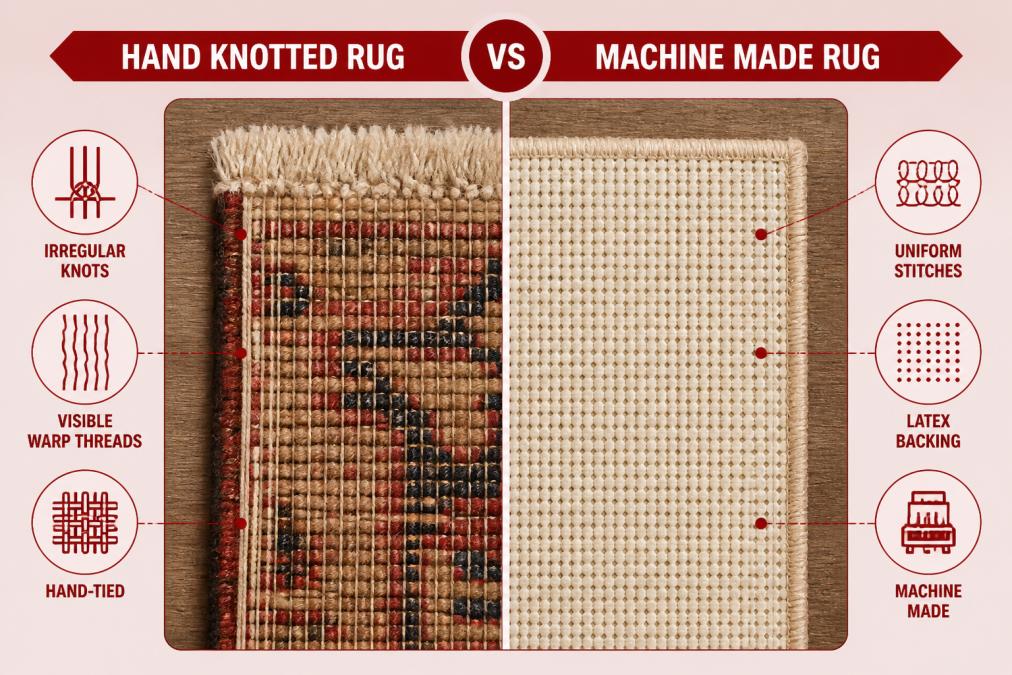
Flip the rug over. On a hand-knotted rug, you will see the actual knots, and the pattern on the back will mirror the pattern on the front with reasonable clarity. On a machine-made rug, the back typically shows a uniform latex or fabric secondary backing that obscures the structure entirely.
Inspecting the Fringe, Warp, and Weft
On a genuine hand-knotted rug, the fringe is not decorative trim sewn onto the edge after completion. The fringe is the exposed continuation of the warp threads that form the structural foundation of the textile. When you pull gently on the fringe of a hand-knotted rug, you are pulling on the skeleton of the rug itself.
On a machine-made rug, the fringe is almost always sewn or glued onto the selvage as a finishing detail. Run your finger along the transition point between the pile and the fringe. If there is a visible seam or a line of stitching, the fringe was added.
Reading Knot Uniformity and Natural Imperfections
Machine-made rugs are defined by uniformity. Every row is identical. Every pile height is consistent. Hand-knotted rugs carry the fingerprints of their makers. Slight asymmetry in the pattern, minor variations in pile height, and subtle inconsistencies in color across the field are evidence of human craft. The technical term for this natural variation is "abrash," referring to the tonal shifts that occur when different batches of hand-dyed yarn are used across the weaving process.
Knot count, expressed as knots per square inch, also varies within a single hand-knotted rug in ways that machine production cannot replicate. A high knot count indicates finer detail and longer production time, and it correlates strongly with both quality and value.
Hand Tufted vs Hand Knotted Rugs: A Distinction That Matters
"Hand-made" does not automatically mean "hand-knotted," and the difference between hand-tufted and hand-knotted rugs is significant enough to affect both price and longevity.
A hand-tufted rug is made using a tufting gun, a tool that punches loops of yarn through a canvas backing. Once complete, a secondary backing, usually latex, is glued to the canvas to hold the fibers in place. That latex backing deteriorates over time, causing the rug to shed, delaminate, and become difficult to clean.
A hand-knotted rug has no secondary backing. The knots are structurally integral to the textile. There is no glue to fail, no canvas to separate. This is why hand-knotted rugs are repairable and hand-tufted rugs generally are not.
Hand Knotted Rug Durability: Why Construction Determines Lifespan
Because each knot is individually tied to the warp structure, a hand-knotted rug does not unravel progressively when damaged. A worn or damaged area can be re-knotted by a skilled restorer without affecting the surrounding textile.
Machine-made rugs lack this repairability. When the pile wears through or a section is damaged, the options are limited to cutting away the damaged area or replacing the rug entirely.
According to Smithsonian Institution research on textile conservation, hand-knotted textiles from centuries ago remain structurally sound when properly maintained, a testament to the durability of the knotting technique.
Natural Wool and Silk vs Synthetic Fibers
Natural wool is lanolin-rich, naturally soil-resistant, and resilient under foot traffic. The fiber springs back after compression, which is why a well-made wool rug can survive decades of daily use in high-traffic areas. Silk adds fineness and sheen and is typically used in higher-knot-count rugs where detail is the priority.
Synthetic fibers, including polypropylene and nylon, are engineered for stain resistance and affordability. They perform well in the short term but do not age gracefully. Synthetic pile flattens under traffic and does not recover the way wool does.
The combination of hand-knotted construction and natural fibers is what makes certain oriental and Persian rugs genuinely multigenerational.
Cost of Hand Knotted Rugs and What Drives the Price
A hand-knotted rug requires hundreds to thousands of hours of skilled labor to complete. A single medium-sized Persian rug with a moderate knot count might represent six months of continuous work by an experienced weaver. That labor cost is the primary driver of price.
Additional factors that affect the cost of hand-knotted rugs include:
- Fiber quality: Fine wool from specific regional breeds, or hand-spun silk, commands a premium
- Knot density: Higher knots per square inch requires finer yarn, more time, and greater skill
- Origin and weaving tradition: Rugs from historically significant weaving regions carry provenance value
- Age and condition: Antique and vintage pieces reflect scarcity as well as craft
- Size: Larger rugs require proportionally more labor and material
Machine-made rugs cost less because the labor component is minimal and synthetic fiber costs are lower than natural wool or silk.
For current pricing on authentic hand-knotted and vintage pieces, visit ABC Rugs Kilims & Jewelry directly. Pricing varies by origin, age, condition, and fiber content, and the collection changes as new pieces are sourced.
Resale Value and Investment Potential of Hand Knotted Rugs
Machine-made rugs depreciate. A machine-made rug purchased today will be worth less in five years, and effectively worthless in twenty. It is a consumable, not an asset.
Hand-knotted rugs, particularly antique and vintage pieces from established weaving traditions, behave differently. Well-maintained examples from significant producing regions have historically held or increased in value over time, especially as the supply of genuinely old pieces diminishes.
The investment case for hand-knotted rugs rests on scarcity, authentic provenance documentation, condition relative to age, and regional and cultural significance.
As documented in The Textile Society of America's research on antique textile markets, authentic handwoven textiles with documented origins consistently attract sustained collector interest across auction markets.
This is not to say every hand-knotted rug is an investment. Mass-produced hand-knotted rugs from contemporary commercial workshops do not carry the same scarcity or provenance value as genuine antique or vintage pieces.
Maintenance, Professional Cleaning, and Indoor Air Quality
Hand-knotted rugs made from natural wool or silk require professional cleaning by specialists who understand fiber behavior and dye chemistry. Standard carpet cleaning equipment and household cleaning products can damage natural fibers, strip lanolin from wool, or cause dye migration in older pieces. Professional rug washing is the correct approach for valuable hand-knotted textiles.
Machine-made synthetic rugs are generally more tolerant of standard cleaning methods. Polypropylene and nylon resist moisture and staining, and many machine-made rugs can be cleaned with standard equipment.
On indoor air quality, natural wool is a hygroscopic fiber, meaning it absorbs and releases moisture from the surrounding air, which can contribute to humidity regulation. Wool fibers do not off-gas volatile organic compounds. Many synthetic rugs, particularly those with latex backings, release VOCs during the off-gassing period after manufacture. According to U.S. Environmental Protection Agency guidance on indoor air quality and VOCs, new synthetic textile products can contribute to elevated VOC levels in enclosed spaces, particularly in the weeks following installation.
For households with respiratory sensitivities or a preference for low-chemical interiors, natural-fiber hand-knotted rugs are the more appropriate choice.
Pros and Cons: Hand Knotted vs Machine Made Rugs Side by Side
Hand-Knotted Rugs
Pros:
- Exceptional longevity, often lasting generations with proper care
- Fully repairable by skilled artisans
- Natural fibers with no synthetic off-gassing
- Resale and investment value, especially for antique and vintage pieces
- Unique artisanal character; no two rugs are identical
- Supports traditional weaving communities and craft preservation
Cons:
- Higher upfront cost reflects genuine labor and material investment
- Requires professional cleaning rather than standard methods
- Limited availability for specific regional styles or antique pieces
- Longer lead time when sourcing specific pieces
Machine-Made Rugs
Pros:
- Lower purchase price and wide availability
- Consistent patterns and colors across production runs
- Stain-resistant synthetic fibers suit high-mess environments
- Faster replacement cycle if trends change
Cons:
- Depreciates quickly; no resale value
- Not repairable in any meaningful way
- Synthetic fibers may off-gas VOCs after installation
- Lacks the depth, character, and tactile quality of handmade textiles
- Contributes to synthetic textile waste at end of life
For a rental property, a high-traffic mudroom, or a temporary space, a machine-made rug is a practical solution. For a living room, a dining room, or any space where you want a piece that improves with age and tells a story, a hand-knotted rug is the only category worth serious consideration.
Many buyers who start with machine-made rugs find themselves replacing them within a decade and spending more in total than they would have on a single quality hand-knotted piece. The economics of durability favor the higher upfront investment when the timeline extends beyond five years.
Choosing between hand-knotted and machine-made rugs is ultimately a question of how you value your space and your investment. If you are ready to explore authentic hand-knotted rugs, kilims, and Persian antique pieces with documented provenance, ABC Rugs Kilims & Jewelry offers a curated collection of handmade rugs and vintage textiles available for both retail and wholesale purchase. Browse the reviewed and trusted inventory at ABC Rugs Kilims & Jewelry to find a piece that will outlast the trends and hold its place in your home for generations.
Frequently Asked Questions
What is the main difference between hand knotted and machine made rugs?
Hand knotted rugs are made by artisans who individually tie each knot onto warp threads on a loom, a process that can take months or years for a single piece. Machine made rugs are produced on computerized power looms in a fraction of the time. The result is that hand knotted rugs display natural asymmetry, higher knot density in fine examples, and genuine artisanal character, while machine made rugs offer consistent uniformity and broader accessibility.
How can you tell if a rug is hand knotted or machine made?
Flip the rug over and examine the backing. On a hand knotted rug, the knots are visible and slightly irregular, the fringe is an extension of the warp threads, and the pattern on the back mirrors the front almost perfectly. On a machine made rug, the backing is often a separate material glued or sewn on, the fringe is typically sewn or glued rather than woven, and the pattern appears more mechanically uniform. Slight imperfections in a hand knotted rug are a sign of authenticity, not a defect.
Do hand knotted rugs last longer than machine made rugs?
Generally, yes. Hand knotted rugs made from natural wool or silk are known for exceptional durability and longevity, authentic Persian and oriental rugs can last for generations with proper care. Machine made rugs, especially those using synthetic fibers like polypropylene or nylon, typically have a shorter lifespan. However, machine made rugs made with quality materials can still serve well in high-traffic areas for many years when maintained properly.
Are hand knotted rugs a good investment?
Hand knotted rugs, particularly authentic Persian, oriental, and antique pieces, are widely considered investment pieces that can hold or appreciate in value over time. Their artisanal construction, natural fiber content, knot density, provenance, and rarity all contribute to resale value. Machine made rugs, while practical and affordable, are mass-produced and generally depreciate like most manufactured goods. For buyers interested in long-term value, a curated hand knotted rug from a trusted source is typically the stronger choice.
What is the difference between hand tufted and hand knotted rugs?
Hand tufted rugs are made by punching yarn through a canvas backing with a tufting gun, faster than hand knotting but not truly hand woven. They require a separate glued backing to hold the pile in place, which can deteriorate over time. Hand knotted rugs have each knot individually tied to the warp, making the structure integral and far more durable. Hand tufted rugs are often marketed as handmade, so checking the backing for glue or a canvas layer is the key way to distinguish them.
Which type of rug is better for high-traffic areas?
For high-traffic areas, machine made rugs using synthetic fibers offer stain resistance and easy maintenance at a lower price point, making them a practical choice. However, a high-quality hand knotted rug made from natural wool, with its dense pile and resilient fiber structure, can also perform very well in heavy-use spaces and will outlast most machine made options over the long term. The right choice depends on your budget, aesthetic goals, and how long you plan to keep the rug.
This article was written using GrandRanker


