

Quick Summary
Style kilim rugs in a living room by choosing a size that lets the front legs of your sofa and chairs rest on it, then pulling one or two colors from the rug into your furniture and accents. A flatweave kilim works as a bold focal point, so keep the walls and other patterns quiet around it.
- Measure your seating area first and tape out the rug footprint on the floor before buying.
- Place the front legs of the sofa and chairs on the rug to anchor the seating group.
- Pair one large-scale kilim pattern with a medium-scale accent, and keep the rest of the room in solids or soft textures.
- Use a non-slip rug pad sized one to two inches smaller than the rug so it stays hidden.
Table of Contents
- Why Kilim Rugs Work as a Living Room Statement Piece
- How to Choose a Living Room Rug Size for Your Furniture Grouping
- Kilim Rug Placement: Anchoring Sofas, Chairs and Open Areas
- Kilim Rug Color Combinations That Work With Neutral and Natural Palettes
- Mixing Patterns With Kilim Rugs Without Overwhelming the Room
- Styling Kilims in Modern, Traditional and Bohemian Interiors
- Caring for Your Kilim and Choosing a Rug Pad to Keep It in Place
- Plan Your Kilim Rug Upgrade With ABC Rugs Kilims
- Frequently Asked Questions
Why Kilim Rugs Work as a Living Room Statement Piece
Last Updated: November 1, 2026
A kilim rug can carry a whole living room. Its bold geometric patterns and vivid colors give the space a clear focal point, and its flatweave construction makes it light enough to move around.
A kilim is a flatweave rug, which means it has no pile. The design is woven in, so the pattern stays sharp from both sides.
Kilims suit a range of styles. They can be a loud accent in a neutral room or a subtle texture in a colorful one.
- Statement use: A large kilim becomes the first thing people notice.
- Accent use: A smaller kilim adds color and texture to a corner or reading nook.
- Layered use: A kilim sits on top of a larger neutral rug for depth.
How to Choose a Living Room Rug Size for Your Furniture Grouping
Start by measuring your seating area before you shop. The rug should be large enough that the front legs of your sofa and chairs rest on it. A rug that only sits under the coffee table often makes a room look smaller.
Use these general guidelines when planning your rug size:
- Sofa and two chairs: Choose a rug that extends at least 6 to 8 inches past the sofa on each side.
- Sectional sofa: Pick a rug large enough to hold the full sectional plus a few feet of open floor.
- Small living room: A medium rug in the front of the seating area can work better than an oversized one.
Placement Measurements for Common Living Room Layouts
Measure the length and width of your sofa, then map the rug on the floor with painter's tape before buying. This simple test shows you how much floor space the rug will cover. It also helps you spot problems with doorways or traffic paths.
A 5-by-8-foot or 8-by-10-foot rug is a common size for a standard living room. Smaller spaces often do well with a 4-by-6-foot option.
Kilim Rug Placement: Anchoring Sofas, Chairs and Open Areas
A rug anchors a room when it holds the furniture together.
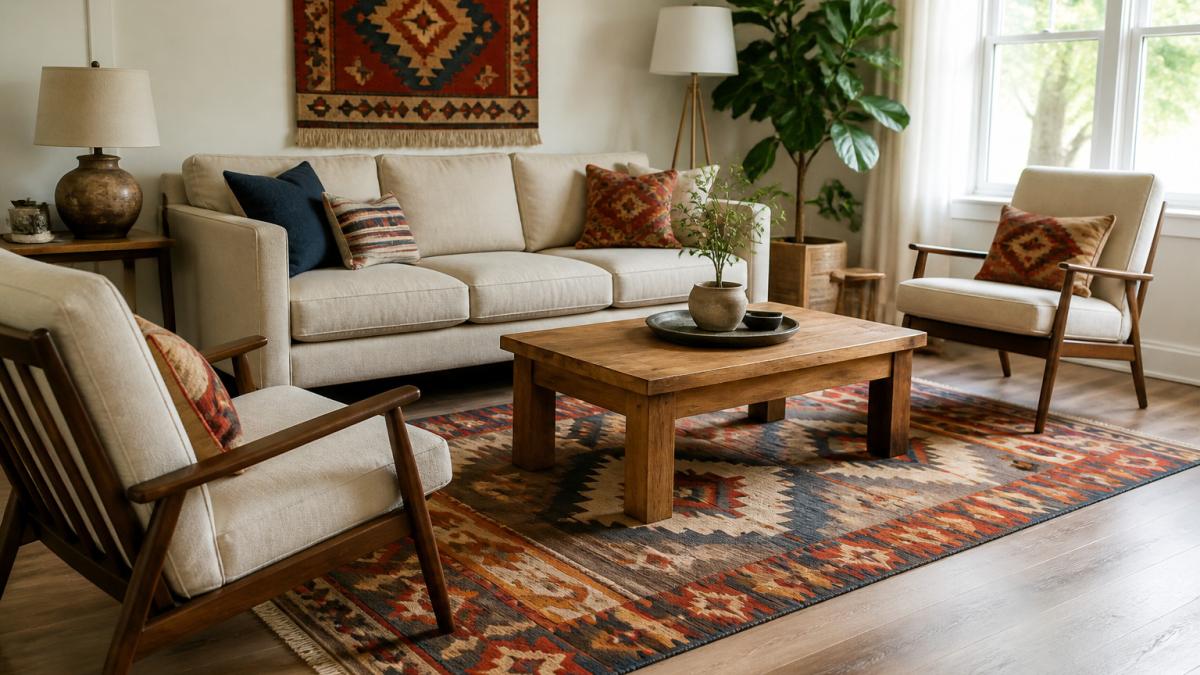
Place the front legs of the sofa and chairs on the rug. This creates a clear boundary for the seating area.
Watch out: A rug that is too small makes the furniture look like it is sliding off the edge.
For a larger seating area, the Marrocco Persian Kilim Collection 8'0" x 4'5" can help define a long, open area.

Kilim Rug Color Combinations That Work With Neutral and Natural Palettes
Kilims pair well with neutral furniture because the rug supplies the color.
Neutral rooms are a natural fit. Cream sofas, warm gray walls, and light wood furniture let a colorful kilim stand out.
The Persian Shiraz Kilim 4'2" x 6'3" is a rug you can consider for a room with a natural palette.

- Pull one accent color from the rug into a pillow or artwork.
- Keep the wall color light so the rug remains the focal point.
- Use wood tones that match the warm shades in the kilim.
Here is a quick look at how the rugs and palettes discussed in this section compare.
| Rug | Best for |
|---|---|
| Persian Shiraz Kilim | Room with a natural palette |
| Marrocco Persian Kilim Collection | Long, open seating area |
| One Of The Kind Persian Shiraz Kilim | Bohemian interiors |
Mixing Patterns With Kilim Rugs Without Overwhelming the Room
A kilim is almost always the loudest pattern in a living room, so the rest of the room has to be cast around it.
One Of The Kind Persian Shiraz Kilim 4'2" x 6'3" →
Start by identifying the rug's two or three dominant colors and its motif scale. A kilim with large geometric medallions reads as a big pattern; one with fine diamond or stripe work reads as a small pattern. That classification tells you what can sit next to it.
A practical framework most designers use:
- One large-scale pattern: the kilim itself, or a single upholstered piece if the rug is small.
- One medium-scale pattern: a throw, a pair of pillows, or a lampshade that echoes a color from the rug.
- One or two solids: the sofa, walls, and curtains in quiet tones pulled from the rug.
Matching pattern scale to the rug
If the kilim has bold, roomy motifs, pair it with small-scale prints, a tight stripe, a tiny dot, a fine block print, so the two patterns do not fight at the same visual weight. If the kilim is finely patterned, you can go slightly larger on a pillow or throw without the room feeling busy.
A common mistake is putting a second large geometric pattern at the same scale right next to the rug, a strong chevron curtain, for example. The eye cannot settle. Soften one of them: swap the curtain for a solid linen or a subtle texture like slubby cotton.
Coordinating with upholstery, cushions, and artwork
- Sofa: keep it solid or a low-contrast texture (bouclé, linen, velvet) in a color drawn from the rug.
- Pillows: pick up one accent color from the kilim and repeat it in a different pattern scale, a stripe, a small motif, or a tonal weave.
- Artwork: choose pieces that share the rug's palette rather than its geometry. Abstract or tonal art sits more comfortably beside a busy kilim than another strong graphic print.
- Curtains and walls: treat these as the quiet background. A light neutral wall and simple curtains let the rug and one patterned accent do the work.
When to break the rule
Maximalist rooms can carry two strong patterns if they share a color family and are separated by distance, a kilim at one end of the room and a patterned wallpaper or screen at the other. The separation gives each pattern its own zone. In a small or open-plan living room, keep to the one-large-one-medium rule; the closer the patterns sit, the more they compete.
Styling Kilims in Modern, Traditional and Bohemian Interiors
Kilims adapt well to different interior styles. In a modern room, a kilim adds warmth to clean lines and minimal furniture.
For modern interiors, keep the rest of the room simple. Let the kilim provide the only strong pattern. For traditional spaces, pair the rug with classic wood furniture and framed artwork.
The One Of The Kind Persian Shiraz Kilim 7'2" x 5'0" is a rug to consider for bohemian interiors.

Caring for Your Kilim and Choosing a Rug Pad to Keep It in Place
A flatweave kilim has no pile to cushion foot traffic, so its wear shows up differently than on a plush rug: edges can curl, warp threads can loosen, and colors can fade where sun hits. A simple routine keeps it looking sharp for years.
Vacuuming and daily care
- Vacuum weekly on low suction with the beater bar off. A spinning brush can snag the exposed weft threads of a flatweave.
- Use a handheld attachment along the edges and fringe, where grit collects.
- Shake or gently beat the rug outdoors every few months to release embedded dust, but do not beat it against a hard edge, which can crack the weave.
- Rotate the rug every three to six months, flipping it end-to-end so traffic and sunlight hit it evenly.
Spills and stains
Blot, do not rub. Press a clean white cloth onto the spill to lift moisture, working from the outside in so the stain does not spread. For wool kilims, a mild wool-safe cleaner diluted in cool water is a common approach; test it on a hidden corner first. Avoid soaking the rug, flatweaves dry slowly, and excess water can distort the weave.
Sun, traffic, and wear
Direct sun fades natural dyes over time. Rotate the rug or use a window film or sheer curtain to diffuse strong light. In high-traffic paths, a runner or a smaller accent kilim placed off the main walkway will wear better than a large rug centered underfoot. For homes with pets or young children, a wool kilim is often a practical choice.
Choosing and fitting a rug pad
A pad does three jobs: it stops slipping, adds a little cushion underfoot, and reduces abrasion between the rug and the floor.
- Non-slip pad: choose a felt-and-rubber or coated polyester pad sized 1 to 2 inches smaller than the rug so it stays hidden.
- Cushioning: a thicker felt pad (about 1/4 inch) softens the flatweave underfoot without changing its low profile.
- Floor protection: on hardwood, a pad with a rubber backing helps keep grit from scratching the finish.
- Edge curl: if corners lift, reverse-roll the rug for a few days or weight the corners with books; a pad with a firm grip helps them lie flat.
Plan Your Kilim Rug Upgrade With ABC Rugs Kilims
Start with the room you want to change. Measure your seating area, pick a color family from your existing furniture, and decide whether the kilim will lead or support the room. Then choose a size that fits the space.
Browse the ABC Rugs Kilims & Jewelry collection to compare kilims in different sizes and palettes, from a smaller accent piece to a larger statement rug.
Frequently Asked Questions
How do you style a kilim rug in a living room?
Start by choosing the kilim as the room's focal point, then let the rest of the room support it. Pick neutral sofas and wood or leather accents so the rug's colors stand out. Position the front legs of your seating on the rug so the furniture feels connected, and keep the rug large enough that at least the front feet of every seat sit on it. Add one or two pillows or a piece of artwork that repeats a color from the kilim to tie the space together.
What furniture goes well with a kilim rug?
Kilims pair well with neutral upholstery such as cream, gray or beige sofas, which let the rug's patterns read clearly. Natural materials like oak, walnut, rattan and brown leather complement the rug's earthy tones. Simple lines work better than heavily ornate pieces, especially in modern or bohemian rooms. Avoid placing a busy patterned sofa directly on top of a patterned kilim unless the two share a common color.
How do you choose the right size kilim rug for a living room?
For a standard living room, a 5x8-foot or 8x10-foot kilim usually works best, depending on how large your seating group is. Measure your sofa and chairs and allow the rug to extend at least 6 to 8 inches beyond the sofa on each side. Leave roughly 12 to 18 inches of floor visible between the rug edge and the walls. Smaller accent rugs suit a single chair or open corner but will not anchor a full seating arrangement.
Can you use a kilim rug in a modern living room?
Yes. A kilim's flatweave construction and geometric patterns suit contemporary interiors when you balance them with clean, minimal furniture. Choose a kilim with a muted or limited palette to avoid visual clutter, and pair it with simple metal, glass or upholstered pieces. The rug works well as a single warm, textured element in an otherwise neutral room.


