

Table of Contents
- Why Authentic Persian Rugs Stand Out as Tangible Investments
- Craftsmanship and Hand-Knotting: The Foundation of Value
- How to Tell If a Persian Rug Is Authentic
- Durability and Longevity: Rugs That Last Generations
- Authentic Persian Rug Value: Understanding Price and Appreciation
- Best Types of Persian Rugs for Collectors and Homeowners
- Persian Rug Care and Maintenance for Long-Term Investment
- Conclusion
- Frequently Asked Questions
Last Updated: October 10, 2026
Why Authentic Persian Rugs Stand Out as Tangible Investments
Authentic Persian rugs have attracted collectors and homeowners for centuries, embodying artistic tradition, exceptional craftsmanship, and tangible value. At ABC Rugs Kilims & Jewelry, we curate collections for clients who understand that authentic Persian rugs deliver both aesthetic richness and long-term investment potential.
Authentic Persian rugs function as both beautiful décor and appreciating assets. Unlike mass-produced alternatives, each hand-knotted rug tells a story through intricate patterns and regional design heritage, offering collectors a physical asset with cultural significance and historical provenance. Integrating these timeless textiles into a home requires a commitment to authentic interior design that prioritizes enduring craftsmanship over fleeting trends.
Craftsmanship and Hand-Knotting: The Foundation of Value
Hand-knotting distinguishes authentic Persian rugs from all other floor coverings. Each knot is individually tied by skilled artisans, a labor-intensive method unchanged for over 2,500 years that creates the durability, design clarity, and longevity making these rugs investment-grade.
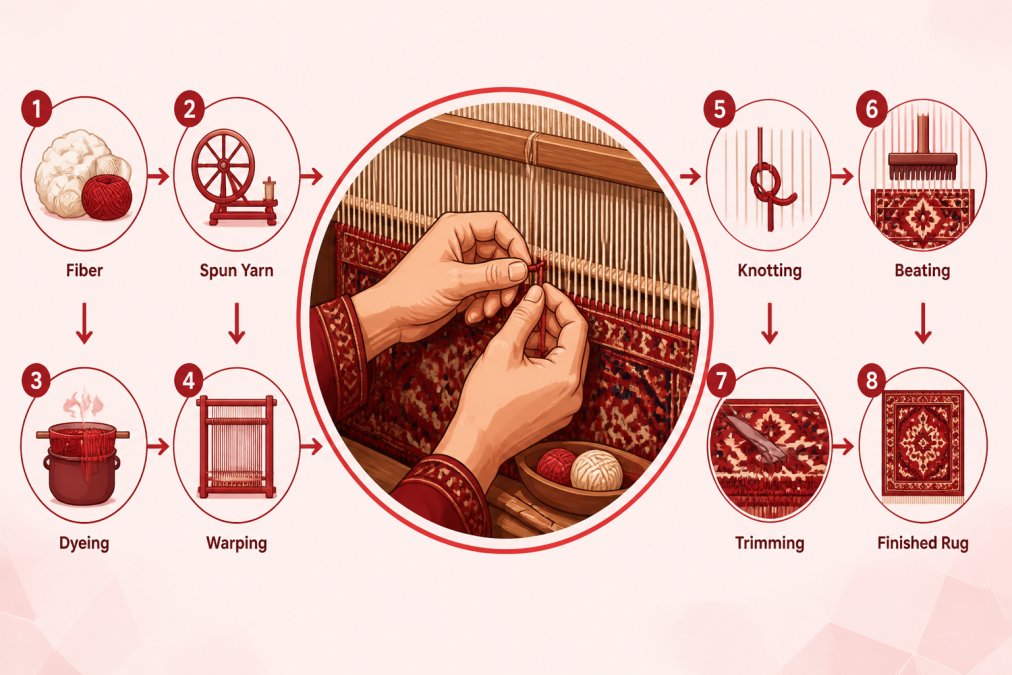
Knot density, measured in knots per square inch, directly determines quality and value retention. Pile construction, foundation materials, and regional weaving variations all contribute to investment characteristics.
Visible inconsistencies in color, pattern alignment, and knot tension prove human creation and reflect artisan skill. These variations are hallmarks of authenticity that contribute to the rug's character and value.
How to Tell If a Persian Rug Is Authentic
Distinguishing authentic Persian rugs from reproductions requires understanding key authentication markers. Authentic hand-knotted rugs show irregular knot patterns from the back, while machine-made rugs display uniform, mechanical precision.
Authentic Persian rugs use vegetable-based and mineral dyes that create subtle color variations and develop patina over decades. Synthetic dyes maintain uniform color and fade predictably rather than aging gracefully.
Weight and flexibility serve as practical tests. Authentic hand-knotted pieces feel substantial and dense with natural flex; machine-made rugs feel lighter and stiffer. The back reveals individual knots in authentic rugs versus backing material in reproductions.
Documentation and provenance matter significantly for investment-grade pieces. According to the American Rug Craftsmen Association, verified provenance increases a rug's market value and collector appeal. ABC Rugs Kilims & Jewelry provides detailed authentication documentation with each piece, ensuring buyers have confidence in their investment.
| Authentication Marker | Authentic Persian Rug | Machine-Made Alternative |
|---|---|---|
| Knot Pattern (back view) | Irregular, individual knots visible | Uniform, mechanical precision |
| Dye Type | Natural vegetable/mineral dyes | Synthetic chemical dyes |
| Weight and Flexibility | Dense, substantial, naturally flexible | Lighter, stiffer backing |
| Color Aging | Develops patina, subtle shifts | Fades predictably or stays uniform |
| Knot Density | 150+ knots per square inch | 30-80 knots per square inch |
Durability and Longevity: Rugs That Last Generations
Authentic Persian rugs are designed to outlast their owners. Hand-knotting and natural materials create textiles that improve with age. Many rugs have been in continuous use for 50, 100, or 200+ years, becoming more valuable over time.

Durability stems from construction quality. High knot density with premium wool and silk creates a foundation withstanding decades of foot traffic. Natural dyes maintain color integrity across generations, and the pile becomes softer and more lustrous with proper maintenance.
Regional variations affect longevity. Mountainous regions feature tighter knots and resilient fibers, while urban centers may emphasize design over durability. Understanding these characteristics helps collectors select pieces that retain value.
Proper care extends lifespan dramatically. Regular gentle cleaning, rotation, and sunlight protection preserve the investment. Many rugs in museums and private homes remain in excellent condition for centuries.
Authentic Persian Rug Value: Understanding Price and Appreciation
The market reflects genuine scarcity and worldwide demand. Pricing varies by age, size, condition, rarity, and regional origin. Contemporary hand-knotted pieces from ABC Rugs Kilims & Jewelry range from approximately $3,400 to $5,000, reflecting labor-intensive production and material quality.
Antique and vintage authentic Persian rugs command higher prices due to rarity and historical significance. Age, condition, and provenance determine investment trajectory, but appreciation is not guaranteed. Understanding real economics requires accounting for full cost of ownership.
Evidence-Based Returns and Risk Factors
While many collectors report that quality antique pieces appreciate over time, documented long-term return data for Persian rugs is limited compared to stocks or bonds. According to the Fine Art Dealers Association, authenticated decorative textiles have shown consistent value retention over 20-year periods, particularly pieces with documented provenance, but "value retention" differs from appreciation.
Several factors affect real investment returns:
Inflation Adjustment: A rug purchased for $5,000 in 2004 selling for $8,000 in 2024 appears to appreciate 60%, but with 55% inflation, the real gain is only 5%, roughly 0.4% annually.
Resale Friction Costs: Selling involves dealer commissions (10-20%), auction fees (15-25%), or private-sale discounts (10-15%). A rug appreciating 3% annually could net negative returns after resale costs, especially if held fewer than 10 years.
Liquidity Constraints: Persian rugs cannot be sold instantly. Finding a qualified buyer typically requires 3-6 months, meaning you cannot quickly access capital if circumstances change.
Condition Deterioration: Rugs show wear over decades. A rug in "excellent" condition may be "very good" after 20 years, reducing per-square-foot value. Restoration costs ($500-$3,000) must be deducted from sale proceeds.
Market Volatility: Rug prices lack transparency or standardization. Similar rugs may sell for vastly different prices, making it difficult to time purchases or sales optimally.
Investment-Grade Selection Criteria
Investment potential depends on several factors: genuine hand-knotting, natural dyes, superior craftsmanship, and excellent condition. Select investment rugs with care, considering authenticity, condition, regional origin, and documented provenance.
One Of The Kind Hand Knotted Persian Rug 10'6" x 8'0" R15470 →
Antique and vintage pieces (pre-1950) have stronger appreciation records than contemporary rugs because supply is finite. However, antique rugs appreciate only if they remain in good condition with documented provenance.
Best Types of Persian Rugs for Collectors and Homeowners
Traditional medallion designs remain the most sought-after pattern, featuring a central geometric or floral medallion surrounded by intricate borders with strong collector demand.
Antique and vintage rugs offer distinct advantages for serious investors. Pieces before 1950 represent finite, non-renewable resources. Documented vintage pieces with clear provenance often appreciate faster than contemporary rugs due to age, rarity, and historical significance.
Contemporary hand-knotted pieces from ABC Rugs Kilims & Jewelry provide accessible entry for new collectors, featuring authentic hand-knotting, natural dyes, and superior craftsmanship at lower prices than antique pieces.
Regional origin influences aesthetics and investment potential. Rugs from Tabriz, Isfahan, or Heriz carry distinct design characteristics and weaving traditions, with collectors specializing in particular regions.
Larger rugs command premium prices due to increased labor and rarity of well-preserved large pieces, offering proportional appreciation potential.
Persian Rug Care and Maintenance for Long-Term Investment
Protecting your authentic Persian rug investment requires understanding proper care and cumulative ownership costs. Regular gentle vacuuming with low suction removes dust; professional cleaning every 3-5 years maintains condition.
Total Cost of Ownership
Professional Cleaning: Costs $1.50-$3.00 per square foot. A 9' × 12' rug costs $160-$320 per cleaning; at 3-5 year intervals, expect $32-$107 annually over 30 years.
Restoration and Repair: Even well-maintained rugs may require restoration. Common repairs include:
- Fringe reattachment or replacement: $200-$600
- Pile repair or patching: $300-$1,500
- Foundation repair (rewarp or reknot): $500-$3,000+
- Moth or damage remediation: $400-$2,000
A single major restoration can cost $1,000-$3,000, significantly reducing net investment returns if the rug appreciates only 2-3% annually.
Insurance: Fine art and collectible rug insurance typically costs 0.5-1.5% of appraised value annually. A $10,000 rug costs $50-$150 per year to insure, or $1,500-$4,500 over 30 years. This is essential protection but represents a direct cost that reduces net returns.
Storage and Environmental Control: If stored rather than displayed, climate-controlled storage costs $50-$200 monthly depending on size and location. Over 30 years, this totals $18,000-$72,000, a substantial hidden cost that many collectors underestimate.
Appraisal and Documentation: Professional appraisals for insurance or sale purposes cost $200-$500 per rug. If you appraise every 5-10 years, expect $1,000-$3,000 in appraisal costs over ownership.
Real Cost Example
Care Practices That Preserve Value
Rotation prevents uneven wear and color fading. Move your rug 90 degrees every 6-12 months to ensure even exposure to light and traffic patterns.
Protection from direct sunlight preserves natural dye colors. Ultraviolet exposure can fade even authentic vegetable dyes over time, particularly reds and blues. Use window treatments to filter harsh afternoon light, or rotate the rug periodically to ensure even aging.
Moisture control prevents mold and mildew damage. Authentic Persian rugs should be stored in dry conditions if not in active use. Humidity levels between 40-60% represent the ideal range.
Professional restoration by experienced conservators can address damage while preserving the rug's authenticity and value. According to the American Institute for Conservation, proper restoration increases a damaged rug's market value by addressing structural issues without compromising historical integrity.
Conclusion
Authentic Persian rugs represent a rare intersection of aesthetic beauty, cultural significance, and genuine investment potential. The hand-knotting craftsmanship, natural materials, and scarcity of quality pieces create conditions for meaningful value retention and appreciation. Whether you're furnishing a home or building a collection, selecting authentic pieces with documented provenance ensures you're making a decision that will be appreciated for decades.
At ABC Rugs Kilims & Jewelry, we specialize in curating hand-knotted authentic Persian rugs that meet rigorous quality standards. Our AAA+ pieces feature superior craftsmanship, natural dyes, and documented authenticity. Explore our collection of one-of-a-kind hand-knotted Persian rugs, each backed by our 30-day exchange privilege, and invest in textiles that will enrich your space and appreciate over time.
Frequently Asked Questions
Are authentic Persian rugs a good investment?
Authentic Persian rugs function as tangible assets that can retain and appreciate in value over time. Unlike mass-produced alternatives, hand-knotted rugs with quality craftsmanship, natural dyes, and traditional patterns tend to maintain their worth. Factors such as knot density, condition, provenance, and regional origin significantly influence investment potential. Antique and vintage pieces often command higher prices, particularly if they show desirable patina and have documented history. While market demand fluctuates, collectors and homeowners consistently seek authentic pieces, supporting stable long-term value.
How can you tell if a Persian rug is authentic?
Authentic Persian rugs exhibit specific characteristics that distinguish them from reproductions. Examine the knot density and knot count on the back. Look for natural dyes that create subtle color variation and patina rather than uniform, synthetic coloring. The pile should feel substantial and soft, usually made from quality wool or silk. Check the foundation for hand-tied knots rather than machine-stitching. Provenance documentation, regional motifs, and traditional weaving techniques all indicate authenticity. Reputable dealers like ABC Rugs Kilims & Jewelry provide verified pieces with detailed information about origin and craftsmanship.
How much is an authentic Persian rug worth?
Authentic Persian rug pricing varies significantly based on size, age, condition, knot density, and regional origin. Contemporary hand-knotted pieces typically range from $2,000 to $10,000 or more. For example, ABC Rugs Kilims & Jewelry offers hand-knotted Persian rugs such as the 10'6" x 8'0" piece at $3,404 and larger formats up to $4,984. Antique and vintage rugs command premium prices, sometimes exceeding $15,000 depending on rarity and provenance. Investment-quality rugs with superior craftsmanship and natural materials tend to hold value better than lower-grade alternatives. Professional appraisal helps determine fair market value based on current demand.
What factors affect the value of an authentic Persian rug?
Several factors determine authentic Persian rug value. Knot count and density directly impact durability and price, higher knot density indicates superior craftsmanship. Natural dyes and color variation add authenticity and appeal to collectors. Condition, including wear patterns and necessary repairs, significantly influences resale value. Provenance and documented origin enhance investment quality, particularly for antique pieces. Regional design and motifs affect desirability among collectors. Rarity, age, and whether the rug is antique or vintage also play roles. Size and material composition, especially quality wool or silk, contribute to both aesthetic and monetary value. Pieces with exceptional craftsmanship and historical significance appreciate more reliably over time.


