

Table of Contents
- Why Antique Rugs Attract First-Time Investors
- How to Identify an Antique Rug Before You Buy
- How Antique Rug Value Is Actually Determined
- Antique Rug Buying Tips for First-Time Buyers
- The Costs Beginners Forget: Ownership, Insurance, and Resale
- Antique Rug Care and Preservation Basics
- Conclusion: Building a Small, Deliberate Collection
- Frequently Asked Questions
Last Updated: October 12, 2026
Why Antique Rugs Attract First-Time Investors
An antique rug investment is the purchase of a hand-woven rug at least 60 to 100 years old with the expectation that it holds or grows in value, which is why more buyers now treat an antique rug investment as a serious alternative asset.
The appeal is simple: these are usable assets that carry both aesthetic and financial value. Most first-time buyers overpay by shopping on looks alone; buyers who do well verify age, origin, and condition first.
What Actually Drives Long-Term Value
Scarcity, craftsmanship, and condition drive antique rug value more than decoration trends. A rug with tight knotting, natural dyes, and documented origins holds appeal across decades; a pretty but common production piece may not.
The factors that matter most:
- Age and rarity of the design and region
- Knot density and weave quality in the foundation
- Condition, including how much restoration work the rug has absorbed
Realistic Returns and the Risks Nobody Mentions
Most antique rugs are not fast money. Quality pieces hold value over years, but the market moves slowly and selling takes time and the right buyer.
The risks beginners should weigh:
- Illiquidity. A rug can sit unsold for months.
- Condition surprises. Hidden repairs or dry rot can erase value.
- Overpayment. Retail markups vary widely, so the same rug may be priced very differently across sellers.
How to Identify an Antique Rug Before You Buy
Learning how to identify an antique rug comes down to three checks: the back, the dyes, and the wear pattern.
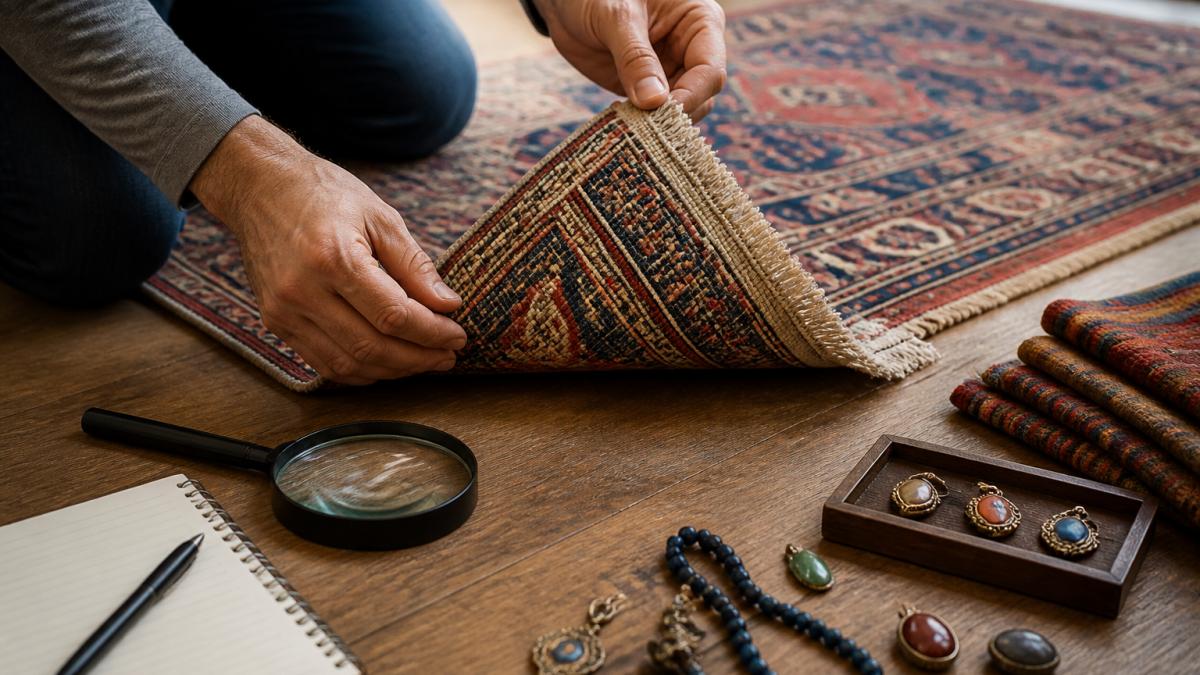
Start with the back. On a genuinely old hand-knotted rug, the pattern appears nearly as clear on the reverse as on the front, because the knots themselves form the design.
Next, check the fringe. On handmade rugs, the fringe is part of the foundation warp threads, woven into the rug itself.
Age, Provenance, and Authenticity Checks
Age shows up in subtle ways. Older wool has a depth and luster new wool lacks, and natural dyes fade unevenly, developing an abrash, or color variation, that synthetic dyes rarely mimic.
Provenance means the documented history of a rug: where it was made, when, and who owned it. Ask sellers for any paperwork, receipts, or appraisals.
For authenticity, look for these tells:
- Knots tied by hand, visible on the back
- Slight irregularities in pattern and color, typical of hand weaving
- Fringe woven into the rug, not attached
Weave, Knot Density, and Materials
Knot density is the number of knots per square inch; higher counts signal finer craftsmanship and higher value. Estimate it by counting knots along one inch of the back and squaring that number. Materials matter just as much: wool is the most common foundation for durable antique rugs, silk appears in finer pieces, and cotton often forms the warp and weft beneath a wool pile.
How Antique Rug Value Is Actually Determined
Appraisers and dealers determine antique rug value through comparable sales, condition assessment, and craftsmanship analysis. Most sellers quote one price with no explanation, so here is a repeatable method for pressure-testing any asking price.
The Four Valuation Numbers You Will See
Different contexts call for different numbers, and confusing them is the most common beginner mistake:
- Fair market value reflects what a willing buyer would pay a willing seller, neither under pressure. Use this when comparing asking prices.
- Replacement value reflects what it would cost to buy a similar rug today, often used for insurance. It is typically the highest of the four.
- Liquidation value reflects what a dealer would pay for a quick resale. Expect this to land well below retail, since the dealer needs margin to resell.
When a seller quotes a price, ask which number they are using. A rug "worth" $8,000 at replacement value may only fetch a fraction of that at liquidation.
Building a Comparable-Sales Set
Comparable sales, or comps, are recent prices for similar rugs of the same origin, size, and condition. Without comps, any price is a guess.
A workable comp set for a beginner looks like this:
- Match on origin and design. A Tabriz is not a comp for a Heriz, even if the colors are similar.
- Match on size within about 10 to 15 percent. Rug pricing is not linear per square foot; a room-size piece and a scatter rug from the same workshop trade in different markets.
- Match on age band. Antique, semi-antique, and vintage pieces are priced separately.
- Match on condition tier. Original condition, minor restoration, and heavily restored pieces belong in separate comp sets.
- Pull from multiple channels. Auction results, dealer listings, and estate-sale records each tell a different part of the story.
Auction records are the most transparent public source, but the hammer price is not the buyer's total cost. Auction houses add a buyer's premium that varies by house and price tier, so add it to get the true transaction price.
How Condition and Restoration Move the Number
Condition is the single biggest swing factor in antique rug value. A rug in original, intact condition commands far more than the same rug with heavy restoration, even when the restoration is well done.
Rank condition in tiers before you price anything:
- Original, intact. Full pile, original selvages and ends, no reweaving. This is the top tier.
- Minor wear or small repair. Some pile loss at the edges or a small professional repair. Acceptable in an antique and priced accordingly.
- Substantial restoration. Rewoven areas, replaced fringes, patched foundation. Value drops sharply.
Ask specifically whether any restoration has been done and by whom; undocumented restoration is a red flag even when the work looks clean.
Provenance and Rarity
Rarity works on two levels: workshop rarity means a named atelier or short production window, and design rarity means an uncommon pattern for its region. Either can lift a rug above its comp set, but only when documented rather than asserted.
A Beginner's Pricing Workflow
Put the pieces together in this order:
- Identify origin, age band, and size.
- Assign a condition tier.
- Build a comp set of three to five recent sales that match on all four.
- Note the range, not a single number.
- Adjust up for documented provenance or genuine rarity, down for any restoration.
- Compare the seller's asking price to your adjusted range.
If the asking price sits far above your range with no explanation, ask the seller to walk you through their reasoning. A reputable dealer can. A seller who cannot is either guessing or hoping you will not check.
For a significant purchase, an independent appraisal is worth the cost. Choose an appraiser who does not also sell rugs, so there is no stake in the transaction. For insurance, replacement value matters most. For resale, fair market value and liquidation value tell you what you can realistically expect.
Antique Rug Buying Tips for First-Time Buyers
The best antique rug buying tips share one theme: slow down and verify before you pay. Rugs that cause regret are almost always bought in a hurry.
Practical steps for a first purchase:
- Decide on a size and budget before you shop, not after.
- Ask for the rug's origin, age, and materials in writing.
- Request detailed photos of the front, back, edges, and any repairs.
- Compare prices across several sellers for similar pieces.
- Have a significant rug independently appraised before finalizing.
- Pay through a method that offers buyer protection.
Buying online is workable when the seller provides thorough documentation and clear return terms. A listing vague about age or origin is a red flag.
Due Diligence and Fraud Prevention
Fraud in the rug market usually takes one of two forms: a modern rug sold as antique, or a damaged rug sold as pristine. Both are avoidable with careful inspection.
Watch for these warning signs:
One Of The Kind Hand Knotted Persian Rug 11'6" x 9'7" R15474 →
- Prices far below the market for a comparable piece
- Vague or evasive answers about origin and age
- No return policy or pressure to buy quickly
For reference on consumer protections when buying goods remotely, the Federal Trade Commission's guidance on online shopping outlines your rights around misrepresentation and refunds.
The Costs Beginners Forget: Ownership, Insurance, and Resale
Owning an antique rug costs more than the purchase price. Insurance, cleaning, and storage add up, and resale rarely returns full retail. Here is the full cost of ownership so you can estimate your net return before you buy.
The Acquisition Costs Beyond the Tag
At auction, the hammer price is only the starting point: buyer's premiums vary by house and price tier.
A working acquisition budget looks like this:
- Hammer price or dealer asking price
- Buyer's premium (auction only)
- Shipping, crating, and insurance in transit
Add these before you decide a rug is "a good deal." A piece that looks cheap at auction can land well above a dealer's retail price once the premium and freight are included.
Recurring Ownership Costs
Insurance is the largest recurring cost. Valuable rugs typically need a rider on a homeowner's or renter's policy, or a standalone collectibles policy, with a professional appraisal to set coverage; insurers may require updates every few years.
Other ownership costs to plan for:
- Professional cleaning every few years, done by a specialist, never a standard carpet cleaner
- Padding underneath to protect the foundation and prevent slippage
- Moth prevention, since moths are the most common destroyer of stored wool rugs
None of these are large individually. Together they form a carrying cost that quietly eats into any gain.
The Resale Spread
On resale, expect a gap between retail price paid and what a dealer will offer. That spread is normal and is why antique rugs reward patience over quick turnover.
The spread has several components:
- Dealer margin. A dealer buying for resale needs room to profit, so the offer will sit below retail.
- Consignment commission. If you consign instead of selling outright, the house or dealer takes a percentage of the sale.
- Auction seller's commission. Selling at auction means paying a seller's commission plus any listing and photography fees.
A common pattern: a beginner buys at retail, holds for years, and sells at or slightly below what they paid once all costs are counted.
Estimating Net Return Before You Buy
Write the numbers down before you buy. Estimate:
- Total acquisition cost, including premium, shipping, and tax.
- Annual carrying cost for insurance, cleaning, and storage.
- Expected holding period in years.
- Realistic resale price, based on your comp set from the valuation section.
- Resale costs, including commission, shipping, and any restoration.
Subtract acquisition and carrying costs from the realistic resale price, then subtract resale costs. If the result is negative or barely positive, the rug is a decorative purchase, not an investment. That is a legitimate reason to buy it, as long as you know which one you are doing.
Recordkeeping and Documentation
Keep every document tied to the rug: the original invoice, appraisals, restoration receipts, shipping records, and before-and-after photographs. This file supports an insurance claim, proves condition and provenance to a future buyer, and gives your appraiser the history to value the piece accurately.
For reference on consumer protections when buying goods remotely, the Federal Trade Commission's guidance on online shopping outlines your rights around misrepresentation and refunds.
Antique Rug Care and Preservation Basics
Antique rug care comes down to three habits: keep it dry, keep it clean, and keep it out of direct sun.
Vacuum gently with a suction-only attachment, avoiding the beater bar that pulls at knots and fringes.
For anything beyond routine care, hire a specialist.
Store rugs rolled, never folded, pile facing inward, in a dry, pest-free space.
For broader guidance on textile preservation, the National Park Service's conservation guidance for textiles offers detailed, free reference material used by museums and collectors alike.
When you are ready to buy, our One Of The Kind Hand Knotted Persian Rug 11'6" x 9'7" R15474 is a genuine hand-knotted Persian piece with a distressed vintage patina, and our Hand-Knotted Persian Wool Rug, 10'7" x 7' is a semi-antique with over 60 years of history and natural vegetable dyes.


Conclusion: Building a Small, Deliberate Collection
The challenge for new buyers is resisting the urge to buy everything at once.
At ABC Rugs Kilims & Jewelry, we curate handmade rugs, kilims, and Persian antique pieces with the documentation serious buyers expect.
Start with one rug you truly understand, buy it right, and let it teach you the market.
Frequently Asked Questions
How much is an antique Oriental rug worth?
Value depends on origin, age, knot density, materials, condition, and rarity. A signed or rare rug from a sought-after weaving region can command far more than a common runner in similar condition. Condition matters enormously: a rug with worn pile, moth damage, or heavy restoration sells for a fraction of an intact piece. Get a written appraisal and check comparable auction results before treating any asking price as market value.
How can you tell whether a rug is antique?
Antique usually means 100 years or older, semi-antique roughly 50 to 90 years. Check the back first: hand-knotted rugs show an irregular, slightly bumpy knot structure, while machine-made rugs look uniform. Look at the dyes, which fade unevenly on older wool, and the selvedges and fringe, which show wear consistent with decades of use. Provenance documents and a dealer's written description strengthen the case.
Are Persian rugs good investments?
Some are, most are not. Investment-grade pieces are rare, in excellent condition, and documented, and they typically trade through established dealers and auction houses. Common production rugs from the mid-20th century generally hold value roughly in line with inflation rather than appreciating sharply. Treat any antique rug investment as a long-term, illiquid purchase, and expect resale to take months and to involve dealer commissions.
What should beginners know before buying an antique rug?
Buy the rug you want to live with, not the one you hope to flip. Set a budget that includes cleaning, a rug pad, insurance, and possible repairs. Ask for provenance, photographs of the back and any damage, and the return policy in writing. Avoid buying online from sellers who will not show the reverse side or answer questions about restoration. A one-of-a-kind hand-knotted Persian rug, such as this 11'6" x 9'7" piece, shows how a documented, single-owner listing should be presented.
Does the condition of an antique rug affect its value?
Yes, more than almost any other factor. Original pile, intact selvedges, and secure fringes support a higher price. Rewoven areas, synthetic touch-ups, and chemical washing reduce it, sometimes by half. Ask specifically whether a rug has been restored, and get that answer in writing. A professional inspection under good lighting, including the back of the rug, will reveal repairs that photographs hide.
Where can beginners buy authentic antique rugs?
Established dealers, reputable auction houses, and specialist online retailers with clear return policies are the safest starting points. Ask each seller how they verify age and origin, and whether they provide documentation. Compare at least three listings of similar size and origin before committing. If a price looks far below the market for that type, assume there is a reason: heavy restoration, a later production date, or a different origin than advertised.
How should you care for an antique rug after buying it?
Vacuum gently with a suction-only attachment, never a beater bar, and rotate the rug every six to twelve months so wear stays even. Use a pad to reduce friction and keep the rug from sliding. Blot spills immediately with a clean cloth; do not rub. Have the rug professionally washed every three to five years, and store it rolled, never folded, in a dry space away from direct sunlight.


