

Table of Contents
- What Makes a Persian Rug Valuable: The Foundation of Quality
- How to Tell If a Persian Rug Is Handmade: Construction Clues
- Persian Rug Knot Count: Understanding Density and Its Limits
- Persian Rug Materials: Wool, Silk, Cotton, and Their Impact
- Natural Dyes Versus Synthetic: Color Integrity and Longevity
- Pattern, Design, and Symmetry: Hallmarks of Authentic Persian Rugs
- How to Value an Antique Persian Rug: Condition, Provenance, and Market Assessment
- Distinguishing Authentic Persian Rugs from Persian-Style Reproductions
- Frequently Asked Questions
Last Updated: October 20, 2026
What Makes a Persian Rug Valuable: The Foundation of Quality
Understanding signs of quality in traditional Persian rugs starts with recognizing what separates a genuine investment piece from a decorative floor covering.
A quality Persian rug isn't just beautiful, it's built to last generations. The finest pieces combine hand-knotted construction, natural materials, and traditional dyeing methods that create depth and character over decades of use. These aren't mass-produced items.

The foundation of value rests on four pillars: how the rug is made, what materials were used, how it was dyed, and its current condition.
How to Tell If a Persian Rug Is Handmade: Construction Clues
The most reliable way to verify a handmade rug is to examine its construction. Machine-made rugs follow predictable patterns. Handmade rugs show the natural variation of human work.
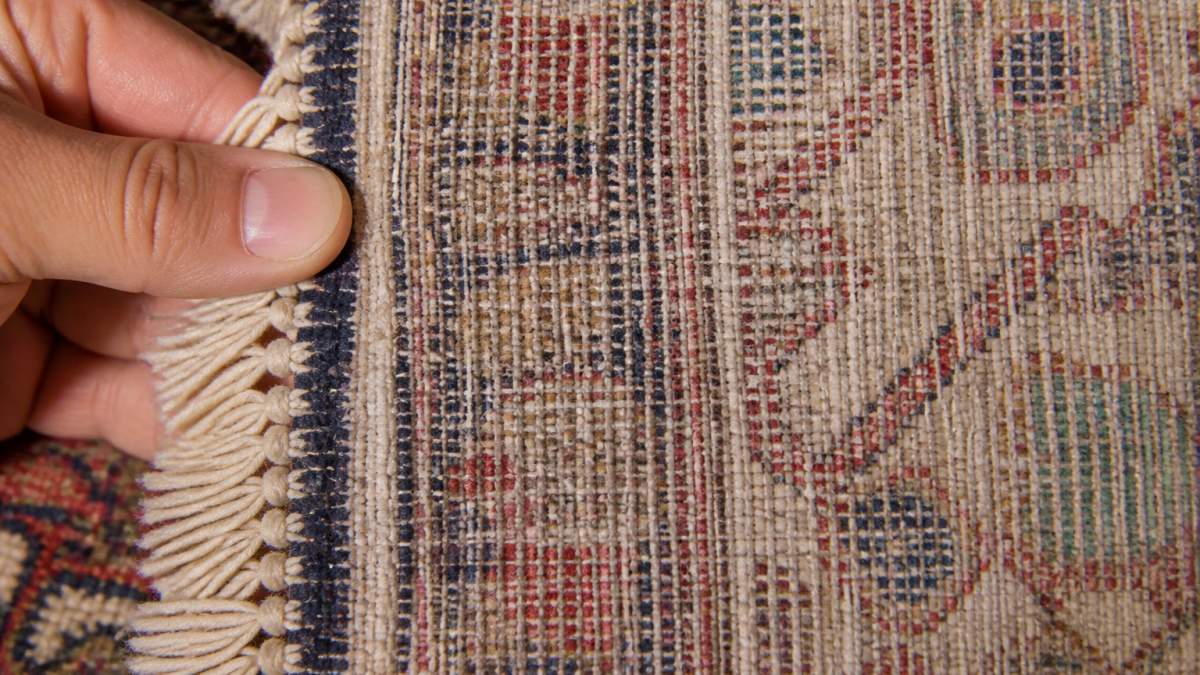
Start by flipping the rug over. A handmade rug's back tells the real story. You'll see individual knots tied by hand, each one slightly different from its neighbor.
Run your hand across the back. Handmade rugs feel irregular. The knots vary in tightness and spacing. This is not a flaw, it's proof of human craftsmanship. Machine-made backs feel smooth and consistent.
Examining the Rug Back and Knot Structure
The rug's back reveals everything about its construction method. Look for these specific signs:
- Individual knot visibility: Each knot should be distinct and hand-tied
- Uneven knot spacing: Slight variations in distance between knots
- Visible foundation: Cotton or wool threads that form the base layer
- Natural color variation: The back should show subtle color differences
- Fringe attachment: Hand-tied fringe connects directly to the foundation threads
Press gently on the back. Handmade rugs have flexibility. The knots move slightly. Machine-made rugs feel stiff and rigid because the backing is glued or fused.
Look at the fringe. In a handmade rug, the fringe is part of the foundation, not sewn on afterward. The fringe threads continue directly from the weaving process. If fringe appears glued or attached separately, the rug is likely machine-made or a lower-quality hand-knotted piece.
Looking for Irregularities and Imperfections
This is where many buyers get confused. Irregularities don't mean poor quality. They mean authentic handmade work.
A handmade rug will have:
- Slight pattern variations: The same motif repeats with minor differences
- Uneven edges: The selvage (side edge) may vary slightly in width
- Color shifts: Natural dyes create subtle tone variations
- Asymmetrical details: Perfect symmetry is actually suspicious in handmade rugs
- Visible weaver corrections: You might see where the weaver fixed a mistake mid-process
These "flaws" are actually authenticity markers. They prove a human made the rug, not a machine. Collectors actively look for them.
Persian Rug Knot Count: Understanding Density and Its Limits
Knot count measures how many knots per square inch the weaver tied. Higher knot counts generally mean finer detail and more labor.
A rug might have 200 knots per inch or 400. Both can be excellent. It depends on the intended use, the materials, and the design.
Here's what knot count actually tells you:
| Knot Density | Quality Level | Best For | Typical Price Range |
|---|---|---|---|
| 50-100 KPI | Good | Tribal, traditional designs | Entry-level handmade |
| 100-200 KPI | Very Good | Most Persian rugs | Mid-range to premium |
| 200-400 KPI | Excellent | Fine detail work, silk accents | High-end pieces |
| 400+ KPI | Museum-Quality | Rare antiques, silk rugs | Collector investment |
Don't assume higher knot count means better value. A 150-knot-per-inch rug with superior wool and natural dyes outperforms a 300-knot-per-inch rug made with synthetic materials and chemical dyes.
Knot count also has practical limits. Extremely high knot counts can make a rug less durable for high-traffic areas.
Ask the seller for the knot count, but verify it independently. Count a one-inch section yourself. Count the knots horizontally and vertically, then multiply.
Persian Rug Materials: Wool, Silk, Cotton, and Their Impact
The materials determine how a rug feels, wears, and ages. Traditional Persian rugs use three primary materials, each serving a specific purpose.
Wool: The Workhorse of Traditional Weaving
Wool is the foundation material in most quality Persian rugs. It's durable, naturally stain-resistant, and accepts dyes beautifully.
High-quality wool comes from specific regions. The best Persian rugs use wool from the Safavid region and central highlands.
Feel the pile. Genuine wool feels soft but substantial. It has a slight spring when you press it. Synthetic fibers feel slick or plastic-like.
Wool rugs improve with age. The pile develops a subtle sheen as it settles. Colors deepen and become richer. This patina is highly valued by collectors.
Silk: Luxury and Luminosity
Silk appears in the finest Persian rugs, usually in specific areas rather than the entire rug. It creates luminous details and catches light beautifully.
Pure silk is expensive. A rug with significant silk content will have a noticeably higher price. Silk also requires more delicate care and handling.
Look for silk in the pile or in accent details. It will shimmer and change color slightly depending on the light angle.
Silk can be less durable than wool in high-traffic areas because the fibers are thinner.
Cotton: Foundation and Fringe
Cotton serves as the foundation, the base layer that holds the knots. It's not visible in the finished rug unless the pile wears away.
Quality matters here too. Thick, tightly-spun cotton creates a more stable foundation. Cheap cotton deteriorates faster and can cause the rug to buckle or warp.
Cotton also appears in the fringe and selvage. High-quality cotton fringe feels firm and substantial. Thin, weak fringe suggests lower-quality construction overall.
Natural Dyes Versus Synthetic: Color Integrity and Longevity
This distinction separates heirloom rugs from temporary decorations. Natural dyes create colors that deepen with age.
Natural dyes come from plants, insects, and minerals. Indigo creates blues. Madder root creates reds and oranges.
One Of The Kind Persian Sarough Rug#06 Size 435x310 cm →
The dyeing process matters as much as the dye itself. Natural dyes require skill and experience.
Synthetic dyes arrived in the late 1800s. They're cheaper and faster.
Test for dye quality by rubbing a damp white cloth on an inconspicuous area.
Look at the rug's back. Natural dyes show subtle color variation throughout.
Antique rugs almost always used natural dyes.
Pattern, Design, and Symmetry: Hallmarks of Authentic Persian Rugs
Persian rug designs carry centuries of tradition. Each region developed distinctive patterns and motifs. Recognizing these patterns helps verify authenticity and origin.
Common Persian patterns include:
- Floral medallions: Central geometric shape with elaborate flower designs
- Herati pattern: Diamond shapes with fish motifs inside
- Boteh design: Small pear-shaped figures arranged in rows
- Geometric medallions: Angular, symmetrical central designs
- Hunting scenes: Depictions of hunters, animals, and landscapes
- Garden layouts: Formal garden designs divided into sections
Authentic handmade rugs show pattern variation. The same motif repeats with slight differences. This is normal and desirable. It proves human creation.
Machine-made rugs have perfect pattern repetition. Every element matches exactly. This uniformity looks impressive initially but signals artificial production.
Symmetry in traditional Persian rugs is deliberate but not absolute. The central medallion should be symmetrical. But the overall pattern may have intentional asymmetries.
How to Value an Antique Persian Rug: Condition, Provenance, and Market Assessment
Value depends on multiple factors working together. A rug with excellent provenance but poor condition may be worth less than a newer rug in perfect condition.
Condition Grading and Repair Assessment
Condition grading follows a standard scale:
- Mint: No wear, no repairs, appears brand new
- Excellent: Minimal wear, no visible damage
- Very Good: Light wear in high-traffic areas, no major damage
- Good: Moderate wear, minor repairs, some color fading
- Fair: Heavy wear, visible damage, multiple repairs needed
- Poor: Severe damage, extensive repairs required
Examine these specific areas:
- Pile wear: Look at high-traffic zones (entry areas, walkways)
- Color fading: Check for uneven fading from sunlight exposure
- Fringe condition: Fringe damage is common and fixable
- Selvage integrity: Side edges should be intact or minimally damaged
- Knot integrity: Missing knots indicate age and wear
- Stains and odors: Permanent stains reduce value significantly
- Moth damage: Small holes suggest insect damage
Minor repairs don't dramatically reduce value if they're done well. A professional reweaver can fix worn areas invisibly. But extensive repairs signal a rug that's reached the end of its practical life.
Documentation and Provenance
Provenance, the documented history of ownership, significantly affects value. A rug with clear documentation of age, origin, and previous owners commands premium prices.
Seek documentation that includes:
- Age verification: Expert assessment or purchase receipt with date
- Origin confirmation: Region and city of production
- Weaver information: If known, the weaver's name or workshop
- Previous ownership: List of documented owners
- Condition reports: Professional assessments over time
- Authentication certificates: From recognized experts or institutions
Rugs without documentation are harder to value. You're relying on visual inspection and expert opinion. This isn't necessarily a problem, many authentic rugs lack formal documentation.
ABC Rugs Kilims & Jewelry maintains detailed records for each piece in our collection. Our One Of The Kind Hand Knotted Persian Rug 12'9" x 9'10" R17519 exemplifies this commitment to transparency and quality documentation.
Distinguishing Authentic Persian Rugs from Persian-Style Reproductions
This is where many buyers get fooled. "Persian-style" doesn't mean Persian.
Authentic Persian rugs are handmade in Iran (historically called Persia) and other Middle Eastern countries with Persian weaving traditions.
Persian-style rugs are reproductions made elsewhere, often in India, Pakistan, Afghanistan, or Turkey, using machines or lower-quality handweaving.
Here's how to distinguish them:
Authentic Persian rugs:
- Hand-knotted with asymmetrical knots
- Irregular back with visible individual knots
- Natural dyes with subtle color variation
- Regional pattern specificity (Tabriz, Kashan, Sarough, etc.)
- Wool, silk, or cotton with documented sourcing
- Documentation of origin and age
- Prices reflect the labor and materials involved
Persian-style reproductions:
- Machine-made or lower-quality hand-knotted
- Uniform, printed-looking backs
- Synthetic dyes with flat, uniform color
- Generic "Persian" patterns without regional specificity
- Mixed or undocumented materials
- No provenance or documentation
- Significantly lower prices
Ask the seller directly: "Where was this rug made?" If they say "Iran" or "Persia," ask for documentation.
Price is a telling indicator. An authentic hand-knotted Persian rug requires 6-12 months of labor. Our One Of The Kind Persian Sarough Rug#06 at $16,200 reflects the premium quality and extensive craftsmanship of a true museum-caliber piece.

If a rug claiming to be Persian costs under $800, it's almost certainly a reproduction or heavily damaged authentic piece.
Frequently Asked Questions
How can you tell if a Persian rug is high quality?
High-quality Persian rugs show several markers: a dense knot count (typically 100-300+ knots per square inch), hand-knotted construction visible on the back, natural dyes with rich color variation, high-quality wool or silk materials, and authentic patterns with minor irregularities. The rug should feel substantial underfoot, with a tightly woven pile that resists compression. ABC Rugs Kilims' AAA+ standard pieces meet these criteria, featuring superior knot density and expert traditional finishing that ensures both magnificent appearance and longevity.
What does the back of a handmade rug look like?
The back of a hand-knotted Persian rug reveals the foundation structure: you'll see individual knots clearly defined, cotton or wool warp and weft threads running parallel and perpendicular, and often a slightly irregular pattern where each knot was tied by hand. Machine-made rugs show uniform, printed patterns on the back with no visible individual knots. On authentic hand-knotted rugs, the back typically displays the same design as the front, though less vibrant, and you can feel the texture of individual knots when running your hand across it.
Does a higher knot count always mean a better Persian rug?
Not necessarily. While knot density matters, it's only one factor in quality. A rug with 200 knots per square inch made from premium natural wool and dyed with authentic dyes can outperform a rug with 400 knots per square inch made from lower-grade materials or synthetic dyes. Knot count reflects detail and fineness, but material quality, dye integrity, and construction technique are equally important. The relationship between knot count and value depends on the rug's origin, age, materials, and condition. ABC Rugs Kilims evaluates rugs holistically, considering all these elements to determine true quality.
What materials are used in high-quality Persian rugs?
Authentic traditional Persian rugs use natural materials: wool for the pile (the visible surface), which provides durability and natural softness; silk for the pile in luxury pieces, adding luminosity and fine detail; and cotton for the foundation (warp and weft threads) and fringe. High-quality rugs use densely spun, naturally oily wool from specific regions known for superior fiber, or silk from premium sources. The combination of these materials, especially natural wool pile on a sturdy cotton foundation, creates rugs that withstand generations of use while maintaining their beauty and value.


