

Last Updated: November 7, 2026
Quick Summary
A hand-knotted rug is worth the investment if you value long-term durability and everyday use, since hand-knotted wool rugs last for many years when cared for properly. Treat resale as uncertain: value depends on condition, demand, and authenticity, and is not guaranteed.
- The back of a hand-knotted rug shows the pattern in reverse, knot by knot.
- Hand-knotted rugs are generally more durable than tufted and machine-made rugs.
- Most practitioners recommend a professional deep clean every three to five years for a wool rug in normal use.
- An 8x10 hand-knotted wool rug typically runs into the low thousands.
- Rotate the rug every year or two to even out the wear pattern.
Table of Contents
- What Is a Hand-Knotted Rug and Why It Costs More
- Hand-Knotted vs. Hand-Tufted Rugs: Construction and Cost
- How Long Do Hand-Knotted Wool Rugs Last?
- The Real Math: Cost Per Year and Total Cost of Ownership
- What a Hand-Knotted Wool Rug 8x10 Actually Costs
- Resale, Authenticity, and Realistic Investment Expectations
- A Buying and Inspection Checklist Before You Commit
- Shop One-of-a-Kind Hand-Knotted Rugs at ABC Rugs Kilims
- Frequently Asked Questions
What Is a Hand-Knotted Rug and Why It Costs More
A hand-knotted rug is a floor covering built entirely by hand, where an artisan ties each individual knot to the warp threads before weaving in the weft. That single definition explains the price gap between these rugs and everything else on the market.
The back of a hand-knotted rug shows the pattern in reverse, knot by knot, row by row. It looks like work. Because it is.
The cost comes down to three things: labor, time, and material. A single weaver can tie thousands of knots in a day and still need months to finish one large rug. Wool and natural dyes add to the bill. No machine can replicate that process, and that is exactly why the question of whether a hand-knotted rug is worth the investment keeps coming up.
Hand-Knotted vs. Hand-Tufted Rugs: Construction and Cost
The two constructions look similar on a showroom floor and behave nothing alike over time. Hand-knotting ties knots through the foundation; hand-tufting pushes yarn through a backing cloth with a tool, then glues a secondary backing to hold it.
That glued backing is the weak point. Tufted rugs shed, compress under furniture legs, and cannot be repaired knot by knot the way a knotted rug can. A tufted rug typically costs less upfront because a machine assists the process.
Hand-knotted rugs are generally more durable than tufted and machine-made rugs. If you want to see what the extra money buys, examine a new hand-knotted Persian rug and compare the knot structure to a tufted piece side by side.

Best for: hand-tufted suits a short-term rental or a room you plan to redecorate in a few years. Skip if: you want a rug that stays in the family, since tufted construction will not survive decades of foot traffic.
How Long Do Hand-Knotted Wool Rugs Last?
Hand-knotted wool rugs are built to last for many years when cared for properly. Wool fibers resist crushing, hold dye well, and spring back after furniture weight is removed.
Lifespan depends on knot density, wool quality, and where the rug sits. A high-traffic hallway wears faster than a formal living room. Rotating the rug every year or two evens out the wear pattern and keeps the pile consistent.
What most guides miss is that wool has natural lanolin, which repels dirt and resists stains. That is why a wool rug can look better at twenty years old than a synthetic rug does at five. The pile develops a patina, a soft sheen that only comes with age, and collectors pay for it.
The Real Math: Cost Per Year and Total Cost of Ownership
Sticker price is the least useful number in this decision. What matters is what the rug costs you per year of use, and that number includes cleaning, pads, repairs, and how often you replace it. Most guides stop at the purchase price. Here is the full ledger.
The four cost lines to track
- Purchase price, the number on the tag, divided by the years you actually keep the rug.
- Routine care, a quality pad, vacuuming, and spot treatment. A pad is a one-time cost that roughly doubles the life of any rug and should be budgeted from day one.
- Professional cleaning, most practitioners recommend a professional deep clean every three to five years for a wool rug in normal use, more often in homes with pets or heavy traffic.
- Repairs and restoration, localized re-knotting, fringe repair, or edge binding. These are occasional, not annual, but they belong in the ledger.
How the math actually breaks down
Hand-knotted rugs are a long-term purchase, and the cost is spread across the years you use them. Cleaning and occasional repairs are part of that ongoing cost.
What the ledger does not capture
Resale value varies and is not guaranteed.
Where the math goes wrong
Basic care, such as regular vacuuming and protection from direct sun and spills, helps keep a wool rug in good condition.
A quick way to run your own numbers
Write down the purchase price and the costs of care you expect, then divide by the years you plan to keep the rug to estimate your yearly cost.
What a Hand-Knotted Wool Rug 8x10 Actually Costs
An 8x10 hand-knotted wool rug typically runs into the low thousands, and the exact number depends on knot density, wool grade, dyes, and origin. Size is the first filter, then construction, then condition.
Here is how the real options in our collection compare at the larger end of that size range:
| Rug | Size | Price | Best For |
|---|---|---|---|
| R15472 | 10'11" x 8'6" | $3,768.00 | Traditional rooms, rich palette |
| R15413 | 12'6" x 9'3" | $4,700.00 | Subtle, understated spaces |
| R15420 | 12'6" x 9'7" | $4,860.00 | Contemporary neutral interiors |
| R15426 | 12'10" x 9'7" | $4,984.00 | Large rooms, tonal palette |
| R15473 | 12'11" x 9'8" | $5,064.00 | Expansive, light-filled rooms |
Each of these is a one-of-a-kind piece, hand-knotted by Persian artisans with high-quality wool and natural dyes. You can browse a hand-knotted Persian rug in the 8x10 range to compare palette and size.

Resale, Authenticity, and Realistic Investment Expectations
A hand-knotted rug is primarily a household item. Here is an overview of what affects its value.
What actually drives resale value
Five factors determine whether a rug holds value, and they are not equally weighted:
- Provenance, documented origin, workshop, or region. A rug with a paper trail is worth more than an identical rug without one.
- Age and condition, antique and semi-antique pieces with genuine patina command premiums; new production rarely resells above its retail price.
- Rarity and design, unusual palettes, older dye lots, and uncommon patterns attract collectors.
- Authenticity, hand-knotted construction, natural dyes, and original fringe. Over-restored pieces can lose value even when they look flawless.
- Demand and timing, resale depends on finding the right buyer, and that can take months. A rug is not a liquid asset.
The realistic expectation
The value of any rug depends on condition, demand, and authenticity, and resale is not guaranteed. Buyers should consider the rug primarily for everyday use.
How to verify authenticity before you buy
- Flip it over. The back should show the pattern in reverse with visible individual knots. A glued secondary backing is a tufted rug, not a knotted one.
- Ask about dyes. Natural dyes vary slightly across a rug; perfectly uniform color on a 'handmade' piece is a red flag.
- Inspect the fringe. It should be part of the foundation, not sewn on afterward.
- Request a written condition report. Any repair, restoration, or patch should be disclosed.
- Ask where it was made and by whom. Provenance is the single biggest driver of resale value, and a seller who cannot answer is a seller to walk away from.
Separating household value from investment value
Household value is the value you get from living on the rug: durability, comfort, appearance, and the fact that you are not replacing it every few years. That value is real and quantifiable, and it is the reason most buyers should buy. Investment value is speculative and depends on factors outside your control. Buy for everyday use, and treat any resale as uncertain.
Terms such as 'antique' and 'vintage' are used loosely online, so ask for documentation in writing before you commit.
You can view a semi-antique hand-knotted rug in our collection.

A Buying and Inspection Checklist Before You Commit
Run this inspection before any hand-knotted rug purchase, whether online or in person. It takes ten minutes and catches most expensive mistakes.
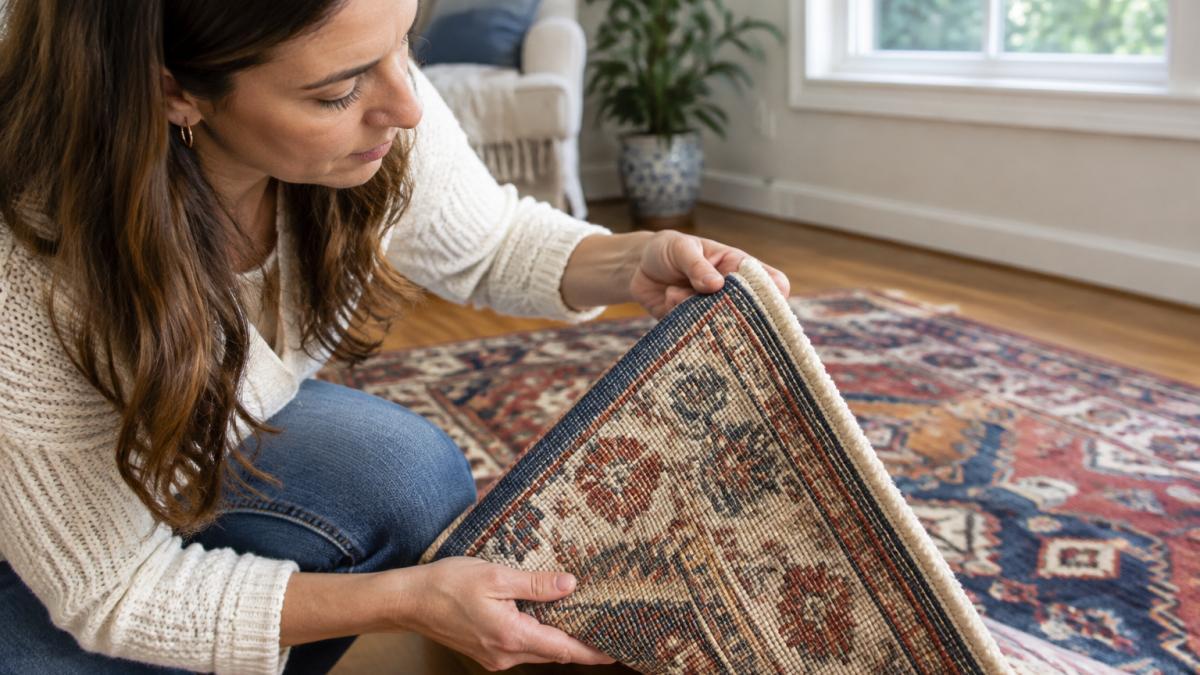
- Flip it over. The back should show the pattern clearly in reverse, with visible individual knots.
- Check knot density. Denser knots mean better durability. Run your fingers across the pile; it should feel tight, not loose.
- Look for color consistency. Natural dyes vary slightly. Perfectly uniform color across a "handmade" rug is a red flag.
- Inspect the edges and fringe. Fringe should be part of the foundation, not sewn on afterward.
- Ask about dyes and materials. Wool and natural dyes age gracefully; synthetic dyes fade unevenly.
- Request a condition report. Any repair, restoration, or patch should be disclosed in writing.
- Confirm the return policy. A rug you cannot return is a rug you are stuck with.
For a parallel guide on separating genuine pieces from fakes, read how to spot real gems versus imitations; the inspection mindset transfers directly to rugs.
Shop One-of-a-Kind Hand-Knotted Rugs at ABC Rugs Kilims
Each hand-knotted rug in our collection is listed as a one-of-a-kind piece.
We offer Persian antique and vintage pieces alongside new hand-knotted rugs for retail buyers. Eligible rugs carry our 30-Day Exchange Privilege. If you are weighing a purchase, see a one-of-a-kind hand-knotted rug in person or on the product page and judge the knot work for yourself.
Choose rugs you would be happy to keep for many years, regardless of resale.
A hand-knotted rug asks for more money upfront and rewards you with decades of wear, a repair path that tufted rugs never have, and a piece no one else owns. If that trade-off sounds right for your home, ABC Rugs Kilims & Jewelry can help you choose with confidence. Our collection includes one-of-a-kind hand-knotted Persian rugs, natural wool and dyes, and a 30-Day Exchange Privilege on every purchase. Get started with ABC Rugs Kilims & Jewelry and find the rug your room has been waiting for.
Frequently Asked Questions
Are hand-knotted rugs a good investment?
They can be, but treat the return as durability and enjoyment first. A hand-knotted rug is made by tying every knot by hand. Resale is real but slower and depends on condition, size, and provenance, so buy a piece you want to live with.
How can you tell if a rug is hand-knotted?
Turn it over. A hand-knotted rug shows an irregular, slightly uneven knot pattern on the back, and the fringe is usually part of the foundation rather than sewn on. Machine-made rugs look uniform and perfectly aligned. Look for small color and knot variations too, since a human tied each one. Ask for provenance details and a photo of the back before buying online, and confirm the seller backs it with a return or exchange policy.
Do hand-knotted rugs hold their value?
Some do, and many do not. Antique and collectible pieces in good condition with documented provenance can hold or gain value, while new production rugs usually sell for less than the purchase price on the secondary market. Factors that matter most are condition, size, knot density, materials, and authenticity. Expect resale to take months, not days, and budget for professional cleaning before a sale.
Why are hand-knotted rugs so expensive compared to hand-tufted rugs?
Labor. A hand-knotted rug is built knot by knot by hand. That labor, plus high-quality wool and natural dyes, drives the upfront cost. Hand-knotted rugs are made with high-quality wool and natural dyes, which is a major part of their cost.


