

Last Updated: November 13, 2026
Quick Summary
Colorful hand-knotted kilim rug styles fall into four working categories: geometric, stripe, medallion, and figurative or mixed kilims. Each combines bold geometric design with genuine hand craftsmanship, and no two pieces are identical. Regional traditions such as Turkish, Iranian, Caucasian, and Central Asian weaving shape the palette and motif vocabulary you see.
- A flatweave kilim is weft-faced and reversible, while a hand-knotted kilim has a knotted pile and is not reversible.
- Geometric motifs often served as weavers' signature marks, so repeated hooks or combs can identify a family or region.
- Turkish kilims classically pair madder red and indigo blue against an ivory or undyed wool ground.
- Rotate a kilim 180 degrees every six to twelve months so sun exposure and foot traffic stay even.
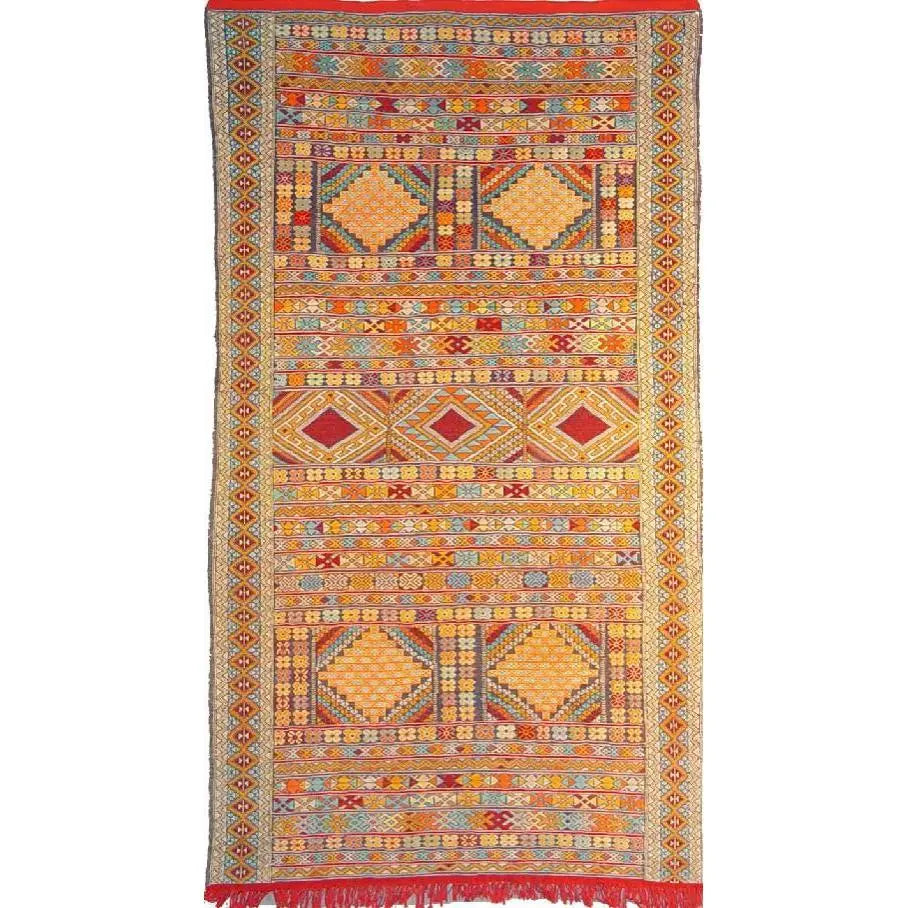
- The Marrocco Persian Kilim Collection piece measures 8'0" x 4'5" and is priced at $308.00.
Table of Contents
- Why Colorful Hand-Knotted Kilim Rug Styles Stand Apart
- A Style Taxonomy of Colorful Kilim Rug Patterns
- Turkish Kilim Rugs and Other Regional Weaving Traditions
- Inside the Flatweave Kilim Rug: Wool, Dyes, and Craft
- Choosing Kilim Rug Sizes for Every Room
- Color and Pattern Selection by Room and Décor
- Care, Cleaning, and Durability for a Handmade Kilim
- Shopping ABC Rugs Kilims for an Authentic Colorful Kilim
- Frequently Asked Questions
Why Colorful Hand-Knotted Kilim Rug Styles Stand Apart
Colorful hand-knotted kilim rug styles are among the most collected textiles in the world because they combine bold geometric design with genuine hand craftsmanship, and no two pieces are identical. The same motif family can look entirely different from one village to the next. A kilim is a flat-woven or knotted textile made without a pile in the traditional flatweave sense, and the pieces that command attention are the ones where color and construction work together.
Below, we break down how the terms actually work, how to read a pattern, and how to choose a piece that suits your room. But first, here is what most guides get wrong: they treat "kilim" and "hand-knotted" as opposites when the real distinction is about weave structure, not quality.
Hand-Knotted Versus Flatweave: What the Terms Actually Mean
A flatweave kilim is woven on a loom with the colored weft threads packed down to form the pattern, producing a thin, reversible, pileless textile. A hand-knotted rug ties individual knots around warp threads to build a pile. Both are handwoven, and both are handmade, but they feel and wear differently.
The confusion is understandable. Many sellers use "kilim" loosely for any colorful flat textile. In practice, a hand-knotted kilim sits at the intersection: it carries kilim-style geometric design but is built with knots. For a deeper look at how construction affects value, see our guide to hand knotted vs machine made rugs.
| Feature | Flatweave Kilim | Hand-Knotted Kilim |
|---|---|---|
| Construction | Weft-faced, no pile | Knotted pile |
| Reversible | Yes | No |
| Thickness | Thin, lays flat | Medium pile |
| Best for | High-traffic, layering | Living rooms, warmth |
A Style Taxonomy of Colorful Kilim Rug Patterns
We group colorful kilims into four working categories, which helps when you are shopping online and cannot touch the piece. Geometric kilims rely on stepped diamonds, latch hooks, and repeating blocks. Stripe kilims use bands of color, often with narrow dividing lines. Medallion kilims center on one large motif with corner spandrels. Figurative and mixed kilims blend small animal or tree motifs into the field.
The four categories below are a way to match a pattern to a room's existing lines. A room full of straight edges can carry a busy geometric kilim; a softer, layered space often suits stripes.
Geometric Motifs, Stripes, and Medallions
Geometric motifs are the backbone of kilim rug patterns, and they are rarely random. A common mistake is assuming every diamond means the same thing; in practice, weavers used motifs as signature marks, so a repeated hook or comb shape often identifies a family or region. Stripes tend to be the most forgiving pattern for beginners because they read as color rather than shape. Medallions demand a centered furniture layout to look intentional.
Turkish Kilim Rugs and Other Regional Weaving Traditions
Regional labels are among the most misused terms in kilim shopping. They describe a weaving tradition, a set of materials, loom habits, palette conventions, and motif vocabulary, not a quality grade. A village piece and a city workshop piece from the same region can differ more than pieces from two different countries.
Turkish kilim rugs are the most widely recognized flatweaves. The classic Anatolian palette pairs madder red and indigo blue against an ivory or undyed wool ground, with crisp stepped borders and a central field of repeating geometric motifs.
Iranian weaving traditions cover a wider range. Shiraz-area kilims, often associated with Qashqai weavers, tend to show denser, smaller-scale geometric fields with strong reds, oranges, and deep blues, and are frequently woven in narrow strips joined into larger pieces. Sanandaj and Kurdish pieces from western Iran often use finer wefts, more muted ground colors, and more intricate border systems.
Caucasian traditions, from the Shirvan, Karabagh, and Kazak weaving areas, are known for bold, large-scale geometric medallions, strong contrast between few colors, and heavier wool. These pieces often have a more graphic, high-contrast look than Anatolian work and pair well with modern furniture.
Central Asian traditions, including Uzbek and Turkmen flatweaves, bring deeper reds, magenta, and orange, with repeating guls (octagonal medallions) and fine striped bands. These palettes are the most saturated of the major traditions and suit rooms that can carry a strong color statement.
The Balkans and the Caucasus border regions produce kilims with tighter geometric repeat and a narrower palette, often two or three colors, which makes them easier to place in a restrained room.
A common pattern when shopping: sellers use a single regional name as a shorthand for an entire look, when the piece may be from a neighboring tradition or a later revival workshop.
For a closer look at how regional patterns differ, see our guide to antique kilim rug styles and regional patterns. What most buyers miss is that regional labels describe tradition, not a quality grade.
Inside the Flatweave Kilim Rug: Wool, Dyes, and Craft
Wool is the material that gives a flatweave kilim rug its hand and its longevity. Natural wool takes dye deeply, and many traditional pieces use vegetable dyes.
For more on identifying natural dyes, see our guide to identifying natural dyes in antique kilims.
Choosing Kilim Rug Sizes for Every Room
Sizing is where most purchases go wrong. A runner belongs in a hallway or beside a bed, an area rug should let at least the front legs of your seating sit on the textile, and a large kilim can anchor an entire living room. Measure your furniture footprint first, then add clearance.
Our detailed walkthrough on how to choose a kilim rug size for a room covers layout math room by room. Measure before you buy, since one-of-a-kind kilims are fixed in size.
Color and Pattern Selection by Room and Décor
Start with the room's fixed colors, then choose the kilim as the accent rather than the anchor. In a neutral living room, a multicolor kilim with reds and blues does the work of artwork. In a bohemian space, layer a vibrant geometric piece over a plain jute base. Scandinavian-style rooms take best to quieter stripes and beige grounds with one strong accent color.
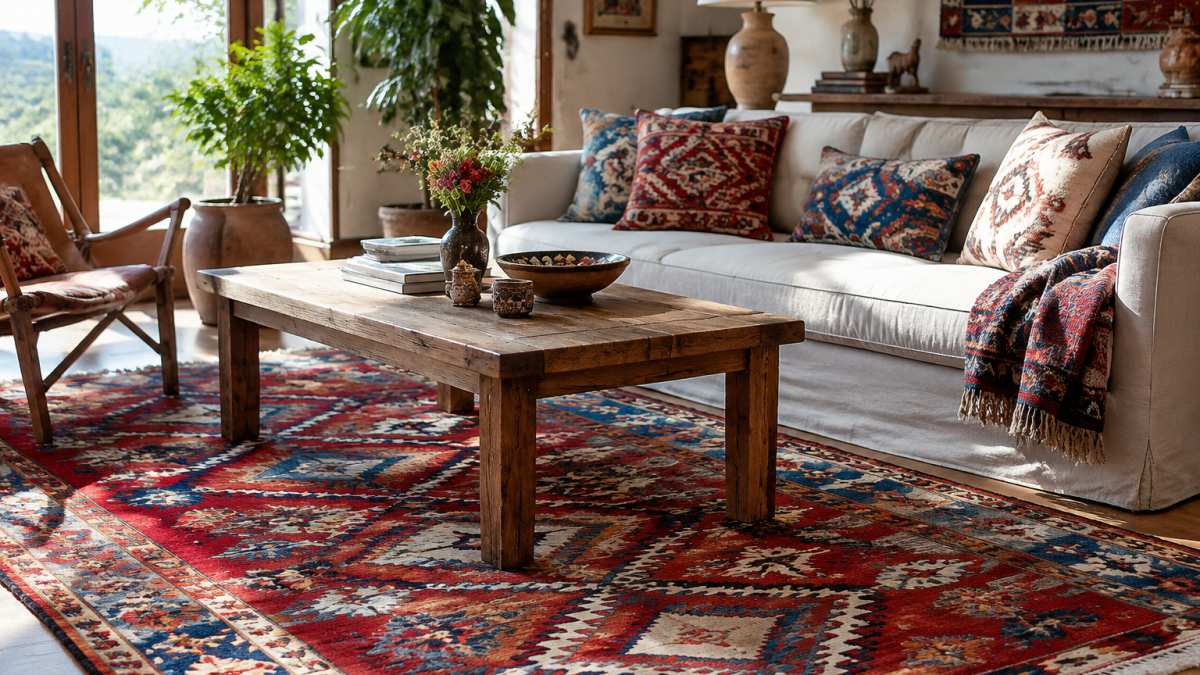
Turquoise, orange, and green palettes read as energetic and suit creative spaces; deeper reds and blues feel traditional and formal. Match pattern density to the amount of visual clutter already in the room.
Care, Cleaning, and Durability for a Handmade Kilim
Care advice for kilims fails when it treats flatweaves and knotted pile as the same object. They are not. A flatweave kilim is a weft-faced textile with no pile to trap soil, so most dirt sits on the surface and comes up with gentle vacuuming.
Routine care, by construction. For flatweaves, vacuum on low suction with a hard-floor head or the bare-floor setting, no beater bar, once a week in traffic areas. For knotted pile, use suction only and avoid the beater bar, which can pull knots and fray fringe.
Spills and stains. Blot, do not rub. Rubbing drives dye and soil deeper into the weave and, on flatweaves, can distort the weft alignment permanently. Lift solids with a spoon, blot liquids with a white absorbent cloth, and work from the outside of the stain inward so you do not spread it.
Sun, moisture, and storage. Direct sun fades vegetable-dyed wool over years, and the fading is not uniform, it follows the pattern, so a faded kilim can lose the contrast that made it readable. Use window film or rotate the piece. Store rolled, never folded; folds create permanent creases in flatweaves and can crack the foundation of old knotted pieces.
Pests. Moths attack wool, especially in dark, undisturbed storage. Clean the rug before storing it, because body oils and food residue attract larvae, and inspect it every few months.
When to call a professional. A handmade kilim may benefit from professional cleaning periodically, sooner in high-traffic or pet households. Call a professional immediately for: pet urine (the odor compounds need enzymatic treatment, and DIY attempts often set the stain), any large liquid spill that reaches the foundation, active moth infestation, fringe that is unraveling, or a vintage piece with fragile selvages.
Durability expectations. A well-made wool flatweave in a low-traffic room can last decades; the same piece in a hallway entry will show wear in a few years because there is no pile to absorb abrasion. Knotted kilims are more forgiving underfoot but shed loose fibers for the first months, that is normal, not a defect.
Shopping ABC Rugs Kilims for an Authentic Colorful Kilim
Buying an authentic piece comes down to construction details, honest photography, and a seller who will answer questions about origin. Our collection focuses on handmade rugs and kilims, Persian antique and vintage pieces, and reviewed, trusted inventory for both retail and wholesale buyers.
A strong starting point is the Marrocco Persian Kilim Collection modern colorful hand-knotted kilim, an 8'0" x 4'5" piece in natural wool and cotton, priced at $308.00. For larger rooms, see our Shiraz and Sanandaj Persian kilims listed in the catalog.
Choosing a colorful kilim is really a decision about construction, pattern, and proportion, and getting those three right matters more than chasing a trend. If you want a piece that is genuinely handmade and backed by a curated, reviewed selection, ABC Rugs Kilims & Jewelry offers handmade rugs and kilims for both retail and wholesale buyers. Get started with ABC Rugs Kilims & Jewelry and bring an authentic, one-of-a-kind kilim into your home.
Frequently Asked Questions
Are kilim rugs hand-knotted or flatwoven?
Both exist, and the label depends on construction. A true flatweave kilim is woven without a pile, with colored wefts passing over and under the warps. Some pieces sold as kilims are hand-knotted, meaning individual knots are tied onto the foundation to create a low pile. ABC Rugs Kilims lists its Marrocco and Shiraz Persian kilims as hand-knotted with natural wool and cotton, so check the construction type before buying rather than assuming every kilim is flat.
What patterns and colors are common in Turkish kilim rugs?
Turkish kilim rugs typically use bold geometric motifs: hooked medallions, ram's horn shapes, stars, and narrow border bands. Color palettes lean on madder red, indigo blue, turquoise, orange, and undyed beige wool, often in high-contrast combinations. Many are woven in narrow runner proportions, which is why they suit hallways and entryways. Motifs vary by village and region, so two Turkish kilims of the same size can look completely different in pattern and color balance.
How do you choose the right kilim rug size for a room?
Measure the furniture footprint first, not the empty floor. In a living room, a kilim should sit under the front legs of the sofa and chairs, which usually means a 9 by 6 foot piece or larger. For a hallway or kitchen, a runner in the 9 by 4 foot range works well. ABC Rugs Kilims lists pieces such as a 9'9" x 4'6" Shiraz kilim and a 9'8" x 6'6" Shiraz kilim, so compare those dimensions against your layout before ordering.
How can you tell if a kilim rug is handmade?
Look at the back and the edges. On a handmade kilim the pattern is usually visible in reverse with slight color shifts, and the selvedges are finished by hand rather than bound with a straight machine tape. Wool has small irregularities in thickness, and natural dyes fade unevenly rather than in uniform bands. Ask for the weave type, country of origin, and material list. ABC Rugs Kilims states construction type, material, and origin on its product pages, which makes verification straightforward.


