

Last Updated: November 12, 2026
Quick Summary
Knots, age and origin are three separate questions, so how to authenticate hand-knotted antique rugs means checking several clues together: the knot structure on the reverse, knot consistency, fringe construction, wear patterns, and documentation. No single test settles it, and a professional appraisal is worth considering when the price is high or the clues conflict.
- Hand-knotted rugs show individual knots that vary slightly in size and tension on the reverse.
- Count knots in a one-inch square; hand-knotting often drifts, while machine-made rugs stay almost perfectly even.
- On a hand-knotted rug, the fringe usually grows directly from the warp threads at the ends.
- Real age usually shows uneven wear on high points of the pile, tied to use rather than evenly sanded.
- Never wash, scrub, sun-fade or pull threads to test a rug, since cleaning can alter dyes and fibers.
Table of Contents
- Why Authenticating a Hand-Knotted Antique Rug Takes More Than One Test
- How to Tell If a Rug Is Hand-Knotted
- How to Tell If a Rug Is Antique: Age, Patina and Wear
-
Reading Dyes, Repairs and Regional Knot Clues Step by Step
- Tools You Actually Need
- Step 1: Photograph Before You Touch
- Step 2: Inspect the Back for Construction
- Step 3: Check Knot Count and Consistency
- Step 4: Examine Fringe and Warp
- Step 5: Read Dyes and Color Variation
- Step 6: Map Repairs and Restoration
- Step 7: Note Regional Knot Clues, and Their Limits
- Step 8: Summarize and Decide
- Using a Rug Identification App or Photo Lookup, and Its Limits
- Identify My Rug by Picture: What Photos Can and Cannot Prove
- Booking an Appraisal for Your Antique Rug Before You Buy or Sell
- Frequently Asked Questions
Buyers searching for how to authenticate hand-knotted antique rugs often expect a single telltale sign that settles the question. There isn't one.
Hand-knotting, age and origin are three separate questions. This guide walks through a safe, non-destructive sequence you can run at home, shows where visual checks stop being reliable, and explains when an appraiser is worth the cost.
Why Authenticating a Hand-Knotted Antique Rug Takes More Than One Test
Each clue points in a different direction. Knots prove how a rug was made. Wear and patina suggest age. Dyes, repairs and regional knot styles hint at origin.
Treat your findings as a pattern, not a verdict. If several clues agree, your confidence grows. If they conflict, that is a reason to get a professional opinion.
- Hand-knotting is about construction.
- Age is about wear, patina and materials.
- Origin is about design, dyes and knot style.
How to Tell If a Rug Is Hand-Knotted
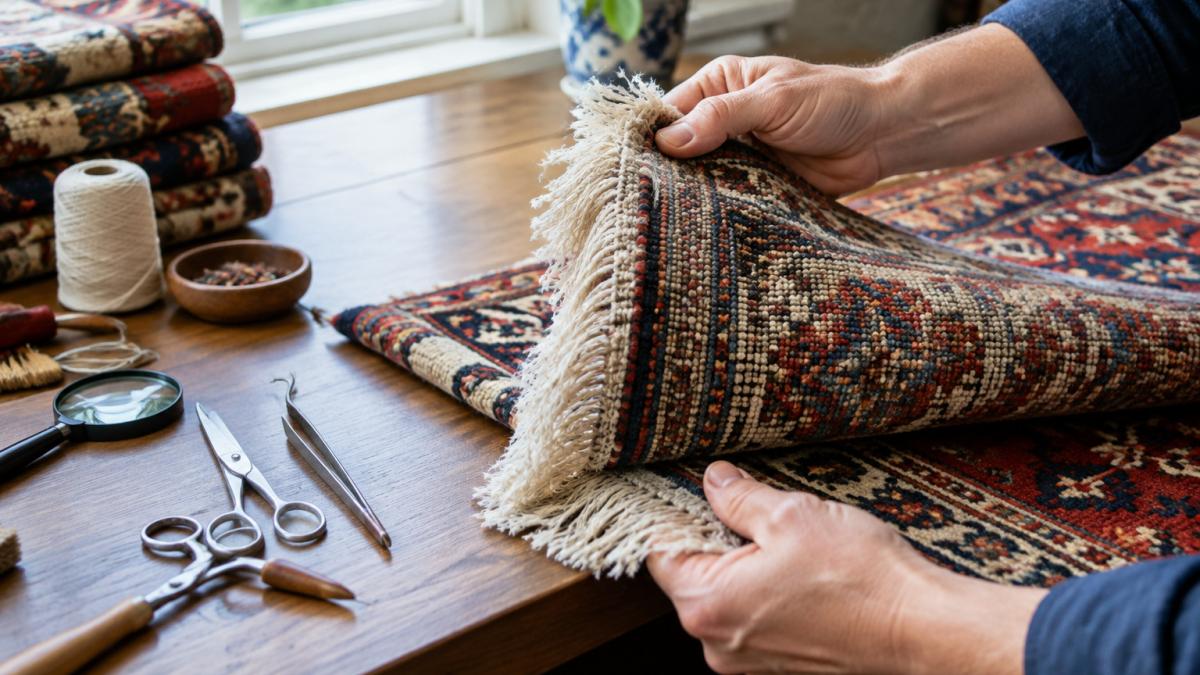
Hand-knotted rugs have individual knots tied one at a time onto the warp threads. Machine-made rugs are woven or tufted with uniform loops. The reverse side is the fastest place to see the difference.
Inspecting the Back and Knot Structure
Turn a corner of the rug over gently, or view the back in good daylight. Look for these signs:
- Individual knots that vary slightly in size and tension.
- Knot ends that are cut and tucked, not uniform loops.
- A design that shows faintly on the reverse, since knots pressed from the front leave a mark.
Never pull threads or force the rug to see the back. If you can't view it safely, stop and ask the seller for photos of the reverse.
Checking Knot Consistency and Fringe Construction
Count knots in a small square, such as one inch, and check whether the count stays roughly steady across the rug.
Look at the fringe too. On a hand-knotted rug, the fringe usually grows directly from the warp threads at the ends.
Watch out: a sharp, perfectly uniform back is a strong sign of machine production, but a worn or heavily cleaned rug can look uneven for other reasons.
How to Tell If a Rug Is Antique: Age, Patina and Wear
"Antique" and "vintage" are age categories, not quality grades, and the trade does not enforce a single legal definition.
Age cannot be proven by appearance alone. What you can do is gather evidence that either supports or undercuts an age estimate, then decide whether the evidence is strong enough for the price being asked.
What Counts as Evidence of Age
- Wear patterns. Real age usually shows abrasion on the high points of the pile, the tops of medallions, the centers of borders, where feet and furniture contact the rug most. The wear should look uneven and tied to use, not evenly sanded across the field.
- Patina and color softening. Natural dyes often mellow and shift over decades, and wool can develop a slight sheen from handling. Abrash, the subtle banding from dye lots, is common in older pieces but also appears in new ones, so it is a clue rather than proof.
- Foundation condition. Older rugs often have a foundation that feels dry, slightly stiff, or brittle at the edges. A supple, springy back is more typical of a newer rug, though storage and cleaning history can change this.
What Appearance Cannot Prove
A skilled reproduction can imitate wear, abrash, and even repairs. Artificial distressing often shows wear in patterns that do not match normal foot traffic, too even, too concentrated in decorative areas, or paired with a foundation that still feels new.
Watch out: do not scrub, wash, sun-fade, or apply any treatment to test a rug's age. Cleaning can alter dyes and fibers, and irreversible changes can reduce both authenticity and value.
A Practical Age-Estimate Sequence
- Ask the seller for any documentation and the age definition they are using.
- Photograph the front, back, fringe, selvages, and any repairs in natural light.
- Compare wear patterns against how the rug would have been used.
- Check the foundation feel and the originality of the ends and selvages.
- Note every inconsistency, then decide whether the evidence supports the asking price.
If the evidence is mixed or the price is significant, treat the age claim as unverified until an appraiser examines the rug in person. Age estimates based on style, color, and wear are screening tools, not proof.
Reading Dyes, Repairs and Regional Knot Clues Step by Step
Most guides list what to look for but not how to check it safely. This section turns the clues into a non-destructive inspection protocol you can run at home with ordinary tools, and it explains what each clue can and cannot prove.
Tools You Actually Need
- A bright flashlight or a phone light.
- A magnifying glass or a phone macro lens.
- A soft measuring tape.
Do not use moisture, cleaning solutions, adhesives, or sharp tools. Do not pull knots, cut fringe, scrape the pile, or expose the rug to direct sun for extended periods.
Step 1: Photograph Before You Touch
Lay the rug flat and photograph the full front, the full back, each corner, the fringe at both ends, the selvages, and any visible repairs. Natural light is best. These photos become your baseline and are useful if you later consult an appraiser.
Step 2: Inspect the Back for Construction
Turn the rug over gently, or lift a corner rather than folding the whole rug. With the light at a low angle, look for individual knots that vary slightly in size and tension, knot ends that are cut and tucked rather than uniform loops, and a faint mirror of the design pressed through from the front.
Watch out: never force a stiff or brittle rug to fold. If the back cannot be viewed safely, stop and ask the seller for clear photos of the reverse.
Step 3: Check Knot Count and Consistency
Count knots in a one-inch square in several areas, field, border, and near a corner. Hand-knotted rugs often drift a little in count and tension, while machine-made rugs stay almost perfectly even. Record the counts; a large variation across the rug is a clue worth noting, not a verdict.
Step 4: Examine Fringe and Warp
On a hand-knotted rug, the fringe usually grows directly from the warp threads at the ends. Machine-made fringe is often sewn or glued on afterward. Look at how the fringe meets the body of the rug and whether the ends look rewoven or replaced.
Step 5: Read Dyes and Color Variation
Older rugs often use natural dyes that show soft, variable color and abrash. Synthetic dyes tend to look more uniform. Color variation alone does not prove age, and some new rugs intentionally mimic abrash. Note the pattern of variation rather than treating any variation as proof.
Step 6: Map Repairs and Restoration
Look for areas where pile density, direction, or sheen differs, color mismatches, re-knotted sections that do not match the original knot count, and edges that look newly stitched. Repairs and replaced fringe affect condition and value, but they do not automatically make a rug inauthentic. Document each one.
Step 7: Note Regional Knot Clues, and Their Limits
Common knot terminology includes symmetric (often called Turkish or Ghiordes) knots and asymmetric (often called Persian or Senneh) knots. These terms describe how the knot is tied, not where the rug was made. Many weaving traditions use both, and a single knot type cannot prove a specific village, workshop, or date. Treat knot style as one clue among several.
Step 8: Summarize and Decide
Write a short summary: what supports hand-knotting, what supports age, what suggests origin, and what remains uncertain. If the clues agree, your confidence grows. If they conflict, or if the price is high, that is the point to consult an appraiser rather than rely on visual checks alone.
The article's step-by-step protocol can be summarised as a quick reference for each inspection clue.
| Step | What to check | What it can and cannot prove |
|---|---|---|
| 1. Photograph | Front, back, corners, fringe, selvages, repairs | Creates a baseline for an appraiser |
| 2. Inspect back | Knot size and tension, cut knot ends | Suggests construction; a uniform grid points to machine-made |
| 3. Count knots | Knots in a one-inch square, several areas | Hand-knotting often drifts; machine-made stays even |
| 4. Examine fringe | Whether fringe grows from the warp | Machine fringe is often sewn or glued on afterward |
| 5. Read dyes | Soft, variable color and abrash | Suggestive, not proof; new rugs can imitate it |
| 6. Map repairs | Density, sheen, knot count and stitching mismatches | Affects condition and value, not automatically authenticity |
| 7. Knot style | Symmetric or asymmetric knots | Describes how a knot is tied, not where the rug was made |
| 8. Summarise | Whether the clues agree | Conflicting clues or a high price call for an appraiser |
Using a Rug Identification App or Photo Lookup, and Its Limits
Rug identification apps and photo lookups can suggest a likely design style or region. They are useful for a first guess, especially for patterns and borders.
They cannot confirm hand-knotting, age or authenticity from a picture. Photos hide the reverse side, fringe texture and wear in person. Treat app results as a starting point, then check the physical clues above.
Identify My Rug by Picture: What Photos Can and Cannot Prove
If you need to identify your rug by picture, take clear photos in natural light. Include the full front, a close-up of the pattern, the reverse side, the fringe, any repairs and the rug's size.
Photos can help narrow down design, color and likely origin. They cannot prove hand-knotting or age, and they cannot detect fine repairs or reproductions reliably.
Booking an Appraisal for Your Antique Rug Before You Buy or Sell
If the price is high, or you plan to sell, a professional appraisal is worth the cost. An appraiser can examine the rug in person, check construction and condition, and provide written documentation that buyers trust.
Our team at ABC Rugs Kilims & Jewelry can help you book a Buy Sell Trade Appraise session before you purchase or sell an antique rug. Once your rug has been checked, you can read our guide on where to sell antique rugs and decide the right next step.
Before you commit, also review our guide to identifying the age of antique Persian rugs and our walkthrough for spotting genuine hand-knotted knots. If your rug includes repairs or a regional kilim, how to verify antique kilim provenance explains what to check.
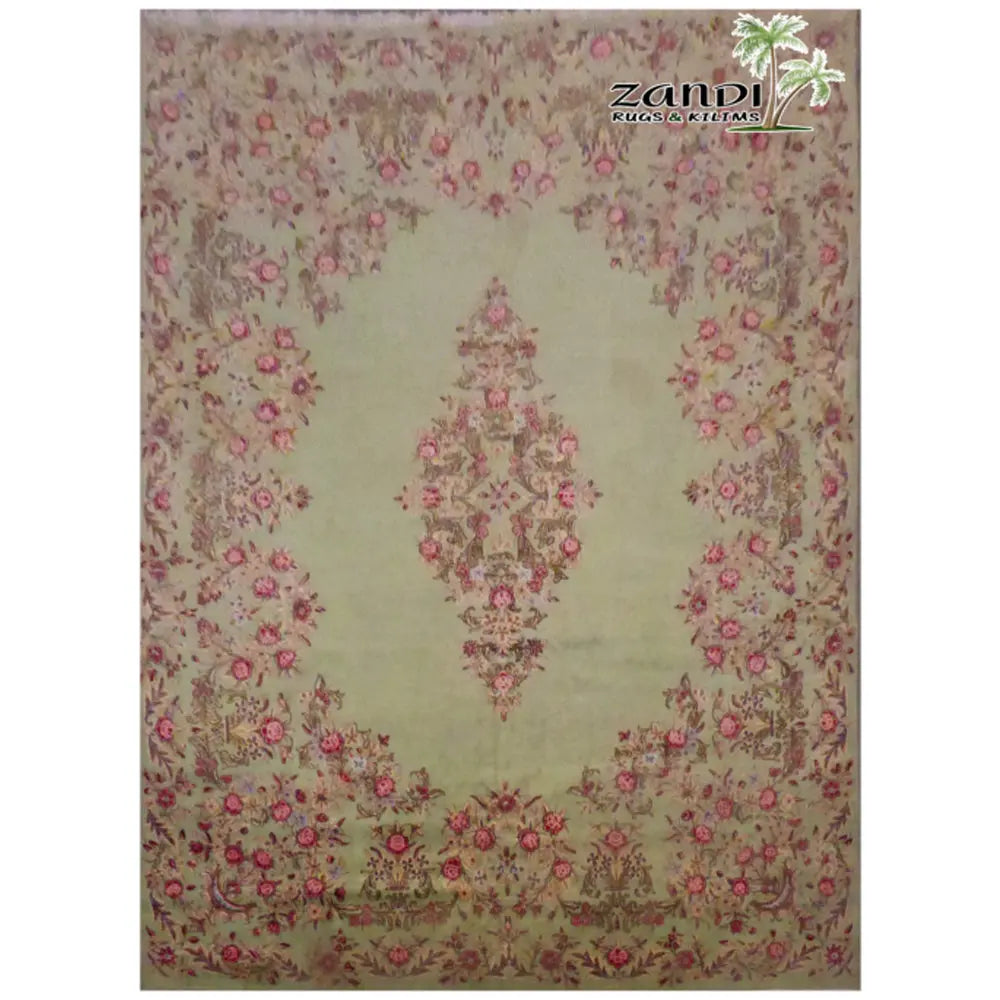
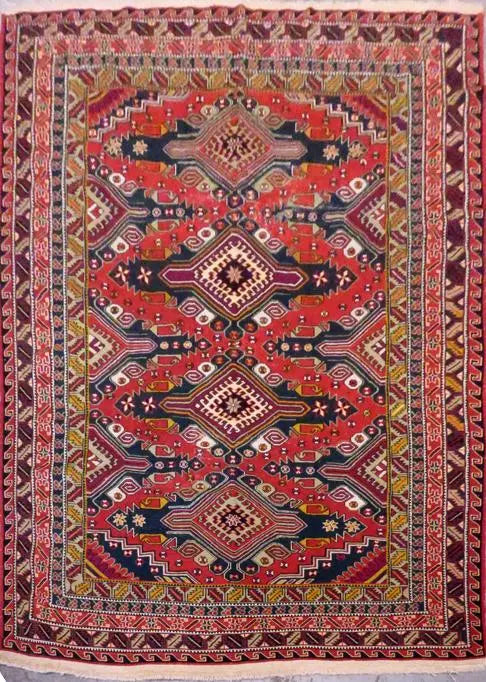
Get started with ABC Rugs Kilims & Jewelry and find authentic, reviewed pieces you can trust. Our curated collection includes One Of The Kind Antique Persian Kerman Rug at $19,216.00 and a Turkish Hand-Knotted Rug at $1,432.00.
Frequently Asked Questions
How do I identify a hand-knotted rug?
Turn the rug over and look at the back. Hand-knotted rugs usually show slightly irregular knots, small variations in row spacing, and a design that is visible but softened on the reverse. Machine-made rugs typically show a uniform, perfectly repeating grid, and their fringe is often stitched or glued onto the foundation rather than made from the warp threads. Use these checks together rather than relying on any single clue, since good reproductions can imitate one or two of them.
What app can I use to identify a rug?
Rug identification apps and reverse image search tools can suggest a likely region, style or pattern name by comparing your photo to catalogued designs. They are useful for a starting point, but they cannot confirm hand-knotting, age or condition. Use the app result as a lead, then check the back, fringe and knot structure yourself, and confirm with a qualified appraiser before relying on the identification for a purchase or insurance valuation.
Does a rug's pattern or origin prove that it is antique?
No. Traditional patterns and regional motifs are reproduced for decades, and modern weavers often copy old designs closely. A pattern or region name tells you where a design style comes from, not when the rug was made. Age has to be assessed from physical evidence such as the wear pattern, the condition of the foundation, the dye behavior and the materials. Documentation or provenance from a reputable seller can add support, but it should also be checked.
When should I have an antique rug examined by an expert?
Have an appraiser examine the rug before a significant purchase or sale, before adding it to an insurance policy, or whenever you see signs of restoration, reweaving or unusual dye fading. Look for appraisers who work with oriental rugs and can explain their methods in writing. An expert can test fibers and dyes and inspect repairs that are difficult to judge from photos or a quick visual check.


