

Last Updated: October 23, 2026
Quick Summary
Layer sterling silver necklaces by starting with a 16-inch anchor chain, then adding 18-inch and 20-inch pieces with at least two inches of length difference between each. Position pendants at different heights, maintain quarter-inch spacing at your neck to prevent tangling, and match chain strength to pendant weight for a polished, intentional look.
- Use chains at least two inches apart in length, such as 16, 18, and 20 inches, to create visible separation and prevent bunching.
- Match chain width to pendant bail size: most sterling silver chains run 1mm to 3mm wide, and the bail opening should be slightly larger than the chain width.
- Place your heaviest pendant on the longest chain and lighter pieces higher up to distribute tension evenly across all layers.
- Store each necklace separately in individual pouches or boxes to prevent tangling and maintain chain flexibility.
- Mix chain styles and finishes strategically, pair two similar chains with one contrasting style, or combine polished and oxidized finishes for visual depth.
Table of Contents
- Start With the Right Sterling Silver Pieces
- Best Necklace Lengths for Layering
- How to Layer Necklaces With Pendants
- Sterling Silver Chain Styles for Layering
- How to Layer Necklaces Without Tangling
- Step-by-Step Guide to How to Layer Sterling Silver Necklaces
- Common Mistakes to Avoid When Layering
- Caring for Your Layered Sterling Silver Necklaces
- Frequently Asked Questions
Start With the Right Sterling Silver Pieces
Layering sterling silver necklaces and pendants comes down to technical details: not all chains work together, and not all pendants suit every base layer. Learn how to identify quality sterling silver pieces before you begin selecting your components.
Your anchor chain sets the tone.
Understanding bail size and chain compatibility
The bail is the loop connecting your pendant to the chain.
Check your pendant's bail diameter before selecting a chain.
Weight matters too. A heavy pendant needs a sturdy chain, or it will stretch or break. Above a few grams, pair it with a cable or curb chain at least 1.5mm wide.
Pendant weight and chain strength
Sterling silver chains have load limits. A 1mm chain holds light charms and small pendants; move to a 1.75mm curb chain for medium-weight pieces. Our Sterling Silver 1.75mm Curb Chain suits most layered setups, strong enough for gemstone pendants without looking heavy. Test before committing: if the chain feels strained or the pendant pulls it down unevenly, the pairing won't work long-term.
Best Necklace Lengths for Layering
Necklace length is everything when layering. Too similar and your pieces blend into visual confusion; the right spacing creates a cascading, intentional look.
Proven length combinations that work
Start with these tested combinations:
- 16 inches + 18 inches + 20 inches, Classic three-layer setup. The 16-inch sits near the collarbone, the 18-inch drops to mid-chest, and the 20-inch creates a longer focal point.
- 14 inches + 18 inches, Two-layer option for a subtler look. Works well with different chain styles to create contrast.
- 18 inches + 22 inches, Best for longer torsos or when you want chains to sit lower on the body.
The two-inch spacing rule works in most cases: if your first chain is 16 inches, your second should be at least 18, so they sit at distinctly different heights instead of bunching at your neck. Our Sterling Silver Rhod-pltd CZ Star and Moon 2in ext 2-strand Necklace comes with an extender, letting you adjust the base length from 16 to 18 inches, useful for testing combinations before committing to fixed lengths.
Adjusting for necklines and body proportions
A choker-length chain (14-16 inches) works on most people, but not everyone. Shorter necks or higher necklines suit a 14-inch first layer; taller frames or lower necklines start at 18. Broader shoulders and longer torsos need chains that drop further, while a petite frame looks better with higher-sitting chains.
These tested length combinations create the cascading, intentional look that makes layering work.
| Combination | Lengths | Best For |
|---|---|---|
| Classic three-layer | 16, 18, 20 inches | Most people; collarbone to longer focal point |
| Subtle two-layer | 14, 18 inches | Understated look with contrast |
| Longer torso | 18, 22 inches | Taller frames or lower necklines |
| Visual breathing room | 16, 20 inches | Skipping middle length for separation |
How to Layer Necklaces With Pendants
Pendants add visual interest but also complexity: one pulls your eye to a spot, two create tension, and three need careful arrangement.
Positioning pendants at different heights
Each pendant should occupy its own vertical space. Stagger them, one at the collarbone, another at mid-chest, a third lower, rather than stacking them. Place your focal pendant on the longest chain as the lowest-hanging piece; secondary pendants sit higher, supporting the main piece without competing.
If you're using our Sterling Silver Starfish and Sand Dollar 18 inch 2-strand Necklace, the two pendants are already positioned at different heights on the same chain. This gives you layering built in. Pair it with a single-pendant chain at 16 inches to create a three-pendant effect with just two necklaces.
Creating a focal point without visual clutter
One pendant should dominate, larger, bolder, or more ornate than the rest. Supporting pendants stay smaller or simpler, so the neckline doesn't feel busy. A common mistake is three equally sized, equally ornate pendants, your eye doesn't know where to land. Pick one statement piece and two supporting charms. Consider finish too: if your focal pendant is shiny and polished, make supporting pendants matte or textured to reinforce the hierarchy.
Sterling Silver Chain Styles for Layering
Chain style affects how your layered look feels. A delicate link chain reads differently than a bold curb chain, so mix styles strategically.
Mixing textures and finishes effectively
Three identical chains look monotonous. Three completely different chains look chaotic. The sweet spot is two similar chains and one that contrasts.
Try two cable chains with one curb chain, or a polished chain with a textured one. See how a blue topaz gemstone pendant pairs with sterling silver chains to understand compatibility and styling options. The contrast should read as intentional variety, not random choices.
Our Sterling Silver 1.75mm Curb Chain works as a strong anchor: its bold, defined links stand out against a thinner cable chain, which provides delicate support.
Sterling Silver Enameled Moon and Back 2-Strand Bar Necklace →
Finish matters as much as style.
When to match metals versus contrast
Sterling silver is your base, all your chains are 925 silver, but some pieces have rhodium plating (brighter, whiter) or anti-tarnish coating. Match plating within your layers: mixing plated and unplated silver makes one piece look noticeably whiter or duller. You can layer sterling silver with gold, rose gold, or mixed metals, but that's advanced.
How to Layer Necklaces Without Tangling
Tangling is the enemy of layered necklaces: chains twist together, knot up, and become impossible to separate without damage. The right spacing and storage prevent this entirely.
Spacing necklaces to prevent knots
Chains tangle when they're too close together. Leave at least a quarter-inch of space between each chain at your neck so they can move independently without catching each other. To create that space, tie a small knot in your chain just below the clasp, it sits against your neck and holds the chain in place.
Storage and daily care to maintain separation
How you store your necklaces matters as much as how you wear them. Store each necklace separately in individual pouches, small boxes, or plastic bags, kept flat or loosely coiled. If you must store multiple chains together, wrap each one around a business card or small piece of cardboard. When you take off your layered necklaces, remove them one at a time and store each piece immediately, don't pile them on your nightstand.
Step-by-Step Guide to How to Layer Sterling Silver Necklaces
Ready to build your first layered look? Follow this process. It works whether you're layering two pieces or three.
Step 1: Choose your anchor piece
Your anchor is the first chain you put on, usually your shortest piece at 16 inches. Choose a chain you love because you'll wear it constantly, it sets the tone for everything else. If you're new to layering, pick a classic style like a cable or simple curb chain, sturdy enough to support additional pieces.
Step 2: Add your second necklace with proper spacing
Your second chain should be 18 inches long (or two inches longer than your anchor). Thread it through your anchor chain's loop at the clasp, or simply layer it on top, the key is that quarter-inch separation at your neck. If it has a pendant, position the pendant below your anchor chain's clasp for visual separation.
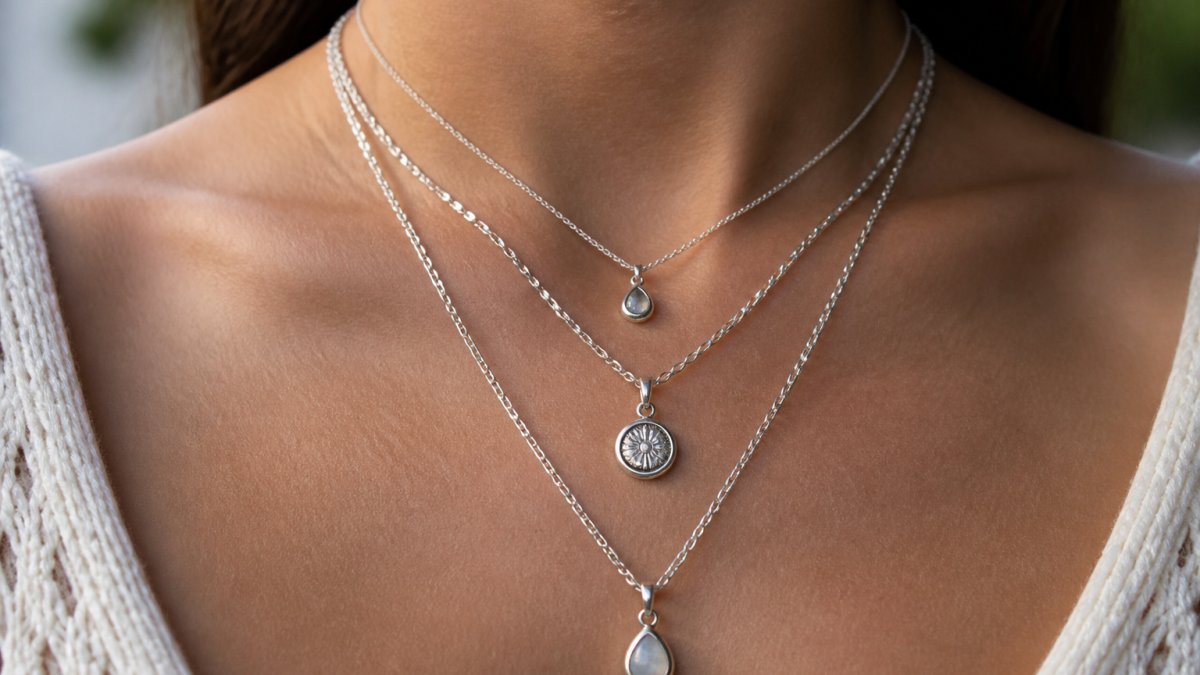
Step 3: Layer a third piece for balance
Your third chain should be 20 inches long, creating the classic cascading effect. Thread it through your previous chains' clasps, or layer it on top, maintaining that quarter-inch separation. It should have a pendant or be visually distinct from your first two chains, a different chain style or bold pendant makes the third layer feel intentional.
Step 4: Adjust and secure
Put on your complete layered set and fasten each chain. Are all three visible, sitting at different heights, and balanced? Make adjustments: add separation if chains tangle, reposition awkward pendants. Small tweaks often make the difference between a polished look and a messy one. Once everything sits right, you've successfully layered sterling silver necklaces and pendants.
Common Mistakes to Avoid When Layering
Most layering problems come from predictable mistakes. Avoid these and your layered look will hold up.
Choosing chains that are too similar in length. If your chains are 16, 17, and 18 inches, they'll bunch together at your neck.
Layering too many pendants. Three pendants is usually the maximum before things feel cluttered. If you want more visual interest, add plain chains instead of more pendants.
Neglecting to clean your chains. Tarnished silver looks dull and feels stiff.
Storing chains tangled together. Prevention is easier than untangling. Store each chain separately from the start.
Caring for Your Layered Sterling Silver Necklaces
Sterling silver requires maintenance. A sterling silver knot pendant necklace and earrings set demonstrates how layered pieces should be cared for to maintain their beauty.
These handmade pieces show the quality and finish you're aiming for when you care for your own necklaces.
Layering sterling silver necklaces and pendants is a skill that improves with practice. Start simple, two chains, one pendant, and build from there.
Frequently Asked Questions
What is the best way to prevent layered sterling silver necklaces from tangling?
Use the two-inch spacing rule: keep at least two inches between necklace layers to prevent chains from intertwining. Store each necklace separately in small pouches or on individual hooks. When wearing, gently arrange each chain so they sit flat against your skin at different heights. A chain separator or layering clasp can hold pieces in place. Before bed, remove necklaces in reverse order and store them flat or coiled separately to maintain their position.
What are the best necklace lengths for layering sterling silver necklaces?
Start with a 16-inch choker or close-fitting necklace as your anchor piece, add an 18-20 inch piece in the middle layer, and finish with a 22-24 inch longer necklace. This creates natural cascading without crowding. For a more delicate look, try 16, 18, and 20 inches. The key is maintaining consistent spacing between each layer. Adjust based on your neckline and body proportions, shorter torsos work better with tighter spacing, while longer frames can accommodate wider gaps.
Can you mix different chain styles when layering sterling silver necklaces?
Yes, mixing chain styles creates visual interest and depth. Pair a delicate curb chain with a paper clip chain, or combine cable and box chains for contrast. The Sterling Silver 1.75mm Curb Chain from ABC Rugs Kilims & Jewelry works well as a base layer with more textured chains layered above. Keep the metals consistent (all sterling silver or all rhodium-plated) to maintain cohesion. Vary thickness rather than style too dramatically, a very delicate chain next to a chunky chain can look unbalanced.
How do you layer necklaces with different pendants without creating visual clutter?
Choose one focal pendant as your statement piece and make it the longest necklace. Keep other pendants smaller and position them at different heights so they don't overlap. For example, use a 16-inch delicate pendant, an 18-inch coin pendant, and a 20-inch statement piece. Ensure each pendant has adequate space below it, at least one inch of chain visible below each charm. The Sterling Silver Starfish and Sand Dollar 18-inch 2-strand Necklace from ABC Rugs Kilims & Jewelry pairs well with simpler delicate chains layered above or below it.


