

Table of Contents
- The Slit Tapestry Technique That Defines Anatolian Kilims
- Nomadic Origins and the Role of Women in Anatolian Weaving
- Symbolism in Traditional Kilim Patterns
- Natural Dyes and the Chemistry of Anatolian Color
- How to Identify Authentic Kilim Rugs
- Antique Kilim Rug Valuation: What Collectors Look For
- Care and Maintenance for Anatolian Kilims
- Conclusion
- Frequently Asked Questions
Last Updated: September 23, 2026
The Slit Tapestry Technique That Defines Anatolian Kilims
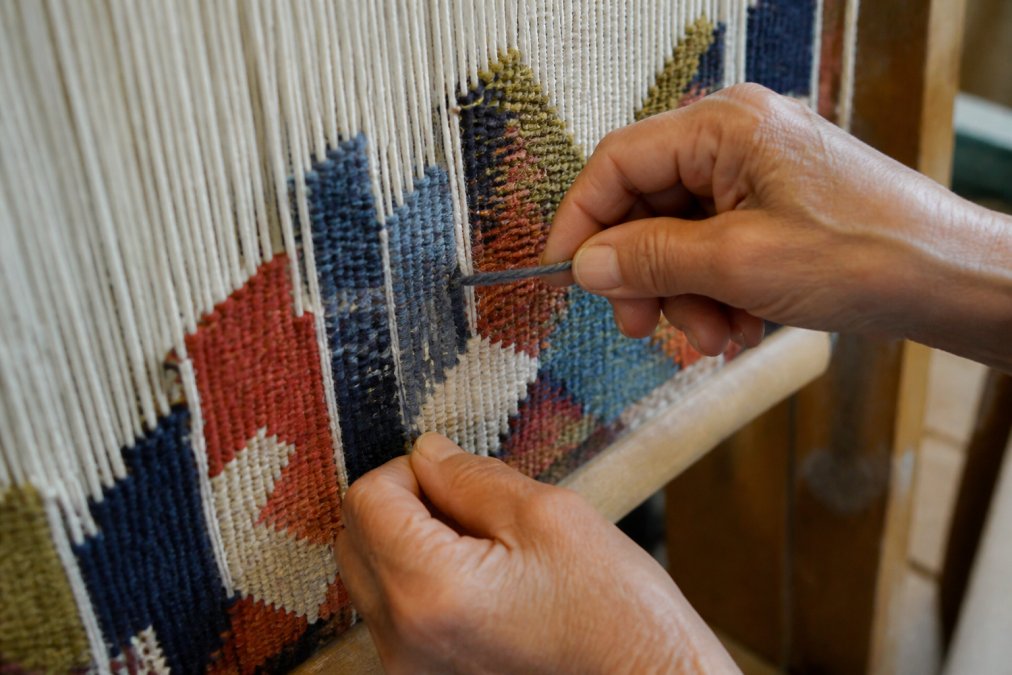
Anatolian kilims are flat-woven textiles from the Anatolian plateau, built entirely from warp and weft threads rather than knotted pile, and this single structural fact explains nearly everything else about them. The weaver interlaces colored weft threads through a wool warp, and where two color blocks meet, the threads turn back on themselves instead of interlocking, leaving a small vertical gap.
Why Weavers Chose Flat-Woven Construction Over Pile
Flat-woven construction solved a practical problem before it became an aesthetic one. A pile rug traps dirt, holds moisture, and weighs considerably more, which matters when your home folds onto a camel every few weeks. Slit tapestry weaving produces a lighter, faster-to-finish textile that lies flat on a tent floor, doubles as a wall hanging, and can be folded into a bundle without crushing the structure.
Nomadic Origins and the Role of Women in Anatolian Weaving
Nomadic culture shaped every design decision in these textiles. Women wove them, girls learned the loom young, and a completed kilim functioned as a dowry, a floor covering, a storage bag, and a burial shroud depending on the day. Because the same hands carried the same motifs across generations, regional patterns stayed remarkably stable over long stretches of textile history.
Symbolism in Traditional Kilim Patterns
Symbolism in traditional kilim patterns functions as a symbolic language rather than decoration. Each motif carried meaning the weaver's community understood without explanation, and the vocabulary was shared across weaving traditions even when the visual execution differed valley to valley.
Common Motifs and What They Represent
- Elibelinde: a hands-on-hips figure associated with fertility and motherhood, often placed in the central field of dowry kilims
- Kocboynuzu: ram's horn, a mark of strength and protection, frequently worked into border bands
- Bukağı: a fetter motif signifying commitment and marital bond, common in bridal textiles
- Pıtrak: a burdock-inspired shape tied to abundance and a good harvest
- Muska: an amulet form used for protection against harm, sometimes woven as a triangular pendant shape
- Bereket: a fertility and prosperity motif rendered as a stylized comb or hand
- Yıldız: an eight-pointed star associated with guidance and good fortune
How Arrangement Changes Meaning
Motifs repeat in borders and central fields, and weavers combined them freely. Two kilims with identical geometry can carry entirely different meanings depending on how the weaver arranged those symbols. A ram's horn placed in a protective border reads differently from the same horn centered in a field meant for a bridal dowry. The border typically frames the piece's regional identity, while the field carries the personal or familial message.
Regional Variation in Motif Vocabulary
A motif that signals abundance in one weaving tradition may appear as a simple filler shape in another. The same geometric form can be read as a ram's horn in one region and a stylized plant in the next, which is why collectors learn to read motifs alongside the piece's structure and palette rather than in isolation. This is also why two kilims with near-identical geometry can be attributed to different traditions once the border vocabulary is compared.
Why Symbolism Survived Commercial Pressure
As kilims moved from tent floors to market stalls, some weavers simplified or dropped motifs that had no meaning to outside buyers. Pieces that retain a full symbolic program, intact borders, coherent field arrangement, recognizable amulet and fertility forms, tend to come from communities that wove for internal use rather than export. That distinction matters to collectors because it separates a textile made to be read from one made to be sold.
Natural Dyes and the Chemistry of Anatolian Color
Natural dyes give older kilims their depth, and they age in ways synthetic color cannot imitate. Madder root produces the deep reds, indigo supplies blues, walnut hulls and onion skins yield browns and yellows. Because each dye bath varied by water, mordant, and season, no two dye lots matched exactly, which is why authentic antique rugs show subtle color shifts across a single field.
How to Identify Authentic Kilim Rugs
Learning how to identify authentic kilim rugs comes down to structure, materials, and honest wear. Follow these steps in order, and you will filter out most reproductions before you ever discuss price.
- Flip the rug over. Handwoven kilims show slightly uneven weft lines and irregular selvedges. Machine-made copies look mechanically uniform.
- Check the back for color. On a genuine slit tapestry, the reverse shows the same pattern in reverse, not a hidden backing or glued surface.
- Look for abrash. Gentle horizontal color bands indicate natural dye lots. Perfectly even color across a large field is a warning sign.
- Inspect the warp. Handspun wool warp feels slightly irregular in thickness. Cotton warp with machine-spun consistency suggests a later commercial piece.
- Test the fringe. On older pieces, fringe is typically part of the original warp, not sewn on afterward.
- Smell it. Genuine wool carries a faint lanolin scent. Chemical treatments leave a sharp, synthetic odor.
- Check the edges under light. Repairs show as slightly raised or mismatched thread direction.
Smithsonian textile conservation guidance on fiber and dye analysis
Fiber Analysis and Degradation Signs
Fiber analysis of antique kilims reveals age through degradation patterns that are difficult to fake. Wool fibers lose elasticity over decades, so an old kilim feels flatter and slightly brittle in high-traffic areas while remaining springy near the borders. Sun exposure bleaches one side of a rug more than the other, and moth damage appears as small, irregular holes rather than the clean cuts a machine would leave.
One Of The Kind Hand Knotted Persian →
| Age Indicator | What You See | What It Means |
|---|---|---|
| Abrash bands | Soft horizontal color shifts | Natural dye lots, likely pre-synthetic |
| Uneven weft | Slightly wavy horizontal lines | Handwoven on a traditional loom |
| Flattened pile areas | Compressed, less springy fiber | Genuine foot traffic over decades |
| Uniform color field | No variation anywhere | Possible synthetic dye or modern weave |
| Sewn-on fringe | Visible stitch line at the edge | Later alteration or repair |
Antique Kilim Rug Valuation: What Collectors Look For
Antique kilim rug valuation rewards condition, rarity, and provenance, in roughly that order. Collectors pay for pieces that are complete, structurally sound, and traceable to a specific weaving tradition. Age alone does not carry value. A worn, fragmentary kilim from a common region often sells for less than a well-preserved piece from a rare one.
The Factors That Move Price Most
- Completeness: intact borders, original ends, no missing sections. A kilim missing its border loses a large share of its market value because the border carries regional attribution.
- Condition: stable structure with honest wear rather than active damage. Active moth damage, dry rot, or a compromised warp drops a piece into a restoration category.
- Rarity: unusual motifs, uncommon regional patterns, early dye palettes. A documented early piece with a full symbolic program commands a premium over a later commercial weave.
- Size: large room-size kilims are scarcer than small bags and runners because most were woven for tent use, not formal rooms.
- Provenance: documented history raises confidence and price. A piece with a known weaving tradition or family history is easier to attribute and easier to resell.
How to Assess Condition Before You Discuss Price
A practical sequence helps separate a collectible from a project:
- Check the foundation first. Lift a corner and look at the warp. If the warp is breaking or the ends are frayed past the fringe, the piece needs stabilization before it can be displayed.
- Map the damage. Note where wear is concentrated. Even wear across a field is expected; a single bald patch usually means a spill, a burn, or a repair that failed.
- Compare repairs to the original weave. A good repair follows the original thread direction and dye tone. A repair that sits proud of the surface or runs against the weave is a red flag.
- Confirm the ends are original. Rewoven ends are common and not automatically disqualifying, but they should be priced in.
- Look for color run. If reds have bled into adjacent whites, the piece has been wet at some point, which affects both appearance and value.
The Gap Between Asking Price and Sold Price
List prices on antique kilims are aspirational. Actual transactions depend on how many buyers are actively looking for that specific region and size at that moment. A rare pattern in a common size may sit for months, while a common pattern in a rare room-size format can move quickly. Collectors who track sold results rather than asking prices develop a more accurate sense of where a piece should trade.
Why Provenance Documentation Matters
If you are sourcing a statement piece for a design project, our One Of The Kind Hand Knotted Persian Rug 12'8" x 9'4" shows how a room-size hand-knotted piece anchors a formal space, and it comes with a Lifetime Exchange Guarantee.

Care and Maintenance for Anatolian Kilims
Care comes down to three habits: rotate, vacuum gently, and keep water away. Rotate the rug every six months so traffic wear stays even. Vacuum on low suction without a beater bar, and never pull at loose fringe. Blot spills immediately with a clean cloth rather than rubbing, since agitation pushes dye into the warp.
Conclusion
The hardest part of collecting Anatolian kilims is trusting what you cannot see: the dye chemistry, the fiber age, the repair history hidden in the weave. Get the identification steps right, and the rest follows. ABC Rugs Kilims & Jewelry offers a curated collection of exquisite handmade rugs, Kilims, Persian antique pieces, gemstones, jewelry, and vintage treasures. We specialize in providing high-quality tapestries, kilims, rugs, and unique jewelry and gemstones for discerning collectors and home decor enthusiasts.
Frequently Asked Questions
What makes Anatolian kilims unique compared to pile rugs?
Anatolian kilims are flat-woven textiles with no pile, created using the slit tapestry technique. This makes them lighter and more pliable than pile rugs, ideal for nomadic transport. The geometric patterns and symbolic motifs woven into Anatolian kilims differ from the curvilinear designs common in pile carpets. The flat surface also reveals the weaver's skill in creating interlocking color blocks without gaps.
How can you tell a real Anatolian kilim from a reproduction?
Authentic Anatolian kilims show irregular handspun wool, natural dye variations, and slight asymmetry from hand-weaving. Check the reverse side for visible weft threads and color changes. Reproductions often use machine-spun yarn, synthetic dyes, and uniform patterns. Fiber analysis can reveal whether the wool was hand-processed, and examining the selvage edges helps confirm age and origin.
Are antique kilim rugs valuable as investments?
Valuation depends on age, provenance, condition, and pattern complexity. However, condition issues like fiber degradation or repairs significantly affect value, so authentication matters.
What role did nomadic culture play in Anatolian kilim weaving?
Nomadic tribes wove kilims as functional items for tents, floor coverings, and storage bags. The flat-woven construction made them lightweight and portable for seasonal migration. Women passed weaving traditions through generations, embedding tribal identity into geometric patterns. This utilitarian function drove innovation in durable, reversible designs that remain distinct from palace-produced carpets.


