

Table of Contents
- Why Buying Vintage Jewelry Online Requires Extra Care
- How to Authenticate Vintage Jewelry Before You Buy
- How to Spot Fake Vintage Jewelry in Listings
- Questions to Ask When Buying Vintage Jewelry Online
- Your Vintage Jewelry Online Buying Checklist
- Marketplace Protections, Payment Safety, and Shipping Security
- What to Do After Your Vintage Jewelry Arrives
- Frequently Asked Questions
Last Updated: October 14, 2026
Why Buying Vintage Jewelry Online Requires Extra Care
Buying vintage jewelry online safely means verifying the piece before you pay, not after. This guide from ABC Rugs Kilims & Jewelry walks through authentication, seller questions, payment safety, and what to do when the package lands.
Vintage jewelry is any piece roughly 20 to 100 years old, while antique jewelry generally means 100 years or older. A single listing can carry decades of wear, hidden repairs, and swapped stones.
That gap between image and object is where money gets lost.
The 5 checks that catch most problems:
- Hallmarks and maker's marks
- Metal testing and weight
- Stone and pearl verification
Get those five right and you avoid the majority of bad purchases.
How to Authenticate Vintage Jewelry Before You Buy
Authentication means confirming the metal, the stones, the maker, and the age all match what the seller claims. You do this with documentation, close-up photos, and a few pointed questions, not guesswork.
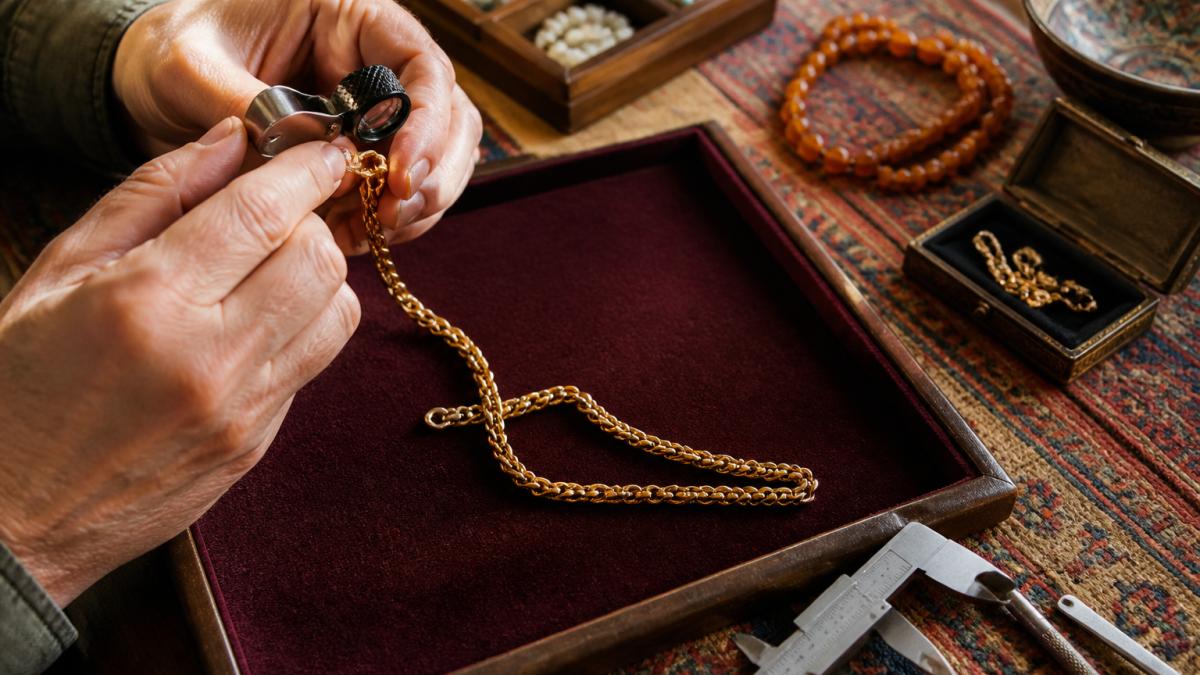
Reading Hallmarks, Stamps, and Maker's Marks
Hallmarks are tiny stamped symbols that tell you the metal purity and often the country and year of assay. In the United States, look for "14K," "18K," "Sterling," or "925" stamped on the piece.
Here's what most buyers miss: a hallmark proves the metal, not the maker. Fakes often carry real stamps on reproduction bodies.
Ask for a photo of the mark at high zoom, in focus, next to a ruler for scale. Then check three things:
- Placement. On older pieces, marks sit on the clasp, the inner band, or the back of a pendant, not on the most visible surface.
- Consistency. The stamp should look struck into the metal, not printed on top of it.
- Wear. A genuine old hallmark is often softened by decades of polishing. A crisp, fresh stamp on a supposedly antique piece is a question worth asking.
Evaluating Gemstones, Pearls, and Metal Quality
Ask the seller to describe the metal by karat and the stones by type, cut, and size. Vague answers, "gold tone," "genuine-looking," "estate stone", are not descriptions.
For pearls, request a photo on a white background in daylight. Real pearls show slight irregularity in shape and luster from bead to bead; plastic imitations look identical across the strand.
For colored stones, request a lab report if the price is high. The Gemological Institute of America's report guide explains what a grading report actually covers and what it leaves out, notably, it grades the stone, not the age or origin of the setting.
Metal Testing and Weight
Weight in grams is one of the most useful numbers a seller can give you, because it is hard to fake and easy to verify on arrival.
For gold, a jeweler can test with an acid kit or an electronic tester in minutes. For silver, look for the "925" or "Sterling" stamp and check that the piece is not magnetic, sterling is not.
Clasps, Links, Settings, and Prongs
This is where vintage jewelry hides its problems. Ask for close-ups of:
- The clasp, open and closed
- The jump rings and links, especially any that look thinner than the rest
- The back of the setting, where a replaced stone often shows different metal or solder
Replaced or repaired components are not automatically disqualifying, vintage pieces get maintained. What matters is whether the seller disclosed them.
A Photo and Video Request List
When you cannot hold the piece, ask for this set in one message:
- Full front, back, and both sides in natural light
- Every hallmark, in focus, with a scale reference
- The clasp open and closed
A seller who answers all six without hesitation is telling you something. A seller who refuses is telling you more.
How to Spot Fake Vintage Jewelry in Listings
Fake vintage jewelry usually gives itself away in the details, not the overall look. Watch for these signals:
- Too-perfect condition on a piece supposedly 80 years old
- One photo only, or images that look like stock shots
- Vague metal claims like "gold tone" or "gold colored"
Any single flag is a question. Two or more is a walk-away.
Questions to Ask When Buying Vintage Jewelry Online
Ask before you pay, in writing, through the platform's message system. Written answers create a record you can use if the piece arrives wrong.
The core questions:
- What is the exact metal and karat, and is it stamped?
- Are the stones original to the piece or replacements?
- Has it been repaired, resized, or replated?
Condition, Wear, and Repair History
Wear is normal on vintage pieces. Hidden repairs are not. Ask directly whether the clasp, prongs, or links have been replaced. A good seller answers without hesitation.
Return Policy, Provenance, and Documentation
Provenance is the documented history of a piece. It might be a receipt, an appraisal, or a family record. Documentation raises confidence but rarely proves authenticity on its own.
Get the return window in writing before payment. The Federal Trade Commission's online shopping guidance outlines your basic rights when an item arrives not as described.
Your Vintage Jewelry Online Buying Checklist
Run this list against every listing before you commit. It takes five minutes and saves months of regret.
| Step | What to Check | Why It Matters |
|---|---|---|
| 1 | Hallmark photo, in focus | Confirms metal purity |
| 2 | Metal weight in grams | Catches hollow or plated pieces |
| 3 | Stone and pearl photos in daylight | Reveals swaps and fakes |
| 4 | Clasp, prong, and link close-ups | Shows hidden damage |
| 5 | Written return window | Protects your money |
| 6 | Seller reputation and reviews | Flags repeat problems |
| 7 | Payment method | Keeps you covered |
Photos, Video, and Verification Requests
Request a short video showing the piece rotating in natural light. Ask for a close-up of every hallmark, the clasp, and the back of the setting. Sellers who refuse are telling you something.
Ask the seller to place the piece next to a coin or ruler in the photo. It gives you real scale, which flat listing images always distort.
Marketplace Protections, Payment Safety, and Shipping Security
This is where online vintage jewelry buying is won or lost. Authentication protects you from a bad piece; payment and shipping protections protect you from a bad transaction. Treat them as separate problems with separate defenses.
Read the Platform's Buyer Protection Before You Bid
Every major marketplace writes its own rules, and the differences matter more than the marketing language. Before you commit, locate and read four things:
- What is covered. Some programs cover items that are not as described; others cover only items that never arrive. A piece that arrives exactly as photographed but is a reproduction may fall outside coverage.
- The claim window. Many platforms start the clock at delivery, not at purchase, and give you a fixed number of days to open a dispute. Miss it and the protection is gone.
- Who decides. Some platforms adjudicate disputes internally; others route you to the payment network. The decision-maker changes your odds.
A practical habit: screenshot the listing, the seller's written claims, and the platform's protection page on the day you buy. Listings get edited and deleted, and your screenshots become your evidence.
Pay So You Can Reverse
Payment method is the single most controllable risk factor. Ranked from strongest to weakest protection:
- Platform checkout with a credit card. You get the platform's dispute process plus the card issuer's dispute rights. Two layers.
- Credit card directly. Federal law gives you the right to dispute charges for goods not received or not as described (§ 1026.13 Billing error resolution.). Debit cards offer weaker, slower protections.
- PayPal Goods and Services. Offers buyer protection for eligible purchases, but not for friends-and-family transfers.
- Peer-to-peer apps, wire transfers, gift cards, and cryptocurrency. Effectively irreversible. A seller who insists on these for a high-value piece is removing your only recovery path.
Any request to move payment off the platform, "to save on fees," "the listing expired," "I'll invoice you directly", also moves you outside the platform's buyer protection. That single request is one of the most reliable scam signals in online jewelry.
Insure, Track, and Sign
A vintage piece is often one of a kind, so a lost package is not replaceable at any price. Build these into the deal before you pay:
- Insured shipping for the full purchase price, with the carrier and coverage amount confirmed in writing.
- Signature required on delivery, so the package is not left on a porch.
- Tracking provided before dispatch, not after you ask.
If the seller will not insure, that is a negotiating point, not a dealbreaker, but understand that an uninsured loss is your loss, not theirs, unless the terms say otherwise.
Know Your Total Landed Cost
The listing price is not what you pay. Before you commit, add up:
- Sales tax collected by the platform
- Insured shipping and any signature fee
- Repairs, resizing, or restringing quoted by a local jeweler
A piece priced below comparable listings can still be the more expensive purchase once these are counted. Compare landed cost, not sticker price.
Protect Your Identity and Your Inbox
Keep every message inside the platform's thread. Off-platform email and text remove the record you will need in a dispute. Never send a photo of your ID, a utility bill, or a selfie holding a payment method to a seller who asks for "verification." Legitimate platforms verify sellers themselves; individual sellers do not need your documents.
If It Goes Wrong
If the piece arrives damaged, misdescribed, or not at all:
- Message the seller in writing the same day, through the platform.
- Photograph the packaging and the piece before you alter anything.
- If the seller will not resolve it, open a dispute with the platform before the claim window closes.
- If the platform denies the claim, dispute the charge with your card issuer within the network's deadline.
Documentation is what wins these cases. Keep it from the first message.
What to Do After Your Vintage Jewelry Arrives
Inspect the piece within the return window, not next month. Open the package on camera, then check it against the listing photos and the seller's written claims.
Your arrival routine:
- Photograph the sealed package before opening
- Compare the piece to the listing images
- Check the hallmark against the seller's claim
If something is wrong, message the seller in writing the same day. If they won't resolve it, open a dispute with the marketplace before the window closes.
At ABC Rugs Kilims & Jewelry, every piece we list is reviewed and trusted.
Frequently Asked Questions
How can you tell if vintage jewelry is authentic when shopping online?
Ask for close-up photos of hallmarks, stamps, and maker's marks, then compare them against known period references. Request a certificate or condition report where available. Check that the metal color, patina, and craftsmanship match the stated jewelry period. A trusted dealer will provide multiple angles and answer detailed questions without hesitation. If a seller avoids documentation or sends only blurry images, treat that as a warning sign and look elsewhere.
What should you ask a seller before buying vintage jewelry online?
Ask about the piece's provenance, any repairs or restorations, and whether the stones are original to the setting. Request the return policy in writing, the exact metal content, and whether a certificate or appraisal accompanies the piece. Confirm shipping method and insurance. A seller who answers clearly and promptly is usually a safer bet than one who dodges specifics or pressures you to buy quickly.
Is vintage jewelry sold online usually returnable?
Return policies vary widely by seller and marketplace. Some trusted dealers offer a 7 to 14 day return window, while auction sites and peer-to-peer marketplaces often sell as-is. Before you buy, read the return policy carefully and confirm whether return shipping and insurance are your responsibility. Pay with a method that offers buyer protection, such as a credit card or a marketplace with a dispute process, so you have recourse if the piece does not match the listing.
How do you avoid scams when buying jewelry online?
Buy from sellers with verifiable reviews and a clear return policy. Never pay by wire transfer, gift card, or cryptocurrency to an unknown seller, since those methods offer no buyer protection. Use a credit card or a marketplace with a dispute process. Request a video call or additional photos if anything seems off. If a deal looks far below market value for the stated materials, assume something is wrong and walk away.
Buying vintage jewelry online comes down to one habit: verify before you pay, and inspect the moment it arrives. That single discipline prevents most losses. ABC Rugs Kilims & Jewelry offers a curated, reviewed collection of vintage jewelry and antique pieces, with detailed listings, documented condition, and responsive support. Browse our collection and buy with confidence.


