

Table of Contents
- Start Here: What You'll Need to Identify Edwardian Jewelry
- Step 1: Set the Edwardian Era Timeline (1901-1915)
- Step 2: Check the Metals and Gemstones
- Step 3: Spot the Motifs and Settings
- Step 4: Compare Victorian vs Edwardian Jewelry Differences
- Step 5: Distinguish Edwardian from Art Deco Jewelry
- Step 6: Read Edwardian Jewelry Hallmarks and Stamps
- Step 7: How to Clean Vintage Antique Jewelry Safely
- Frequently Asked Questions
Last Updated: September 24, 2026
Start Here: What You'll Need to Identify Edwardian Jewelry
Edwardian jewelry is fine jewelry made between 1901 and 1915, during the reign of King Edward VII. It is known for platinum settings, delicate lace-like designs, and light, airy stones. This guide from ABC Rugs Kilims & Jewelry walks you through how to identify Edwardian jewelry step by step.
- A jeweler's loupe (10x magnification)
- A soft cloth and good lighting
- A magnet (to test for base metals)
- A notebook for notes and photos
Step 1: Set the Edwardian Era Timeline (1901-1915)
The Edwardian era ran from 1901 to 1915. If a piece was made outside that window, it is not Edwardian, no matter how similar it looks.
Why the 1901-1915 Window Matters for Identification
The dates matter because jewelers changed how they worked during this period. Platinum became easier to shape. That let makers build thin, open settings that held stones with almost no visible metal.
Step 2: Check the Metals and Gemstones
The metal is your fastest clue. Edwardian pieces use a white metal look, usually platinum, sometimes white gold or silver topped with a thin layer of platinum.
Platinum, White Gold, and the White Metal Look
Platinum is dense and heavy for its size. Pick the piece up and compare it to a similar-sized gold ring. If it feels heavier than expected, that points to platinum.
Common stones in Edwardian jewelry include:
- Diamonds, often small and set in clusters
- Pearls, usually natural or early cultured
- Sapphire and emerald as accent stones
- Demantoid garnet, a green stone prized in this era
Step 3: Spot the Motifs and Settings
Motifs are the quickest visual giveaway. Edwardian design favors garland style, laurel wreaths, bow motifs, and swirling, ethereal patterns.
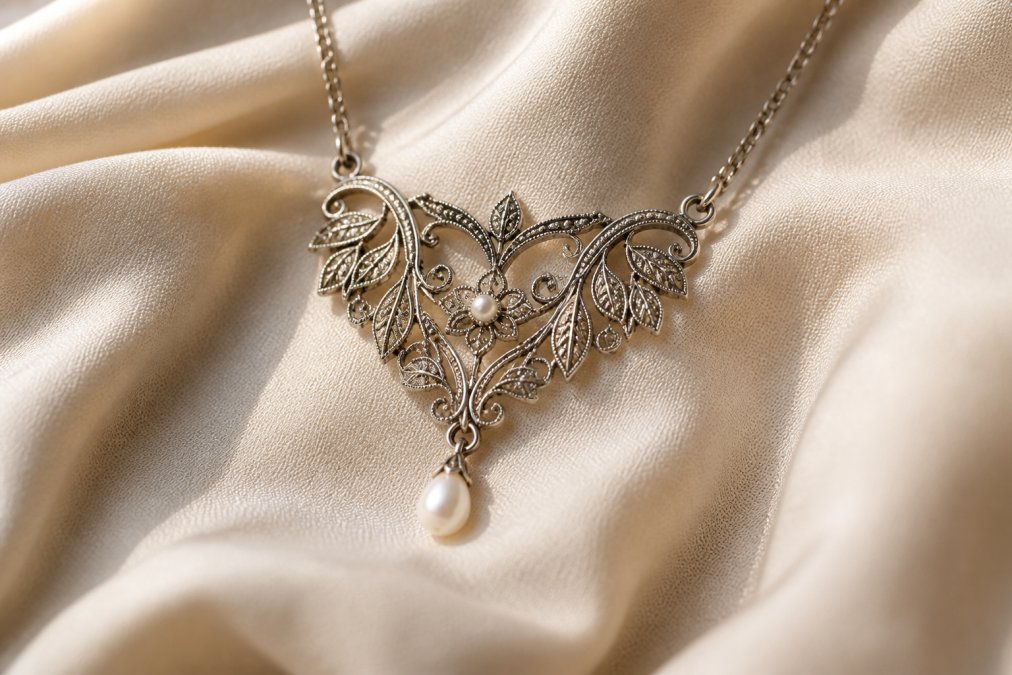
Garland Style, Laurel Wreaths, and Bow Motifs
Garland style mimics ribbon and flower swags. Laurel wreaths curve in a circle or arc. Bow motifs appear as small knots or ribbons at the top of a pendant.
Settings matter just as much. Look for:
- Milgrain: tiny beaded edges around a stone
- Filigree: fine openwork metal that looks like lace
- Bezel setting: a thin metal rim holding the stone
- Openwork: gaps in the metal that let light pass through
Step 4: Compare Victorian vs Edwardian Jewelry Differences
Victorian jewelry is heavier and more symbolic. Edwardian jewelry is lighter and more decorative.
- Is the metal heavy and dark, or light and bright?
- Are the motifs symbolic or decorative?
- Does the design feel solid or delicate?
Victorian leans solid. Edwardian leans delicate.
Step 5: Distinguish Edwardian from Art Deco Jewelry
Art Deco jewelry is geometric and bold. Edwardian jewelry is soft and flowing. Both use platinum and diamonds, which is why they get confused.
Step 6: Read Edwardian Jewelry Hallmarks and Stamps
Edwardian jewelry hallmarks and stamps are your best proof of origin, and the one area most identification guides skip. A hallmark is a small stamped mark that shows the metal content, the maker, and often the country of origin. On Edwardian pieces, marks are your fastest way to separate a genuine period piece from a later revival.
Where to Find Marks
Look for marks in these spots:
- Inside the band of a ring
- On the back of a brooch or bar brooch
- Along the edge of a pendant
- On the clasp of a necklace
- On the pinstem or catch of an earring
Use your 10x loupe. Marks are often tiny, worn, or partially polished away. A maker's mark, an assay mark, or a country stamp all add value. If a piece has no marks at all, treat it as unverified until a jeweler checks it.
What the Marks Actually Tell You
Edwardian pieces were made in several countries, and each used its own marking system. The most common marks you will encounter fall into four categories:
- Metal purity marks. Platinum pieces often carry a "PLAT" or "PT" stamp, sometimes with a number such as 950, which indicates 95% platinum content. White gold pieces may carry a karat mark such as 14K or 18K. Silver-topped pieces may show a sterling mark such as "STERLING" or "925."
- Maker's marks. These are small initials or a symbol stamped by the jeweler or workshop. They are the most useful for attribution, but they are also the most commonly worn away. A clear maker's mark on an Edwardian piece is a strong signal of quality.
- Assay or purity office marks. These are small symbols stamped by a government assay office to confirm metal content. They often appear alongside the maker's mark and the purity mark.
- Country of origin marks. A piece made in one country and sold in another may carry marks from both. This is common on Edwardian pieces that traveled through the export trade.
How to Read a Mark in Order
When you find a mark, read it in this sequence:
- Identify the metal purity mark first. This tells you what the piece is made of.
- Look for the maker's mark next. This tells you who made it.
- Check for an assay or country mark. This tells you where it was tested or sold.
- Note the position of the marks. Marks on the inside of a band or the back of a brooch are typical of period pieces. Marks on a clasp or a jump ring are more common on later pieces.
Red Flags in Marking
- A mark that is too crisp and modern-looking on an otherwise worn piece
- A purity mark that does not match the metal (for example, a "925" stamp on a piece that tests as platinum)
- A maker's mark that is stamped over another mark
- No marks at all on a piece that is otherwise consistent with the era
If a piece has no marks at all, treat it as unverified until a jeweler checks it. For context on how antique pieces are documented and valued, the Antiques Roadshow appraisal guides offer useful background on what appraisers look for.
What This Means for Value
A clear, legible hallmark or maker's mark can significantly increase the value of an Edwardian piece because it confirms origin and quality. A piece with no marks is not necessarily less valuable, but it is harder to sell at a premium without documentation. If you are buying at an estate sale or auction, the presence of a readable mark is one of the strongest signals that the piece is worth a closer look.
Step 7: How to Clean Vintage Antique Jewelry Safely
Learning how to clean vintage antique jewelry safely protects both the metal and the stones. Harsh cleaners can strip plating and loosen settings. But cleaning is only half the story, the other half is understanding what makes an Edwardian piece worth cleaning carefully in the first place.
Safe Cleaning Steps
Follow these steps:
- Fill a bowl with warm water and a drop of mild soap.
- Soak the piece for two to three minutes.
- Brush gently with a soft toothbrush.
- Rinse in clean water.
- Pat dry with a soft cloth.
Avoid these mistakes:
- Never use ultrasonic cleaners on pearls or glued stones
- Never soak pieces with foil-backed stones
- Never use ammonia or bleach on antique metal
- Never scrub milgrain or filigree with a stiff brush
Store each piece in its own soft pouch. Keep pieces apart so they do not scratch each other. For pieces with delicate openwork or fine chain, store them flat rather than hanging to avoid stress on the links.
What Actually Drives Edwardian Value
Most guides stop at "rarity." In practice, Edwardian value is driven by a handful of specific factors that buyers and appraisers weigh together:
- Metal content. Platinum pieces generally command a premium over silver-topped or white gold pieces of the same design. The weight of the metal matters too, a heavier platinum piece holds more intrinsic value.
- Stone quality and size. Diamonds are the primary value driver. Larger, cleaner stones set in Edwardian pieces carry a significant premium. Pearls, sapphires, and emeralds add value but are secondary to diamonds in most Edwardian pieces.
- Condition. Edwardian settings are delicate by design. Missing stones, bent filigree, or repaired claws reduce value. Original, unaltered settings are worth more than restored ones.
- Maker and provenance. A documented maker's mark or a known retailer name can increase value substantially. Provenance, a history of ownership or a known collection, adds another layer.
- Completeness. A piece with its original box, paperwork, or matching set is worth more than a standalone piece.
When to Get a Professional Appraisal
If you want a professional opinion, a jewelry appraisal gives you a written record of metal, stones, and value. That record matters for insurance and resale. For Edwardian pieces, look for an appraiser who has experience with antique and estate jewelry, not just modern pieces. Ask whether the appraisal is for insurance replacement value or fair market value, the two are different numbers and serve different purposes.
A Quick Value Checklist
Before you buy or sell, run through this list:
- Does the piece carry a readable hallmark or maker's mark?
- Is the metal platinum, white gold, or silver-topped?
- Are the stones original and intact?
- Is the filigree and milgrain intact, or has it been repaired?
- Does the piece have its original box or paperwork?
For collectors who want verified pieces without the guesswork, ABC Rugs Kilims & Jewelry offers a curated selection of vintage jewelry and gemstones, each reviewed before listing. We also carry handmade rugs, kilims, and Persian antique pieces for buyers building a full collection.
Frequently Asked Questions
What years were considered Edwardian jewelry?
Edwardian jewelry covers the reign of King Edward VII, from 1901 to 1915. The era ended with the start of World War I, when platinum became scarce and jewelry production shifted. Pieces made during this 14-year window carry the light, lace-like look collectors prize. Anything before 1901 falls into the Victorian era, and anything after 1915 moves toward Art Deco styling.
How does Edwardian jewelry differ from Victorian jewelry?
Victorian jewelry (1837-1901) tends to be heavier, with darker metals, mourning pieces, and bold gemstones. Edwardian pieces use platinum and white metal, openwork filigree, milgrain details, and garland motifs. Victorian designs often feel ornate and weighty; Edwardian designs feel ethereal and delicate. If a piece feels light in the hand and looks lace-like, it leans Edwardian.
What metals and gemstones were most common in Edwardian pieces?
Platinum dominated Edwardian fine jewelry because it allowed thin, strong settings. White gold and silver-topped gold also appeared. Diamonds were the star gemstone, often paired with pearls, sapphires, emeralds, and the rare demantoid garnet. The white-on-white look, diamonds set in platinum against platinum, defined the era. Colored stones usually served as accents around a diamond center.
How can you tell if a piece of jewelry is Edwardian style or authentic?
Style clues include garland motifs, laurel wreaths, bow motifs, milgrain edges, and lozenge-shaped openwork. Authenticity requires more: check for hallmarks and maker's marks, examine the setting techniques, and look for wear consistent with age. A jeweler or appraiser can confirm metal content and stone identity. Style alone tells you the design era; hallmarks and materials confirm the piece is genuinely antique.
Identifying Edwardian jewelry comes down to patience and a few repeatable checks. The era, the metal, the motifs, and the marks will tell you most of what you need to know.
When you want pieces that have already been checked by people who handle antiques daily, ABC Rugs Kilims & Jewelry is a trusted place to start. Browse our reviewed collection of vintage jewelry, gemstones, and antique textiles, and find something worth keeping.


