

Table of Contents
- What Makes Kilim Rugs a Sustainable Choice
- Hand Knotted vs Machine Made Rugs: Why the Loom Matters
- Benefits of Vintage Wool Rugs for a Greener Home
- Natural Dyes and Fibers: Non-Toxic and Renewable
- How to Identify Authentic Kilim Rugs
- End-of-Life and Comparative Environmental Impact
- Conclusion: Choosing Sustainable Home Decor with Confidence
- Frequently Asked Questions
Last Updated: September 21, 2026
What Makes Kilim Rugs a Sustainable Choice
A kilim rug is a flat-weave textile, meaning it has no pile, produced on a loom by hand rather than by machine. That single structural fact explains most of why are kilim rugs considered sustainable home decor: they use natural fibers, skip the energy-intensive tufting process, and can last for generations instead of a few years. At ABC Rugs Kilims & Jewelry, we handle vintage and antique kilims daily, and the difference between a well-made flat-weave and a mass-produced floor covering shows up long before either one wears out.
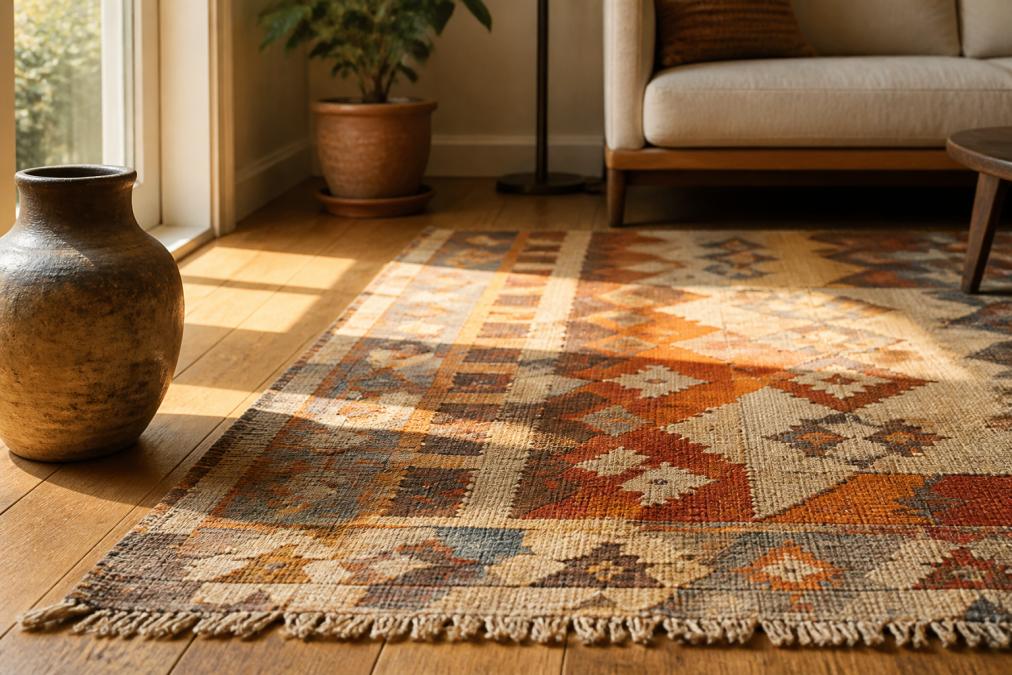
The Environmental Cost of Conventional Rugs
Most machine-made rugs rely on synthetic fibers derived from petroleum. They are produced on high-speed power looms, backed with latex or synthetic adhesives, and treated with chemical stain repellents. When they wear out, they typically go to landfill, where synthetic fibers can persist for decades.
How Kilims Fit Circular Design and Slow Home Decor
Circular design asks a simple question: what happens to this object after you're done with it? Slow home decor applies the same logic to interiors, favoring fewer, better-made pieces over frequent replacements. Prioritizing locally made decor further minimizes the environmental footprint of your living space by reducing the energy required for long-distance transport.
Hand Knotted vs Machine Made Rugs: Why the Loom Matters
Hand knotted vs machine made rugs is not just a price distinction. A hand-knotted or hand-woven rug is built one knot or one weft pass at a time on a loom, while a machine-made rug is produced on a power loom that can output many times the volume in the same period. That speed gap is exactly where the environmental cost hides.
Energy, Waste, and Durability in Hand-Woven Rugs
Hand-woven rugs generate almost no production waste. Yarn that isn't used in one kilim gets worked into another. Machine production, by contrast, produces offcuts, backing scraps, and rejected runs that are often discarded.
Benefits of Vintage Wool Rugs for a Greener Home
The benefits of vintage wool rugs start with the fact that their environmental cost has already been paid. No new fiber was spun, no new dye was mixed, and no new loom time was spent to bring an existing rug into your home. Buying vintage is the closest thing the textile world has to a zero-new-production purchase.
Wool Resilience, Biodegradability, and Patina
Wool is biodegradable. Given the right conditions, a wool textile will break down over time rather than persisting in a landfill. That's a meaningful contrast with petroleum-based fibers.
Natural Dyes and Fibers: Non-Toxic and Renewable
Traditional kilims are dyed with vegetable-based dyes derived from plants, roots, insects, and minerals. Madder root produces reds, indigo yields blues, walnut hulls give browns, and pomegranate rind produces yellows. These are renewable inputs, and they are non-toxic compared with the synthetic azo dyes used in much of the mass-market textile industry.
How to Identify Authentic Kilim Rugs
Learning how to identify authentic kilim rugs protects both your investment and your sustainability claim. A machine-made flat-weave sold as handmade carries the same environmental footprint as any other power-loom product, so verification matters.
Here's a practical checklist to run before you buy:
Pillows Covers 16" X 16" Rugs Kilim →
- Check the reverse. A true kilim shows the pattern on both faces, with visible weft threads and no glued backing.
- Look for irregularity. Hand-woven rugs have slight variations in width, knot density, and pattern alignment. Perfect uniformity usually signals machine production.
- Examine the selvedge. Hand-finished edges are slightly uneven and often show hand-stitching. Machine edges are razor-straight and uniform.
- Test the fiber. Wool feels warm and slightly coarse; synthetic yarn feels cooler and slicker. A burn test on a loose fiber (done safely outdoors) smells like burnt hair for wool and like plastic for synthetics.
- Ask about provenance. Reputable sellers can describe the region, era, and weaving tradition behind a piece.
| What to Check | Authentic Hand-Woven Kilim | Machine-Made Flat-Weave |
|---|---|---|
| Reverse side | Same pattern, visible weft | Uniform, printed look, glued backing |
| Width consistency | Slight variation | Perfectly uniform |
| Selvedge | Hand-finished, slightly uneven | Straight, machine-cut |
| Fiber | Wool, cotton, goat hair | Often synthetic blends |
| Dyes | Vegetable-based, may shift with age | Synthetic, colorfast |
End-of-Life and Comparative Environmental Impact
End-of-life is where kilims separate most clearly from synthetic alternatives, and it's also where most rug content stops short. A wool kilim at the end of its usable life can be repaired, repurposed, composted, or donated. A synthetic rug typically goes to landfill, where its fibers may persist for decades. That contrast is the headline, but the useful detail is in the mechanics.
What Actually Happens to a Wool Kilim at End of Life
Wool is a protein fiber (keratin), which means it is biodegradable under the right conditions. In a home compost pile or an industrial composting environment with adequate moisture, oxygen, and microbial activity, a 100% wool textile will break down over time and return nutrients to the soil. The practical caveats matter:
- Dyes and finishes. Vegetable-dyed wool is the cleanest candidate for composting. Wool treated with synthetic dyes, mothproofing, or stain repellents is a poorer compost input and is better routed to textile recycling.
- Blends. A kilim woven with cotton warp and wool weft will still break down, but the cotton portion decomposes on a different timeline. Pure-wool pieces are the simplest case.
- Backing and bindings. Any glued backing, latex, or synthetic binding must be removed before composting. A true flat-weave kilim usually has none.
- Scale. A full-size rug is a large volume for a home compost pile. In practice, most owners donate, sell, or downcycle before composting becomes the option.
Comparative Lifecycle: Wool Kilim vs. Synthetic Rug
| Lifecycle Stage | Hand-Woven Wool Kilim | Synthetic Machine-Made Rug |
|---|---|---|
| Raw material | Renewable wool, cotton, goat hair | Petroleum-derived fibers (polypropylene, polyester, nylon) |
| Production energy | Human-powered loom | High-energy power loom |
| Chemical inputs | Vegetable dyes, no stain treatment | Synthetic dyes, stain repellents, latex backing |
| Typical lifespan | Decades, often generations | A few years |
| Repairability | Re-weavable at the warp and weft level | Rarely repairable once backing fails |
| End of life | Repairable, repurposable, compostable (if untreated wool) | Landfill, minimal recycling |
| Microplastic shedding | None (natural fiber) | Sheds fibers during use and washing |
Certification Transparency: What to Actually Look For
There is no single universal "sustainable rug" certification, and labels vary widely in what they verify. Rather than trusting a logo, ask what a given certification actually covers across three axes: fiber origin, dye and chemical inputs, and labor conditions.
- Fair Trade certifications generally focus on labor conditions, fair wages, and worker protections in the supply chain. They are not a fiber or dye guarantee.
- GoodWeave focuses specifically on eliminating child labor in rug production and on verified supply-chain inspections. It is a labor-focused standard, not an environmental one.
- Wool fiber standards (for example, responsible-wool programs) address animal welfare and land management on the fiber side, but say nothing about dyes or weaving labor.
- Organic fiber standards address how the fiber was grown, not how the rug was made.
The Gap Most Comparisons Miss
Most lifecycle comparisons stop at the point of sale, which understates the advantage of a rug that can be repaired and re-woven rather than replaced. A rug that lasts 30 years instead of 3 spreads its production impact across ten times the service life, and a rug that can be repaired extends that further still. That is the number that matters, and it is the one most rug content never states.
Conclusion: Choosing Sustainable Home Decor with Confidence
Building a home around sustainable home decor means asking harder questions about where a piece came from and where it will end up. Kilims hold up well under that scrutiny: renewable fibers, low-energy production, vegetable-based dyes, and a lifespan measured in decades rather than seasons.
Frequently Asked Questions
Are vintage kilim rugs better for the environment than new rugs?
Vintage kilims avoid new production entirely, so they skip the water, energy, and raw materials a new rug requires. They also keep existing textiles in use, which supports circular design and waste reduction. Because vintage wool has already aged, it is less likely to shed or need chemical treatments. Choosing a vintage kilim is one of the lowest-impact ways to add sustainable home decor.
What materials are used in authentic kilim rugs?
Authentic kilims are woven from natural fibers, most often wool, sometimes with cotton for the warp. Traditional makers use vegetable-based dyes from plants, roots, and insects. These materials are renewable, biodegradable, and non-toxic. Wool resilience means the rug holds up for decades. When you are shopping, look for listings that name the fiber and dye type, such as hand-knotted wool with natural dyes, to confirm authenticity and sustainability.
How can I tell a hand-knotted kilim from a machine-made one?
Turn the rug over. A hand-knotted or hand-woven kilim shows slight irregularities in the weave, knots, and pattern, plus a soft, flexible feel. Machine-made rugs have perfectly uniform rows, a stiff backing, and often a synthetic sheen. Hand-woven rugs also age with patina instead of pilling. If the price seems too low for a handmade piece, ask about the loom and fiber. Authentic kilims carry subtle signs of traditional craftsmanship.
Can a kilim rug work in a modern home?
Yes. Kilims are pileless and flat-weave, so they lie low and fit under furniture without bulk. Their geometric patterns and earthy colors pair well with modern and minimalist interiors. You can layer a kilim over a larger rug or use one as a wall hanging. For a smaller accent, a kilim pillow cover, such as the hand-knotted Turkish pillow covers made with natural New Zealand wools and cotton, adds the same sustainable style to a sofa or bed.


