

Table of Contents
- Kilim Rugs vs Dhurrie Rugs: The Core Differences at a Glance
- What Is a Kilim Rug?
- What Is a Dhurrie Rug?
- Identifying Authentic Handmade Kilims
- How to Clean Flatweave Rugs Without Damaging Them
- Styling Dhurrie Rugs in Modern Interiors
- Durability, Maintenance, and High-Traffic Use
- Conclusion
- Frequently Asked Questions
Last Updated: September 16, 2026
Kilim Rugs vs Dhurrie Rugs: The Core Differences at a Glance
The difference between kilim rugs and dhurrie rugs comes down to structure, origin, and ornamentation: kilims are tightly woven, tapestry-style flatweaves from Central Asia, the Middle East, and the Balkans, while dhurries are lighter, simpler cotton flatweaves from the Indian subcontinent. This guide from ABC Rugs Kilims & Jewelry breaks down kilim rugs vs dhurrie rugs in practical terms.
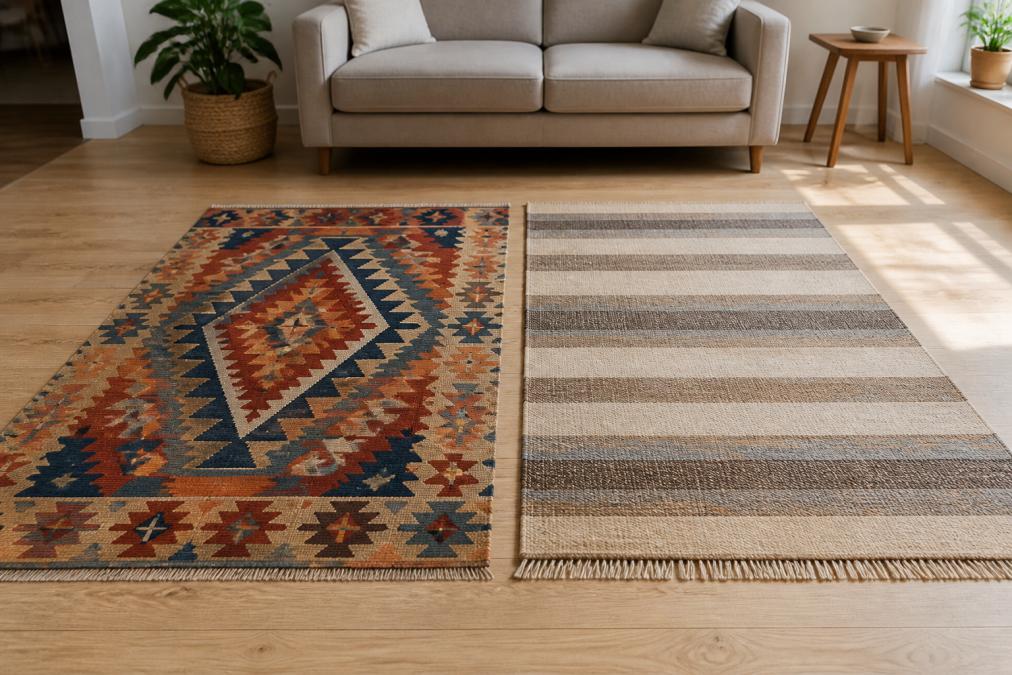
| Feature | Kilim | Dhurrie |
|---|---|---|
| Primary origin | Central Asia, Middle East, Balkans | Indian subcontinent |
| Dominant fiber | Wool, sometimes with cotton warp | Cotton, sometimes wool blends |
| Weave type | Tapestry (weft-faced, slit weave) | Flat plain weave, lighter density |
| Typical look | Bold tribal motifs, geometric patterns | Simple stripes, checks, minimal motifs |
| Weight and feel | Denser, heavier, more structured | Lightweight, pliable, casual |
| Best use | Living rooms, wall hangings, layering | Bedrooms, casual spaces, layering |
What Is a Kilim Rug?
A kilim rug is a pileless flatweave in which the colored weft threads form the entire design, covering the warp so no knots or pile are visible. This tapestry weave produces its flat surface, crisp color blocks, and reversible structure.
Origins and Weaving Regions
Kilim weaving spans a wide belt of cultural heritage documentation from the Smithsonian's textile collections traditions, from Central Asian nomadic groups through Anatolia, the Caucasus, and into the Balkans. Nomadic weavers made kilims as practical furnishings: lightweight, portable floor coverings and tent dividers that could be rolled and carried. That functional origin shaped the aesthetic. Motifs were passed down and varied by tribe and region, which is why two kilims of similar age can look completely unrelated.
Construction and Signature Motifs
The defining technical feature is the slit weave: when a weaver changes color, the two weft blocks don't always interlock, leaving a small vertical gap that gives kilims their stepped diagonal lines. Many weavers use interlocked joins instead, producing cleaner horizontal edges.
What Is a Dhurrie Rug?
A dhurrie rug is a lightweight, flatwoven floor covering traditionally made in the Indian subcontinent, most often from cotton. The name derives from the Hindi word for a cotton floor mat, and the construction is a plain weave rather than the tapestry weave used in kilims, a single structural fact that drives almost every other difference between the two.
Regional Weaving Traditions
Dhurrie production clusters in a handful of weaving centers, each with a recognizable hand:
- Rajasthan, the best-known source of flatwoven cotton dhurries, including the striped and checked patterns that dominate the export market. Weavers here often work on horizontal pit looms, which limits width and encourages the long, narrow proportions common in vintage pieces.
- Uttar Pradesh, home to finer cotton dhurries and many wool-blend pieces, with tighter weaves and more intricate geometric borders.
- Punjab, associated with heavier, more durable dhurries that bridge the gap toward kilim density, often using thicker cotton yarns.
- Gujarat, known for bold color work and block-printed or embroidered embellishment on top of the woven base.
Materials and Weave Structure
Cotton dominates dhurrie construction because it is affordable, breathable, and takes dye evenly; wool appears in higher-grade dhurries, usually blended for softness and resilience. The plain weave means less density than a kilim and a looser hand.
Design Vocabulary
Dhurrie patterns are traditionally flatter and more restrained than kilim motifs:
- Horizontal stripes in two or three colors
- Checks and windowpane grids
- Simple repeating diamonds or stepped borders
- Solid fields with a single contrasting band at each end
Identifying Authentic Handmade Kilims
Authenticity in a handmade kilim shows up in irregularity. Machine-made reproductions are too perfect, straight lines, even color, uniform edges. Handwoven kilims carry small imperfections that are extremely difficult to fake at scale.
Run through this checklist before you buy:
- Check the selvedge edges. Hand-finished edges are slightly uneven and tightly bound. Machine edges are razor-straight.
- Look at color transitions. Natural dyes shift and abrash (intentional tonal variation) across a field. Synthetic dyes stay flat and uniform.
- Inspect the back. A true kilim is reversible; the pattern should read clearly from the reverse side.
- Weigh the density. Hand-loomed wool kilims feel substantial for their thickness. Flimsy and light usually means machine production.
- Check for a cotton warp. Many traditional kilims use a cotton foundation with wool weft, which is normal and not a defect.
How to Clean Flatweave Rugs Without Damaging Them
Cleaning flatweave rugs starts with dry soil removal, not water. Because kilims and dhurries have no pile to trap grit, loose dirt works into the fibers with every footstep, so regular vacuuming matters more than on a pile rug.
Routine maintenance (weekly):
- Vacuum both sides on the lowest suction setting, no beater bar
- Rotate the rug every few months so traffic wear stays even
- Shake or beat lighter dhurries outdoors to release embedded dust
Stain removal (act immediately):
- Blot, never rub, with a clean white cloth
- Use cool water and a mild pH-neutral detergent
- Work from the outer edge of the stain inward to avoid spreading
- Test any solution on a hidden corner first
Styling Dhurrie Rugs in Modern Interiors
Styling dhurrie rugs in modern interiors works best when you treat them as a texture layer rather than the focal point. Their lighter weight and simpler patterns let them sit under furniture without competing with artwork.
A few approaches that hold up in practice:
- Layering. Place a dhurrie over a neutral wall-to-wall carpet or jute base to add pattern without bulk. This is the single most effective trick for large, open-plan rooms.
- Under a bed. A dhurrie's low profile makes it ideal for bedrooms, where a thicker pile can catch on doors and furniture legs.
- Dining areas. Flatweaves let chairs slide in and out without the rug bunching, which is a persistent problem with pile rugs.
- Color anchoring. Pull one accent color from the dhurrie and repeat it in cushions or art to tie the room together.
Durability, Maintenance, and High-Traffic Use
Durability favors the kilim in almost every comparison, for mechanical reasons. A kilim is weft-faced: the colored weft threads are packed so densely they form the entire wearing surface, so traffic abrades the thickest, most tightly spun part of the structure. A dhurrie is a balanced plain weave, so traffic abrades both warp and weft, and the thinner of the two fails first.
One Of The Kind Hand-Knotted Persian →
How Each Type Wears Over Time
Knowing where each type fails first lets you inspect a rug before you buy and monitor it after.
Kilim wear pattern:
- Slit gaps (the small vertical openings where colors change) can open slightly with age, especially in dry climates. This is normal and rarely structural.
- Folds and creases from storage can become permanent if the rug is left rolled tightly for years.
- Selvedge edges are the most vulnerable point; a broken selvedge thread can unravel a column of weft if not secured.
Dhurrie wear pattern:
- Edge fray is the first failure, usually starting at the corners where chairs and feet catch the weave.
- Center compression appears as a dull, flattened band in the traffic lane.
- Loose weft threads can snag and pull, creating visible ridges across the surface.
Maintenance Cadence That Actually Works
Maintenance is broadly similar for both types, but the margin for error is not. A kilim forgives a delayed cleanup better than a cotton dhurrie, because wool resists staining and holds dye more tenaciously.
Weekly:
- Vacuum both sides on the lowest suction setting, no beater bar. The beater bar is the single most common cause of accelerated wear on flatweaves.
- Rotate the rug 180 degrees every few months so traffic wear stays even.
- Shake or beat lighter dhurries outdoors to release embedded dust.
Monthly:
- Inspect edges and corners for fraying or loose weft threads. Catch them early; a single loose thread can be secured in minutes, while a full edge repair is a professional job.
- Check for insect activity under the rug, especially in humid months. Wool is attractive to moths; cotton less so, but both can host carpet beetles.
Seasonally:
- Rotate the rug's position relative to sunlight. Both wool and cotton dyes fade under direct UV, and natural dyes fade unevenly, which is more noticeable on a kilim's large color blocks.
- Air the rug outdoors in shade, not direct sun, for a few hours to refresh fibers and release trapped moisture.
Stain Removal by Fiber
The correct cleaning method depends on the fiber, not the rug type. Treating a wool kilim like a cotton dhurrie is how people ruin both.
Wool kilims:
- Blot, never rub, with a clean white cloth.
- Use cool water and a mild pH-neutral detergent. Hot water and alkaline cleaners can felt wool and strip natural dyes.
- Work from the outer edge of the stain inward to avoid spreading it.
- Test any solution on a hidden corner first, especially on reds and deep blues, which are the most likely to bleed.
- For wool with natural dyes, professional cleaning is the safer route for anything beyond a fresh spill, because some natural dyes can migrate with excess moisture.
Cotton dhurries:
- Cotton tolerates more water and more agitation than wool, but it still should not be machine-washed.
- Blot spills immediately; cotton wicks liquid into the weave faster than wool.
- A mild detergent solution and a soft brush can lift most stains, but dry the rug flat and away from direct sun to prevent shrinkage and fading.
- Never wring or twist a wet dhurrie; the weave will distort permanently.
Repair Economics
Repair cost is where the durability difference becomes financial. A small edge repair on a dhurrie, re-securing a frayed corner or re-weaving a short section of selvedge, is typically a modest, routine service. A comparable repair on a kilim is more involved because it must match the weft-faced structure and the original dye lot, and a mismatched repair is visible on a flat, graphic surface.
| Situation | Better choice | Why |
|---|---|---|
| High-traffic hallway | Kilim | Dense weft resists abrasion; wool recovers from compression |
| Bedroom or casual nook | Dhurrie | Light, soft underfoot, easy to move |
| Layering over carpet | Dhurrie | Low profile, will not bunch |
| Wall hanging or statement piece | Kilim | Graphic motifs read as textile art |
| Dining room under chairs | Either | Both flatweaves allow chairs to slide |
| Under a sofa with heavy legs | Kilim | Wool resists permanent dents; cotton compresses |
| Rental or frequently rearranged space | Dhurrie | Light enough to move without help |
Conclusion
Choosing between these two flatweaves comes down to matching construction to purpose. If you need density, graphic impact, and long-term durability, a kilim is the stronger investment. If you want lightness, easy handling, and a quiet pattern layer, a dhurrie does the job at a fraction of the weight.
Frequently Asked Questions
What is the difference between a dhurrie and a kilim rug?
Both are flatweave, pileless rugs, but they differ in origin and construction. Kilim rugs come from Turkish, Persian, Caucasian, and Central Asian weaving traditions, use slit tapestry weave, and often feature bold geometric or tribal motifs in wool. Dhurrie rugs originate in India, are typically woven from cotton or wool, and tend toward simpler stripes, checks, or flat geometric patterns. Kilims are usually reversible and heavier; dhurries are lighter and often thinner.
How can I identify an authentic handmade kilim rug?
Check the back first. A genuine handmade kilim is reversible, with the pattern visible on both sides and slight irregularities in the weave. Look for hand-spun wool with natural dye variation, uneven selvages, and minor color shifts from sun exposure or age. Machine-made copies have perfectly uniform edges and identical front-and-back patterns. Ask for provenance details, including region and estimated age, before buying.
Are kilim and dhurrie rugs both considered flatweaves?
Yes. Neither has a pile, so both fall under the flatweave category. Kilims use weft-faced tapestry weave, where the colored weft threads cover the warp entirely. Dhurries use a similar flat construction but are often woven more loosely and with cotton warps. This shared pileless structure makes both lightweight, reversible, and easy to layer, though the kilim's tighter weave generally gives it more weight and density.
Which is more durable: a kilim or a dhurrie rug?
Kilim rugs generally hold up longer in high-traffic areas because their tightly packed wool weft creates a denser, heavier fabric. Wool resists crushing and soil better than cotton. Dhurrie rugs are lighter and can shift or wear faster under heavy foot traffic, especially cotton versions. For entryways, hallways, or family rooms, a wool kilim or a wool-blend dhurrie is the safer choice. Rotate either rug periodically to even out wear.


