

Table of Contents
- Why Verifying Rug Seller Reviews Matters
- How to Spot Fake Rug Reviews
- Identifying Authentic Antique Rugs Through Customer Feedback
- Checking Customer Feedback and Testimonials
- Tools for Checking Website Legitimacy
- Rug Seller Return Policy Red Flags
- Verifying Rug Origin and Authenticity Claims
- Comparing Prices and Spotting Unrealistic Deals
Last Updated: August 29, 2026
Why Verifying Rug Seller Reviews Matters
When investing in a hand-knotted Persian rug or rare antique kilim, you're making a significant financial and aesthetic commitment. Online marketplaces have become difficult to navigate safely, with fake reviews, doctored images, and misleading descriptions proliferating across e-commerce platforms. Learning how to verify online rug seller reviews is essential to protecting yourself.
Understanding how to authenticate customer feedback is your first line of defense against costly mistakes.
How to Spot Fake Rug Reviews
Identifying fake reviews requires attention to patterns that real customer feedback rarely exhibits. Genuine testimonials contain specific details about the buying experience, the rug's appearance, and how it performs in the customer's home. Fake reviews tend to be generic, overly enthusiastic, and focused on broad praise rather than concrete observations.
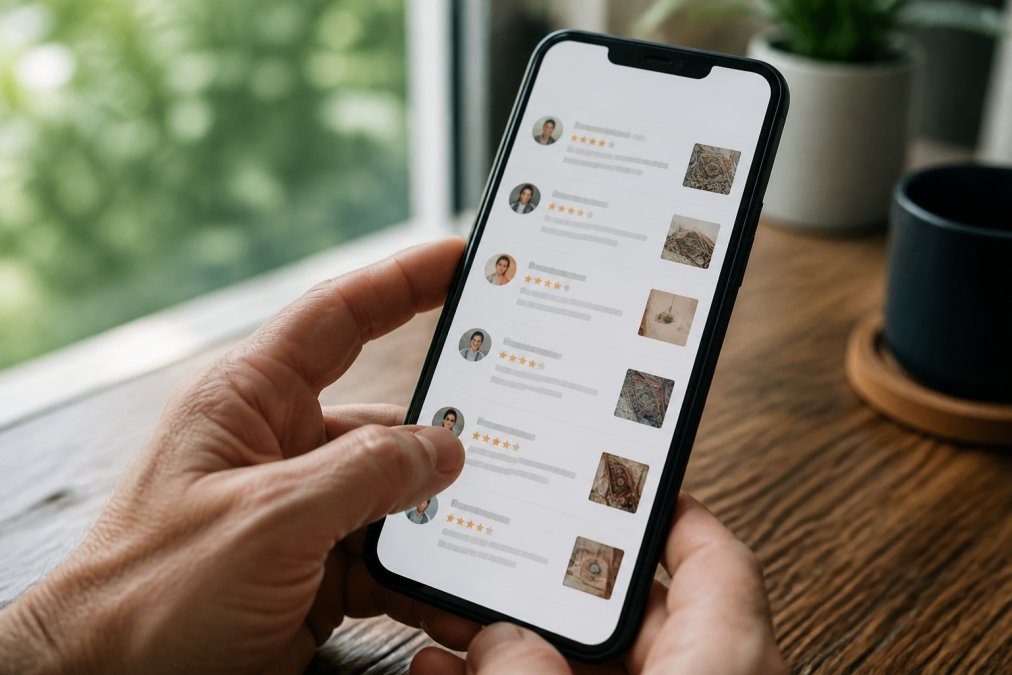
Red flags in review language and patterns
Authentic customer reviews mention specifics: the rug's color in natural light, how it feels underfoot, whether the fringe held up, or how it looked in their particular room. Reviews saying "Amazing quality!" or "Perfect rug!" without supporting detail are warning signs. Fake reviews use stilted phrasing like "I am very satisfied with this purchase" or "This seller is highly recommended," avoiding contractions and reading like marketing copy.
Pay attention to review timing. If a seller suddenly receives 20 five-star reviews within a single week, especially before a major sale event, that pattern suggests manipulation. Legitimate feedback arrives gradually and irregularly.
Verification through reviewer history
Click on reviewer profiles to examine their history. Are they reviewing dozens of unrelated products in a suspiciously short timeframe? Do they only leave five-star reviews? Authentic reviewers have varied feedback patterns across different product types and timeframes. If a reviewer has left 15 reviews, all five stars, all within the past month, all for similar rug sellers, that's a coordinated review scheme.
Check whether reviews are marked "Verified Purchase." Most reputable platforms mark verified reviews. Unverified reviewers could be anyone, including the seller or their associates.
Identifying Authentic Antique Rugs Through Customer Feedback
Customer testimonials reveal whether a seller understands antique rugs or is reselling mass-produced items under the guise of authenticity. Listen for customers mentioning specific details about the rug's origin, age, or construction.
Knowledgeable sellers attract informed customers. You'll see reviews mentioning "the seller correctly identified the region and approximate age" or "the documentation provided was thorough and accurate." These comments indicate genuine expertise in authenticating antique pieces.
If reviews consistently mention vague descriptions like "beautiful old rug" without specifics about provenance, region, or era, the seller likely doesn't know much about what they're selling. Legitimate antique dealers understand knot density, fiber content, and how these factors date a piece. Their customers reference this knowledge in feedback.
Pay attention to reviews mentioning the seller's responsiveness to authenticity questions. Did the seller provide documentation? Did they explain provenance? Authentic dealers welcome these questions and provide detailed answers.
Checking Customer Feedback and Testimonials
Once you've filtered for likely authentic reviews, extract actionable information from legitimate testimonials. Not all positive reviews are equally useful.
What legitimate testimonials reveal about quality
Genuine feedback often addresses the gap between online photos and the physical product. A customer might say, "The colors are even more vibrant in person than the listing photos suggested." Look for testimonials mentioning the rug's performance over time: Has it held up well? Are colors fading? Is the fringe still intact? These observations indicate durability and long-term satisfaction.
Testimonials about the buying experience matter too. Did the seller ship quickly? Was packaging adequate? Did they respond to questions? These details indicate professional treatment throughout the transaction.
Sample size and review volume considerations
A seller with 50 reviews carries more weight than one with five, but quantity alone isn't determining. A newer seller with 20 detailed, specific reviews might be more trustworthy than an established seller with 200 generic five-star reviews.
Look at rating distribution. A seller with exclusively five-star reviews across hundreds of reviews is statistically unlikely. A realistic distribution might be 85-90% five-star, 5-10% four-star, and perhaps 1-2% lower ratings, suggesting genuine feedback rather than curation.
Tools for Checking Website Legitimacy
Beyond reviews, verify that you're buying from a legitimate seller operating a secure, professional website.
Third-party verification services
Check whether the seller appears on the Better Business Bureau website or has legitimate business registration. Third-party review aggregators like Trustpilot or Google Reviews provide independent platforms where customers can leave feedback outside the seller's controlled environment. If a seller has glowing reviews only on their own site but negative reviews on independent platforms, that discrepancy is a major red flag.
SSL certificates and secure payment processing are baseline expectations. Your browser should show a padlock icon and the URL should begin with "https://" not "http://". If a seller's website lacks these security features, do not enter payment information.
Reverse image search and visual verification
One of the most effective ways to spot sellers using misleading photos is reverse image search. Upload a product photo to Google Images or TinEye. If that exact image appears on multiple seller websites or stock photo sites, the seller is using images that aren't actually of their inventory.
This is particularly valuable for verifying antique rugs. Authentic antique pieces are unique and shouldn't appear identically on multiple seller websites. If you find the exact same rug photo listed by three different sellers as three different rugs, those listings are fraudulent.
Examine photos for signs of manipulation. Are colors unnaturally saturated? Do lighting conditions seem artificial? Professional sellers photograph rugs in natural light, showing them in context. Heavily filtered or artificially enhanced photos suggest the seller is hiding something.
Rug Seller Return Policy Red Flags
A seller's return policy reveals their confidence in their products and commitment to customer satisfaction. Generous return policies indicate a seller who stands behind what they sell.
Be wary of sellers offering no returns or returns only within 7-14 days. Rugs need time to settle into a space. A reasonable return window is at least 30 days, and 60 days is increasingly common among reputable sellers.
Pay attention to restocking fees. Some sellers charge 15-25% restocking fees, which significantly increases your cost if the rug doesn't work out. Check whether the seller covers return shipping. Reputable sellers typically cover return shipping for items that don't match their descriptions.
Verifying Rug Origin and Authenticity Claims
When a seller claims a rug is a Persian antique, Turkish kilim, or Afghan hand-knotted piece, you need ways to verify these claims beyond their description.
Documentation and provenance verification
Legitimate sellers of antique rugs provide documentation supporting authenticity claims. This might include certificates of authenticity, provenance history, or detailed condition reports. Ask for this documentation before purchase. For high-value pieces, consider requesting a third-party appraisal. Professional rug appraisers can verify authenticity, identify region of origin, and estimate age.
Examine the seller's expertise. Do they provide detailed information about the rug's region, weaving techniques, dye sources, and historical context? Knowledgeable dealers discuss these factors in depth. Sellers simply listing "Persian rug" without regional specificity may not understand what they're selling.
Technical details: knot density, fiber content, and construction
Technical specifications provide concrete evidence of authenticity and quality. Knot density, the number of knots per square inch, varies significantly by region and age. A seller claiming a rug is Persian should provide knot density information that aligns with that claim.
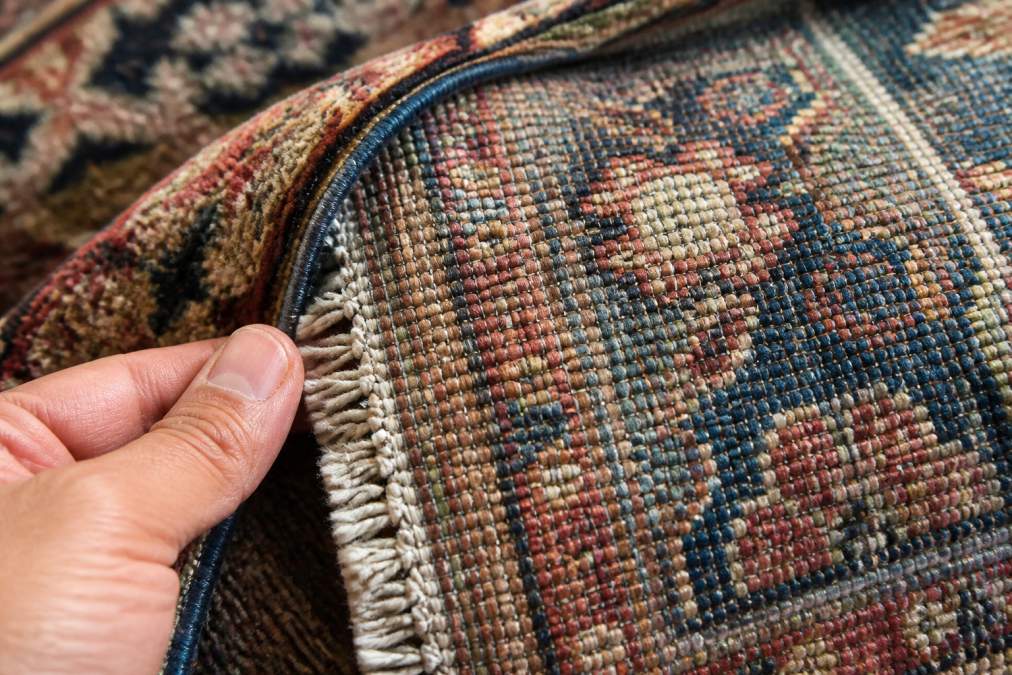
Fiber content matters for both authenticity and durability. Genuine hand-knotted rugs use natural fibers: wool, silk, or cotton. A seller should clearly specify fiber content. The construction method reveals authenticity. Hand-knotted rugs have knots tied individually by hand. Hand-woven rugs are loomed without individual knots. Machine-made rugs have a uniform, perfect appearance.

Examine the back of the rug if possible. Hand-knotted rugs show individual knots on the back. Ask about dye sources. Antique rugs used natural dyes that age and fade in specific ways, different from modern synthetic dyes.
Comparing Prices and Spotting Unrealistic Deals
Price is often the first indicator of whether a deal is legitimate. Rugs that seem significantly underpriced compared to similar pieces warrant investigation.
Research comparable rugs across multiple sellers. Look at size, age, condition, region of origin, and material. A 9x12 hand-knotted Persian rug in good condition should fall within a fairly consistent price range across reputable dealers. If one seller offers the same rug for 40% less than competitors, ask why.
Consider the seller's business model. Discount retailers often source from multiple suppliers and prioritize volume over curation. Their prices are lower because they're selling mass-produced items, not carefully selected antiques.
ABC Rugs Kilims & Jewelry maintains transparent pricing on our hand-knotted pieces because we stand behind authenticity. Our One Of The Kind Hand Knotted Persian Rug 4'0" x 2'1" (R17713) is priced at $324.00, reflecting the quality and craftsmanship of a genuine hand-knotted piece. Our larger pieces, like the One Of The Kind Hand Knotted Persian Rug 12'7" x 9'0" (R15424) at $4,580.00, command higher prices because of their size and the labor involved in creating them.

Be cautious of sellers running constant sales or deep discounts. If a seller is always advertising 50% off, question whether those are their real prices.
| Verification Method | What It Reveals | Time Required | Reliability |
|---|---|---|---|
| Review history analysis | Seller reputation and customer satisfaction | 10-15 minutes | High |
| Reverse image search | Whether photos are authentic or reused | 5 minutes | High |
| Third-party verification | Seller legitimacy and business registration | 5-10 minutes | High |
| Technical specification review | Rug authenticity and quality level | 15-20 minutes | High |
| Price comparison | Whether pricing is realistic for the market | 20-30 minutes | Medium |
| Return policy examination | Seller confidence and customer protection | 5 minutes | Medium |
When evaluating an online rug seller, use multiple verification methods rather than relying on any single indicator. A seller with positive reviews, authentic photos, detailed technical specifications, reasonable pricing, and a generous return policy is far more trustworthy than one excelling in only one or two areas.
The investment in verification time upfront prevents costly mistakes. Thorough vetting before purchase is always faster and cheaper than dealing with problems after the sale.
According to the Federal Trade Commission's guidance on online shopping, consumers have rights when purchasing items online, including accurate product descriptions and honest representations. If a seller violates these standards, you have recourse through dispute resolution processes and credit card chargebacks.
Research from consumer protection organizations tracking e-commerce fraud shows that the most common complaints about online purchases involve misrepresented items and inaccurate photos. The rug market is particularly vulnerable because high-value items justify the effort sellers invest in creating convincing fraudulent listings.
Consider consulting industry resources for antique rug authentication when making significant purchases. Museums and cultural institutions often provide educational resources about rug identification, regional characteristics, and authenticity markers.
Buying rugs online requires balancing convenience with caution. By systematically verifying seller reviews, checking website legitimacy, examining technical specifications, and comparing prices across multiple sources, you protect yourself from fraud and ensure you receive exactly what you paid for.
ABC Rugs Kilims & Jewelry has built our reputation on authenticity and customer trust. Every piece in our collection undergoes careful verification for origin, construction, and condition. Our reviewed and trusted status reflects years of delivering exactly what customers expect. When you shop with us, you're buying from sellers who understand the importance of verification, because we apply those same rigorous standards to every piece we source.
Frequently Asked Questions
How can I tell if an online rug review is fake?
Look for reviews that use generic, repetitive language or contain excessive praise without specific details about the rug's condition, color, or size. Fake reviews often appear in clusters on the same date, come from new accounts with no purchase history, or use stock phrases. Check the reviewer's profile for other reviews, legitimate customers typically review multiple purchases. Cross-reference seller ratings across third-party platforms like Trustpilot or the Better Business Bureau to confirm consistency.
What are the red flags of an untrustworthy rug seller?
Untrustworthy sellers avoid detailed product descriptions, refuse to provide fiber content or knot density information, offer prices significantly below market rates without explanation, lack clear return policies, and have few or suspiciously positive reviews. Watch for sellers who pressure you to complete payment through non-secure methods, don't provide tracking information, or ignore questions about authenticity. Reputable dealers will provide certificates of authenticity and detailed provenance documentation.
How do I verify the authenticity of a vintage or antique rug?
Request detailed documentation including origin, age, materials, and knot density, authentic antique rugs have specific technical specifications. Ask for high-resolution photos showing the back, edges, and close-ups of the weave pattern. Legitimate sellers provide third-party appraisals or certificates. Compare the rug's characteristics against known examples of rugs from that region and era. Be cautious of sellers unable to answer technical questions about construction or materials, as authentic dealers understand their inventory thoroughly.
What should I look for in a rug seller's return policy?
A trustworthy return policy allows at least 14-30 days for inspection and approval, covers shipping costs if the rug doesn't meet the description, and permits returns for any reason without penalty. Red flags include no return period, restocking fees exceeding 15%, or policies requiring you to cover return shipping for seller errors. Clear policies specify whether returns cover condition issues, color discrepancies, or size mismatches. Reputable sellers offer extended approval periods for high-value pieces, recognizing that customers need time to evaluate handmade rugs in their own spaces.
This article was written using GrandRanker


