

Table of Contents
- Understanding Rare Kilims and Regional Origins
- Identifying Authentic Kilim Rugs by Weaving Technique
- Identifying Antique Rug Origins Through Pattern and Motif
- Verifying Provenance and Textile Authentication
- Step-by-Step Authentication Checklist for Non-Experts
- Sourcing Rare Kilims: Regional Rarity Index and Logistics
- Caring for Antique Textiles After Purchase
- Conclusion
Last Updated: August 25, 2026
Understanding Rare Kilims and Regional Origins
Rare kilims are handwoven flatweave textiles from specific nomadic and village communities across distinct geographic regions, each producing distinctive patterns, materials, and construction methods that define their scarcity and value. Rarity stems from the decline of traditional weaving communities, migration of nomadic tribes away from weaving, loss of natural dye knowledge, and the overwhelming production of synthetic alternatives that displaced authentic handwoven pieces. The geographic concentration of weaving traditions means pieces from certain villages, particularly those that abandoned production decades ago, now represent finite collectible resources. Konya-region kilims, Dazgir pieces, and specific nomadic group weaving fall into this category.
Identifying Authentic Kilim Rugs by Weaving Technique
Authentic kilim rugs reveal their origins through construction methods nearly impossible to replicate mechanically. The weaving technique itself becomes your primary authentication tool.
Warp and Weft: The Foundation of Regional Variation
Warp threads run lengthwise through the loom, while weft threads pass horizontally, interlocking to create the flatweave surface. Regional kilim traditions use specific warp materials, wool, cotton, or silk, and employ distinct weft densities that vary predictably by origin.
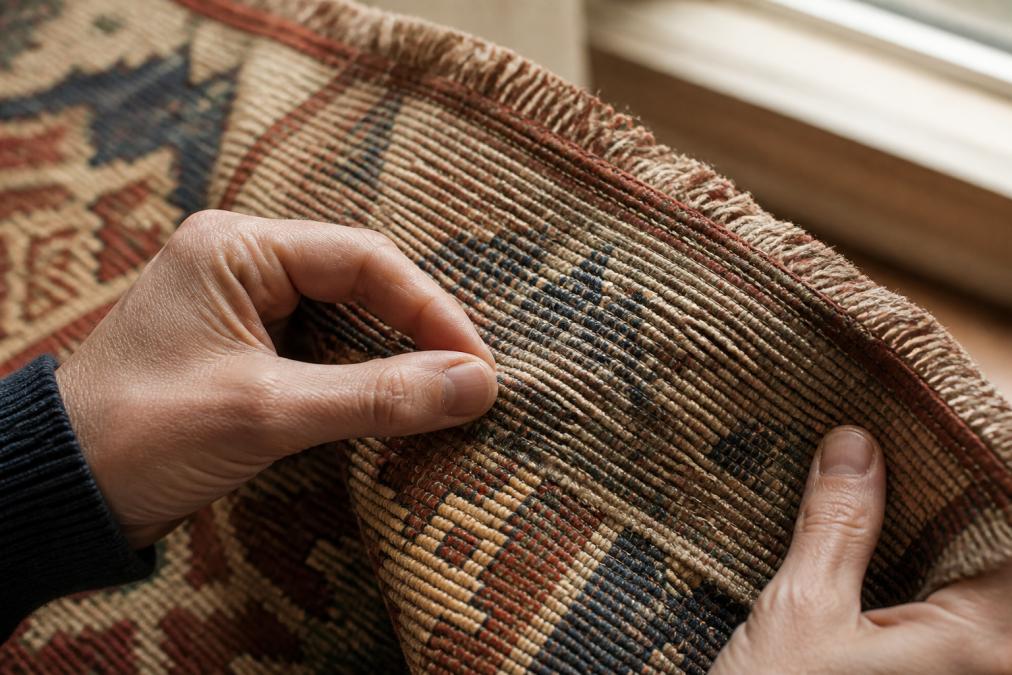
Anatolian kilims typically feature wool warps with tightly packed wool wefts, creating dense, durable pieces. Persian village kilims often use cotton warps with wool wefts, resulting in different drape and weight. To assess authenticity, examine the back under natural light. Handwoven pieces show irregular tension variations; machine-made reproductions display uniform tension and perfectly regular fringe. The density of weft passes per inch correlates with regional tradition and age. Older tribal kilims tend toward looser weaves with visible warp showing through, while modern reproductions often over-tighten wefts, creating unnaturally rigid handle.
Natural Dyes vs. Synthetic: What to Look For
Natural dyes derived from indigo, madder root, cochineal, walnut, and pomegranate fade predictably and develop character over decades. Synthetic dyes produce uniform color that resists fading unnaturally.
Hold the piece to strong sunlight and examine the back side. If the back shows significantly lighter coloring than the front, synthetic dyes were used. Natural dyes fade uniformly throughout the fiber, so back and front show similar color depth. Natural dye kilims display subtle color shifts within each hue, a red field shows variations from rust to burgundy, never flat uniform tone. By the 1950s, most village production had switched to synthetic dyes. Deep indigo blues, rust reds, and ochre yellows with visible variation suggest natural dyes, while bright, uniform reds and electric blues point to synthetic production.
Identifying Antique Rug Origins Through Pattern and Motif
Geometric motifs and symbolic patterns function as regional signatures, a visual language identifying origin when you understand the vocabulary.
Geometric Motifs as Regional Signatures
Anatolian kilims favor bold, angular designs with prominent diamond shapes, stepped triangles, and linear patterns creating strong visual rhythm. Persian village kilims employ different geometric logic, often featuring hexagonal medallions, intricate lattice patterns, and smaller, densely packed motifs. Tribal kilims from nomadic traditions display looser, more spontaneous geometric arrangements, with no two pieces identical, a hallmark of authentic tribal production.
Document the specific motif arrangement before purchasing. Photograph the pattern and research regional kilim collections through museum archives or specialized dealers to cross-reference your potential purchase against documented examples.
Tribal and Village Weaving Markers
Tribal kilims, woven by nomadic communities for personal use rather than commercial sale, show characteristics distinguishing them from village pieces made for trade. Tribal pieces typically feature asymmetrical designs with intentional irregularities and imperfections proving human creation under non-industrial conditions. Village production, while still handmade, follows more standardized patterns and shows greater consistency across pieces from the same workshop.
Size variation provides another tribal marker. Nomadic weavers created pieces to fit specific loom dimensions available during migration. The color palette intensity also differs; tribal weavers used dyes available during their current location, leading to color variations across pieces, while village workshops maintained consistent dye supplies. curating unique decor.
Verifying Provenance and Textile Authentication
Provenance, the documented ownership and location history of a textile, represents the gold standard for authentication and eliminates authentication doubt.
Fiber Analysis and Wool Quality Assessment
Professional fiber analysis provides objective authentication data. Laboratories can determine fiber type, assess dye composition, and identify synthetic versus natural dyes with certainty. For high-value acquisitions, this investment typically costs $200-$500 and provides definitive authentication (the American Academy of Dermatology).
Wool quality assessment requires hands-on examination. Run your fingers across the surface; authentic handwoven wool feels irregular with slight texture variations. The fiber should show visible crimp (the natural wave pattern in sheep's wool), particularly visible under magnification. Authentic aged wool develops a slightly waxy texture and subtle sheen from lanolin content.
Documentation and Chain of Custody
Request complete documentation from any seller claiming provenance: original purchase receipts, previous owner information, exhibition history, insurance appraisals, and photographs showing the piece's condition evolution. Gaps in documentation don't automatically disqualify a piece; many authentic kilims lack complete records. However, absence of documentation should lower your confidence in attribution claims.
Insurance appraisals from qualified textile appraisers carry significant weight. Verify the appraiser's credentials through the American Society of Appraisers or equivalent professional organizations (appraisers.org). Auction house catalogs provide valuable documentation; pieces sold through major auction houses undergo expert authentication and are documented in permanent catalogs.
Step-by-Step Authentication Checklist for Non-Experts
Comprehensive authentication requires systematic evaluation across multiple criteria.
Visual Inspection Protocol
Begin with overall visual assessment in natural daylight. Photograph the piece from multiple angles: front, back, close-ups of motifs, fringe detail, and overall composition.
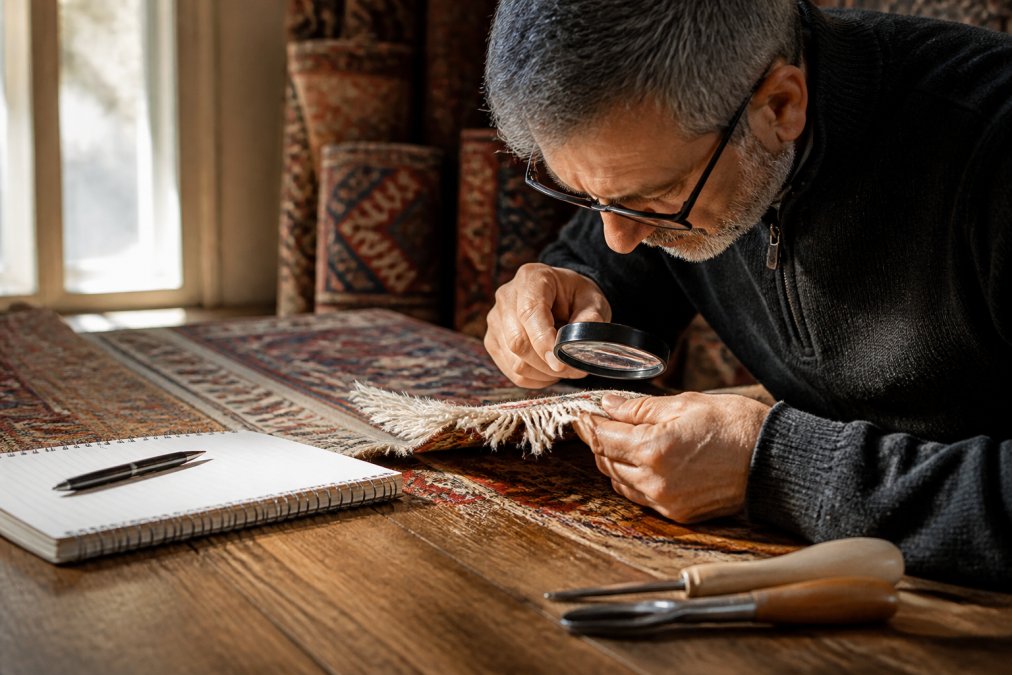
Assess color uniformity and fading patterns. Natural fading appears gradual across the entire piece, with slightly more fading in areas exposed to direct sunlight. Examine the fringe carefully; original fringe should show individual warp threads clearly visible and slightly irregular in thickness. Look for repairs and restoration work by searching for color discontinuities in the surface or areas where knots appear different in tightness. Check the selvedge edges (the finished sides running the length of the piece). Authentic kilims show irregular, hand-finished selvedges with visible warp threads.
Condition Grading Standards
Establish a baseline condition assessment using standard textile grading:
| Condition Grade | Characteristics | Authentication Implication |
|---|---|---|
| Museum Quality | No visible wear, original condition, all elements intact | Rare; commands premium; requires provenance |
| Excellent | Minimal wear, slight fading, all structural elements sound | Likely authentic; age-appropriate condition |
| Very Good | Light wear, visible fading, minor repairs acceptable | Standard for vintage pieces; verify repairs |
| Good | Moderate wear, noticeable fading, some visible repairs | Common for antique pieces; assess repair quality |
| Fair | Significant wear, substantial fading, multiple repairs | Requires expert assessment; verify structural integrity |
| Poor | Heavy damage, extensive repairs, structural concerns | Proceed with caution; professional assessment essential |
Document specific wear patterns. Authentic aged textiles show wear concentrated in high-traffic areas. Assess pile retention and evaluate overall structural integrity by gently flexing the piece in different directions.
Sourcing Rare Kilims: Regional Rarity Index and Logistics
Identifying rare kilims represents only half the challenge; sourcing them requires understanding which regions produce genuinely scarce pieces.
High-Rarity Regions and What Makes Them Scarce
Konya-region kilims from central Anatolia represent high-rarity pieces. The Konya weaving tradition largely ceased by the 1970s as younger generations abandoned textile production for urban employment. Dazgir kilims, produced by a specific nomadic group, fall into the rare category due to the group's small population and the tradition's near-complete abandonment. Fewer than a dozen authenticated Dazgir pieces appear in major collections.
Village weaving from specific communities that ceased production 40-60 years ago creates artificial scarcity. Natural dye kilims from the pre-1960s era represent another rarity category. Size and format affect rarity significantly; large kilims (over 12 feet in length) required substantial loom space and extended production time, limiting historical production volume.
Sourcing Logistics and Availability
Sourcing rare kilims requires patience and strategic networking. Specialized dealers like ABC Rugs Kilims & Jewelry maintain relationships with collectors and estate liquidators, creating access to pieces before they reach the broader market. Auction houses offer transparent acquisition with professional authentication and clear provenance documentation. Building relationships within collector communities provides access to private sales. Market timing affects availability and pricing; spring and fall typically see increased availability as collectors liquidate pieces.
Caring for Antique Textiles After Purchase
Proper care extends the lifespan of rare kilims and preserves their value. Establish appropriate environmental conditions immediately: maintain stable temperature and humidity at 65-70 degrees Fahrenheit with 45-55% relative humidity (si.edu). Avoid direct sunlight, which fades colors and weakens fibers.
Rotation and repositioning prevent uneven wear. If displaying a kilim as a floor rug, rotate it 180 degrees every 3-6 months. Vacuuming requires careful technique; use a low-suction vacuum with a screen overlay, vacuuming only in the direction of the pile or weave. Professional cleaning should occur infrequently, typically every 5-10 years for pieces in regular use. Address spills immediately but gently by blotting with clean white cloth using cool water only.
Store pieces properly if not displaying them. Roll kilims loosely around an acid-free tube rather than folding. Wrap in unbleached muslin or acid-free tissue, never plastic. Store in cool, dry locations away from direct light and check stored pieces annually for pest activity or moisture issues.
Finding rare kilims demands patience, knowledge, and access to trusted sources. The authentication process, examining weaving technique, assessing natural dyes, verifying provenance, and evaluating condition, separates authentic regional pieces from reproductions and misattributed textiles. ABC Rugs Kilims & Jewelry offers collectors and designers access to verified pieces with confidence in their authenticity and quality. Whether building a personal collection or sourcing pieces for professional projects, working with established dealers who maintain rigorous authentication standards protects your investment and ensures you acquire genuine regional textiles with lasting value.
Frequently Asked Questions
How can I tell if a kilim rug is authentic and not a modern reproduction?
Authentic kilim rugs show signs of age through natural color variation, uneven dye saturation from handmade processes, and specific wear patterns. Examine the back for warp and weft construction, handwoven kilims have irregular, visible knots and fiber structure. Check fringe attachment; authentic pieces have fringe woven into the structure, not glued on. Reproductions often have uniform, perfect colors and machine-consistent weaving. Request fiber analysis or provenance documentation when available, especially for rare kilims claiming specific regional origins.
What are the key differences between Anatolian and Afghan authentic kilim rugs?
Anatolian kilims typically feature geometric motifs with bold primary colors and tighter weaving density, reflecting nomadic tribal traditions. Afghan kilims often display more intricate patterns with secondary colors and looser construction. Anatolian pieces use wool from specific regional flocks with distinct natural dye characteristics, while Afghan kilims may incorporate different fiber blends. Regional weaving technique differences are visible in knot density and pattern symmetry. Understanding these distinctions helps identify antique rug origins and assess rarity.
Why do rare kilims from specific regions cost more, and are they a good investment?
Rare kilims from specific regions command higher prices due to limited production, cultural heritage significance, and scarcity of authentic examples. Nomadic weaving traditions have largely ceased in many areas, making vintage and antique pieces increasingly difficult to source. Collectible kilims appreciate when they have verified provenance, excellent condition, and documented cultural or historical importance. However, investment value depends on authentication quality, condition grading standards, and market demand. Pieces with clear textile restoration history or uncertain origins hold less value. Consult textile appraisers and review comparable sales before purchasing rare kilims as investment pieces.
How do I verify the regional origin of a vintage kilim I'm considering buying?
Verify regional origin by examining geometric motifs, each region has signature pattern styles tied to tribal or village weaving traditions. Study the natural dyes and color palette; specific regions used particular plants and minerals creating distinctive hues. Analyze warp and weft construction and knot density, which vary by location and nomadic migration patterns. Request documentation of provenance and chain of custody from the seller. Professional fiber analysis can confirm wool type and age. Compare your kilim against authenticated examples from known regions. ABC Rugs Kilims & Jewelry provides detailed provenance documentation to help collectors verify authenticity and regional identification.
This article was written using GrandRanker


