

Table of Contents
- Why Affordable Persian Rugs Matter for Design Professionals
- Quick Comparison: Hand-Knotted vs. Machine-Made Construction
- Material Quality: Wool, Silk, and Synthetic Blends Explained
- Wholesale Persian Rugs for Designers: Sourcing Strategies and Pricing
- How to Style Persian Rugs in Modern Interiors
- Verifying Authenticity and Ethical Sourcing
- Budget-Friendly Alternatives and Investment Pieces
- Conclusion
Last Updated: August 18, 2026
Why Affordable Persian Rugs Matter for Design Professionals
Interior designers face a persistent challenge: sourcing authentic, high-quality textiles that elevate spaces without consuming project budgets. Hand-knotted Persian rugs deliver authentic craftsmanship, durability, and design value that justifies their investment across residential and commercial projects.
At ABC Rugs Kilims & Jewelry, we understand that designers need reliable access to authentic pieces without premium markups. The distinction between wholesale Persian rugs for designers and retail pricing can mean the difference between a profitable project and one that strains margins. Affordable doesn't mean compromised quality; it means strategic sourcing and direct access to curated inventory.
The real opportunity lies in understanding construction methods, material composition, and regional variations. A hand-knotted wool rug from a specific Persian region carries distinct characteristics that inform both aesthetic and functional decisions.
Quick Comparison: Hand-Knotted vs. Machine-Made Construction
The construction method determines everything: durability, visual character, and long-term value.
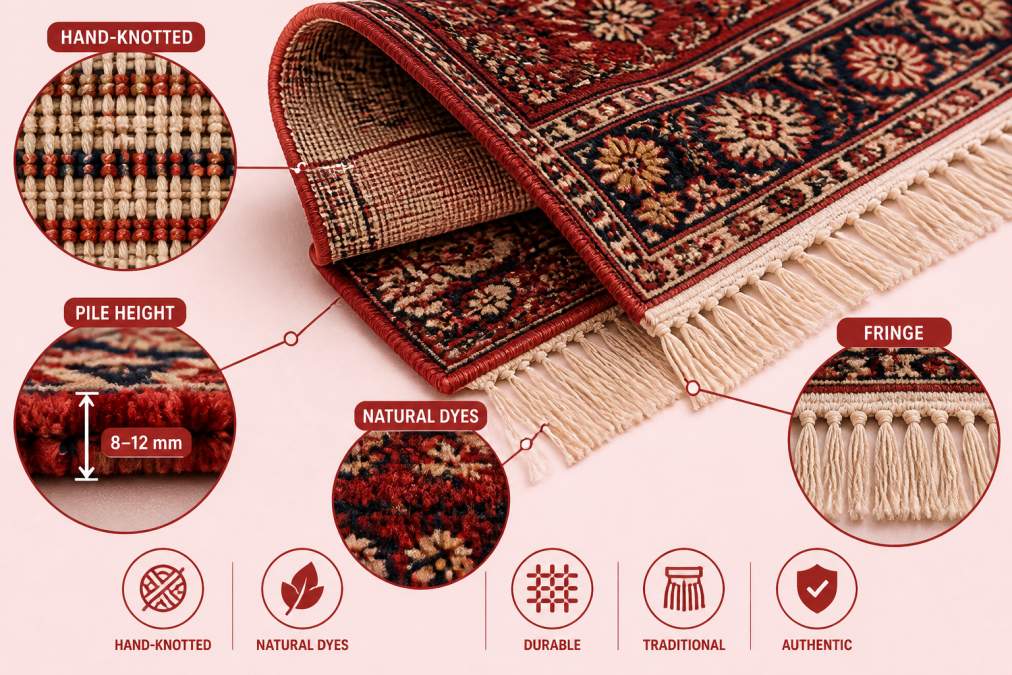
Hand-knotted construction involves tying individual knots onto a warp and weft foundation, a labor-intensive process that can take months for a single rug. This creates irregular pile heights, natural color variation from vegetable dyes, and tactile quality that photographs cannot capture. Hand-knotted rugs improve with age, developing patina and character that collectors value.
Machine-made rugs achieve uniform pile height and consistent pattern replication through industrial looms, compressing production to weeks. However, the construction lacks structural complexity. Machine-made pieces show wear patterns differently, pile flattens more predictably, and they don't develop authentic patina.
For interior designers, the distinction matters most in high-traffic spaces. Hand-knotted construction distributes wear across thousands of individual knots, while machine-made rugs rely on adhesive and backing that can fail under sustained traffic.
The Textile Arts Center's guide to rug construction methods documents how hand-knotting creates structural resilience that machine production cannot replicate.
Material Quality: Wool, Silk, and Synthetic Blends Explained
Material composition determines visual depth, tactile quality, durability, and maintenance requirements.
Natural wool remains the gold standard for Persian rugs. Wool fibers have natural crimp and elasticity that allows pile to recover from foot traffic. Wool accepts vegetable dyes beautifully, creating color saturation and subtle variations that synthetics cannot achieve. Lanolin in wool fibers provides inherent stain resistance and natural self-cleaning properties.
Silk blends introduce luminosity and fine detail. Silk-wool blends (typically 20-30% silk) preserve durability while adding visual sophistication. However, pure silk rugs require careful placement and perform poorly in high-traffic areas. Silk works best in formal spaces, bedrooms, or as accent pieces.
Synthetic blends (polypropylene, acrylic) offer affordability and stain resistance but sacrifice authenticity and longevity. Synthetics don't accept natural dyes effectively, resulting in flat color appearance. Pile flattens rapidly under traffic, and the material doesn't develop patina.
The American Fiber Manufacturers Association's textile durability standards establishes benchmarks for fiber performance in residential and commercial applications. Natural wool consistently outperforms synthetics in durability testing.
The material choice directly impacts pricing. A hand-knotted wool rug costs significantly less than a comparable silk-wool blend, yet delivers superior durability for most residential applications.
Wholesale Persian Rugs for Designers: Sourcing Strategies and Pricing
Accessing wholesale Persian rugs for designers requires understanding the supply chain and recognizing pricing transparency. Direct wholesale relationships fundamentally change project economics.
Retail pricing typically includes multiple markups: importer margins, distributor margins, and retailer margins. A rug wholesale-priced at $1,200 might retail for $3,500 through standard channels. Designers who access wholesale inventory directly recapture those margins for project profitability or client value.
Direct wholesale relationships work best when you develop ongoing purchasing volume. Suppliers offer better pricing for repeat orders and larger quantities. ABC Rugs Kilims & Jewelry serves both wholesale and retail markets, offering designer-specific pricing for ongoing projects with inventory transparency.
Pricing transparency matters. Legitimate wholesale pricing reflects genuine margin reduction, not marketing language. When comparing options, request documentation of construction method, fiber content, and origin, then evaluate pricing against those specifications.
The wholesale advantage compounds across multiple projects. A designer managing five projects annually might recapture $5,000-$10,000 in margin differences through wholesale relationships alone.
The Professional Interior Designers Association resource guide on vendor relationships recommends establishing direct supplier relationships to optimize project profitability without compromising client value.
How to Style Persian Rugs in Modern Interiors
Authentic Persian rugs anchor contemporary spaces through visual contrast and textile depth.
Room anchoring remains foundational. A hand-knotted Persian rug defines seating areas, creates visual weight in open-plan spaces, and establishes color direction. A properly scaled rug becomes architectural rather than merely decorative.
Rug layering creates visual sophistication. Layering a smaller modern abstract rug over a larger traditional Persian piece generates texture, defines zones within open spaces, and adds design complexity. The traditional rug grounds the composition; the modern layer adds contemporary energy.
Color saturation and pattern density require careful consideration. Traditional Persian motifs feature intricate geometric patterns and rich color saturation from vegetable dyes. In minimalist interiors, these visual qualities can overwhelm if not balanced through furniture simplicity and wall neutrality. Designers often pair bold Persian rugs with understated furniture, allowing the textile to dominate visually.
Material texture contributes significantly to modern styling. Hand-knotted construction creates pile height variation and surface texture that photographs differently than machine-made alternatives. Natural wool develops patina and character over time, becoming more visually interesting rather than worn.
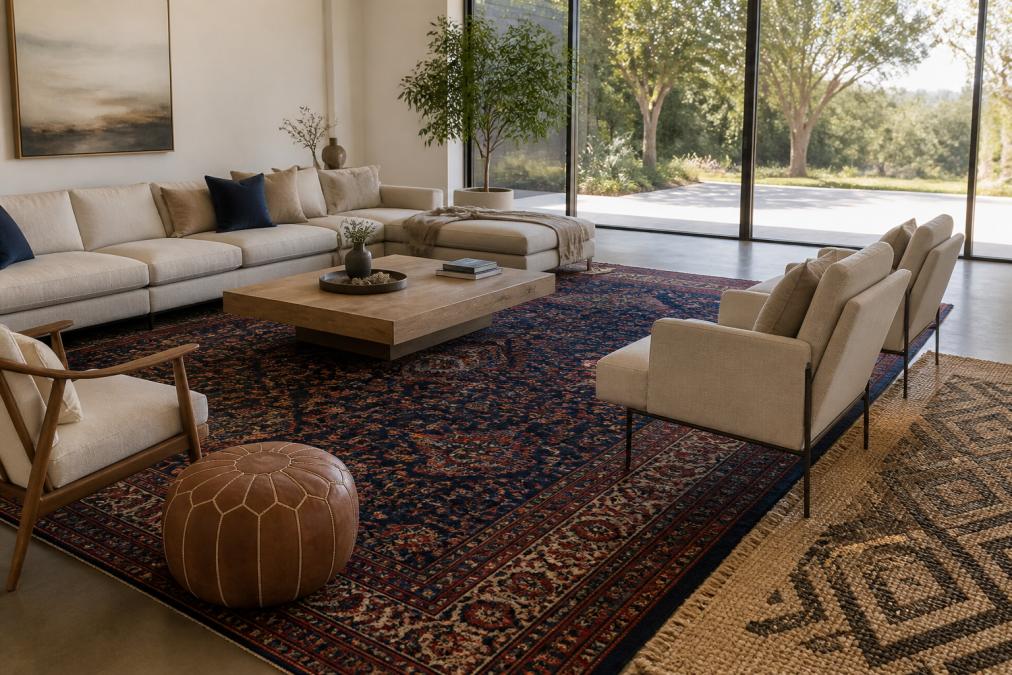
Successful modern-traditional fusion depends on restraint. When Persian rugs dominate a space visually, surrounding elements should recede. Neutral wall colors, simple furniture forms, and minimal accessories allow the textile to command attention.
Verifying Authenticity and Ethical Sourcing
Authenticity verification and ethical sourcing represent critical concerns for designers specifying high-value textiles.
Construction verification begins with physical examination. Hand-knotted rugs display irregular knot patterns when viewed from the back; no two knots align perfectly. The fringe should be integral to the rug structure, not sewn on afterward. Pile height varies naturally across hand-knotted pieces; machine-made rugs show uniform pile throughout.
Fiber content verification requires supplier documentation. Legitimate sources provide material composition, regional origin, and construction method. ABC Rugs Kilims & Jewelry includes detailed specifications for each piece, enabling designers to verify claims before purchase.
Dye verification distinguishes authentic vegetable-dyed rugs from synthetic-dyed alternatives. Vegetable dyes create color variation across the rug surface, subtle shifts in tone that reflect natural dye processes. Under natural light, vegetable-dyed rugs display depth and luminosity that synthetic dyes cannot match.
Ethical sourcing documentation should include information about artisans, production methods, and fair-trade practices. Reputable suppliers can trace rugs to specific regions and often document artisan communities. This transparency protects against purchasing pieces produced under exploitative conditions.
The Fair Trade USA certification standards for textiles establishes criteria for ethical production and artisan compensation.
Budget-Friendly Alternatives and Investment Pieces
Strategic sourcing creates opportunities to deliver authentic Persian rugs at price points that serve different project budgets.
Vintage and semi-antique rugs offer authentic craftsmanship at lower prices than newly produced pieces. These rugs have developed patina and character through years of use. A semi-antique hand-knotted rug typically costs 30-50% less than a newly produced piece with similar specifications.
Regional variations in production create pricing opportunities. Rugs from less-celebrated regions often feature comparable craftsmanship to famous Persian centers but command lower prices. Understanding these regional distinctions lets designers specify authentic textiles across different budget tiers.
Smaller format rugs deliver authentic craftsmanship at accessible prices. A 4'×6' hand-knotted wool rug costs significantly less than 8'×10' alternatives while providing authentic design impact in bedrooms, home offices, or accent spaces.
ABC Rugs Kilims & Jewelry offers pieces across price ranges, including the One Of The Kind Hand-Knotted Persian Wool Rug in Luxurious Vintage Design at $2,336.00, a semi-antique hand-knotted piece measuring 10'7" × 7' with traditional floral motifs and natural vegetable dyes.

Investment potential distinguishes authentic Persian rugs from temporary textiles. Hand-knotted rugs with authentic vegetable dyes and quality construction appreciate over time. Designers can position affordable Persian rugs as investment-grade textiles that serve immediate design needs while building client asset value.
| Rug Type | Price Range | Best For | Investment Potential |
|---|---|---|---|
| Vintage hand-knotted | $800-$2,500 | Budget-conscious designers | High, appreciates with age |
| Semi-antique wool | $1,500-$4,000 | Professional projects | High, established value |
| New production wool | $1,200-$3,500 | Contemporary styling | Moderate, depends on craftsmanship |
| Kilim alternatives | $600-$1,800 | Accent pieces | Moderate, strong design value |
Affordable Persian rugs for interior designers represent strategic sourcing decisions that balance authenticity, craftsmanship, and project economics. When you understand construction methods, material quality, and regional variations, you can specify pieces that deliver genuine value without compromise.
ABC Rugs Kilims & Jewelry bridges the gap between authenticity and affordability by offering wholesale and retail options with transparent sourcing, verified authenticity, and pricing that reflects genuine value. Access to curated inventory, detailed specifications, and designer-specific pricing transforms how you approach textile sourcing.
Start by evaluating your sourcing relationships. If you're currently purchasing through retail channels, exploring wholesale alternatives could recapture significant project margin while delivering better client value. Build relationships with suppliers who provide construction documentation, fiber verification, and ethical sourcing transparency. Your reputation depends on specifying authentic textiles; affordable pricing should never require compromising on these fundamentals.
Frequently Asked Questions
How do I know if a Persian rug is actually hand-knotted and not machine-made?
Hand-knotted Persian rugs show irregular knot density, natural color variations, and visible warp and weft on the back. Machine-made rugs have uniform knots, consistent backing patterns, and printed designs. Inspect the fringe, hand-knotted pieces have fringe that's part of the warp threads, while machine-made rugs have sewn-on fringe. Run your hand across the back; hand-knotted rugs feel textured and irregular, while machine-made rugs feel smooth and uniform.
What's the difference between affordable Persian rugs and antique pieces, and which should designers specify?
Affordable Persian rugs are typically newer hand-knotted pieces or vintage-inspired designs that offer authentic craftsmanship at accessible price points. Antique pieces command premium pricing due to age, rarity, and provenance. For client projects, affordable hand-knotted rugs provide durability and design flexibility without the investment risk of true antiques. They work well for high-traffic areas and clients with moderate budgets while maintaining the authentic textile texture and traditional motifs that elevate interiors.
How do wholesale pricing and to-the-trade options work for interior designers?
Wholesale Persian rugs for designers typically offer 20-40% discounts off retail pricing when purchasing in volume or with a design business license. To-the-trade suppliers like ABC Rugs Kilims & Jewelry provide professional sourcing, consistent inventory, bulk order capabilities, and direct pricing for design firms. These suppliers often offer custom sizing, faster turnaround on specific requests, and dedicated account support. Establish a professional relationship to access wholesale pricing and ensure you can meet client deadlines across multiple projects.
What maintenance and cleaning guidance should I provide clients for hand-knotted Persian rugs?
Hand-knotted Persian rugs require regular vacuuming (without a beater bar), professional cleaning every 3-5 years, and immediate blotting of spills. Avoid direct sunlight to prevent color fading and rotate the rug annually for even wear. Rugs made with vegetable dyes need extra care as dyes can run if exposed to excess moisture. Provide clients with a care sheet covering these basics and recommend professional cleaning from specialists experienced with hand-knotted pieces to preserve the rug's value and appearance.
This article was written using GrandRanker


