

Table of Contents
- The Enduring Appeal of Kilim Patterns in Modern Homes
- Kilim Rug Symbolism and Meanings: What the Motifs Actually Say
- Hand Knotted vs Machine Made Rugs: Why Construction Shows in the Pattern
- Room-by-Room Styling With Authentic Kilim Patterns
- How to Spot a Genuine Kilim: Antique and Vintage Markers
- Care and Maintenance for Flat Weave Rugs
- The Investment Case for Traditional Kilim Patterns
- Frequently Asked Questions
Last Updated: September 19, 2026
The Enduring Appeal of Kilim Patterns in Modern Homes
Walk into any well-designed living room in 2026 and you may spot one: a flat-weave textile with bold geometric motifs, layered over hardwood or draped across a bench. Traditional kilim patterns are finding new homes in contemporary interiors because they combine tribal heritage with a look that reads as both timeless design and global flair. This guide from ABC Rugs Kilims & Jewelry explains where these motifs come from, what they mean, and how to use them well.
Kilim Rug Symbolism and Meanings: What the Motifs Actually Say
Every motif in a kilim is a word in a symbolic language passed down through generations of weavers. The kilim rug symbolism and meanings behind these shapes are not decorative accidents: they are a visual structure for protection, fertility, marriage, and resilience. Integrating these ancestral narratives into a contemporary interior transforms a room into a living archive, demonstrating how indigenous home decor grounds modern spaces in the enduring wisdom of the past.
Elibelinde, Hands on Hips, and Other Common Motifs
The Elibelinde (hands-on-hips) motif represents the mother figure, fertility, and the continuity of the family line. Other recurring symbols include the ram's horn for power and fertility, the wolf's mouth for protection, and the tree of life for connection between earth and sky. Because these symbols were passed down orally rather than written, regional variations exist. Two kilims with the same motif may tell slightly different stories depending on the village that wove them.
How Tribal Heritage Travels Into Contemporary Rooms
A geometric kilim that once hung in a nomadic tent can anchor a minimalist living room without any translation. The reason is simple: the motifs are abstract enough to read as modern art while still carrying their original meaning for anyone who knows the symbolic language. That double life is what makes a collected aesthetic feel personal rather than staged.
Hand Knotted vs Machine Made Rugs: Why Construction Shows in the Pattern
The difference between hand knotted vs machine made rugs appears in the pattern itself, but the more useful distinction for a kilim buyer is between the flat-weave techniques themselves. Not all flat-weaves are built the same way, and the technique is one of the clearest signals of both age and value.
Warp and Weft: Reading a Kilim's Flat-Weave Structure
In a kilim, the pattern is created by the weft threads passing over and under the warp. Where two color blocks meet, the weaver often leaves a small gap, a technique called slit-weave. That slit is not a defect: it is the signature of hand-woven construction. Machine-made flat-weaves hide these slits because the pattern is printed or woven continuously, which is why their motifs look uniform and slightly stiff.
Slit-Weave, Soumak, and Cicim: The Technical Weave Comparison
Most guides stop at "flat-weave" and never explain that the term covers several distinct techniques. Knowing the difference tells you why two kilims of similar size and age can differ sharply in price.
- Slit-weave (kilim proper): The weaver builds color blocks and leaves a vertical slit where two colors meet. It is the fastest technique and the most common. Slits are visible on the reverse and can gap slightly on curves, which is why slit-weave designs favor strong geometric blocks over fine curves.
- Soumak: An extra weft is wrapped around the warp rather than passed straight through, producing a raised, braided surface with a slight diagonal grain. Soumak is slower to weave, more durable underfoot, and often used for borders or for the entire field of a heavier piece. Because it uses more yarn, a soumak commands more than a comparable slit-weave.
- Cicim: A supplementary-weft technique in which floating threads create the pattern on the surface while a plain weave holds the structure. Cicim is lighter and more decorative than structural, so it is common in cushions, bags, and wall pieces rather than high-traffic floor rugs.
- Knotted pile (halı): Not a kilim at all. Knots are tied around the warp and cut, producing a pile and the fluid curves typical of Persian city rugs. A seller who calls a knotted rug a kilim is using the word loosely.
Why the Technique Shows in the Pattern
Technique constrains design. Slit-weave favors stepped diagonals and clean color blocks because long slits weaken the fabric. Soumak can carry denser, more textured fields. Cicim allows finer drawn motifs because the pattern floats above a stable ground. This is why a kilim's geometry is not just an aesthetic choice: it is a record of how the weaver worked. A pattern that looks "too fine" for slit-weave is a prompt to check the reverse for soumak wrapping or cicim floats.
Room-by-Room Styling With Authentic Kilim Patterns
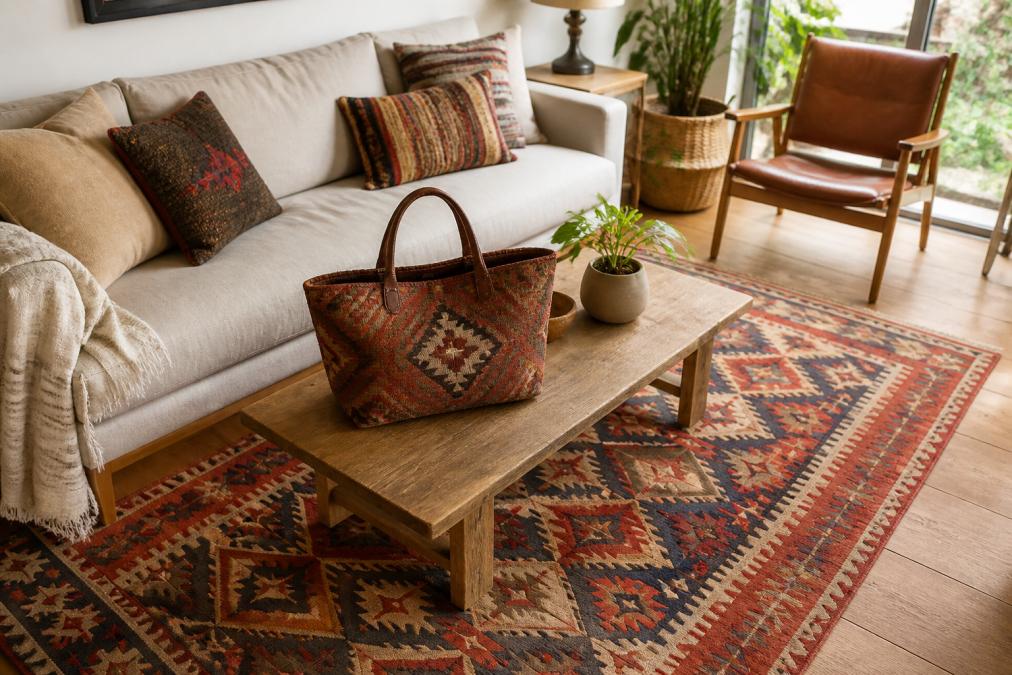
A kilim can work in nearly any room, but the styling approach changes with the space. In living rooms, layer a large kilim over a neutral jute or hardwood floor for textural warmth and a clear focal point. In bedrooms, a runner along the side of the bed or a small kilim at the foot adds color without overpowering the bedding.
How to Spot a Genuine Kilim: Antique and Vintage Markers
Authenticity shows up in irregularities. A genuine antique or vintage kilim has slightly uneven edges, subtle color shifts within a single motif, and a hand-spun wool texture that feels slightly coarse rather than slick. Natural dyes fade gracefully into softer tones over decades, while synthetic dyes tend to hold their original brightness or bleed at the edges.
Hand-Woven Kilim Bag 8" x 6", HD28 →
Look for these markers:
- Slight asymmetry in motifs, because the weaver worked from memory
- Abash (color striations) within a single field, caused by different dye lots
- Hand-spun yarn with visible thickness variation
- Fringe that is part of the warp, not sewn on afterward
Care and Maintenance for Flat Weave Rugs
Care and maintenance for flat weave rugs is simpler than for pile rugs, but it has its own rules. Rotate the kilim every six months so sunlight and foot traffic wear it evenly. Vacuum on low suction without a beater bar, which can snag the weft threads. For spills, blot immediately with a clean cloth and cool water; avoid scrubbing, which can distort the weave.
The Investment Case for Traditional Kilim Patterns
Traditional kilim patterns hold value in a way that mass-produced floor coverings do not. Because each piece is hand-woven and one of a kind, supply is inherently limited, and demand from collectors and interior designers has grown steadily. Antique and vintage kilims, in particular, are valued for their natural dyes, hand-spun wool, and documented tribal heritage. What most guides skip is a framework for actually judging that value, and the sourcing questions that separate a sound purchase from a risky one.
A Practical Valuation Framework
Rather than treating value as a feeling, weigh five variables and score each on a simple low-to-high scale. The total, not any single factor, drives the price.
- Age band. Broadly: contemporary (woven within the last few decades), vintage (roughly mid-20th century), and antique (commonly defined in the trade as 100 years or older). Age alone does not equal value; a worn antique can be worth less than a clean vintage piece.
- Condition. Look at pile height (none, for a kilim), selvage and end finishes, and whether the field is intact. Original ends and selvages carry a premium. Rewoven areas, cut-and-shut repairs, and re-dyed fields reduce value.
- Rarity of motif and region. A documented, uncommon regional pattern outsells a common one. Motifs tied to a specific tribe or village, with a known design vocabulary, are more collectible than generic geometric fields.
- Provenance. A documented origin, an old dealer tag, or a published reference strengthens the case. Undocumented pieces are not worthless, but they are priced as anonymous.
- Technique and materials. Natural dyes and hand-spun wool support higher value than synthetic dyes and machine-spun yarn. A soumak or heavily worked piece carries more labor than a plain slit-weave of the same size.
Ethical Sourcing and Fair Trade: The Questions to Ask
Value and ethics are linked. A piece with a clean supply chain is easier to document, easier to resell, and less likely to carry the legal and reputational risk of an illicitly exported antique. Ask the seller:
- Where was it woven, and how do you know? A specific region and tribe is a better answer than "the Middle East."
- How was it acquired? Direct purchase from weaving cooperatives, estate sales, and established dealers are traceable. "Sourced on a buying trip" is not.
- Who was paid, and how? Fair-trade and cooperative sourcing means the weaver or the weaving family was compensated at the point of production, not through a chain of middlemen.
- Are there export or import documents? For antique pieces, paperwork matters. Antiques above a certain age can face restrictions on export from their country of origin, and a seller who cannot speak to that is a risk.
- Is the age claim documented or asserted? A carbon-14 test is uncommon and expensive, but a dealer who can point to dye analysis, construction, and design evidence is more credible than one who simply says "antique."
What This Means for a Buyer
Treat a kilim purchase the way you would treat any collectible: buy the best example you can afford in the best condition, from a seller who can answer the sourcing questions above. A clean, well-documented vintage piece will hold value more reliably than a heavily restored antique with no provenance, even if the antique is older. And a piece you genuinely love to live with is the only kind that reliably pays a return in daily use.
Frequently Asked Questions
What do traditional kilim motifs and symbols represent?
Kilim motifs carry a symbolic language passed down through generations of weavers. Common designs include the elibelinde (hands on hips) for fertility, the evil eye for protection, and the tree of life for renewal. Because patterns were woven from memory rather than charts, the same symbol can shift slightly between villages. That variation is part of what makes each kilim a unique cultural narrative rather than a repeatable print.
How can you tell a real kilim from a machine-made imitation?
Flip the rug over. A genuine hand-woven kilim shows the same pattern on both sides, with slight irregularities in the weft and selvage edges that no machine reproduces. Look for natural dyes that fade unevenly and wool with subtle texture variation. Machine-made imitations usually have perfectly uniform rows, synthetic backing, and a printed or tufted surface that hides the weave structure entirely.
Can you have a kilim rug in a modern home?
Yes, and it often works better than a neutral rug in contemporary spaces. The flat-weave profile sits low under furniture, and the geometric motifs add visual structure without overwhelming a minimal room. Pair a bold kilim with a monochrome sofa or a glass-and-steel table so the pattern becomes the focal point. Interior designers frequently use them to add textural warmth to otherwise cool, modern palettes.
What are the best ways to maintain the value of a vintage kilim rug?
Rotate the rug every few months so sun exposure and foot traffic wear evenly. Vacuum on low suction without a beater bar, and blot spills immediately with a clean cloth rather than rubbing. For deeper cleaning, use a professional who works with flat-weave textiles. Store rolled, never folded, in a breathable cotton sheet away from damp basements. Keeping the original selvage and fringe intact preserves both condition and resale value.


