

Table of Contents
- Why Antique Kilim Rugs Fade: Causes and What You Can Reverse
- How to Clean Vintage Kilim Rugs Safely Before Any Color Work
- Dye Stability Testing and Natural vs. Synthetic Dye Identification
- Step-by-Step: Restoring Faded Colors in Antique Kilim Rugs at Home
- Professional Rug Color Restoration Cost and When to Consult a Restorer
- Best Practices for Antique Rug Maintenance and Kilim-Specific Care
- Frequently Asked Questions
Last Updated: September 17, 2026
Why Antique Kilim Rugs Fade: Causes and What You Can Reverse
Fading in antique kilim rugs comes from three sources: UV light, oxygen exposure, and trapped soil. Two are fixable; one is not.
UV Degradation, Oxidation, and Soil Accumulation
Each cause needs a different response; treating them the same is a common mistake.
- UV degradation: permanent dye loss from sunlight. Cannot be reversed.
- Oxidation: slow chemical aging of wool. Part of the patina, not damage.
- Soil accumulation: trapped dirt dulling the surface. Fully reversible.
How to Tell Soil Buildup from Actual Color Loss
Soil buildup sits on top of the fiber; color loss happens inside the dye.
How to Clean Vintage Kilim Rugs Safely Before Any Color Work
Cleaning a vintage kilim before color work is non-negotiable: dirt blocks restoration products from reaching the dye and abrades the weave with every footstep.
- No pile buffer. Moisture hits the dyed weft and warp almost immediately instead of traveling through thick wool.
- Exposed foundation. Visible warp threads can swell when wet, and uneven swelling distorts the weave.
- Slack and draw-in. Older tribal kilims often have slight edge waviness that excess moisture exaggerates.
- Thin profile. A kilim dents, creases, and folds more easily when wet.
A Kilim-Safe Cleaning Sequence
- Vacuum both sides with low suction and no beater bar, which can pull the exposed weft.
- Test every color with the dye stability test before any liquid touches the rug.
- Test any cleaning solution on a hidden corner, then wait 24 hours to see how it dries.
- Work in small sections with a soft brush or microfiber cloth. Never scrub, it abrades the weft and lifts dye.
- Blot, never wipe, to lift loosened soil; wiping drags dye into neighboring colors.
- Rinse sparingly with clean, cool water and blot again. Do not flood the rug.
- Lay flat to dry away from direct sun with airflow on both sides, lifting it occasionally so the underside breathes.
Never soak a kilim. Never machine wash it. Never wring it out. Never hang it wet, the weight of the water can stretch the weave out of shape.
Why Moisture Control Matters More on a Flat-Weave
On a pile rug, extra water is absorbed by the pile and evaporates. On a kilim, it sits against the dyed threads and foundation, and two things go wrong:
- Dye migration. Unstable dye dissolves into the water and wicks into adjacent colors or the undyed warp. This is the most common way a home cleaning turns a small dull patch into a permanent stain.
- Foundation distortion. Wet warp swells, and if the rug dries unevenly, one corner faster than another, it can dry slightly out of square. Once that happens, it is very hard to correct without a professional.
Dye Stability Testing and Natural vs. Synthetic Dye Identification
Dye stability testing tells you whether a color will bleed during cleaning. On an antique kilim it separates a safe restoration from a ruined rug, because with no thick pile to buffer moisture, every drop sits directly against the dyed weft and warp.
How to Run a Dye Stability Test
Work in a hidden area first, a corner, edge, or the underside, and test each color individually, since one kilim can hold a dozen dyes at different levels of fastness.
- Dampen a white cotton swab with cool, distilled water. Tap water minerals can skew the result.
- Press the swab gently against one color for about 30 seconds. Do not rub, rubbing forces dye out of the fiber and gives a false positive.
- Lift the swab and check it against a white paper towel. Any color transfer means that dye is unstable.
- Repeat for every distinct color, including the border and any small accent motifs.
- If a color transfers, re-test with a barely damp swab and a shorter contact time. If it still transfers, treat that color as non-washable.
Reading the Results: What Each Outcome Means
- No transfer, dry swab: the dye is stable. Normal careful cleaning is safe.
- Slight transfer on a damp swab: the dye is marginally stable. Use minimal water, cool temperatures, and blot rather than wipe.
- Clear transfer on a damp swab: the dye is unstable. Clean that area dry only, or hand it to a professional.
- Transfer that spreads into adjacent colors: dye migration is already underway. This is a stop signal for any home treatment.
Natural vs. Synthetic Dyes: How to Tell Them Apart
Antique kilims made before roughly the 1870s were almost always colored with vegetable and insect dyes, madder root for red, indigo for blue, weld and saffron for yellow, walnut hulls for brown, cochineal for deep crimson. Aniline and other synthetics spread from the late 1800s and dominated after the 1920s.
- Natural dyes: soften and mellow over time, with subtle variation across the rug. Abrash, the gentle horizontal striping where dye lots shifted, is a hallmark of natural dyeing and is prized by collectors.
- Synthetic dyes: tend to stay sharp or fade unevenly, and early aniline dyes in particular are prone to turning gray, pink, or orange as they break down. They are also more likely to bleed when wet.
A few practical checks confirm what you are seeing:
- Look at the back. Natural-dyed kilims often show deeper, less faded color there because it saw less light.
- Look for variation. Perfectly uniform color across a large antique kilim points to synthetic dye.
- Look at the wear points. Natural dyes reveal a lighter, warmer tone where abraded; some synthetics turn grayer or cooler.
Step-by-Step: Restoring Faded Colors in Antique Kilim Rugs at Home
You can restore the appearance of faded colors in antique kilim rugs at home, but only for soil-related dullness. True UV fading needs a professional.
One Of The Kind Persian Bidjar Rug#12 →
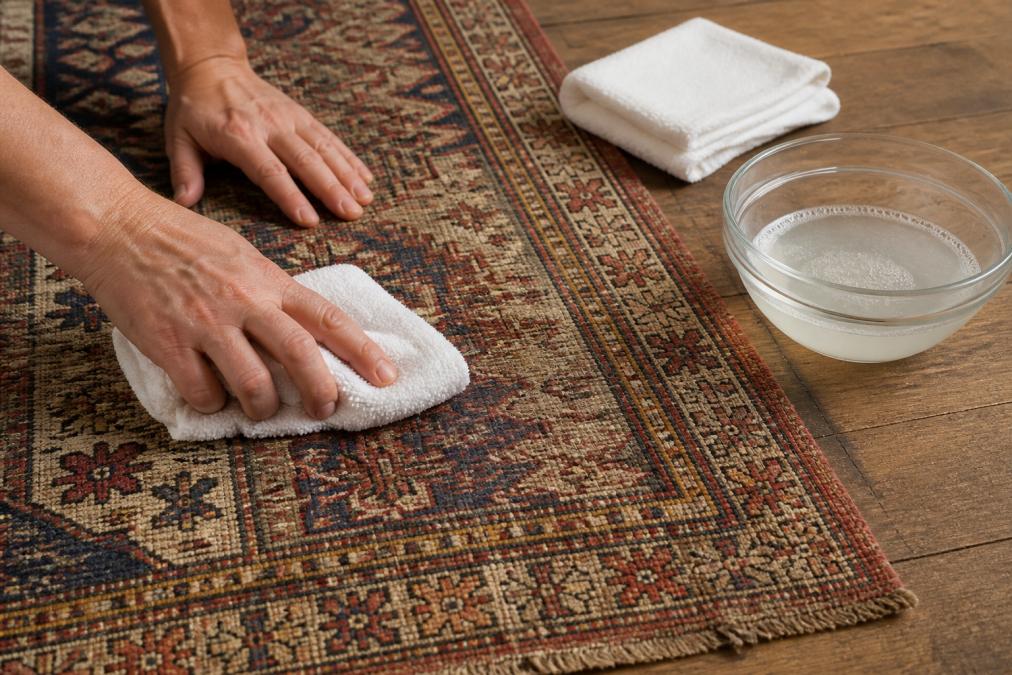
- Clean the rug fully using the steps above. Let it dry completely.
- Test dye stability on every color before applying anything.
- Mix a pH-balanced cleaning solution with cool water.
- Apply with a soft cloth, working one small section at a time.
- Blot with a clean dry cloth to lift loosened soil.
- Rinse with plain water and blot again.
- Dry flat, away from sun, for at least 24 hours.
Natural Cleaning Solutions: Vinegar, Salt, and Baking Soda
Natural solutions work for light cleaning but will not restore lost dye.
- White vinegar: one part vinegar to three parts water, for mild dullness.
- Salt: sprinkle on light stains, let sit, then vacuum; a gentle abrasive.
- Baking soda: a water paste for spot cleaning; rinse fully afterward.
Chemical Color Correction: What Works and What Destroys Wool
Chemical color correction is risky on antique kilims. Most home products do more harm than good.
Professional Rug Color Restoration Cost and When to Consult a Restorer
Professional rug color restoration cost varies widely by size, condition, and workload; small touch-ups cost far less than full restoration.
Call a professional restorer when:
- The fading is from UV light, not soil.
- Dye bleeds during your stability test.
- The kilim has tears, holes, or weak spots.
- The rug is a valuable antique or collector's piece.
- You are unsure about any step.
Best Practices for Antique Rug Maintenance and Kilim-Specific Care
The best practices for antique rug maintenance come down to prevention. Keep the rug out of direct sun and clean it gently and often.
Kilim-specific care adds a few rules:
- Rotate the rug every few months for even light exposure.
- Use a rug pad to reduce friction and wear.
- Keep humidity stable to prevent fiber swelling.
- Vacuum with low suction only.
- Store rolled, never folded, if you put it away.
Frequently Asked Questions
How can I tell if my kilim rug is genuinely faded or just dirty?
Dirt sits on the surface and lifts with gentle blotting, while true fading means the wool fibers themselves have lost pigment. Test a small corner with a pH-balanced cleaner: if the cloth lifts brown grime but color stays weak, the issue is UV degradation or oxidation, not soil. Brightness returns only when the underlying dye is intact. For antique kilim rugs, always spot-test first to avoid disturbing fragile vegetable dyes.
Can kilim rugs be washed at home, or does that damage the dyes?
Flat-weave kilims can tolerate careful hand-washing, but never machine-wash or fully submerge an antique piece. Use cool water, a pH-balanced cleaner, and a blotting technique rather than scrubbing. Test for colorfastness on a hidden edge before applying any liquid. If the rug has loose ends, dye migration, or a fragile foundation, professional rug cleaning is safer. Improper washing can set stains and accelerate fiber damage.
Is professional rug color restoration cost worth it for antique kilims?
Costs vary by size, dye stability, and how much color revival is needed. For rare or high-value kilims, a restorer can use dye stability testing that home methods cannot replicate. If the rug has sentimental or market value, the investment usually outweighs the risk of DIY damage.
What are the best practices for antique rug maintenance to prevent future fading?
Rotate the rug every three to six months so UV exposure is even, and keep it out of direct sunlight. Vacuum flat-weaves on low suction without a beater bar. Use a rug pad to reduce abrasion, and blot spills immediately rather than rubbing. Have the piece professionally cleaned every two to three years, and store it rolled (never folded) with acid-free paper. These habits slow oxidation and protect fiber integrity.


