

Table of Contents
- What You'll Need Before You Start Inspecting
- Vintage Costume Jewelry Identification Marks to Check First
- How to Test Vintage Jewelry for Gold or Silver at Home
- Spotting Fake Vintage Jewelry: Stones, Settings, and Weight
- Clasps, Hardware, and Signs of Wear That Reveal Fakes
- How to Clean Vintage Antique Jewelry Safely
- Digital Authentication Tools and When to Get a Jewelry Appraisal
- Frequently Asked Questions
Last Updated: September 18, 2026
What You'll Need Before You Start Inspecting
Before you learn how to spot fake vintage costume jewelry, gather a few simple tools.
Here is what to have on hand:
- A jeweler's loupe (10x magnification) or a phone macro lens
- A small magnet (any fridge magnet works)
- A black light (UV flashlight)
- A soft cloth and a clean tray
- A bright desk lamp or natural daylight
Vintage Costume Jewelry Identification Marks to Check First
Marks are the fastest way to date and verify a piece. Vintage costume jewelry identification marks tell you who made it, when, and from what. Check the back of the brooch, the clasp, or a ring band.
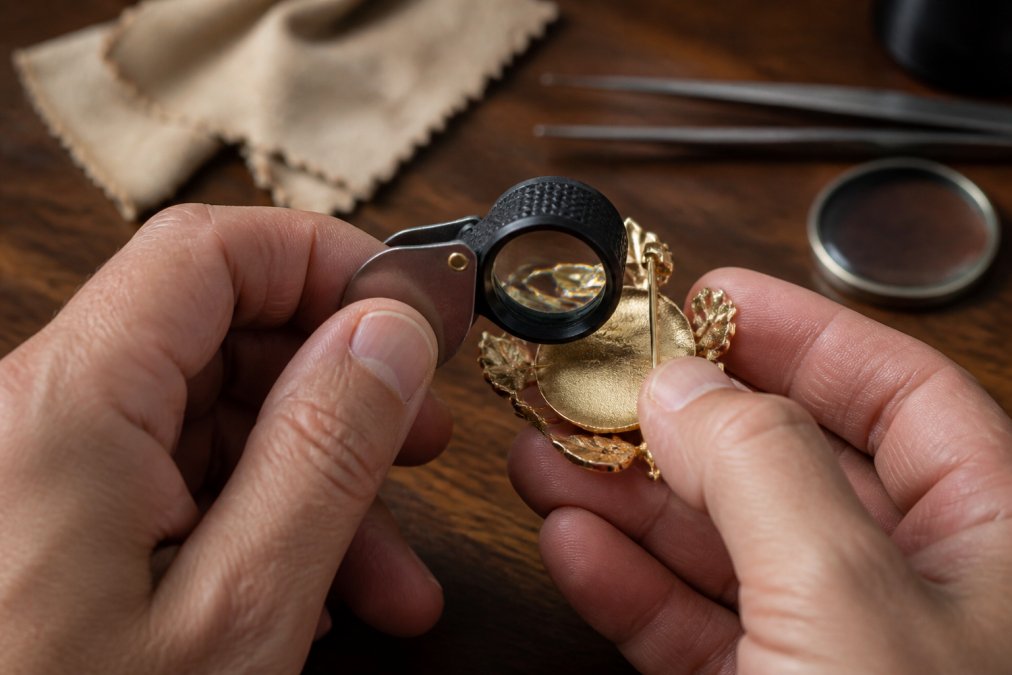
Reading Hallmarks, Maker's Marks, and Karat Stamps
A hallmark is an official stamp showing metal purity; a maker's mark identifies the company. A karat stamp like "14K" or "925" signals real gold or sterling silver. Costume jewelry usually carries a designer signature.
Watch for these clues:
- Crisp, even lettering suggests a factory stamp
- Blurry or shallow marks often mean a later copy
- Missing marks on an old piece are a red flag
- A "925" stamp with no other detail deserves a closer look
Signed vs Unsigned Pieces: What Each Tells You
Signed pieces carry a designer name and are easier to trace. Unsigned pieces can still be genuine vintage but need more testing, many mid-century makers never signed their work, so judge build quality.
How to Test Vintage Jewelry for Gold or Silver at Home
Home testing answers one narrow question: is the metal what the seller claims? It cannot date a piece or prove a designer, so treat every result as one data point, and know which tests can damage a vintage piece.
Start With the Tests That Cannot Hurt the Piece
Work from least invasive to most invasive. If a non-destructive test gives a clear answer, stop there.
The Acid Test: What It Actually Does and Why to Avoid It
Jewelry testing acid works by chemical reaction: a drop of nitric acid solution on a gold alloy dissolves base metals and leaves gold largely intact, and the reaction color indicates karat range. Home kits include a touchstone, solutions keyed to 10K, 14K, 18K, and 22K, and instructions to scratch the stone and apply solution to the streak.
Black Light Inspection: What UV Actually Reveals
A UV flashlight (365-395 nm is the common range) makes certain materials fluoresce. Look for:
- Modern epoxy and cyanoacrylate glues often glow a milky blue-white under UV. Original vintage settings were usually soldered or mechanically set, not glued.
- Some resins and plastics used to imitate amber, tortoiseshell, or ivory fluoresce in ways the real materials do not. Real amber typically fluoresces a dull yellow-green to blue; many plastic imitations glow bright blue-white.
- Repairs and restorations show up as glowing lines where a stone was re-set or a break was filled.
- Some rhinestones and paste have a characteristic glow that differs from natural gemstones, though this varies too much by material to be a standalone test.
| Test | What It Actually Checks | Safe on Vintage? | Main Limitation |
|---|---|---|---|
| Magnet | Ferrous core only | Yes | Misses brass/copper-core plated pieces |
| Weight & feel | Density vs. known metals | Yes | Subjective; hollow pieces mislead |
| Loupe on wear points | Plating wear-through | Yes | Requires good light and magnification |
| UV black light | Glue, resins, repairs | Yes | Not a metal test; results vary by material |
| Acid | Karat range of gold alloy | No, can permanently damage | Requires scratching or direct acid contact |
Non-Destructive Alternatives Worth Knowing
For a metal reading without risking the piece, two options exist. Electronic gold testers use a probe and small current to estimate surface karat, non-destructive, but fooled by thick plating. X-ray fluorescence (XRF) analyzers accurately read surface composition without touching the piece, and many jewelers and pawn shops will run one for a small fee. Neither replaces a full appraisal, but both beat acid.
Spotting Fake Vintage Jewelry: Stones, Settings, and Weight
Before judging a stone, settle a definition problem that trips up most buyers. A fake is a modern reproduction made to deceive, a new piece styled to look old, or a real vintage design copied and re-stamped. Vintage costume jewelry is a legitimate historical category: pieces made from the 1930s through the 1980s using non-precious materials by design.
Reading Stones: Paste, Rhinestones, and Foil-Backed Glass
Paste is leaded glass formulated to imitate gemstones. It scratches with a pin or fingernail in a way quartz and corundum do not, and it warms quickly against skin while real stones stay cool longer.
Settings and Construction: Where Fakes Cut Corners
Look at the back of the piece, not the front. Fakes are finished on the side that shows.
- Prong settings: count the prongs and check their tips. Vintage prongs are often slightly uneven from hand-finishing and show small dents from decades of wear. Machine-perfect, uniform prongs on an "old" piece suggest modern production.
- Glue: original vintage settings were usually soldered, crimped, or mechanically set. Visible glue around a stone is a strong sign of a later repair or a modern fake.
- Solder joints: vintage solder is often slightly discolored or uneven. Clean, bright, uniform solder on an aged piece can indicate a modern re-strike.
- Rhinestone channels: in good vintage pieces, stones sit at consistent height in their channels. If some stones sit higher or lower, they have likely been replaced or the piece was cheaply made.
- Filigree: hand-cut filigree has tiny irregularities, no two openings are identical. Stamped copies repeat the same pattern exactly across the piece.
Weight, Density, and the Feel Test
Weight is one of the hardest things for a faker to replicate cheaply. Solid metal and dense stones feel substantial for their size; hollow stampings and plastic feel light and sometimes rattle.
- A solid brass or copper vintage brooch of a given size will feel noticeably heavier than a hollow stamped copy of the same design.
- Glass rhinestones feel heavier than acrylic or plastic imitations of the same size.
- A piece that feels surprisingly light for its bulk is often a modern reproduction using thin stamped metal and plastic stones.
A Quick Diagnostic Order
When you pick up an unknown piece, run this sequence:
- Flip it over. Look for marks, solder, and construction quality on the back first.
- Weigh it in your hand. Does it feel consistent with the materials it claims to be?
- Loupe the stones. Check for scratches, foil condition, and glue.
- Check the settings. Prongs, bezels, channels, even or rushed?
- UV-light the piece. Look for glowing glue lines and repairs.
- Only then consider metal testing. And only if the piece is unsigned and low-risk.
Clasps, Hardware, and Signs of Wear That Reveal Fakes
Hardware is where fakes fall apart. A real vintage piece shows even wear from decades of use. A fake often looks too new or wears in odd spots.
Check these details:
- Clasp mechanism: smooth action, no sharp edges
- Prong setting: even prongs, no gaps or glue
- Patina: soft, even aging on the metal
- Oxidation: darkening in the crevices, not on the surface
How to Clean Vintage Antique Jewelry Safely
Cleaning is where many collectors ruin good pieces. Learn how to clean vintage antique jewelry safely before you touch a single stone. Harsh cleaners strip foil, loosen glue, and dull patina.
Follow these rules:
- Use a soft, dry cloth for dust
- Skip ultrasonic cleaners on foil-backed or glued stones
- Keep water away from rhinestones and paste
- Never soak a piece with a signed back
Digital Authentication Tools and When to Get a Jewelry Appraisal
Technology now helps confirm what your eyes suspect: digital tools compare marks, stones, and settings against large databases, and a photo search can match a maker's mark to a known designer in seconds.
Frequently Asked Questions
How can I tell if costume jewelry is real vintage or a modern fake?
Check the clasp style, maker's marks, and signs of wear. Genuine vintage costume jewelry often has patina, oxidation in crevices, and clasps that match known production eras. Modern fakes tend to look too clean, use lightweight base metal, and lack consistent hallmarks. A jeweler's loupe helps you inspect stamping quality, which is usually crisper on authentic pieces.
Does a magnet stick to costume jewelry?
A magnet will stick to pieces made with iron, steel, or nickel-based base metal, which are common in vintage costume jewelry. It will not stick to gold, sterling silver, or most plated pieces. Use the magnetic test as one clue, not a verdict. Pair it with a loupe inspection and a check for hallmarks before deciding whether a piece is fake vintage jewelry.
What is considered vintage in costume jewelry, and does age affect value?
Most collectors treat costume jewelry made before the 1990s, and especially pieces from the 1920s through the 1970s, as vintage. Age alone doesn't guarantee value. Signed pieces from known makers, quality prong settings, and intact rhinestones or cabochons matter more. Unsigned pieces with heavy wear and replaced clasps typically sell for less, even when they are genuinely old.
What are the safest ways to clean vintage antique jewelry without damaging it?
Use a soft cloth dampened with lukewarm water and a drop of mild dish soap. Avoid ultrasonic cleaners, ammonia, and vinegar on plated, foil-backed, or rhinestone pieces because they strip finish and loosen glue. Dry immediately with a lint-free cloth. For pieces with patina you want to keep, clean around the oxidation rather than scrubbing it off. When in doubt, consult a jeweler before cleaning.
Fakes are getting better every year, and a quick glance is no longer enough. At ABC Rugs Kilims & Jewelry, we hand-check every piece for marks, metal, and stone quality before it goes up for sale. Our curated selection of vintage jewelry and gemstones comes reviewed and trusted, with wholesale and retail options for collectors and designers alike. Get started with ABC Rugs Kilims & Jewelry and shop pieces you can trust.


