

Table of Contents
- Why Distinguishing a Handmade Kilim Matters
- Test 1: Examine the Weave Structure and Backside
- Test 2: Inspect the Fringe and Tassels
- Test 3: Identify the Fibers: Wool, Cotton, or Synthetic
- Test 4: Look for Irregularities and Human Craftsmanship
- Test 5: Use the Burn Test for Fiber Verification
- Hand Knotted vs Machine Made Rugs: Key Differences
- Kilim Rug Identification Guide: Regional Clues
- Frequently Asked Questions
Why Distinguishing a Handmade Kilim Matters
A kilim is a flatweave textile created by interlocking warp and weft strands, producing a reversible rug with no pile. Telling a genuine handwoven piece from a machine-made reproduction protects your investment, since the two differ enormously in durability, resale value, and textural character. At ABC Rugs Kilims & Jewelry, we offer a curated collection of exquisite handmade rugs, and understanding authenticity is key. The good news is that learning how to tell if a kilim is handmade takes only a few minutes once you know what to look for.
Below, we'll walk through seven practical tests you can run at home or in a gallery. These methods move beyond surface-level advice and give you a reliable way to verify authenticity before you commit to a purchase.
Test 1: Examine the Weave Structure and Backside
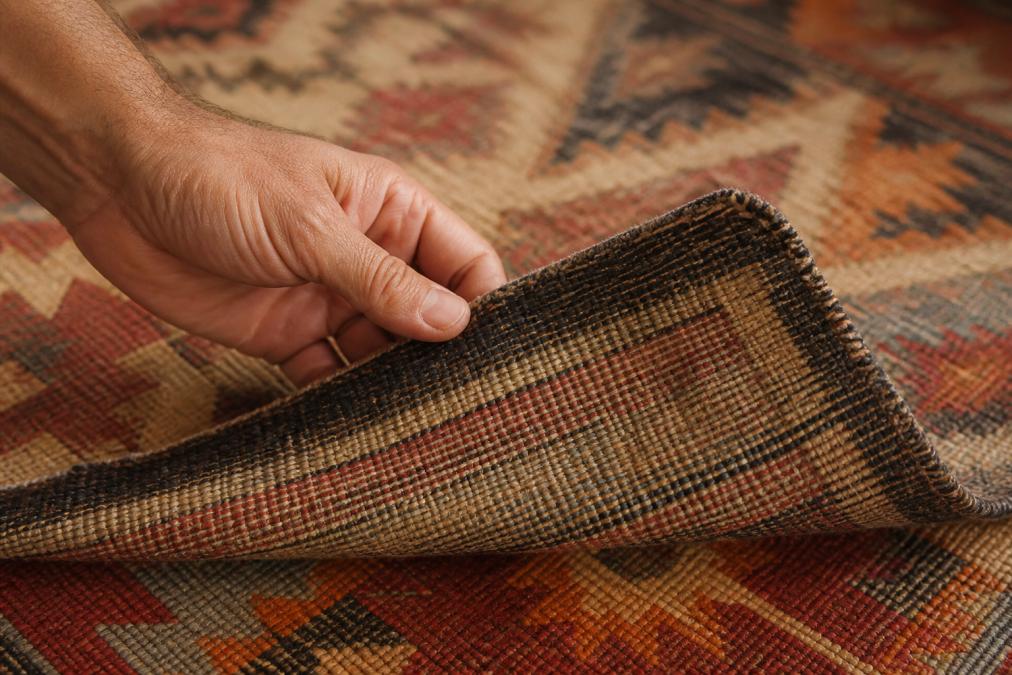
The most reliable indicator of a handmade kilim is the structure of its weave. Flip the rug over and study the back: a handwoven kilim will show the same geometric patterns visible from the front, with clean, consistent lines where the weft strands interlock.
Machine-made kilims typically display a uniform, almost mechanical tension across the entire surface. Handwoven pieces, by contrast, show subtle variations in the tightness of the weave, particularly when you run your fingers across the surface. The weave density also differs: handwoven kilims generally have a coarser, more tactile feel, while machine production allows for extremely fine, uniform threads.
Test 2: Inspect the Fringe and Tassels
Fringe tells a revealing story about how a rug was made. On handwoven kilims, the fringe is an extension of the warp threads themselves, meaning the tassels flow continuously from the body of the rug with no visible attachment point.
Machine-made rugs often have fringe that is sewn or glued onto the finished edges. If you can see a distinct seam, stitching, or adhesive where the fringe meets the rug body, the piece is almost certainly machine-made. You can also gently tug on the tassels: warp-extended fringe on a handmade piece feels firmly anchored, while attached fringe may shift or pull away slightly.
Test 3: Identify the Fibers: Wool, Cotton, or Synthetic
Authentic kilims are woven from natural fibers, most commonly wool for the front face and cotton for the foundation. While touch and sheen offer initial clues, they are subjective and can be misleading. To move beyond surface-level advice, we'll combine a visual inspection with a safe, non-destructive fiber identification technique that most online guides miss: the burn test.
Visual and Tactile Clues
Start with the obvious signs. Wool has a slightly oily, resilient feel and a matte sheen, while cotton feels softer and cooler to the touch (cotton.org). Synthetic fibers such as polypropylene or nylon feel slick and often produce a visible static charge when you rub the surface (sciencedirect.com). Natural fibers also age gracefully; look for subtle variations in color that suggest vegetable dyes rather than the perfectly uniform tones of chemical dyes. A genuine wool kilim will show slight inconsistencies in fiber thickness, a hallmark of hand-spun yarn.
The Burn Test: A Definitive Fiber Check
Visual inspection alone cannot always distinguish a high-quality synthetic blend from natural wool. The most reliable method for fiber verification is the burn test, which is safe to perform on a small sample. Here is the step-by-step procedure used by many textile conservators and appraisers:
- Extract a Sample: Remove a few loose strands from the fringe or an inconspicuous corner of the rug. If no loose strands are available, use a sharp blade to carefully snip a small tuft from the backside, away from the main pattern.
- Prepare Your Workspace: Work over a fireproof surface, such as a ceramic plate or a metal sink. Keep a small bowl of water nearby as a precaution.
- Ignite the Sample: Hold the strands with metal tweezers and pass them through a flame from a lighter or candle. Observe how the fiber reacts.
-
Analyze the Results:
- Wool: Smells like burning hair. It burns slowly, may self-extinguish, and leaves a brittle, black bead that crushes easily into ash.
- Cotton: Smells like burning paper. It burns quickly with an afterglow and leaves a fine, gray ash that retains the shape of the thread.
- Silk: Smells like burning hair but burns more readily. It leaves a black, hollow bead that crushes into powder.
- Synthetic (Acrylic, Polyester, Polypropylene): Melts and shrinks away from the flame rather than burning. It produces a chemical or sweet odor and leaves a hard, plastic-like bead that does not crush.
This test gives you certainty about the fiber content when visual inspection is inconclusive. A kilim that claims to be wool but melts under the flame is a reproduction, regardless of how convincing the weave pattern looks.
Test 4: Look for Irregularities and Human Craftsmanship
Perfect symmetry is a red flag, not a compliment, when evaluating kilims. Handwoven pieces inevitably contain small irregularities: a slightly off-kilter motif, a minor variation in pattern spacing, or an edge that curves by a fraction of an inch over several feet. spot fake silk products.
These imperfections are the fingerprints of human craftsmanship. The weaver's tension changes subtly across hours of work, producing a rug with organic rhythm. Machine-made kilims, by contrast, achieve near-perfect geometric precision because every row is identical. If every motif is exactly the same size and every line is perfectly straight, you are likely looking at a reproduction.
Test 5: Use the Burn Test for Fiber Verification
While the burn test is the most definitive method for identifying fibers, its utility extends beyond simple material confirmation. When combined with a macro-photography approach, it becomes a powerful tool for authenticating the entire construction of a kilim. This section moves beyond the basic test to show you how to use a close-up lens to verify the structural integrity of the weave itself.
The Macro-Photography Guide to Weave Verification
Most authentication guides rely on naked-eye inspection, but a simple macro lens or even the zoom function on a modern smartphone camera can reveal details that are invisible otherwise. This 'zoom-in' guide shows the difference between a hand-interlocked weft and a machine-stitched edge, a major differentiator.
- Photograph the Weave Structure: Place your camera lens within 2-3 inches of the rug's surface, focusing on the area where the weft strands interlock. On a handmade kilim, you will see individual strands of yarn wrapping around each other in a distinct, almost braided pattern. The yarn itself will appear slightly irregular, with tiny variations in thickness and twist. On a machine-made rug, the weave will appear as a perfectly uniform grid, with each strand lying flat and parallel with no visible interlocking.
- Inspect the Selvedge Under Magnification: The selvedge is the finished edge along the sides of the rug. Zoom in on this area. A handwoven kilim's selvedge is often wrapped with wool or goat hair in a contrasting color, and the wrapping may be slightly uneven, with visible overlaps. Machine-made edges are perfectly uniform and typically use a single, continuous cotton thread.
- Examine the Fringe Attachment Point: Take a close-up shot of the exact point where the fringe meets the rug body. On a handmade piece, the warp threads flow directly from the weave, with no seam or adhesive. Under magnification, you will see the individual warp strands continuing seamlessly into the tassels. On a machine-made rug, you will often see a clean cut, a line of stitching, or a bead of glue holding the fringe in place.
Combining the Burn Test with Macro Analysis
The most reliable authentication method combines the burn test for fiber verification with macro-photography for structural analysis. A piece that passes both tests, natural fibers that burn correctly and a weave structure that shows human-level variation, is almost certainly a genuine handmade kilim. This dual approach gives you certainty that visual inspection alone cannot provide, and it is a technique that professional appraisers use to distinguish high-quality reproductions from authentic pieces.
Hand Knotted vs Machine Made Rugs: Key Differences
Understanding the broader category of hand knotted vs machine made rugs helps contextualize kilim identification. A kilim is flatweave with no pile, while a hand-knotted rug features thousands of individual knots tied by hand onto the warp. Both are authentic handmade textiles, but they differ fundamentally from machine-made rugs.
| Feature | Handmade Kilim | Machine-Made Rug |
|---|---|---|
| Construction | Flatweave, interlocked weft | Power-loomed, uniform pile |
| Fringe | Warp extension | Sewn or glued on |
| Fiber | Wool, cotton, natural dyes | Often synthetic |
| Weave consistency | Slight natural variation | Perfectly uniform |
| Reversibility | Reversible | Single-sided |
| Price point | Higher, reflects labor | Lower, mass-produced |
Machine-made rugs are produced on power looms at high speed, often using synthetic fibers to keep costs down (britannica.com). They lack the structural integrity and longevity of handwoven pieces. The differences in durability are substantial: a well-made wool kilim can last generations with proper care, while synthetic machine-made rugs typically show wear within a decade.
Kilim Rug Identification Guide: Regional Clues
This kilim rug identification guide would be incomplete without noting that regional styles offer strong authentication clues. Anatolian kilims from Turkey, for example, frequently feature geometric motifs such as the elibelinde, or "hands on hips" fertility symbol, woven in red, blue, and natural white.
Persian kilims often incorporate more intricate medallion layouts, while Caucasian weavers favor bold, angular stars and diamonds in vivid hues. Understanding these regional variation indicators helps you spot inconsistencies: a piece claiming to be a specific tribal kilim should use the dye palette and motif vocabulary of that region. Natural, vegetable-dyed wool from different regions also produces distinct color depths that are difficult to replicate synthetically.
Consider enhancing your home decor with an authentic piece like the Hand Knotted Turkish Kilim Pillow Cover (Beige) 18" X 18" Rc_27123 for $78.00. We also offer other unique options such as the Hand Knotted Turkish Kilim Pillow Cover (Beige) 18" X 18" Rc_27216, the Hand Knotted Turkish Kilim Pillow Cover (Beige) 18" X 18" Rc_27215, and the Hand Knotted Turkish Kilim Pillow Cover (Beige) 18" X 18" Rc_27214, all priced at $78.00.


Frequently Asked Questions
How can I tell a real kilim rug?
Look for a flatweave construction with no pile. Real kilims have warp and weft threads visible on both sides, creating a reversible textile. The weave should show slight irregularities in tension, and the fringe should be a natural extension of the warp threads, not sewn on separately.
Are handmade kilim rugs more valuable than machine-made ones?
Yes. Handmade kilims require hundreds of hours of skilled labor and use natural materials like wool and cotton. Machine-made rugs are produced quickly with synthetic fibers, which lowers their durability and resale value. A genuine handmade kilim also carries cultural and artisanal significance that machine production cannot replicate.
Do handmade kilims have imperfections?
Yes, and that is a good sign. Slight asymmetries in geometric patterns, minor variations in weave density, and small color inconsistencies from natural dye lots are markers of human craftsmanship. Perfect symmetry and uniform dye color usually indicate machine production.
What should I look for on the back of a kilim rug?
The back of a handmade kilim should look nearly identical to the front, since flatweave construction is reversible. Check for clean, continuous weft threads and a selvedge that is hand-wrapped. Machine-made rugs often have a distinct backside with visible glue, canvas backing, or clipped threads.
Authenticating a kilim takes practice, but these seven tests give you a systematic approach to how to tell if a kilim is handmade with confidence. At ABC Rugs Kilims & Jewelry, every piece in our curated collection is reviewed and trusted, sourced directly from Anatolian villages and verified for authenticity. Explore our selection of handwoven kilims and pillow covers, each one a one-of-a-kind piece of textile history, and bring genuine craftsmanship into your home.
This article was written using GrandRanker


