

Table of Contents
- Start with the Big Picture: Vintage vs. Antique
- The First Clue: How to Identify Vintage Jewelry Hallmarks
- Inspecting Metal Purity and Gemstone Settings
- Recognizing the Signs of Fake Vintage Jewelry
- Advanced Checks: Non-Destructive Testing and Digital Risks
- How to Clean Vintage Antique Jewelry Safely
- What Restoration and Resizing Mean for Authentic Vintage Rings
- Frequently Asked Questions
Last Updated: September 12, 2026
Start with the Big Picture: Vintage vs. Antique
Vintage jewelry is any piece between 20 and 100 years old, while antique jewelry is more than 100 years old. (the FTC) That distinction decides how it was made, what metals and cuts you'll find, and how much you should pay.
"Vintage" gets thrown around loosely in online listings, which is why so many buyers end up disappointed. Knowing what to look for in authentic vintage rings starts with pinning down the era first.
At ABC Rugs Kilims & Jewelry, we offer a curated collection of exquisite handmade rugs, Kilims, Persian antique pieces, gemstones, jewelry, and vintage treasures. The same pattern shows up again and again: buyers fall for a story instead of a piece. The Federal Trade Commission's guidance on jewelry advertising is clear that sellers must be truthful about a product's origin and composition, so a vague "antique-style" label is a red flag, not a selling point.
Here's the framework we use to sort a real period piece from a modern imitation:
- Antique: Made before roughly 1920. Expect hand-fabricated settings and old European or old mine cuts.
- Vintage: Made between the 1920s and early 2000s. Art Deco through mid-century and beyond.
- Estate: A catch-all term for previously owned jewelry of any age, which says nothing about era.
The First Clue: How to Identify Vintage Jewelry Hallmarks
Hallmarks are tiny stamped symbols on the inside of a band or the back of a setting that identify metal purity, the maker, and sometimes the country and year of assay. They are vintage jewelry's closest thing to a birth certificate.
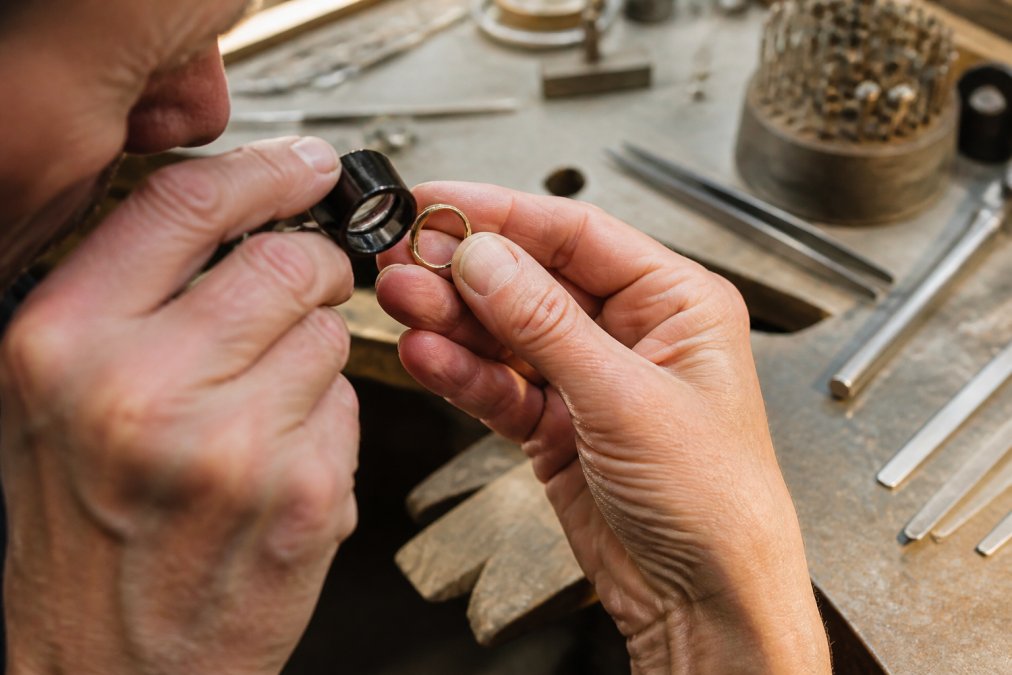
You will not read them with the naked eye. A 10x jeweler's loupe is the standard tool. Hold the piece under bright, angled light and check the inner shank, clasp, or bail, rotating slowly, a mark visible at only one angle is often a partial strike.
Decoding Common Marks and Maker's Marks
A maker's mark identifies who made the piece; a purity mark tells you what it is made of. On American pieces you'll often see "14K" or "18K" for gold, "925" or "sterling" for silver, and "plat" or "PLAT" for platinum. A few conventions narrow the era fast:
- "Sterling" spelled out rather than "925" points to pre-1900s American silver more often than not.
- "10K" was common in mass-market American jewelry from the 1930s through the 1970s; it is legal, but it is a lower gold content than most antique pieces.
- "GF" (gold filled) and "RGP" (rolled gold plate) are not solid gold. They are a base metal with a bonded gold layer, and they were extremely common in costume jewelry from the 1920s through the 1950s. A seller calling a gold-filled ring "solid gold" is misrepresenting it.
- "Coin silver" or "pure coin" indicates pre-1868 American silver, which was typically 90% silver rather than sterling's 92.5% (usmint.gov).
- European import marks often include a small assay office symbol (a leopard's head, a Minerva head, a lion passant) alongside the purity number. These are not forgeries when they appear on an American-market piece, they usually mean the ring was imported.
Early stamping was inconsistent. Before federal regulation tightened, some pieces carried only a maker's mark, and some were never stamped at all. An unstamped ring is not automatically fake, but you cannot verify purity from the surface alone, ask for an XRF reading or a written statement of metal content.
A few patterns worth memorizing:
- Hand-punched marks sit unevenly and often off-center, one side deeper than the other.
- Laser-etched modern marks are perfectly crisp on a piece claiming to be from 1910.
- A missing mark on a heavily worn piece is common; on a "mint condition" antique it is not.
- A mark too deep, too centered, or too consistent across one seller's rings suggests a modern stamping die.
What a Hallmark Cannot Tell You
A hallmark confirms metal purity and, sometimes, the maker. It does not confirm the stone, the era of the setting, or whether the piece has been altered. A genuine 1920s platinum shank with a modern brilliant-cut diamond is still a genuine 1920s shank, but it is not an original piece and should not be priced as one.
Inspecting Metal Purity and Gemstone Settings
Metal purity and setting construction are where reproductions give themselves away fastest. A forger can fake a hallmark, but hand-cut prongs and a hand-soldered shank take real labor, and most counterfeiters skip it.
The shank is the band of the ring. On genuinely old pieces it is usually thinner at the bottom from decades of wear and may show a solder seam from repair; modern reproductions tend to have a uniformly thick, perfectly round shank. Prongs tell a similar story: hand-cut prongs are slightly irregular, while cast prongs are identical.
Evaluating Gemstone Cuts and Prong Integrity
Older stones were cut by hand, and the cuts look different. An old mine cut has a high crown, a small table, and a large open culet. An old European cut is rounder with a similar deep profile. Both predate the modern brilliant cut and have a chunkier, warmer sparkle.
Check prong integrity by running a fingernail along the top edge of each prong. If your nail catches, the prong is worn or bent and the stone is at risk. Loose stones in a vintage setting are normal and fixable; a missing prong is a repair you should price before buying.
Recognizing the Signs of Fake Vintage Jewelry
The clearest signs of a fake are anachronisms: modern materials or techniques used on a piece claiming to predate them. Rhodium plating, laser engraving, and perfectly matched machine-cut stones are the three most common giveaways. Here is a comparison to help you identify authentic pieces:
| Feature | Authentic Period Piece | Common Reproduction |
|---|---|---|
| Hallmark | Hand-punched, slightly uneven | Laser-etched, perfectly crisp |
| Shank | Thinner at base from wear | Uniform thickness throughout |
| Prongs | Hand-cut, subtly irregular | Cast, identical to each other |
| Gemstone cut | Old mine or old European | Modern brilliant |
| Patina | Natural oxidation in recesses | Uniform or artificially darkened |
| Plating | None, or worn through | Fresh rhodium, mirror-bright |
Patina is the soft, uneven darkening that develops in the crevices of old metal, and it cannot be rushed convincingly. A piece bright and uniform in every recess has likely been polished hard or plated recently.
Reproduction and forgery are not the same thing. A reproduction is an honest modern copy; a forgery is a reproduction sold as an original, and that is where the real money gets lost.
Advanced Checks: Non-Destructive Testing and Digital Risks
Non-destructive testing lets you verify metal and stone without damaging the piece, which matters enormously with antique work. An acid test uses a small scratch and a drop of solution to confirm gold karat, but it leaves a mark, so many buyers prefer alternatives:
- Electronic gold testers read conductivity through the surface with no scratching. They are fast and accurate on solid gold, but thick plating over a base metal core can fool them, so pair them with a visual check of the shank edges.
- X-ray fluorescence (XRF) identifies metal composition without touching the piece. It reads the surface layer only, a heavily plated ring can read as solid gold. Ask for a reading on a filed or worn edge.
- Refractive index testing uses a refractometer to identify a gemstone by how it bends light. It is non-invasive, quick, and the standard first step before more involved stone testing.
- Ultraviolet light can reveal treatments, some synthetic stones, and certain dyes. It is a screening tool, not a confirmation, fluorescence does not automatically mean treated, and its absence does not mean natural.
- Specific gravity testing weighs the stone in air and in water to estimate density. It distinguishes natural from synthetic corundum and beryl, but usually requires removing the stone.
None of these replace a gemologist's report for a high-value stone. For a ring under a few hundred dollars, a refractometer reading plus a loupe inspection is usually enough; above that, budget for an independent appraisal.
The Digital Authentication Problem
The newer risk is digital. High-resolution photos and AI-generated listing images can make a piece look better online than in hand, and some sellers use stock images for pieces they do not hold. A few checks can help close most of that gap:
- Reverse-image search the listing photos. If the same image appears on multiple seller accounts or a manufacturer's catalog page, the listing is not showing you the actual piece.
- Ask for a live video call showing the hallmark under magnification. A legitimate seller will say yes; one who deflects or claims the piece is "in the vault" is telling you something.
- Request a photo of the ring next to a coin or ruler. This confirms scale and forces the seller to handle the actual item.
- Check the return policy in writing before payment. A no-returns policy on a vintage ring sold online is a strong signal to walk away.
- Pay with a method that offers recourse. Credit cards and established payment platforms give you a dispute path; peer-to-peer transfers generally do not.
- Be wary of "estate sale" framing with no provenance. The phrase implies age without requiring proof. Ask for the specific era, the hallmark photo, and any prior appraisal documentation.
When to Walk Away
Some signals are not fixable with more questions. A seller who will not provide a hallmark photo, do a live video call, state the metal content in writing, or explain a price far below comparable listings is not worth negotiating with. The cost of a missed ring is low; the cost of a forged one is the full purchase price plus the appraisal fee.
How to Clean Vintage Antique Jewelry Safely
The safest approach to cleaning vintage antique jewelry is the least aggressive one: warm water, a drop of mild dish soap, and a soft baby toothbrush. Anything stronger risks the finish, the patina, or the stones.
Work through it in this order:
- Inspect first. Check every prong and the shank for looseness before the piece gets wet.
- Mix the bath. Warm water with one drop of mild soap in a small bowl.
- Soak briefly. Two to three minutes is enough.
- Brush gently. Use a soft brush around the setting and the underside of the stone.
- Rinse and dry. Pat dry with a lint-free cloth and let it air for an hour.
Skip ultrasonic cleaners on vintage pieces with old mine cuts, opals, emeralds, or any stone with visible fractures. Skip vinegar, baking soda, and toothpaste entirely; they are abrasive and can strip plating. For soft or porous stones, use a dry soft cloth.
What Restoration and Resizing Mean for Authentic Vintage Rings
Resizing and restoration change a vintage ring's value, sometimes permanently, so the decision deserves more thought than it usually gets. A resized ring is no longer in original condition, and serious collectors pay less for it.
The practical trade-offs:
- Sizing down is usually straightforward and minimally invasive.
- Sizing up can thin the shank and stress old solder joints.
- Re-tipping prongs is routine maintenance and generally does not hurt value.
- Re-polishing removes patina and metal, reducing value.
- Replacing a stone with a modern cut breaks the era consistency of the piece.
If the ring is for daily wear, resize it and enjoy it. If it is an investment piece, leave it alone and wear it occasionally. Those goals pull in opposite directions, and pretending otherwise is how people end up with a beautiful ring worth a fraction of what they paid.
Buying authentic vintage jewelry comes down to patience and verification: read the hallmark, inspect the shank and prongs under magnification, question anything that looks too clean, and get the piece in front of a camera before money changes hands. ABC Rugs Kilims & Jewelry offers a curated collection of exquisite handmade rugs, Kilims, Persian antique pieces, gemstones, jewelry, and vintage treasures, including pieces like our 925 sterling silver ruby ring and our emerald cut engagement ring in 14k white gold plating. Our platform ensures you find authentic, reviewed, and trusted pieces to elevate your living space. Discover timeless artistry and craftsmanship with our carefully selected inventory available for purchase today. Browse the collection at ABC Rugs Kilims & Jewelry and start your collection with pieces you can actually verify.


Frequently Asked Questions
How can you tell if a vintage ring is real?
Start by checking for hallmarks or maker's marks, which indicate metal purity and origin. Use a jeweler's loupe to inspect the setting and prongs for wear patterns consistent with age. Look for gemstone cuts like old European or old mine cuts, which are common in authentic vintage rings. A patina on the metal and subtle oxidation in crevices also suggest authenticity. If unsure, a professional jeweler can perform non-destructive tests like acid or XRF analysis.
What are the hallmarks of authentic vintage jewelry?
Authentic vintage jewelry often features stamped hallmarks indicating metal purity, such as 14K or 925, and maker's marks. These stamps are usually crisp and consistent with the era. Look for signs of handcrafting, like slight irregularities in filigree or milgrain detailing. The presence of a patina or oxidation in recessed areas, rather than uniform shine, can also indicate age. Reproductions often have too-perfect finishes or lack proper stamps.
How do I verify the authenticity of a gemstone in a vintage ring?
Examine the gemstone's cut: vintage rings typically feature old European or old mine cuts with larger culets and less symmetry than modern cuts. Check for natural inclusions under magnification, as synthetic stones may lack them. A jeweler can use a refractometer or microscope to confirm. For valuable stones, request a certification from a gemological lab. Be wary of overly flawless stones at low prices, as they may be fakes.
What should I look for when inspecting vintage ring settings?
Inspect the prongs for wear: authentic vintage rings often have worn or re-tipped prongs from years of use. Check the shank for thinning or repairs, which indicate age. Look for consistent metal color and patina around the setting. The setting style should match the era, such as bezel settings in Art Deco pieces. If the setting looks too new or machine-perfect, it may be a reproduction. Always use magnification for a thorough check.


