

Table of Contents
- What You'll Need for Testing Vintage Jewelry at Home
- Step 1: Antique Jewelry Hallmark Identification
- Step 2: How to Test Gold at Home with Non-Destructive Methods
- Step 3: Identifying Sterling Silver vs Silver Plated
- Step 4: When to Use Acid Testing Kits and Electronic Testers
- Common Mistakes to Avoid When Checking Purity
- When to Seek a Professional Appraisal
- Frequently Asked Questions
Why Vintage Jewelry Metal Purity Matters Before You Buy
Understanding vintage jewelry metal purity is the difference between paying for a treasure and overpaying for a trinket. The metal content determines a piece's actual value, durability, and resale potential, and identical-looking pieces can differ in worth by hundreds of dollars based on what is under the surface.
At ABC Rugs Kilims & Jewelry, we understand how often appearance misleads. With a few basic tools and a methodical approach, you can perform meaningful vintage jewelry metal purity checks at your kitchen table.
This guide walks through the entire process, from reading hallmarks to running simple home tests, covering non-destructive methods first and then explaining when acid kits and electronic testers make sense.
What You'll Need for Testing Vintage Jewelry at Home
Before starting any test, gather these supplies. Most are inexpensive and available online or at a hardware store.
- A jeweler's loupe with 10x magnification
- A strong neodymium magnet
- An unglazed ceramic tile or plate
- A digital scale that reads grams to two decimal places
- A small container of water for specific gravity testing
- White vinegar or iodine for basic silver screening
- A soft cloth for cleaning test surfaces
The jeweler's loupe is your most important tool. It lets you read tiny hallmarks, inspect wear patterns, and spot plating seams that the naked eye misses. A 10x loupe costs between $10 and $30 and should be your first purchase.
Step 1: Antique Jewelry Hallmark Identification
The hallmark is your starting point for antique jewelry hallmark identification, and it is the only test that tells you exactly what the maker declared. Look inside bands, on clasps, and along the backs of pendants for stamps such as 14k, 18k, 925, or 800.
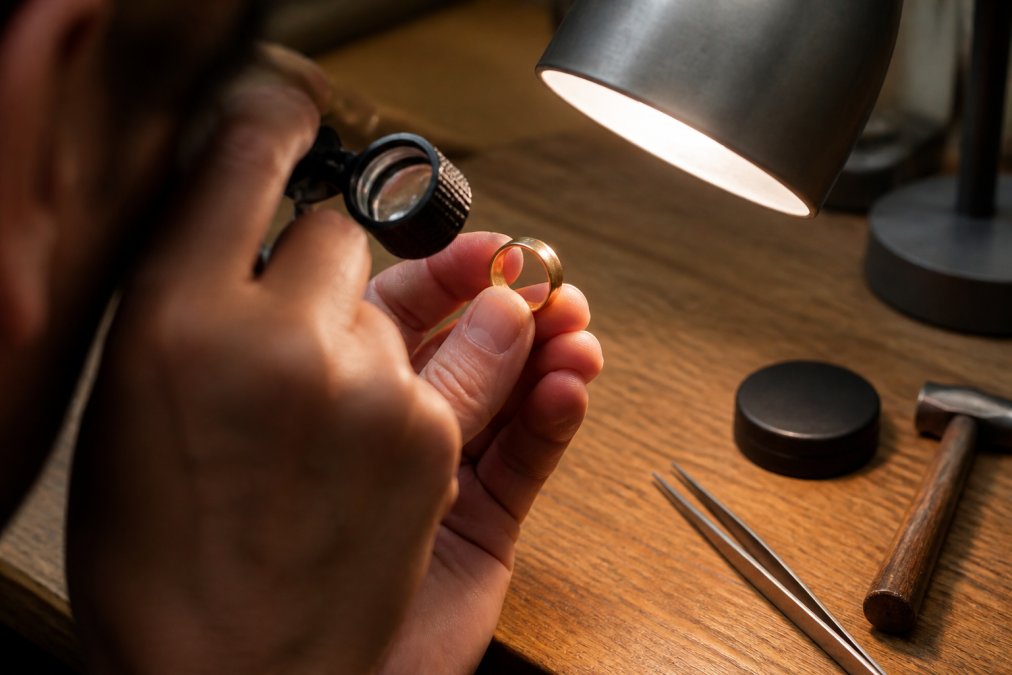
A loupe reveals the full picture. You are looking for three elements: the purity stamp, the maker's mark, and sometimes a date letter or assay office symbol. For example, a piece marked "925" indicates 92.5 percent silver content, while "14k" means 14 parts gold out of 24, or roughly 58.5 percent pure gold. The Federal Trade Commission's Jewelry Guides provide official definitions for these quality marks and what they legally represent.
Do not stop at the number. Plated items sometimes carry misleading stamps, and older pieces may have worn marks. If the hallmark is faint or partially worn, move to the physical tests in the next steps.
Decoding the Hallmark System: Beyond the Number
A hallmark often contains more data than the purity number. Understanding the full system can help you date a piece and verify its authenticity.
Purity Stamps (Fineness Marks): These are the most common. In the United States, you will typically see:
- Gold: 10k (41.7% gold), 14k (58.5% gold), 18k (75% gold), and 22k (91.7% gold).
- Silver: 925 (92.5% silver, also known as sterling), 800 (80% silver, common in European pieces), and 950 (95% silver, often used in higher-end pieces).
- Platinum: 950 (95% platinum) or 900 (90% platinum).
Maker's Marks: This is the registered trademark of the manufacturer or designer, and can be a name, initials, or a symbol. For vintage pieces, this mark is a crucial tool for dating and attribution, a piece from Tiffany & Co. will have a specific mark that has changed over the decades.
Assay Office Marks: In many countries, an official government office tests and certifies metal purity, often leaving a small symbol. While the United States does not have a federal assay office for jewelry, pieces imported from the UK, France, and other European countries will carry these marks.
A Quick Guide to International Hallmarks
Since vintage jewelry often comes from abroad, knowing a few key international marks is invaluable.
- British Hallmarks: The UK has a rigorous system. You will often see a lion passant (a walking lion) for sterling silver, a crown for gold, and a leopard's head for London. The system also includes a date letter (a letter in a specific font and shield shape) that pinpoints the year of assay.
- French Hallmarks: France uses a boar's head for silver and an eagle's head for gold. These marks are often small and require a loupe to see clearly.
- German Hallmarks: Germany uses a crescent moon and crown for silver and a sun for gold. The fineness is often expressed in thousandths (e.g., 585 for 14k gold).
How to Look Up a Hallmark You Don't Recognize
If you encounter a mark you don't recognize, several resources are at your disposal:
- Online Databases: Websites like the Online Encyclopedia of Silver Marks, Hallmarks & Maker's Marks offer searchable databases of thousands of marks. You can browse by country, time period, or symbol.
- Reference Books: Books like Kovels' Antiques and Collectibles Price Guide or specialized texts on silver and gold hallmarks are excellent for deep dives.
- Jewelry Forums: Online communities of collectors and dealers are often happy to help identify unusual marks. Post a clear photo of the hallmark along with a description of the piece.
The Pitfall of Misleading Stamps
The most significant risk in hallmark reading is a false or misleading stamp. While outright counterfeiting is less common on vintage pieces, it does happen. More frequently, you will find:
- Plated Items with Full Hallmarks: Some plated pieces are stamped with a karat mark to deceive. This is why hallmark reading is only the first step, not the final answer.
- Worn or Altered Marks: A hallmark that has been worn down or deliberately filed off is a red flag. It may indicate the piece was originally plated and the mark was removed, or that the piece is of lower quality than the original mark suggested.
Always treat a hallmark as strong evidence, not a guarantee. The physical tests in the following steps are essential for confirming what the stamp claims.
Step 2: How to Test Gold at Home with Non-Destructive Methods
How to test gold at home starts with methods that will not damage the piece. Run these in order, because each one narrows the possibilities.
The Magnet Test. Gold and sterling silver are not magnetic. Hold a strong neodymium magnet near the piece. If it snaps to the metal, you are almost certainly dealing with a base metal core or steel alloy. A weak pull can indicate a magnetic clasp or finding, so test the main body separately. This test is fast but not conclusive on its own.
The Ceramic Test. Drag the piece gently across an unglazed ceramic tile. Real gold leaves a yellow-gold streak; a black or gray streak indicates base metal or plating. This test leaves a visible mark, so only use it on a hidden area like the inside of a band.
The Specific Gravity Test. This is the most reliable home method. Weigh the dry piece, then suspend it on a thin thread in water and weigh it again. Divide the dry weight by the loss of weight in water. Pure gold gives a result near 19.3, 14k gold near 13.5, and sterling silver near 10.5. A result far from these numbers means the piece is not what the stamp claims.
Step 3: Identifying Sterling Silver vs Silver Plated
Identifying sterling silver vs silver plated is easier than most people expect. Start with the hallmark: genuine sterling carries "925," "Sterling," or a lion passant symbol. Silver plate often shows marks like "EPNS" (electroplated nickel silver) or no mark at all.
For a more definitive answer, use the vinegar test. Apply a drop of white vinegar to a hidden spot and wait about 30 seconds. Real sterling silver will not react visibly. Silver plate over copper may show a slight greenish tinge where the vinegar exposes the base metal through micro-scratches. Tarnish is another clue: sterling develops a dark, even patina, while plated pieces tend to tarnish in patches or not at all. identify gold coins.
The Definitive Test: Finding the Wear-Through Points
The most reliable way to distinguish vintage sterling from silver plate is to look for wear-through points, areas where the plating has worn away to reveal the base metal underneath.
Why Wear-Through Happens: Plating is a thin layer of silver, often only a few microns thick, applied over a base metal like copper, brass, or nickel silver. Over decades of use, this layer wears away on the parts that receive the most friction.
Where to Look for Wear-Through:
- High-Friction Edges: The most common wear points are the edges of a piece. On a bracelet, look at the outer edges of the links. On a pendant, examine the rim. On a ring, check the shoulders and the inside of the band.
- Clasps and Catches: The tongue of the clasp, the hook, and the area where the clasp connects to the chain are all prime spots for plating loss.
- Raised Details: The raised parts of a pattern or engraving will wear first. Run your fingernail over the design; if you feel a slight ridge or see a color difference, you have found a wear point.
- Inside of Chains: The inside of the links (the part that touches your skin) will show wear before the outside.
What Wear-Through Looks Like:
- On Copper Base: A reddish or pinkish tint. Copper is a common base for silver plate.
- On Brass Base: A yellowish-gold tint. Brass is also a frequent base metal.
- On Nickel Silver Base: A grayish or greenish tint. Nickel silver (which contains no actual silver) is another common base.
The Difference in Tarnish Patterns
Tarnish is not just a sign of age; it is a diagnostic tool. Sterling silver tarnishes because the silver reacts with sulfur in the air to form silver sulfide, which is dark gray or black.
- Sterling Silver: Tarnishes evenly across the entire surface. The patina is uniform and can be polished away to reveal bright silver underneath.
- Silver Plate: Tarnishes in patches or not at all. If the plating is thin or has micro-scratches, you may see tarnish only in those specific areas.
A Simple Home Test for Plating Thickness
While not a scientific measurement, you can get a sense of plating thickness with a simple test. Take a soft, white cloth and rub a small, hidden area firmly for about 30 seconds. On a heavily plated piece, the cloth may pick up a slight dark residue (tarnish). On a lightly plated piece, you might expose the base metal, revealing a color change.
Why This Matters for Value
The distinction between solid sterling and silver plate is a difference of significant value. A solid sterling silver necklace might be worth $50 to $100 based on its weight alone, while a silver-plated necklace of the same design might be worth $5 to $10. Knowing how to spot the difference protects you from overpaying.
Step 4: When to Use Acid Testing Kits and Electronic Testers
Acid testing kits and electronic gold testers provide more certainty, but each has trade-offs. Acid kits use nitric acid to test the metal's reaction; a drop on a testing stone mixed with a small metal sample produces a color change that indicates karatage. These kits are accurate and inexpensive, but they are destructive: they remove a tiny amount of metal and leave a visible mark.
Electronic testers measure electrical conductivity to estimate purity. They are non-destructive and give results in seconds, making them ideal for checking multiple pieces. Quality testers cost several hundred dollars and require calibration. For a single purchase, the cost rarely justifies itself. For dealers and collectors who test regularly, an electronic tester pays for itself quickly.
Safety matters here. Nitric acid causes burns and releases fumes. Work in a ventilated area, wear gloves and eye protection, and keep baking soda nearby to neutralize spills. The Occupational Safety and Health Administration's guidelines on chemical handling offer practical protocols for working safely with acids at home.
Common Mistakes to Avoid When Checking Purity
The most frequent error is trusting the hallmark without inspecting the piece for plating. A "925" stamp on a clasp does not make the chain sterling if the chain itself is plated base metal. Check every component separately, especially clasps, which manufacturers often make from a different alloy.
Another common mistake is testing only the surface. Plating can be thick enough to fool a magnet or even an acid test. Look for wear at edges, where plating thins and reveals the base metal underneath. A reddish or greenish tint at the edges of a "gold" piece signals copper or brass beneath the surface.
Do not skip the specific gravity test because it seems complicated. It is the single best home method for distinguishing solid metal from plated pieces. Finally, avoid testing on visible surfaces. Use the inside of a band, the back of a pendant, or the underside of a clasp where a small mark will not affect the piece's appearance.
When to Seek a Professional Appraisal
Home testing gets you most of the way, but certain situations demand professional help. If the piece has significant monetary or sentimental value, if the hallmarks are worn beyond reading, or if your test results conflict with the stamp, take the item to a certified appraiser.
A professional appraisal provides documentation of purity, weight, and estimated value. This matters for insurance purposes and for resale. Appraisers use advanced equipment like X-ray fluorescence analyzers that identify metal composition without any damage. The American Gem Society's guide to finding a certified appraiser explains what credentials to look for and how the process works.
At ABC Rugs Kilims & Jewelry, our vintage pieces come with clear descriptions of their metal content, including pieces like our [14KT gold-electroplated necklace(/products/vintage-14kt-gold-electroplated-necklace-w-red-oval-gemstone-pendant) with red oval gemstone pendant | abcrugskilims.com], so you know exactly what you are buying. When a piece in our collection is gold-plated or rhodium-finished, we state that plainly rather than letting a hallmark imply more than the metal delivers.
Knowing how to check vintage jewelry metal purity protects your wallet and your confidence as a collector. Start with hallmark reading, confirm with non-destructive tests, and escalate to acid or electronic testing only when needed. For pieces that matter most, invest in a professional appraisal.
When you shop with ABC Rugs Kilims & Jewelry, you get transparent descriptions of every piece, from our 925 silver with rhodium and 18K gold plating to our earth-mined gemstone necklaces. Each item is reviewed and trusted, so you can buy with certainty. Browse our vintage collection today and find a piece you will treasure for years.
Frequently Asked Questions
How can I tell if vintage jewelry is real gold or silver?
Start by checking for hallmarks like 14k, 18k, 925, or 800 using a jeweler's loupe. Then perform a magnet test: gold and sterling silver are not magnetic. For a more reliable check, use a testing stone with a drop of nitric acid, or take the piece to a professional jeweler for electronic testing.
What do the numbers on vintage jewelry stamps mean?
Numbers on vintage jewelry indicate the purity of the precious metal. For gold, 10k means 41.7% gold, 14k is 58.3%, and 18k is 75%. For silver, 925 means 92.5% pure silver, also known as sterling silver, while 800 means 80% silver. These stamps, along with maker's marks, are key identifiers for antique jewelry hallmark identification.
How do I use a magnet to test jewelry metal purity?
Hold a strong neodymium magnet near the piece. Real gold and sterling silver are not magnetic, so if the jewelry is strongly attracted to the magnet, it likely contains a significant amount of base metal. However, be aware that clasps or findings might be made of a different, magnetic metal. This test is a quick screening tool, not a definitive proof of purity.
When should I take vintage jewelry to a professional appraiser?
Take your piece to a professional appraiser when you need a certified valuation for insurance or an estate sale, or when your at-home tests are inconclusive. A gemologist can use electronic gold testers and specific gravity tools without damaging your piece. They also have the expertise to identify complex items like gold-filled or plated vintage jewelry that might fool an amateur eye.


