

Table of Contents
- Why Authentic Pre-Owned Designer Jewelry Makes Financial Sense
- How to Authenticate Designer Jewelry: Essential Verification Steps
- Pre-Owned Jewelry Investment Value: What Holds Its Worth
- Access to Rare, Vintage, and Signed Pieces
- Sustainability and Ethical Consumption in Luxury
- Quality, Craftsmanship, and Heirloom Potential
- What to Look for When Buying Pre-Owned Designer Jewelry
- Maintenance and Care for Vintage and Estate Jewelry
- Frequently Asked Questions
Last Updated: September 3, 2026
Why Authentic Pre-Owned Designer Jewelry Makes Financial Sense
Buying authentic pre-owned designer jewelry offers substantial cost reduction compared to retail prices. A piece retailing for $5,000 may be available on the secondary market for $3,000 to $3,500 depending on condition, age, and demand. You're not sacrificing quality, a pre-owned designer piece from a reputable seller like ABC Rugs Kilims & Jewelry carries the same craftsmanship, materials, and design integrity as when it left the manufacturer.
Pre-owned designer jewelry typically holds its value better than new pieces over 3-5 years. A new designer ring loses 20-30% of its value immediately upon purchase, while a pre-owned piece that's already settled on the secondary market experiences much slower depreciation (peer-reviewed research).
How to Authenticate Designer Jewelry: Essential Verification Steps
Authentication is the foundation of any pre-owned designer jewelry purchase. Without it, you're buying on faith alone.
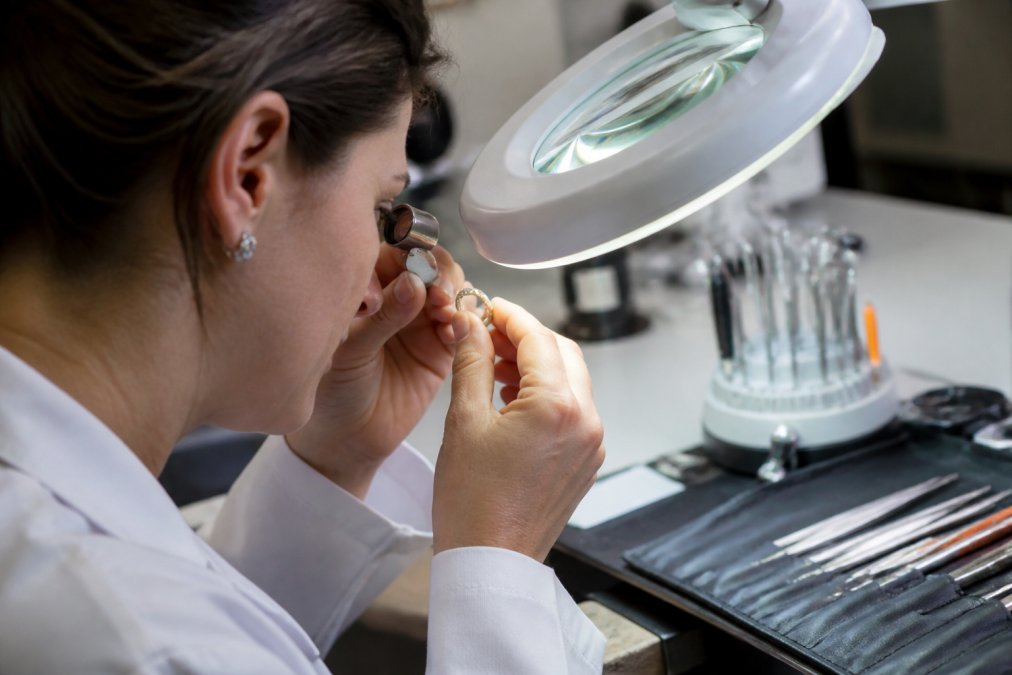
Start with hallmarks and maker's marks. Every legitimate designer jewelry piece carries identifying marks stamped into the metal. For gold, you'll see purity marks: 10K, 14K, 18K, or 750 (75% pure gold) (the FTC). Platinum pieces show "PT" or "PLAT." These marks must be crisp, even, and properly aligned. Blurry, shallow, or misaligned stamps indicate counterfeits.
Examine the maker's mark itself. Cartier pieces display the Cartier hallmark in a specific font and size. Tiffany & Co. uses their distinctive mark. Each luxury house has unique, recognizable stamps. Serial numbers and date codes provide additional verification. Many designer houses encode production information into their pieces. A ring claiming to be from 1985 but bearing a serial format only used after 2000 is immediately suspect.
Hallmarks, Serial Numbers, and Maker's Marks
The hallmark is your first line of defense against counterfeits. Legitimate designer jewelry houses maintain strict quality control on their stamping. The mark should be perfectly centered, consistent in depth and clarity, properly proportioned, and located in standard positions.
Serial numbers tell a story if you know how to read them. Cartier's serial numbers changed format in 1972, 1990, and 2005. Tiffany & Co. uses a different system entirely. Understanding these variations is essential to confident buying.
Maker's marks extend beyond the house name to include the craftsperson's mark, assay office mark (indicating where the piece was tested for purity), and sometimes a date letter. In European jewelry, the assay office mark reveals where the piece was officially tested and hallmarked.
Red Flags and Common Authentication Mistakes
A genuinely aged piece will show wear on its hallmarks, this is normal and expected. What's not normal is a hallmark so faint it's barely visible on a recent piece, or so deep and crisp on a vintage piece that it looks newly stamped.
Weight and density provide another verification layer. Gold and platinum have specific densities. A piece that feels unusually light for its size and material might be gold-plated rather than solid gold. A water displacement test can verify density, though this requires careful handling.
Gemstone settings reveal counterfeits through their construction. Legitimate designer houses use specific setting techniques, the way prongs are cut, the depth of the setting, the type of metal used for the basket underneath. The gemstone itself should have certification from a reputable lab like the Gemological Institute of America (GIA) (gia.edu).
Pre-Owned Jewelry Investment Value: What Holds Its Worth
Not all pre-owned designer jewelry retains value equally. Understanding which pieces hold their worth is essential for sound financial decisions.
Vintage pieces from iconic designers appreciate over time. A Cartier Juste un Clou bracelet from the 1970s is worth more today than it was ten years ago. A Hermès piece in gold might appreciate 3-5% annually. Cartier, Van Cleef & Arpels, Bvlgari, and Hermès pieces from their iconic collections are far more likely to hold or appreciate in value than contemporary pieces from lesser-known designers.
Condition dramatically affects value retention. A piece in excellent condition with minimal wear retains 70-85% of its secondary market value over five years. A piece with significant wear, repairs, or restoration loses value more rapidly. If a piece requires $1,500 in repairs to reach excellent condition, that cost comes out of your equity. Detailed condition reports are critical to evaluating true investment value.
Rarity and provenance drive appreciation. A piece with documented ownership history, especially if it belonged to someone notable or was featured in publications, commands premiums. Clear provenance documentation makes a piece easier to resell and typically appreciates faster than one with murky origins.
Access to Rare, Vintage, and Signed Pieces
The pre-owned market is the only place to acquire truly rare and vintage designer jewelry. If you want a Cartier piece from the 1920s Art Deco period or a Van Cleef & Arpels vintage brooch from the 1950s, the secondary market is your only option.
Signed jewelry carries particular cachet and value. A piece with a maker's signature confirms its authenticity and provenance in ways unsigned pieces cannot match. Collectors actively seek signed pieces because the signature itself is a form of authentication and a guarantee of the maker's reputation.
Vintage pieces offer access to design eras that shaped modern jewelry aesthetics. The Art Deco period (1920s-1930s) produced sophisticated geometric designs. Mid-century modern (1940s-1960s) brought sculptural forms and innovative settings. These eras are gone, no contemporary designer can replicate the exact aesthetic and technical approach of those periods.
Sustainability and Ethical Consumption in Luxury
Buying pre-owned designer jewelry aligns with circular economy principles. Every pre-owned piece purchased is one fewer new piece requiring mining, refining, manufacturing, and shipping. The environmental footprint of a pre-owned diamond or gold piece is dramatically lower than a newly mined and processed stone or metal.
Gold mining requires substantial water resources and generates mining waste. By purchasing pre-owned pieces, you're recycling materials that have already been extracted and processed, reducing demand for new mining and its associated environmental impact.
Ethical sourcing becomes simpler with pre-owned pieces. Conflict diamonds and ethically questionable gold sources are ongoing concerns in the jewelry industry. A pre-owned piece with clear provenance documentation bypasses these concerns entirely.
Quality, Craftsmanship, and Heirloom Potential
Designer jewelry from established luxury houses represents a different tier of craftsmanship than contemporary mass-produced pieces. The construction techniques, material quality, and attention to detail in a Cartier or Van Cleef & Arpels piece exceed what most contemporary jewelry offers.
Older pieces often feature superior craftsmanship compared to modern production. Mid-century designer jewelry was hand-finished to a degree that's economically unfeasible in contemporary manufacturing. A 1950s Tiffany & Co. brooch likely involved dozens of hours of hand labor. Contemporary pieces incorporate more machine finishing to maintain profitability.
Material quality has changed over time in ways that affect durability. Older gold pieces often contain higher percentages of pure gold mixed with different alloy metals than contemporary pieces. A 1940s 18K gold piece might have different working properties than a contemporary 18K piece due to different alloy compositions.
Heirloom potential is a legitimate consideration. A piece that's survived 50+ years in wearable condition has proven its durability. The design has proven its timelessness. Pieces from iconic collections are far more likely to achieve true heirloom status than contemporary pieces.
What to Look for When Buying Pre-Owned Designer Jewelry
Condition assessment requires understanding what's normal wear versus damage. A pre-owned piece will show signs of use, micro-scratches on the metal, slight patina on older gold, minimal dings on edges are all consistent with authentic wear. What you're looking for is structural integrity. The piece should function as designed. Clasps should close securely. Stones should be secure in their settings.
Sizing and fit matter significantly for wearable pieces. A ring that doesn't fit your size can be resized for $150-400 depending on complexity. Factor these costs into your evaluation.
Gemstone condition requires careful evaluation. A diamond with visible inclusions might be significantly lower in value than one that's eye-clean. A GIA or AGS report tells you exactly what you're getting.
Condition Reports and Restoration Costs
A detailed condition report should document metal condition (scratches, dents, patina, structural integrity), gemstone condition (clarity, inclusions, treatments), setting condition (secure stones, intact prongs, stable construction), clasp or closure function, any previous repairs or restoration work, and any missing components.
Restoration costs vary dramatically. A simple cleaning and polishing might cost $50-150. A stone that needs resetting could run $300-800. A clasp replacement might be $200-500. These costs should be factored into your purchase decision. A piece priced at $3,000 that requires $800 in restoration work is effectively a $3,800 acquisition.
Provenance and Documentation
Documentation transforms a piece from an unknown secondary-market item into an authenticated collectible. Ideal documentation includes original purchase receipt or certificate, appraisal documentation from a certified gemologist, detailed photographs showing hallmarks and serial numbers, certificates of authenticity, condition reports, and repair history.
Provenance, the documented ownership history, adds significant value. A piece with clear documentation of previous ownership, especially if it belonged to someone notable, commands premiums. Comprehensive documentation with each piece is important because this information separates legitimate pre-owned designer jewelry from questionable secondary-market purchases.
Maintenance and Care for Vintage and Estate Jewelry
Vintage and pre-owned designer jewelry requires specific care approaches. The materials and construction methods of older pieces sometimes differ from contemporary standards.
Regular professional cleaning maintains appearance and allows you to spot potential problems early. Professional cleaning by a jeweler experienced with vintage pieces is preferable to DIY methods. Ultrasonic cleaners can damage certain gemstones or loosen stones in older settings. Professional cleaning costs $50-150 and should be done annually for regularly worn pieces.
Storage matters significantly for long-term preservation. Pieces should be stored in a cool, dry environment away from direct sunlight. Individual compartments or soft pouches prevent pieces from rubbing against each other. For valuable pieces, a home safe or safe deposit box provides both security and appropriate storage conditions.
Periodic inspection by a qualified jeweler catches problems before they become expensive. A jeweler can assess whether stones are still secure, whether clasps function properly, and whether any metal work needs attention. Annual inspections for regularly worn pieces are a reasonable maintenance practice.
Buying authentic pre-owned designer jewelry represents a convergence of financial intelligence, sustainability, and access to craftsmanship that contemporary production often cannot match. The secondary market for luxury jewelry has matured into a sophisticated ecosystem where authentication is rigorous, documentation is comprehensive, and value retention is measurable. ABC Rugs Kilims & Jewelry specializes in curating this market, sourcing authenticated pieces with complete provenance documentation, providing detailed condition reports, and ensuring that every piece meets the standards expected by discerning collectors. Whether you're building an investment collection, seeking specific vintage pieces, or making financially smart choices about luxury goods, the pre-owned designer jewelry market offers advantages that new purchases cannot replicate.
Frequently Asked Questions
What are the main benefits of buying authentic pre-owned designer jewelry?
Authentic pre-owned designer jewelry offers significant cost savings compared to retail prices while maintaining quality and craftsmanship. You gain access to rare, vintage, and signed pieces no longer in production. Pre-owned luxury jewelry supports sustainable consumption by extending product lifecycles, and investment-grade pieces often retain value well. The secondary market allows you to acquire heirloom-quality items with documented provenance and authentic hallmarks that would be prohibitively expensive at retail.
How can you verify the authenticity of pre-owned designer jewelry?
Verify authenticity by examining hallmarks, maker's marks, and serial numbers specific to the brand and era. Request a condition report and gemstone certification from reputable sources. Check provenance documentation and the jewelry's weight using precious metal scales. Inspect for signs of poor restoration or over-polishing. Work with established dealers who provide detailed authentication protocols and are transparent about the piece's history. Red flags include missing hallmarks, inconsistent weight for the metal type, or vague seller information.
Does pre-owned designer jewelry hold its value over time?
Investment-grade pre-owned designer jewelry, particularly pieces from established luxury brands with strong secondary market demand, retains value well. Vintage and estate jewelry often appreciates if craftsmanship, materials, and condition are exceptional. Depreciation depends on brand recognition, condition, and whether the piece is signed or has historical significance. Precious metals like gold and platinum provide inherent value, while gemstone certification supports resale value. However, fashion-driven designs may depreciate more than timeless classics.
What should you look for when inspecting pre-owned designer jewelry before purchase?
Examine the condition report carefully, noting any repairs, restoration, or damage. Verify precious metal content and weight. Check that gemstones are certified and secure. Review the piece's provenance and documentation. Assess whether restoration costs are reasonable if work is needed. Confirm the seller's return policy and authentication guarantee. Look for consistent wear patterns that match the piece's age. Request professional appraisal details and ensure the price aligns with comparable pieces in the secondary market.
Is buying pre-owned designer jewelry sustainable?
Yes. Purchasing pre-owned designer jewelry supports circular economy principles by reducing demand for new mining and manufacturing. It extends the lifecycle of luxury goods, minimizing environmental impact and resource consumption. Choosing pre-loved pieces over new retail items is an ethical consumption choice that aligns with sustainable luxury practices. This approach is particularly valuable for high-value items like precious metals and gemstones, where secondary market circulation reduces the need for extraction and new production.
What maintenance and care do vintage and estate jewelry pieces require?
Vintage and estate jewelry requires specialized care depending on materials and condition. Have pieces professionally cleaned and inspected before wearing. Store in acid-free materials away from direct sunlight and humidity. Clean gently with appropriate solutions for the metal and gemstones, avoid harsh chemicals. Have loose stones or worn settings repaired by a jeweler experienced with vintage pieces. Document any restoration work and maintain records for provenance. Regular professional maintenance preserves condition and supports long-term value retention.
How do retail price and resale value compare for designer jewelry?
Pre-owned designer jewelry typically sells at 30-60% below original retail prices, depending on brand, condition, and demand. Resale value retention varies: luxury brand pieces with strong secondary market appeal hold value better than trendy designs. Investment-grade jewelry with precious metals and certified gemstones maintains stronger value. Documentation, provenance, and condition significantly impact resale pricing. The secondary market for authentic designer pieces is active, making it easier to eventually resell quality items compared to fast-fashion jewelry.
This article was written using GrandRanker


