

Table of Contents
- What You'll Need Before You Start Authenticating
- Common Art Deco Jewelry Materials and What They Tell You
- Art Deco Jewelry Hallmarks: Reading Purity Stamps and Maker's Marks
- How to Spot Fake Vintage Jewelry: 5 Red Flags
- Microscopic Wear Patterns and Chemical Testing Safety
- Provenance Documentation and When to Get a Jewelry Appraisal
- Frequently Asked Questions
Last Updated: September 16, 2026
What You'll Need Before You Start Authenticating
Learning how to authenticate art deco jewelry starts with the right tools, not a trained eye. A 10x jeweler's loupe, a strong raking light, and a soft cloth reveal more than any certificate. This guide walks through the forensic checks collectors use to separate genuine 1920s and 1930s pieces from later reproductions.
Art deco jewelry is period jewelry produced roughly between 1920 and 1939, defined by geometric motifs, symmetrical design, and platinum or white gold settings. The era's jewelers favored clean lines over Victorian flourish.
Gather these before you begin:
- 10x loupe for reading hallmarks and inspecting girdle edges
- Bright raking light to expose microscopic wear patterns
- Soft cloth and gloves to avoid adding oils or scratches
- A magnifying app or macro lens for photographing hallmarks
- A notebook for recording provenance details as you find them
Common Art Deco Jewelry Materials and What They Tell You
Materials are the fastest filter in authentication. Platinum and white gold dominated the period, and gemstone cuts were engineered to fit tight geometric settings.
Platinum, White Gold, and the Metals of the 1920s and 1930s
Platinum was the prestige metal of the era, prized for its strength and cool white tone. White gold emerged as a cheaper alternative, usually plated with rhodium to mimic platinum's color. Look for a warmer undertone on white gold and rhodium wear at high-contact points like clasp edges.
| Metal | Purity Mark | Period Use | Wear Signal |
|---|---|---|---|
| Platinum | Plat, 950 Plat | 1920s-1930s, high-end | Dense, cool gray-white |
| 18K White Gold | 18K, 750 | 1920s-1930s, mid-market | Warm undertone, plating wear |
| 14K Gold | 14K, 585 | Common in US production | Yellower tone |
| Silver | Sterling, 925 | Costume and accent work | Tarnish in recesses |
Gemstones and Calibré Cuts Typical of the Period
Calibré cut stones are square or rectangular gems cut to fit flush into a metal channel with no visible prongs.
Art Deco Jewelry Hallmarks: Reading Purity Stamps and Maker's Marks
Art Deco jewelry hallmarks are the small stamped marks on the metal that record purity and the maker.
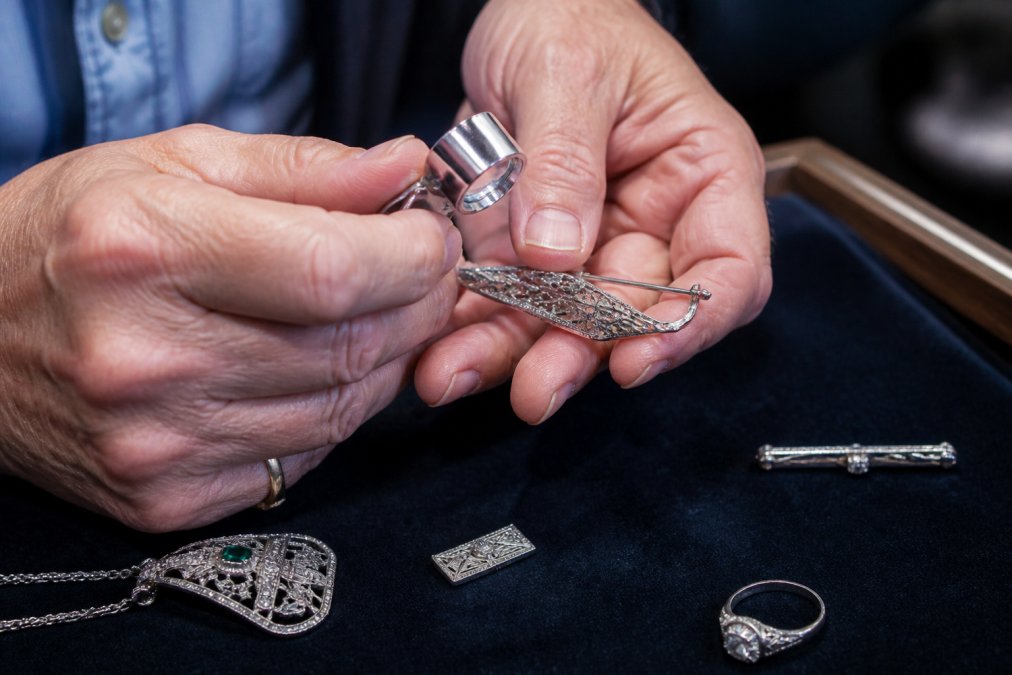
Where to Look and What a Loupe Reveals
Hallmarks hide on the least visible surface: inside a ring band, on a clasp tongue, along a brooch frame edge, or under a bail.
How to Spot Fake Vintage Jewelry: 5 Red Flags
- Too-perfect wear. A 90-year-old piece shows softened edges, tiny scratches, and patina in recesses. A reproduction looks new. Tell: examine the highest-contact point, the top of a ring band, the tip of a pin stem. If it is as crisp as the protected areas, the piece has not been worn for decades.
- Laser-engraved hallmarks. Tell: a die-struck mark displaces metal, leaving a slight raised lip or burr around each character. A laser mark sits flat on the surface with sharp, shallow edges and no displacement. Under 10x, laser marks often show a faint brown or heat-affected halo.
- Uniform machine-cut stones. Period calibré work shows hand variation in the girdle and slight differences in depth from stone to stone. Tell: machine-cut stones are dimensionally identical and their girdles are uniformly faceted.
- Inconsistent metal. Mixed alloys on the same piece, or plating over base metal. Tell: look for color shifts at joints and solder points, and for wear-through on rhodium plating at clasp edges and the backs of settings.
- Modern findings. Spring-ring clasps, safety catches, and certain box clasps postdate the 1930s. Tell: compare the finding against period trade catalogs or a known-original piece; a modern finding on a period-style piece is a strong signal the whole piece is later.
Common Forgery Techniques Used on Art Deco Pieces
Each leaves a specific signature:
- Cast from a mold. Look for a faint seam line where the mold halves met, a slightly porous or "orange-peel" surface, and soft, rounded edges where a period jeweler would have filed and polished a crisp line. Cast pieces also tend to be slightly heavier or lighter than the original they were copied from, because the mold captures shape but not the original's exact metal distribution.
- Period stones in a modern mount. The stones may be genuine and period-correct, but the mount's construction gives it away: modern prongs are often thicker and more uniform, and the gallery under the stone may be stamped or cast rather than hand-fabricated. Check whether the stone's wear pattern matches the mount's, a period stone in a new mount often shows old abrasion on the pavilion that the new setting would not have caused.
- Transferred maker's mark. A genuine stamp applied to a modern piece is the hardest forgery to catch visually. Tell: the mark's wear should match the rest of the piece. A crisp, unworn stamp on an otherwise heavily worn piece is inconsistent. Cross-reference the maker's mark against period trade directories, and be suspicious of a famous mark on a piece whose construction does not match that maker's known work.
Hand-Forged vs. Modern Cast: The Loupe Test
Under 10x magnification, hand-forged and die-struck originals show fine tool marks, a tight grain, and slightly irregular interior edges from sawing and filing.
Microscopic Wear Patterns and Chemical Testing Safety
Microscopic wear is the detail most guides skip, and one of the hardest things to fake.
Reading the Wear Fingerprint Under a 10x Loupe
Work at 10x first to map the piece, then move to 20x or 30x to confirm.
Why Cast Reproductions Fail the Wear Test
A cast piece taken from a mold of an original inherits the original's shape but not its history.
Chemical Testing: What Is Safe and What Is Not
A safer decision path, in order:
- Visual and loupe inspection first. Purity marks, wear, and construction often answer the metal question without touching the surface.
- Magnet test. Platinum and gold are non-magnetic. A strong pull toward a magnet suggests a base-metal core under plating. This is free and non-destructive, though it only rules things out, it does not confirm purity.
- X-ray fluorescence (XRF). A handheld XRF analyzer reads the metal's elemental composition without scratching, heating, or altering the piece. Many jewelers and pawn shops offer this as a paid service. It is the preferred method for high-value or plated pieces because it is non-destructive and reports actual alloy percentages.
- Independent appraisal. For a piece you intend to buy, insure, or resell, a credentialed appraiser's written opinion carries more weight than any home test.
Provenance Documentation and When to Get a Jewelry Appraisal
Provenance documentation is the paper trail supporting a piece's history: receipts, auction records, insurance schedules, and family notes.
Frequently Asked Questions
How can you tell if jewelry is Art Deco?
Art Deco jewelry from the 1920s and 1930s shows geometric motifs, symmetrical design, and platinum or white gold settings. Look for calibré-cut stones, invisible settings, milgrain edges, and filigree work. Pieces often feature bold color contrasts with onyx, coral, or jade against diamonds. Check for hallmarks like 'Plat' or '18K' and examine the clasp style, which changed significantly during this period.
Is Art Deco jewelry valuable?
Value depends on metal purity, gemstone quality, maker, and condition. Platinum pieces with fine diamonds from known makers command higher prices. Common Art Deco jewelry materials like platinum and 18K white gold hold intrinsic value. Reproductions made from base metals with paste stones are worth far less. A professional jewelry appraisal gives you an accurate figure based on current market conditions and the piece's authenticity.
How do I identify Art Deco hallmarks and stamps?
Use a 10x loupe to examine the clasp, inner band, or back of the piece. Look for 'Plat' or '950' for platinum, '18K' or '750' for gold, and maker's marks often in geometric cartouches. American pieces may show '14K' or '10K'. Hallmarks should be crisp and evenly struck. Faded, shallow, or oddly placed stamps suggest a reproduction or later addition.
What materials were commonly used in Art Deco jewelry?
Platinum dominated high-end Art Deco pieces for its strength and ability to hold invisible settings. White gold, often rhodium-plated, offered a lower-cost alternative. Yellow gold remained common in American pieces. Gemstones included diamonds, sapphires, rubies, emeralds, onyx, coral, jade, and rock crystal. Calibré-cut stones and carved gems were hallmarks of the era. Paste and synthetic stones appeared in costume versions and are a key sign of how to spot fake vintage jewelry.
Authenticating period jewelry is a skill built on patience and a good loupe. The pieces that hold their value are the ones with clean hallmarks, consistent materials, and a documented history. ABC Rugs Kilims & Jewelry offers a curated selection of vintage jewelry and gemstones, with reviewed and trusted listings, wholesale and retail options, and detailed provenance on the pieces that carry it. Get started with ABC Rugs Kilims & Jewelry and find period pieces you can verify before you buy.


