

Table of Contents
- Why Large Kilim Wall Hangings Need a Different Approach
- Best Tools for Hanging Heavy Rugs Without Damage
- How to Sew a Sleeve Onto a Rug for Even Weight Distribution
- Step-by-Step Mounting Instructions for Large Kilims
- Matching Hardware to Your Wall Type and Load Capacity
- Styling Vintage Rugs 2026: Placement and Interior Design Tips
- Long-Term Tension Management and Textile Preservation
- Frequently Asked Questions
Last Updated: September 15, 2026
Why Large Kilim Wall Hangings Need a Different Approach
A large kilim is not a poster, and treating it like one is how walls, textiles, and tempers get damaged. Kilim wall hangings are flat-woven wool textiles, often hand-woven and decades old, which means they carry weight unevenly, react to humidity, and show every stress point you create. This guide from ABC Rugs Kilims & Jewelry covers how to display large kilim wall hangings safely, from hardware selection to long-term care.
Here is the core problem most guides skip: a kilim has no rigid backing. A fine rug might weigh 15 to 30 pounds at room size, and that load concentrates wherever you attach it. Nail it at four corners and gravity does the rest, stretching the weave and pulling the warps out of alignment within months.
The good news is that damage-free hanging is a solved problem. The methods below are the same ones conservators and collectors use.
Best Tools for Hanging Heavy Rugs Without Damage
The best tools for hanging heavy rugs are a wooden rod with a sewn sleeve, tapestry clips for lighter pieces, and Velcro strips for temporary displays. Each method suits a different weight class and wall type, so match the hardware to the textile before you drill anything.
Hardware Options Compared: Rods, Clips, Velcro, and Magnets
| Method | Best For | Damage Risk | Weight Capacity |
|---|---|---|---|
| Wooden rod + sewn sleeve | Large, heavy kilims | Lowest | High |
| Tapestry clips | Medium hangings, no sewing | Low | Medium |
| Velcro strips | Rentals, temporary display | Low | Light to medium |
| Magnetic mounts | Small, light textiles | Low | Light |
A wooden rod inside a fabric sleeve spreads load across the entire top edge, which is why it remains the standard for antique textiles. Tapestry clips grip the weave directly and work well when you cannot sew, but they concentrate pressure at each clip point. Velcro strips let you remove a hanging without touching the wall again. Magnetic mounts suit small pieces only; anything hand-woven and room-sized will overwhelm them.
How to Sew a Sleeve Onto a Rug for Even Weight Distribution
Sewing a sleeve is the highest-value skill in this entire process. A sleeve is a fabric channel stitched along the top back edge of the kilim, and it does one job: it turns a handful of attachment points into a continuous line of support.
Step-by-Step Sleeve Installation
- Measure the top edge of the kilim and cut a strip of sturdy cotton canvas 4 to 6 inches wide and 2 inches longer than the width.
- Hem both short ends of the canvas strip so it cannot fray.
- Fold the strip in half lengthwise and press a crease with an iron on low heat.
- Pin the strip to the back top edge, aligning the fold line with the kilim's edge.
- Hand-stitch with a curved needle and heavy thread, using loose stitches every inch. Never stitch through to the front face.
- Slide the rod through and test the hang before mounting.
Use thread that matches the textile's age and fiber. On a hand-woven wool kilim, cotton canvas and linen thread are safe choices because they will not abrade the wool.
Step-by-Step Mounting Instructions for Large Kilims
Mounting a large kilim safely takes about 45 minutes with the right tools and a second pair of hands.
What You'll Need:
- Stud finder
- Spirit level
- Pencil
- Drill with appropriate bits
- Wall anchors rated for your load
- Wooden rod and finials
- Two heavy-duty brackets
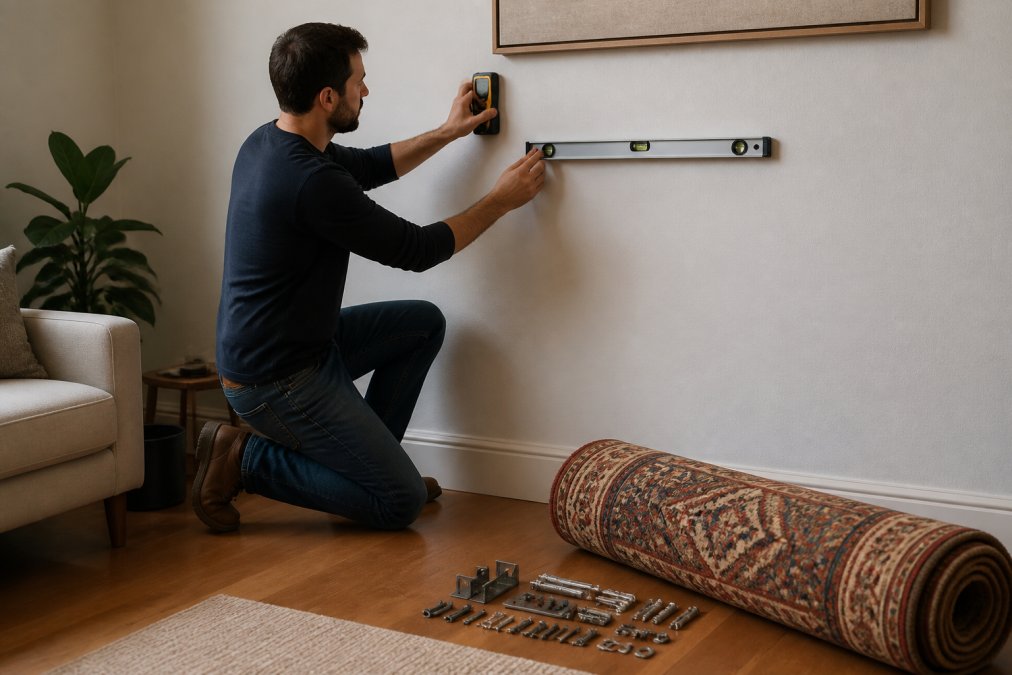
Step 1: Locate Studs [Time: 10 minutes]
Run a stud finder across the wall and mark every stud with a pencil. Studs give you the strongest possible anchor points.
Step 2: Mark Bracket Height [Time: 5 minutes]
Hold a level against the wall and draw a line where the top of the rod will sit. A kilim hung even slightly off-level looks visibly crooked once the pattern lines up.
Step 3: Drill and Anchor [Time: 10 minutes]
Drill pilot holes and set anchors. For heavy kilims, always anchor into studs where possible.
Expected Result: Brackets that do not shift when you apply downward pressure.
Step 4: Mount the Rod and Hang [Time: 15 minutes]
Set the rod in the brackets, then lift the sleeved kilim onto it with a helper. Let it settle for a few minutes before adjusting.
Matching Hardware to Your Wall Type and Load Capacity
Wall type decides your anchor strategy, and this is where most installations fail. The reason is physics: a hanging textile does not pull straight down on an anchor. It pulls down and out, because the rod sits away from the wall and the fabric's weight creates a lever. That outward pull, not the dead weight, is what rips anchors out of drywall.
What Each Wall Surface Actually Holds
| Wall Type | Typical Anchor | Realistic Load Per Anchor | Notes |
|---|---|---|---|
| 1/2-inch drywall, no stud | Plastic expansion plug | 5-10 lb | Fails under sustained outward pull |
| 1/2-inch drywall, no stud | Heavy-duty toggle (snap-toggle style) | 25-50 lb | Best non-stud option; spreads load behind the panel |
| 1/2-inch drywall, into stud | Lag bolt or structural screw | 75-100+ lb | Strongest drywall option |
| Plaster over wood lath | Toggle or lag into lath/stud | Varies widely | Lath crumbles; always find the stud |
| Brick or masonry | Sleeve anchor or wedge anchor | 100+ lb | Requires carbide bit; do not use plastic plugs |
These are working ranges, not guarantees. A common pattern is that a single toggle holds a 20-pound kilim fine for a year, then loosens as seasonal humidity swells and shrinks the drywall around it. That is why the safety margin matters more than the rated number.
How to Calculate the Load You Actually Need
- Weigh the kilim. Lay it flat on a bathroom scale, or weigh yourself holding it and subtract your weight. A room-sized flat-weave commonly lands between 15 and 30 pounds; denser weaves run higher.
- Add the rod and hardware. A solid wood rod with brackets can add 3 to 8 pounds on its own.
- Multiply by a safety factor of 4. If the total is 25 pounds, size your anchors for 100 pounds. This covers the outward lever force, humidity cycling, and the occasional accidental tug.
- Divide by the number of anchors. Two brackets rated at 50 pounds each give you 100 pounds of capacity, enough for a 25-pound load with margin.
The Rental and No-Drill Trade-off
Removable adhesive strips are rated for light loads only, typically well under 10 pounds per strip, and they degrade with heat and humidity.
Styling Vintage Rugs 2026: Placement and Interior Design Tips
Long-Term Tension Management and Textile Preservation
A Maintenance Schedule That Works
Why Sagging Happens, and How to Reverse It
Climate: The Factor Almost Nobody Mentions
Protecting Value: Insurance and Documentation
Frequently Asked Questions
How do I prevent a large kilim from sagging on the wall?
Sagging happens when weight pulls on a few points instead of spreading across the textile. Sew a fabric sleeve along the entire top edge and slide a wooden rod through it. The rod distributes weight evenly. Use wall anchors rated for at least twice the kilim's weight. Check tension every six months and adjust the rod or re-sew the sleeve if you notice drooping.
Is it safe to use adhesive strips for large kilim wall hangings?
Adhesive strips are not safe for large kilim wall hangings. They can fail under sustained weight, especially in humid rooms or on textured walls. The adhesive can also leave residue on the textile that damages fibers. For anything heavier than a small lightweight tapestry, use mechanical anchors and a rod or clips instead.
What is the best way to hang a Turkish rug on the wall without damaging it?
The safest method is sewing a cotton sleeve to the back and hanging it on a wooden rod with curtain rings. This keeps the weight off the fibers. Avoid nails or screws directly through the rug. If you prefer not to sew, use tapestry clips that grip the rug's edge without piercing it. Always use wall anchors rated for the rug's weight plus a safety margin.
Can I use a rod to hang a heavy kilim rug?
Yes, a wooden rod is one of the best options for heavy kilims. Choose a rod at least 2 inches in diameter to prevent bowing. The rod should be 4 to 6 inches wider than the kilim so the fabric hangs freely. Mount the rod brackets into wall studs or use heavy-duty toggle anchors. This setup distributes weight evenly and protects the textile.
Hanging a large kilim safely comes down to preparation: the right sleeve, the right anchors, and a wall that can carry the load. ABC Rugs Kilims & Jewelry offers authentic, reviewed handmade kilims and Persian antiques, with wholesale and retail options, so collectors and designers can source pieces worth hanging properly. Get started with ABC Rugs Kilims & Jewelry and display your textiles with confidence.


