

Table of Contents
- What Over-Restoration Means in Vintage Jewelry
- The Impact of Polishing on Antique Jewelry Value
- How to Spot Re-Tipped Prongs on Vintage Rings
- Identifying Excessive Soldering and Repair Work
- Refinishing and Metal Fatigue: Red Flags to Watch
- Distinguishing Authentic Wear from Over-Worked Metal
- The Value Trade-Off: When Restoration Costs More Than the Piece
- Conclusion
Last Updated: August 10, 2026
What Over-Restoration Means in Vintage Jewelry
Over-restoration in vintage jewelry refers to excessive cleaning, polishing, refinishing, or repair work that removes the piece's original surface character and diminishes its authenticity and value. When a vintage or antique piece undergoes too much restoration, it loses the patina, wear patterns, and material integrity that collectors and appraisers value. The goal of proper restoration is to stabilize and preserve; over-restoration destroys the historical record written into the metal and stones.
Over-restoration happens because some jewelers believe clients want pieces to look new, others lack specialized conservation knowledge, and still others use industrial polishing equipment designed for production work, not delicate vintage pieces.
The Impact of Polishing on Antique Jewelry Value
Polishing is the most visible and most damaging form of over-restoration. Each pass of a polishing cloth or wheel removes a microscopic layer of metal, irreversible damage on a vintage piece.
When you polish gold, you're literally removing material. A vintage ring polished multiple times loses weight and its original surface finish. Antique jewelry was often finished with specific techniques, hand-planishing, engine-turning, or subtle texturing, that modern polishing obliterates. Once that surface is gone, it cannot be recreated authentically.
The impact on value is direct and measurable. A vintage diamond ring with original patina will appraise 15-25% higher than an identical ring that's been aggressively polished. Serious collectors recognize this immediately.
Chemical vs. Natural Patina
Natural patina is the slow oxidation and surface change that occurs over decades or centuries of wear and environmental exposure. On silver, this appears as soft gray or dark toning. On gold, it's a subtle deepening of color and change in light reflection. This patina is proof of age and authenticity.
Chemical patina is artificially induced through exposure to sulfur compounds or other oxidizing agents. It looks similar at first glance but sits on the surface and can flake or wear away unevenly. Natural patina is integrated into the metal itself through years of gradual change.
Over-restoration removes both types of patina indiscriminately. When a restorer then tries to "age" the piece back by applying chemical patina, the result is obviously artificial. The patina doesn't follow wear patterns; it sits uniformly across the entire surface, which is never how authentic aging works.
How to Spot Re-Tipped Prongs on Vintage Rings
Re-tipping prongs is one of the most common repairs on vintage rings, and it's often done poorly. A prong is the small metal claw that holds a stone in place. Over time, prongs wear down, bend, or break. Properly re-tipped prongs are nearly invisible; poorly done re-tipping is obvious.
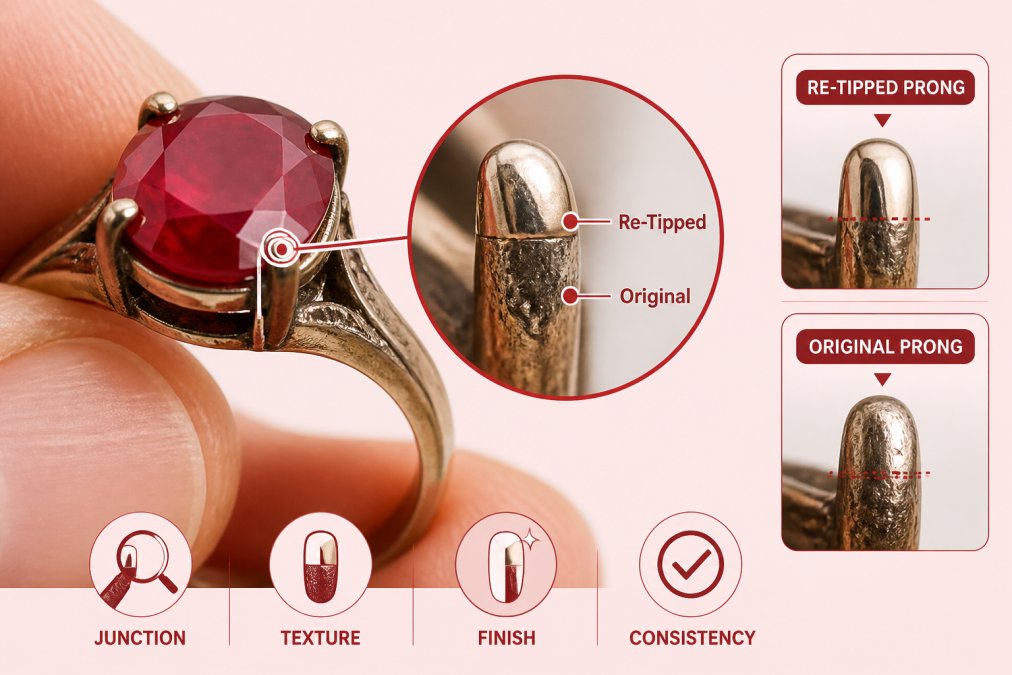
When a prong is re-tipped, a jeweler removes the worn prong and solders a new piece of metal onto the remaining base. Here's what to examine:
Metal color mismatch. Original prongs will have aged the same way as the rest of the ring. New prongs are bright metal. If prongs look noticeably newer or brighter than the surrounding setting, they've been replaced. This is especially obvious on white gold rings, where new white gold has a different tone than aged white gold.
Solder lines. Where a new prong is soldered to the old base, there's a visible line if the work wasn't done carefully. Look at the base of each prong where it meets the setting. A clear line or slight color change indicates re-tipping.
Prong thickness and shape. Vintage prongs often have a specific profile. New prongs are often cut from stock material and won't match the original profile exactly. If one prong looks thicker or has a different shape than the others, it's likely a replacement.
Wear patterns. Authentic vintage prongs show wear consistent with the age of the piece. New prongs are perfect and unmarked. If some prongs show age and others look pristine, the pristine ones are replacements.
The presence of re-tipped prongs doesn't automatically mean over-restoration. Replacing worn prongs is legitimate maintenance. A ring with one carefully re-tipped prong and otherwise original surface is fine. A ring where all prongs have been replaced and the entire setting polished to a mirror shine has been over-restored.
Identifying Excessive Soldering and Repair Work
Soldering is how jewelers join metal pieces together. On vintage jewelry, solder lines are often evidence of repair work. Some repair work is necessary; excessive soldering indicates over-restoration.
Look for multiple solder lines in areas that shouldn't have them. A vintage ring might have solder where the band joins the setting, that's normal. But solder lines along the gallery or multiple seams in the same area indicate the piece has been taken apart and reassembled multiple times, a sign of heavy-handed restoration.
Old solder has aged and oxidized. New solder is bright and obvious. If you see bright solder lines on a piece that's supposed to be 80+ years old, that's recent work. Multiple bright solder lines indicate multiple recent repairs, a sign of over-restoration.
The color of solder matters too. Gold solder on a vintage gold ring should match the gold tone. If the solder is noticeably different in color, it's either the wrong solder or very recent work that hasn't aged yet.
If a ring is otherwise original with authentic patina but has bright new solder lines, that's a single targeted repair, probably fine. If a ring has been heavily polished, has multiple solder lines, and shows signs of multiple interventions, it's been over-restored.
Refinishing and Metal Fatigue: Red Flags to Watch
Refinishing goes beyond polishing. It includes electroplating, re-gilding, or applying new finishes to the surface. This is serious restoration work that dramatically alters the piece.
When a jeweler electroplates a vintage ring, they coat it with a thin layer of new metal. This might restore color to a faded gold ring or plate a silver ring with gold. The problem is that electroplating is visible under magnification and changes the piece's authenticity. More importantly, it can hide problems like corrosion, pitting, or damage underneath.
Metal fatigue is the real danger with over-restored pieces. When metal is repeatedly heated (for soldering), polished (removing surface layers), and refinished, it becomes brittle and weak. The crystalline structure breaks down. A vintage ring aggressively restored multiple times becomes prone to breaking, bending, or cracking under normal wear.
Watch for signs of metal fatigue: cracks in the metal, especially radiating from solder joints or heavily polished areas; thin bands showing signs of previous bending or straightening. These indicate the metal has been worked repeatedly and is weakening.
The structural integrity of a vintage piece matters as much as its appearance. A beautiful ring that will crack in six months is not a good buy, regardless of restoration quality. This is why over-restored pieces often become problematic after purchase, the restoration masked underlying weakness.
Distinguishing Authentic Wear from Over-Worked Metal
Authentic wear tells a story. Over-worked metal tells a different story, one of aggressive restoration.
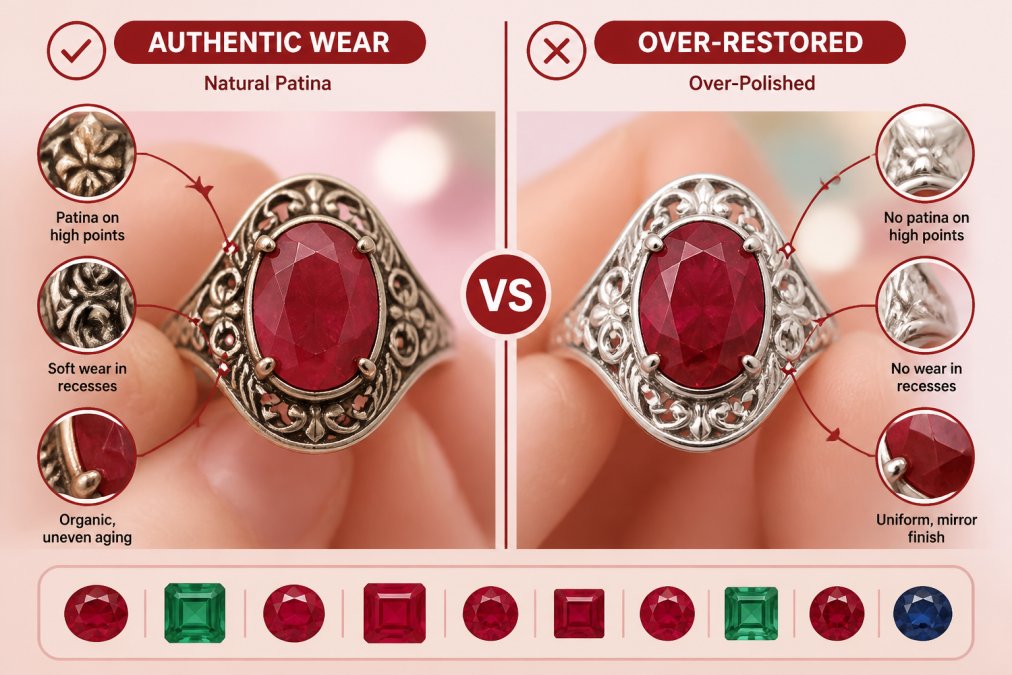
Authentic wear on vintage jewelry follows predictable patterns. On a ring, high points of the band wear first. Recessed areas and decorative details retain more patina and color. On a brooch, the back wears more than the front. On a pendant, the bail shows the most wear.
This wear is never uniform. It's concentrated where the piece has been used, with gradual transitions from heavily worn to less-worn areas. There's no sharp line between worn and unworn metal.
Over-worked metal looks different. Aggressively polished pieces have uniformly bright surfaces. Re-finished pieces are too perfect. Repeatedly soldered and worked pieces show signs of stress: tiny cracks, brittleness, or unusual discoloration from heat.
A key indicator is the relationship between wear and patina. On authentic vintage pieces, wear and patina align. Where worn, patina is lightest; where least worn, patina is darkest. On over-restored pieces, this relationship is broken. You might see uniform polishing across the entire surface or patina that doesn't follow wear patterns.
The edges of a vintage piece are particularly revealing. The edges of a ring band, corners of a brooch, edges of a pendant, these show the most authentic wear and patina. If these edges look worn and aged but the main surface is polished to a mirror shine, the piece has been selectively over-restored. If the edges themselves look polished and smooth, the entire piece has been aggressively worked.
The Value Trade-Off: When Restoration Costs More Than the Piece
Sometimes restoration costs more than the piece is worth. Sometimes restoration actually decreases the piece's value more than the damage it fixes.
Consider a vintage gold ring worth $800 in original condition. A broken prong might cost $150-300 to re-tip carefully. The restored ring is still worth approximately $800; the repair maintained integrity. But if the same ring goes to a jeweler who charges $400 to aggressively polish, re-tip prongs, and re-finish the band, the piece now looks newer but is worth $600 because the restoration was too heavy. The owner paid $400 to decrease the piece's value by $200.
This happens constantly. Jewelers specializing in restoration understand the value trade-off. Jewelers who don't specialize in vintage work often restore pieces the way they'd restore modern jewelry, with aggressive polishing, heavy refinishing, and multiple interventions. This works fine for modern pieces designed to look new; it destroys vintage pieces designed to look aged.
When evaluating a vintage piece, ask: has this restoration increased or decreased the value? Carefully re-tipped prongs on an otherwise original ring increase value by stabilizing the piece. Aggressive polishing that removes all patina decreases value significantly. The question isn't "does the piece look nice?" It's "does the restoration respect the piece's authenticity and age?"
ABC Rugs Kilims & Jewelry recommends prioritizing original condition over cosmetic perfection. A vintage ring with minor damage and original patina is almost always a better investment than an identical ring aggressively restored. The original piece will hold its value; the restored piece will continue to depreciate as collectors recognize the over-restoration.
Conclusion
Over-restored vintage jewelry is one of the biggest traps for collectors who don't know what to look for. A piece that's been aggressively polished, re-tipped, re-soldered, and re-finished might look beautiful in the moment, but it's lost the authenticity and historical character that makes vintage jewelry valuable. The patina is gone. The wear patterns are erased. The metal's integrity is compromised.
When evaluating a vintage piece, look past the surface shine. Examine the patina, wear patterns, solder lines, and overall metal condition. Ask whether the restoration respected the piece's age or erased it. Our curated collection emphasizes original condition and honest aging, pieces that have been preserved rather than over-restored. Get started with ABC Rugs Kilims & Jewelry and build a collection of authentic vintage jewelry that holds its value and tells a genuine story.
Frequently Asked Questions
Does restoration decrease the value of vintage jewelry?
Yes, extensive restoration typically reduces value. Minor repairs preserve authenticity, but over-restoration removes original patina, alters metal surfaces, and destroys the historical record of wear. Collectors specifically seek pieces with authentic aging. Professional appraisers document restoration history because it directly impacts market value. The extent of work matters, a single replaced stone costs less in value loss than complete refinishing.
What are the common signs of over-polishing on antique gold?
Over-polished antique gold shows a uniform, mirror-like finish that lacks the depth of authentic aging. Look for abraded surfaces where filigree details have been smoothed flat, micro-scratches in one direction (indicating machine polishing), and loss of maker's marks or hallmarks that should be visible. Authentic antique gold retains micro-variations in surface texture that polishing erases. The metal may also appear thinner around edges if aggressive polishing removed layers.
How can you tell if a gemstone has been replaced in a vintage setting?
Replaced stones show mismatched wear patterns, the setting bears decades of patina and scratches while the stone's facets remain pristine. Check for fresh solder marks around the bezel or prongs. Compare the stone's color and clarity against period-appropriate standards for that era and region. Original stones often show subtle inclusions, cloudiness, or slight color variations. Professional jewelers can identify replacement stones through UV light examination or by checking whether the stone's wear matches the setting's age.
What is the difference between conservation and restoration in jewelry?
Conservation preserves the piece as-is with minimal intervention, cleaning only, stabilizing loose elements, preventing further damage. Restoration actively changes the piece, replacing parts, refinishing surfaces, altering dimensions through resizing. Collectors value conservation because it maintains authenticity and historical integrity. Restoration reduces value because it obscures the original maker's work and removes evidence of genuine aging. When buying vintage jewelry, ask whether work done was conservation or restoration; restoration significantly impacts market value.
This article was written using GrandRanker


