
Quick Summary
Choose an aquamarine gemstone by starting with color: look for a clean, even blue with a hint of green, judged in daylight. Then check for eye-clean clarity, confirm whether the stone is natural or heat treated, and compare price per carat rather than carat weight alone.
- Compare color in natural daylight, since warm store lighting can shift a blue-green stone.
- Ask sellers whether a stone is natural or heat treated, and get the disclosure in writing.
- Choose an eye-clean stone, one with no inclusions visible to the naked eye.
- Check cut for even brightness, no dark dead spots, and no window in the center.
- Calculate price per carat (price divided by carat weight) to compare like with like.
Table of Contents
- Start With Color: Choosing the Right Shade of Blue
- Judging Clarity, Inclusions and Eye-Clean Stones
- How Cut and Shape Affect Light Performance
- Carat Weight, Size and What Drives Price
- Aquamarine vs Blue Topaz Comparison: How to Tell Them Apart
- Is Aquamarine Good for Engagement Rings?
- Buying Checklist and Next Steps for Your Aquamarine
- Frequently Asked Questions
Start With Color: Choosing the Right Shade of Blue
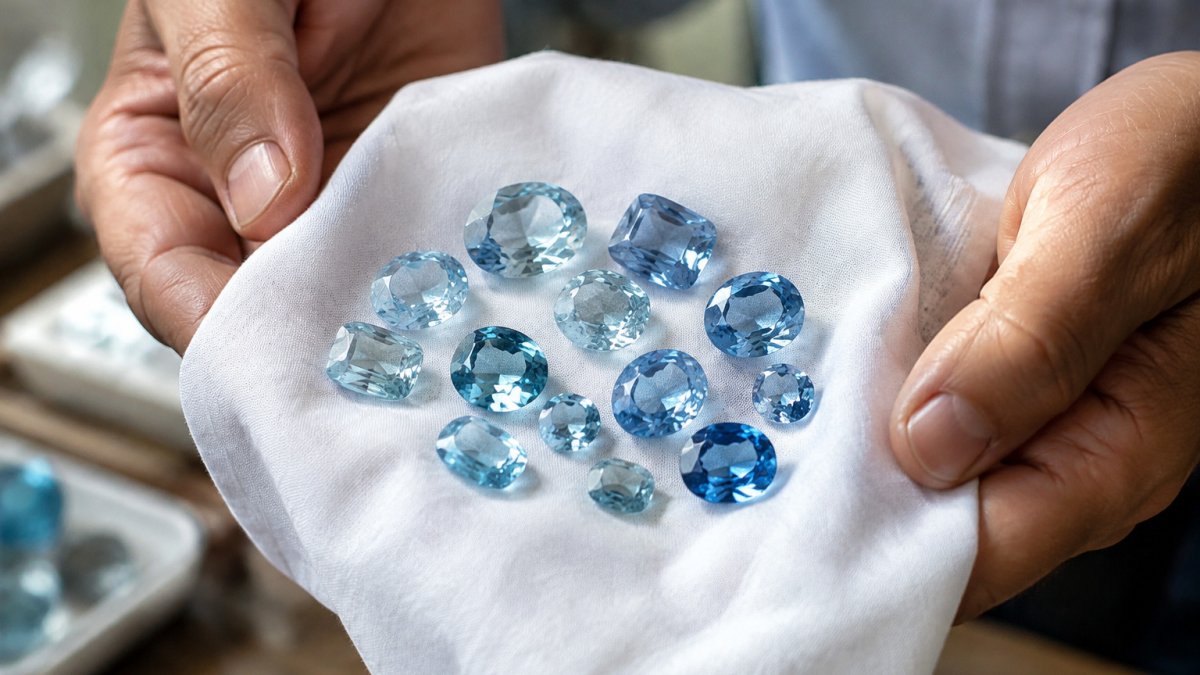
An aquamarine gemstone is the blue-green member of the beryl family, and its color does more to determine price and appeal than any other factor. Most buyers look for a clean, even blue with a hint of green, while pale stones can read as washed out and very dark stones can look almost navy. Knowing which shade suits your taste is the first step.

Color intensity and saturation
Color intensity, or saturation, describes how strong the blue appears. A light, airy stone suits everyday wear and pairs well with white and silver settings. A medium, saturated blue carries more visual weight and tends to hold attention in a ring. Compare stones in natural daylight rather than under a store's warm spotlights, since lighting can shift a blue-green stone noticeably.
A medium blue aquamarine gemstone with a slight greenish cast is a common choice for many buyers, since it balances brightness and depth.
Why some aquamarine is heat treated
Many aquamarines on the market have been heat treated to remove greenish tones and produce a bluer color. Buyers should ask any seller whether a stone is natural or treated, and request that the disclosure appear in writing.
Judging Clarity, Inclusions and Eye-Clean Stones
Clarity affects how transparent a stone looks. An "eye-clean" stone shows no inclusions visible to the naked eye, which is a practical standard many buyers use.
Look at the stone in good light from several angles. Small inclusions that are invisible from above can become obvious through the side. For a piece you will wear daily, an eye-clean stone is usually the better long-term choice than one that only looks clean under magnification.
How Cut and Shape Affect Light Performance
Cut influences whether an aquamarine looks bright and even or dull and patchy. Aquamarine is pleochroic, meaning it shows different color intensities from different viewing directions, so a well-oriented rough produces a stone with stronger face-up color. A poorly oriented stone can look washed out from the top even when it looks saturated from the side.
What good cut quality looks like
A well-cut aquamarine returns light evenly across the table, with no dark dead spots and no window (a see-through area in the middle where light leaks out instead of reflecting back). Check three things face-up in daylight:
- Evenness: the color should look consistent across the stone, not concentrated at the edges with a pale center.
- Brightness: tilt the stone slowly; a well-cut stone stays lively through a range of angles, while a shallow one goes dark or glassy.
- Symmetry: facet junctions should line up and the outline should be balanced; sloppy symmetry shows up as uneven light patterns.
A deep stone hides weight below the girdle and can look smaller than its carat weight suggests, while a shallow stone may window. Neither is a defect in durability, but both affect how much you pay for how the stone actually looks.
Shape-by-shape trade-offs
The shape you choose changes both the look and the practical buying considerations:
- Emerald cut (step cut): long, open facets showcase clarity and color and give a clean, architectural look. Step cuts hide nothing, so inclusions and windowing are more visible; buy the cleanest stone you can afford. Our 29.5 carat Madagascar emerald cut is listed at $5,310.00.
- Oval: spreads light evenly and tends to look larger face-up per carat than a round, which makes it a practical choice for a given budget. Our 9.0 carat oval is listed at $1,620.00.
- Round: the most light-efficient shape and the most forgiving of minor clarity issues, but round aquamarine is less common in large sizes and often carries a premium.
- Cushion and pear: softer outlines that can concentrate color, but pears are more vulnerable at the point and need a protective setting.
- Trillion and fancy cuts: striking for pendants and earrings, but harder to match in pairs and less protected in a ring.
How to compare cuts consistently
Compare stones under the same light, face-up, at the same distance, and note the millimeter dimensions alongside the carat weight. A stone that is 10 mm across but shallow will look larger and paler than a 9 mm stone with better depth. Ask for face-up photos and video in daylight, and ask the seller to state whether the stone windows or has any dark areas.
Ask for a daylight video with the stone tilted toward and away from the camera before you commit, since studio photos can make a windowed or shallow stone look lively.
Carat Weight, Size and What Drives Price
Carat measures weight, not size (Understanding Carat Weight: GIA Diamond Grading Reports). Because aquamarine is cut in a range of proportions, two stones of the same carat weight can differ noticeably in face-up diameter and in how large they look in a setting. Always compare millimeter dimensions (length × width × depth) alongside carat weight, and ask for the depth percentage if the seller has it.
How price actually scales
Aquamarine pricing is not linear with weight. Fine-color aquamarine becomes disproportionately rarer in larger sizes, so price per carat typically climbs as stones get bigger and as color saturation improves. Price per carat often steps up at size thresholds, so larger stones of the same color can cost more per carat than smaller ones. Pale material scales more gently; saturated blue material scales steeply.
Our current listings include a 0.30 carat oval at $2,392.00 and a 29.5 carat emerald cut at $5,310.00. Size alone does not set price, because color, clarity, and cut quality move the number as much as weight does. When you compare listings, calculate price per carat (price ÷ carat weight) for each stone so you are comparing like with like.
The four trade-offs that decide a budget
Most buyers end up choosing among four trade-offs rather than maximizing every factor:
- Color versus size: a smaller, richly saturated stone usually looks more striking than a larger pale one, and it often costs less per carat at the top color grades.
- Clarity versus size: aquamarine is usually eye-clean, so paying for flawless clarity under magnification rarely shows up in the finished piece; put the money into color or size instead.
- Cut versus carat: a well-cut 2 carat stone can look larger and brighter than a poorly cut 3 carat stone, so cut quality is often the best value lever.
- Origin versus everything else: origin premiums exist for certain localities, but color and cut matter more to how the stone looks; treat origin as a preference, not a quality grade.
Budget-based guidance
At a lower budget, prioritize a well-cut, eye-clean stone in a medium blue with a slight greenish cast, and accept a smaller size. At a mid budget, you can add size or step up to a stronger blue, but usually not both at the top of each scale. At a higher budget, the trade-off shifts to fine saturated color in a larger, well-proportioned cut, where the per-carat premium is steepest. Ask the seller for the price per carat on comparable stones so you can see where the step-ups fall.
A low price per carat on a large stone can signal pale color, a window, or heavy inclusions, so compare the stone face-up in daylight against a smaller, better-colored stone before deciding.
The four trade-offs below summarise how color, clarity, cut and size balance against each other when you set a budget.
| Trade-off | Typical choice | Why it matters |
|---|---|---|
| Color versus size | Smaller, richly saturated stone | Often looks more striking and costs less per carat at top color |
| Clarity versus size | Eye-clean stone, spend on color or size | Flawless clarity rarely shows in the finished piece |
| Cut versus carat | Well-cut 2 carat stone | Can look larger and brighter than a poorly cut 3 carat stone |
| Origin versus everything else | Treat origin as a preference | Color and cut matter more to how the stone looks |
Aquamarine vs Blue Topaz Comparison: How to Tell Them Apart
Blue topaz is often sold as an alternative because it is less expensive and comes in similar colors. Aquamarine is a beryl with a Mohs hardness of about 7.5 to 8. The practical difference lies in color depth and value. Aquamarine typically shows a blue-green character, while blue topaz is often described as a more uniform blue.

If you are unsure which you are being shown, ask for a written gemological report that names the species. Reputable laboratories can identify the stone, which protects you from misrepresentation.
Is Aquamarine Good for Engagement Rings?
Aquamarine can work well for an engagement ring, especially for someone who wears jewelry daily and prefers a calm blue stone. Its hardness is sufficient for everyday use, though it can chip if struck hard, so a protective setting is wise. Prong or bezel settings that cover the girdle help reduce risk.
For a ring, a cut with a stable profile, such as an oval or emerald cut, and a setting that keeps the stone secure during daily activities are commonly considered. If the ring will see heavy use, a bezel setting is one option to consider.
Buying Checklist and Next Steps for Your Aquamarine
Use this checklist before you buy:
- Confirm the species and any treatment in writing.
- Compare color in daylight, not only in product photos.
- Check for eye-clean clarity from several angles.
- Review cut quality and facet alignment.
- Compare price per carat across similar stones.
- Ask about return policies and whether a certificate is included.
GIA certification and verification can be arranged for gemstones; the cost ranges from $350 to $1,500, depending on the item and services requested, with fees paid directly to GIA. Browse our current aquamarine selection at ABC Rugs Kilims & Jewelry to compare options side by side.
Frequently Asked Questions
What is the most valuable color of aquamarine?
Many buyers prefer a strong, even blue with a slight greenish or blue-green hue. Pale, washed-out stones usually cost less, while deeper saturated blues command higher prices per carat. Color is the single biggest price driver, so compare stones in the same lighting before deciding. Look for even color without visible zoning, since uneven color can lower value even when the overall shade is attractive.
Is aquamarine good for engagement rings?
Aquamarine rates about 7.5 to 8 on the Mohs hardness scale. It resists scratches reasonably well but can chip if struck hard, so a protective setting such as a bezel or halo is a practical choice. Avoid sharp, thin prongs for a ring worn every day. Pair it with a sturdy band and remove it during heavy manual work or gym sessions.
How do I clean aquamarine jewelry?
Wash aquamarine in warm water with a few drops of mild dish soap, then rinse and dry with a soft cloth. Use a soft toothbrush to reach around prongs and settings. Avoid ultrasonic and steam cleaners if the stone has inclusions or treatment, since heat and vibration can cause damage. Store pieces separately in soft pouches to prevent scratches from harder gems.
How can you tell if an aquamarine gemstone is real?
Buy from a seller who provides a gemological report from a recognized laboratory such as the Gemological Institute of America (GIA). A report confirms identity, origin treatment and quality details. ABC Rugs Kilims & Jewelry can arrange GIA certification for gemstones, with fees that typically range from $350 to $1,500 depending on the item and services requested, paid directly to GIA.


