

Table of Contents
- Why the Back of the Rug Reveals the Truth
- Knot Structure: V-Shapes, Symmetry, and Irregularity
- How to Check Rug Knot Density and What It Tells You
- Hand Knotted vs Machine Made Rugs: Key Differences
- Fringe, Foundation, and Backing: What to Inspect
- Signs of a Handmade Persian Rug You Can Verify at Home
- Final Checklist Before You Buy
- Frequently Asked Questions
Last Updated: September 9, 2026
Why the Back of the Rug Reveals the Truth
The front of a rug is designed to impress. The back is where the weaver's honesty shows. Learning how to identify genuine hand knotted rug knots starts with flipping the piece over, because the foundation, knot structure, and fiber behavior on the reverse side are nearly impossible to replicate in a machine-made product.
On the back of a hand-knotted rug, the design appears mirrored but with visible irregularities: knots sit at slight angles, rows waver, and wool fibers protrude unevenly. This is the signature of human hands working a loom.
Machine-made rugs display a uniform, almost printed appearance on the back because the pattern is often tufted or woven with a mechanical backing. If the back shows a glued canvas, a latex coating, or a perfectly flat synthetic surface, you are not looking at a hand-knotted piece.
Knot Structure: V-Shapes, Symmetry, and Irregularity
Understanding knot structure is the core of authentication, but reading about it is not enough. This guide uses a macro-photography approach to show the difference between a genuine knot and a machine-made imitation.
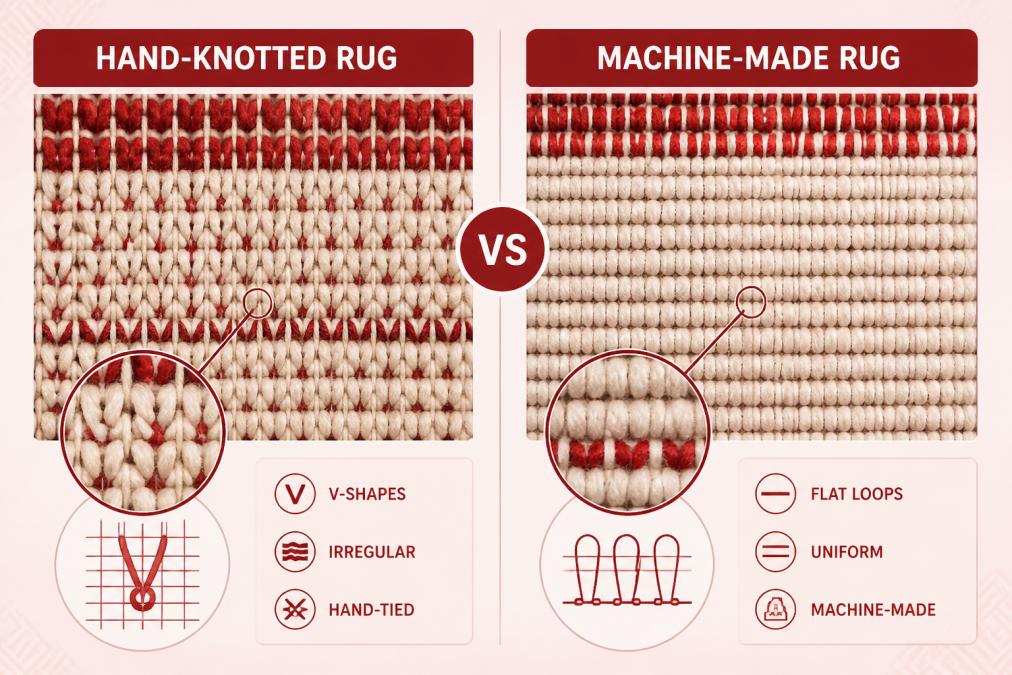
The Visual Anatomy of a Hand-Tied Knot
Hand knotted rug knots are tied around the warp threads and secured by weft threads beaten down tightly after each row. On the back, each knot appears as a small, distinct bump or curve around a single warp thread. Under a 10x loupe, you are looking for the evidence of a human hand, not a perfect pattern.
The Two Main Knot Families: Persian vs. Turkish
Beyond just 'handmade vs. machine,' the type of knot tells you about the rug's origin.
- The Symmetrical Knot (Turkish/Ghiordes): This knot wraps around two adjacent warp threads. When you look at the back, the two ends of the yarn emerge side-by-side between the warps, creating a clean, symmetrical 'V' shape. It is the workhorse knot of Anatolian and Caucasian weavers.
- The Asymmetrical Knot (Persian/Senneh): This knot wraps around one warp thread completely and only loops around the adjacent one. On the back, this creates a slightly offset, less symmetrical silhouette. It is the dominant knot in Persian, Indian, and Chinese rugs, allowing for finer, more detailed patterns.
The Macro-Photography Test: What 'Real' vs. 'Fake' Looks Like
Here is the practical test you can perform with a magnifying loupe or a smartphone camera with a macro lens.
- Look for the 'V' or 'U' Silhouette: A genuine knot will show a distinct, three-dimensional loop of yarn around a warp. A machine-made rug will often show a flat, uniform tuft that is glued or locked into a backing, with no visible loop around a vertical strand.
- Check for Irregularity in the Rows: Run your eye along a single row of knots. In a hand-knotted piece, the row will waver slightly. The weaver's tension changes subtly from knot to knot. A machine-made rug has perfectly straight, rigid lines of tufts.
- Examine the Fiber Ends: You should see tiny, uneven wool ends where the weaver clipped the pile after tying each row. These ends are not uniform. In a machine-made rug, the pile is cut to a precise, even height, often leaving a flat, almost 'fuzzy' surface on the back.
Why 'Perfect' Symmetry is a Red Flag
A common misconception is that a high-quality rug has perfectly uniform knots; the opposite is true. The beauty of a hand-knotted rug lies in its micro-irregularities, which are not flaws but the signature of the weaver's hand. If the back looks like a printed grid of identical shapes, you are almost certainly looking at a power-loom product.
How to Check Rug Knot Density and What It Tells You
Rug knot density, measured in knots per square inch (KPSI), is a direct indicator of quality and time invested. A higher knot count means finer detail, a denser pile, and more hours at the loom.
To check density, fold back a corner of the rug to expose the foundation and count the knots in a one-inch square. For a standard checklist on evaluating texture and construction, reference the Smithsonian's guide to textile conservation, which outlines how to handle and assess woven textiles without causing damage.
A coarse tribal rug might have 40 to 80 KPSI, while a fine city rug can exceed 300 KPSI (si.edu). Bend the rug back: if the foundation is visible through sparse knots, the piece is coarse; if the pile is so dense you cannot see the warp threads, it signals a high-quality, durable piece.
Hand Knotted vs Machine Made Rugs: Key Differences
The distinction between hand knotted vs machine made rugs comes down to construction, not appearance. A machine-made rug is produced on a power loom that weaves or tufts the pile rapidly, often using synthetic fibers like polypropylene, resulting in a flat, uniform backing with a latex or canvas coating.
A hand-knotted rug is built one knot at a time. The weaver ties each knot around the warp, then beats down the weft threads to lock the row in place. This process cannot be rushed, which is why a single rug can take months to complete.
| Feature | Hand-Knotted Rug | Machine-Made Rug |
|---|---|---|
| Backing | Visible warp and weft, no adhesive | Canvas, latex, or glued backing |
| Knot appearance | Individual V-shapes, slight irregularity | Uniform loops or tufts, no visible knots |
| Fiber content | Wool, silk, or cotton | Often polypropylene or blended synthetics |
| Fringe | Extension of the warp threads | Sewn or glued on separately |
| Pile | Dense, with natural wool texture | Even, sometimes shiny or plasticky |
| Folding | Bends naturally, foundation visible | Stiff backing resists folding |
The most reliable test is the fold test. Fold the rug back on itself. A hand-knotted rug bends easily at any point because it is made of flexible wool and cotton; a machine-made rug with a latex backing will resist folding and may crack or crease.
Fringe, Foundation, and Backing: What to Inspect
The fringe on a hand-knotted rug is not an attachment; it is the actual warp threads extending beyond the woven field, often finished with a kilim strip at each end. On a genuine piece, the fringe is continuous with the foundation and will pull slightly if tugged but will not detach easily.
Inspect the edges of the rug, called the selvage. On hand-knotted pieces, the selvage is overcast with wool or cotton wrapping to protect the side warps. This wrapping should be even but slightly irregular, showing the hand of the finisher.
The foundation itself should be wool, cotton, or silk. If you see a synthetic backing, a printed pattern on the reverse, or any sign of glue, the rug is not hand-knotted. For more on identifying natural fibers in textiles, the USDA's guidelines on wool labeling provide a useful reference for understanding fiber content claims.
Signs of a Handmade Persian Rug You Can Verify at Home
Authenticating a rug goes beyond just looking at the knots. The most deceptive machine-made rugs mimic the front of a hand-knotted piece but rely on a chemical shortcut to hold the pile in place. This section covers the at-home tests that reveal those shortcuts.
The 'Glue' Test: Exposing the Latex Backing
This is the single most effective non-destructive test for identifying a machine-made or tufted rug. Many power-loomed rugs use a latex or glue-based secondary backing to lock the yarn tufts in place, a definitive sign the rug is not hand-knotted.
How to perform the test:
- Find a corner: Gently fold back a corner of the rug to expose the foundation.
- Press and rub: Use your thumb or a blunt object (like the back of a spoon) to press firmly against the exposed backing.
- Feel for stiffness: A hand-knotted rug will have a flexible, woven foundation that gives slightly under pressure. A machine-made rug with a latex backing will feel stiff, plasticky, and unyielding.
- Look for residue: Rub your finger across the backing. If you feel a powdery or sticky residue, or if the backing has a shiny, painted-on appearance, it is a chemical coating.
A glued or latex-backed rug is a definitive red flag. Hand-knotted rugs never require a secondary backing because the knots themselves hold the pile in place. If you see adhesive, the rug is machine-made or tufted, regardless of what the seller claims. This test is non-destructive and can be done in seconds.
The 'Fiber Burn' Test (For a Small Sample)
If you have a loose fiber from the rug (often found in the fringe or a corner), you can perform a simple burn test. This is destructive, so only do it on a fiber you are certain is not part of the rug's structure.
- Wool: Burns slowly, smells like burning hair, and leaves a brittle, black ash that crumbles easily.
- Silk: Burns quickly, smells like burning hair, and leaves a fine, soft black ash.
- Polypropylene (Synthetic): Melts and shrinks away from the flame, smells like plastic, and leaves a hard, melted bead.
The 'White Cloth' Dye Test
This test checks for dye stability and fiber type.
- Dampen a white cloth: Use a clean, white, damp (not wet) cloth.
- Rub firmly: Rub the cloth across a dark area of the rug's pile with firm pressure.
- Analyze the transfer: A small amount of color transfer is normal for vegetable-dyed wool. A heavy, immediate transfer indicates unstable dyes. Conversely, if there is zero transfer on a very dark rug, it may be a synthetic fiber that resists dye penetration, a sign of a machine-made product.
Regional Variations: Beyond 'Handmade vs. Machine'
The knot type is also a key indicator of regional style.
- Persian (Iranian) Rugs: City rugs from Tabriz, Isfahan, and Qom predominantly use the asymmetrical (Persian) knot, allowing for fine, curvilinear designs.
- Turkish Rugs: Rugs from Turkey, such as those from Hereke or Milas, typically use the symmetrical (Turkish) knot, producing a more geometric, angular pattern.
- Tribal Rugs: Nomadic weavers (from regions like the Caucasus or Baluchistan) often use coarser, more irregular knots. The designs are geometric, and the knot density is lower, but the authenticity is never in question due to the irregularity and wool quality.
The 'Weight and Drape' Test
A hand-knotted rug is dense and heavy. When draped over a chair or banister, it conforms naturally, bending easily at any point. A machine-made rug with a latex backing feels stiff and resists folding, often creating a 'tenting' effect rather than a smooth drape.
Final Checklist Before You Buy
Before you commit to a purchase, run through this final verification checklist to confirm you are buying a genuine hand-knotted piece:
- Flip the rug over and confirm you can see the warp and weft foundation with no glue or canvas backing.
- Look for individual V-shaped knots on the reverse, with slight irregularities in the rows.
- Fold the rug back to check that it bends naturally without cracking a stiff backing.
- Examine the fringe to confirm it is an extension of the warp threads, not sewn on.
- Rub the pile to feel the natural texture and warmth of wool or silk.
- Bend a corner to assess knot density; the foundation should be obscured by tightly packed knots.
- Check the selvage edges for hand-overcast wrapping.
When you are ready to invest in a piece you have verified, our collection at ABC Rugs Kilims & Jewelry features one-of-a-kind hand-knotted Persian rugs, including the One Of The Kind Hand Knotted Persian Rug 12'5" x 9'5" R17714, which exemplifies the dense knot structure and wool foundation described above. Each piece in our curated inventory is reviewed and trusted, offering the authenticity and craftsmanship that discerning collectors expect.

Authenticating a rug takes practice, but the skills are learnable. Start with the back, look for the V-shaped knots, and trust the irregularity that signals human hands at work. When you are ready to add a verified piece to your home, ABC Rugs Kilims & Jewelry offers a curated selection of hand-knotted Persian rugs, kilims, and antique treasures, with wholesale and retail options to suit collectors and designers alike.
Frequently Asked Questions
Do hand-knotted rugs have fringe?
Yes, genuine hand-knotted rugs have fringe, but it is part of the rug's foundation, not sewn on. The fringe is an extension of the warp threads that run through the entire rug. If you gently pull on the fringe, it should feel securely attached and connected to the rug's weave. Machine-made rugs often have fringe glued or stitched onto the edges, which can pull away easily.
What is the difference between hand-knotted and hand-woven rugs?
Hand-knotted rugs are made by tying individual knots around the warp threads on a loom, creating a thick, plush pile. Hand-woven rugs like kilims are flat-weave, meaning there is no pile at all. To identify a hand-knotted rug, look at the back: you should see symmetrical or asymmetrical knots. A hand-woven kilim will show a flat, smooth surface with no visible knots.
How can I tell if a rug is hand-knotted by looking at the back?
Fold back a corner of the rug and examine the foundation. On a hand-knotted rug, you will see individual knots tied around the warp threads. The design on the back will mirror the front, with slight irregularities in the weave. Machine-made rugs have a smooth, uniform backing, often with a glued canvas or latex layer that hides the construction.
What does knot density tell me about a handmade Persian rug?
Higher knot density, measured in knots per square inch (KPSI), generally indicates a finer, more detailed rug that took longer to weave. A city rug like those from Tabriz or Qom can have over 300 KPSI, while a tribal rug might have between 60 and 120 KPSI. Denser rugs are more durable and often more valuable, but a lower-density tribal rug can still be a high-quality, authentic piece.


