

Table of Contents
- Why Look Beyond Nazmiyal for Vintage Rugs?
- What to Look for in a Nazmiyal Alternative
- Top Nazmiyal Alternatives for Vintage Rugs
- Comparing Return Policies and Condition Grading
- Authentic Kilim Rugs: A Specialized Sourcing Niche
- Best Practices for Rug Maintenance After Purchase
- Making the Final Choice for Your Space
- Conclusion
- Frequently Asked Questions
Last Updated: September 6, 2026
Why Look Beyond Nazmiyal for Vintage Rugs?
Collectors often treat Nazmiyal as the default for antique carpets, but the search for alternatives usually begins after a shopper hits a wall: a piece "on hold," thin provenance, or a price that assumes unlimited patience.
ABC Rugs Kilims & Jewelry offers a curated collection of Persian antique pieces and vintage kilims. A vintage rug is an investment piece; choosing where to buy it matters as much as choosing the rug.
What to Look for in a Nazmiyal Alternative
A credible dealer earns trust through documentation. Look for clear provenance details, origin, estimated age, and fiber content. Reputable sellers use vegetable dyes and natural wool and should say so explicitly (merriam-webster.com).

Condition reporting separates serious dealers from casual resellers. Ask whether the dealer uses a grading scale for pile height, wear, and restoration, and whether a rug has undergone restoration or has a distressed finish from age, not artificial distressing.
Return policies matter enormously for an online purchase. A rug can look different in your lighting than it did on screen, and the tactile feel of wool fiber is impossible to judge digitally (the FTC). The strongest alternatives offer a clear inspection window and a straightforward return process. FTC guidance on online purchase protections outlines the consumer rights that apply to remote sales, which is worth reviewing before any large transaction.
Top Nazmiyal Alternatives for Vintage Rugs
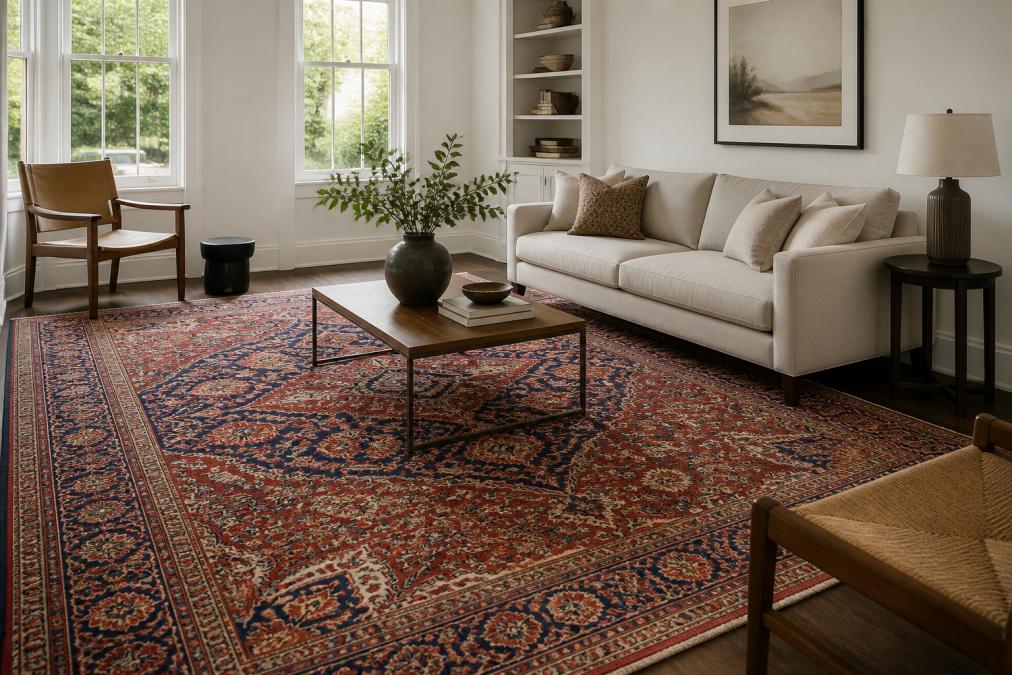
ABC Rugs Kilims & Jewelry: Curated Selection with Transparent Grading
The catalog is built around authentic hand-knotted pieces with documented history, such as the One Of The Kind Hand-Knotted Persian Wool Rug, a 10'7" x 7' piece with over 60 years of history woven from natural wool and cotton. Pieces like this one come with clear descriptions of their vintage condition and fiber content, so you know what you are getting before it arrives.
The collection spans Persian antiques, vintage rugs, and authentic kilims, with wholesale options for designers. Curation ensures high-quality pieces.
Specialist Dealers for Antique and Semi-Antique Pieces
Beyond our catalog, several specialists focus on antique and semi-antique pieces with genuine provenance, built through global sourcing and estate acquisitions.
The advantage is expertise, the owner can explain loom, knot density, and regional style. The drawback is price: showrooms and appraisals add overhead.
Online Marketplaces for Broader Inventory
What you sacrifice is certainty. Condition descriptions vary wildly, provenance is often vague, and "vintage" might mean 20 years while "semi-antique" can mean 40 to 70. Marketplaces suit experienced buyers comfortable evaluating rugs from photographs.
Comparing Return Policies and Condition Grading
A Standardized Condition Grading Framework
When a dealer says "good condition," it can mean anything from "minor, even wear" to "structural damage professionally repaired." Use a five-point grading scale that evaluates the rug as a textile object.
| Grade | Pile Height | Wear Pattern | Restoration Status | Typical Price Impact vs. 'Perfect' Example |
|---|---|---|---|---|
| 1 - Mint | Full, uniform pile | No visible wear; original fringes intact | None; all original | Benchmark |
| 2 - Excellent | Even pile with slight low spots | Light, even patina; fringes show minor fraying | None or invisible re-knotting on ends | 10-20% below benchmark |
| 3 - Good | Noticeable low pile in high-traffic areas | Visible wear pattern; some foundation showing in spots | Minor, professional restoration (e.g., end re-weave) | 25-40% below benchmark |
| 4 - Fair | Significant pile loss; foundation visible in multiple areas | Heavy, uneven wear; edges may be fraying | Visible restoration; possible color touch-up | 50-70% below benchmark |
| 5 - Poor | Pile nearly or entirely absent in large sections | Severe structural wear; holes or tears present | Extensive restoration required or already performed | 75%+ below benchmark |
This scale is a starting point, not a substitute for a dealer's notes. Ask these specific questions:
- Pile Height: What is the approximate pile height in millimeters? Is it uniform across the field, or are there low spots near the edges or in the center?
- Foundation: Is the cotton or wool foundation visible anywhere on the surface? If so, where and how large is the area?
- Fringes: Are the fringes original to the piece, or have they been re-knotted or replaced? Original fringes on a 60-year-old rug will show wear; replaced fringes are a sign of restoration.
- Color and Dyes: Are the colors uniform, or are there areas of fading that suggest natural dye variation? Has the rug been chemically washed or artificially distressed to create a patina?
- Restoration: Has any section been re-woven, re-piled, or re-dyed? If so, request a close-up photograph of the repaired area. A professional restoration on a high-end piece can be nearly invisible, but it still affects value.
Return Policy Mechanics: What the Fine Print Actually Means
| Policy Element | Curated Specialist (e.g., ABC Rugs Kilims & Jewelry) | Established Antique Dealer | Online Marketplace (e.g., eBay, Chairish) |
|---|---|---|---|
| Return Window | 30 days from delivery | 7-14 days from delivery | Varies by seller; often 3-7 days after delivery confirmation |
| Return Shipping | Dealer typically covers or provides a prepaid label | Buyer usually covers; insurance is mandatory | Buyer covers; seller may require signature confirmation |
| Restocking Fee | Rare; most curated dealers waive it | Possible; 10-20% is not uncommon | Seller-dependent; some platforms prohibit it, others allow it |
| Condition for Return | Rug must be in original condition; light foot traffic from trying it in a room is usually acceptable | Rug must be in pristine, un-used condition; often must be rolled exactly as shipped | Seller may dispute condition; photographic evidence is critical |
| Refund Timeline | Refund issued after rug is received and inspected; typically 5-10 business days | Refund after inspection; may take longer if restoration is needed | Platform holds funds until dispute is resolved; can take weeks |
The Inspection Window as a Risk-Management Tool
An inspection window is a risk-management tool: it lets you evaluate the rug in your lighting, against your flooring, and underfoot.
Marketplace risk is highest: you rely on a seller's photos and a dispute process designed for low-value goods. Use a credit card with purchase protection and photograph the rug's condition the moment it arrives.
A return policy is only as good as its mechanics: a 30-day window with a restocking fee is less protective than a 14-day window with free shipping.
Authentic Kilim Rugs: A Specialized Sourcing Niche
For authentic kilims specifically, sourcing is even more critical. Kilims are flat-woven, giving them a distinct texture and lighter weight, and they require different evaluation criteria than pile rugs.
The best kilim-focused alternatives show the weave structure clearly and explain the difference between a genuine vintage kilim and a modern reproduction. Look for irregular edges, natural dye variations, and tribal motifs of a specific region.
Best Practices for Rug Maintenance After Purchase
Proper maintenance is about preserving structural integrity and patina, not keeping a rug pristine.
The First 72 Hours: Acclimation and Inspection
A rug arrives rolled tightly, possibly for days. Unroll it flat in its room and leave it 48 to 72 hours to acclimate to ambient humidity. Wool is hygroscopic; placing heavy furniture on a rug still adjusting risks permanent creases.
During acclimation, inspect the rug: walk the perimeter, check fringes, and examine the back for knot density and foundation. Photograph any undisclosed damage and contact the seller. Test colorfastness by blotting a damp white cloth on an inconspicuous corner; color transfer means dyes are not set and the rug needs professional cleaning.
Vacuuming: Technique Matters More Than Frequency
Vacuuming a vintage rug differs from vacuuming wall-to-wall carpet. Use a suction-only setting, no beater bar, which accelerates fiber wear on hand-knotted pile, especially older, lower-pile rugs.
Vacuum in the direction of the weave; going against it can pull knots and loosen the foundation. Vacuum the back for the first few cleanings to remove transit dust. With pets, vacuum more often, dander attracts moths, the primary biological threat to wool.
Professional Cleaning: The Annual or Biennial Standard
Textile conservation practitioners recommend professional cleaning every 12 to 24 months, depending on traffic and pets. Find a cleaner who specializes in hand-knotted rugs; a specialist washes by hand with a mild, pH-neutral detergent and dries flat in a controlled environment.
:::warning Avoid steam cleaning. The high-temperature moisture can shrink the cotton foundation, distort the pattern, and cause wool fibers to felt or become brittle. Similarly, avoid any cleaner that uses a rotary brush or extraction wand, these are designed for tufted carpets and will damage a hand-knotted pile. ::: vintage decor shops.
Ask about the drying process: a cotton foundation can take days to dry, and quick or direct-sunlight drying can warp it. A reputable specialist dries flat with air circulation and returns the rug only when fully dry.
Moth Prevention: The Silent Threat
Moth larvae feed on keratin, the protein in wool, and thrive in dark, undisturbed areas. The first sign of infestation is often damage: small, bare patches where pile has been eaten to the foundation.
Prevention is straightforward: vacuum the underside periodically, especially edges. In humid climates, use a dehumidifier, moths prefer above 50% relative humidity. Cedar and lavender are mild deterrents, not substitutes for cleaning. If you suspect infestation, isolate the rug and consult a conservator; avoid aerosol moth sprays, which damage natural dyes and attract dirt.
Sunlight and Fading: Managing Natural Dye Exposure
Natural dyes, madder root, indigo, weld, are more susceptible to UV fading than synthetics. Direct sunlight for several hours daily causes uneven fading: exposed areas lighten while areas under furniture stay saturated.
Rotate the rug every six months to distribute wear and light. For south- or west-facing windows, use UV-filtering film or sheer curtains during peak hours. The goal is to prevent uneven fading; an even, natural patina is desirable, a patchwork is not.
The Rug Pad Question
A high-quality rug pad is not optional: it prevents slipping, cushions the pile, and allows air circulation. A rug on hardwood or tile can develop mold from trapped moisture; a pad lifts the rug and prevents the foundation from wicking moisture.
Choose natural rubber or felt, not PVC, which can off-gas and stick to the foundation. The pad should be about two inches shorter on each side so it does not show.
When to Call a Textile Conservator
Most maintenance can be handled by a specialist cleaner, but a true antique, over 100 years old with significant value, requires a textile conservator trained in museum-grade techniques. Conservators stabilize fragile foundations, re-weave damaged areas, and document condition for insurance. More expensive than a cleaner, but for a museum-quality piece the investment protects value and history.
Making the Final Choice for Your Space
The right rug balances aesthetics, condition, and budget. Measure your space and decide on a palette: a distressed finish suits a modern interior, while a bold medallion pattern makes a statement in a traditional room.
Consider age honestly: a mid-20th-century semi-antique offers vintage appeal with less fragility than an 1800s antique. In high-traffic areas, prioritize durability over rarity; for display pieces, provenance and condition matter more.
For designers and boutique buyers, wholesale access changes the calculus: sourcing multiple pieces with consistent quality is worth more than any single rug's provenance. A dealer who handles bulk orders and offers trade pricing becomes a partner.
Conclusion
Finding the best alternative comes down to matching the dealer to your priorities: specialists offer transparency, antique dealers bring provenance, and marketplaces provide volume at lower prices. Evaluate condition grading and return policies before you commit, and a good dealer will answer provenance and restoration questions without hesitation.
ABC Rugs Kilims & Jewelry combines a curated inventory of hand-knotted Persian rugs and authentic kilims with transparent condition reporting and wholesale options. Our pieces are reviewed and trusted by collectors who value authentic craftsmanship. Explore our collection and find a vintage rug that brings genuine textile history into your home.
Frequently Asked Questions
Are vintage rugs still in style for modern home decor?
Yes, vintage rugs remain a staple in modern interior design. Their patina, natural dyes, and hand-woven textures add warmth and character that new mass-produced rugs cannot replicate. They work well in minimalist spaces as a focal point or in layered, eclectic designs. The key is to match the rug's scale and color palette to your existing furniture. A semi-antique piece with a distressed finish can bridge traditional and contemporary aesthetics seamlessly.
How do I verify the authenticity of a vintage rug before buying?
Look for dealers who provide detailed provenance and condition reports. Ask specific questions about the weaving technique, such as whether it is hand-knotted, the type of wool fiber used, and the knot density. Authentic pieces will show slight irregularities in the weave and the use of vegetable dyes, which create subtle color variations. Reputable sellers should also have a clear return policy, allowing you to inspect the rug in person before committing.
What should I look for when assessing the condition of a vintage rug?
Focus on the pile height, the integrity of the warp and weft, and any signs of prior restoration. Minor wear and a distressed finish are normal in vintage pieces and add value. However, check for large areas of missing pile, water stains, or poorly executed repairs that could compromise the structure. Ask the seller for photos of the back of the rug to assess the foundation and look for any moth damage or weak spots.
What is the difference between antique and vintage rugs?
The distinction generally comes down to age. A rug is typically classified as antique if it is over 100 years old, while vintage rugs are usually between 40 and 100 years old. Antique carpets are often considered investment pieces due to their scarcity and historical value. Vintage rugs offer a similar aesthetic with a more accessible price point and are often in better condition for daily use, making them a practical choice for high-traffic areas.


