

Table of Contents
- What Separates a Kilim from an Oriental Rug
- Hand Knotted vs Machine Made Rugs: Why Structure Matters
- How to Identify Handmade Oriental Rugs: Backside Inspection and Knot Count
- Texture, Thickness, and Fringe: The Hands-On Tests
- Design Differences: Geometric Patterns vs Floral Motifs
- Durability, Maintenance, and Room-Specific Suitability
- Frequently Asked Questions
Last Updated: September 13, 2026
What Separates a Kilim from an Oriental Rug
Learning how to distinguish between kilim and oriental rugs starts with one structural fact: a kilim and oriental rug differ in that a kilim is a flatweave, while an oriental rug is almost always a pile rug. That single difference in construction drives everything else, from thickness and texture to how each one wears over decades. At ABC Rugs Kilims & Jewelry, we handle both categories daily, and the confusion is understandable. "Oriental rug" is a broad trade term for handwoven rugs from the Middle East, Central Asia, and nearby regions, and some kilims technically fit that geographic definition. The practical distinction is structural, and once you know where to look, you can identify either type in under a minute.
Flatweave vs Pile Construction
A kilim is a flatweave textile woven on a loom by passing weft threads over and under the warp, with no knots tied into the foundation. The result is a dense, flat fabric with no pile height at all. A pile rug, which describes most oriental rugs, is built by tying individual knots around the warp threads, then cutting them to create a raised surface of tufts. That structural difference explains why a kilim lies almost flush with the floor while a hand-knotted rug sits several millimeters above it. It also explains why kilims are lighter, easier to move, and reversible, while pile rugs are not.
A Quick Comparison Table
| Feature | Kilim (Flatweave) | Oriental Pile Rug |
|---|---|---|
| Construction | Interwoven weft, no knots | Hand-knotted or machine-made tufts |
| Surface | Flat, reversible | Raised pile, one-sided |
| Weight | Light | Heavy |
| Typical materials | Wool, cotton, sometimes silk | Wool pile on cotton foundation |
| Fringe | Often woven in or added | Warp threads extend past the ends |
| Best rooms | Low-traffic, casual spaces | Living rooms, bedrooms, dining rooms |
Hand Knotted vs Machine Made Rugs: Why Structure Matters
Structure determines value, durability, and how a rug ages, which is why the hand knotted vs machine made rugs question matters more than most buyers realize. A hand-knotted rug is built knot by knot on a vertical loom, a process that can take months for a large piece. A machine-made rug is produced on a power loom in hours, with uniform tufts glued or stitched to a backing. The difference shows up in three places: the backside, the fringe, and the price. Hand-knotted rugs carry irregular knots and a soft, flexible foundation. Machine-made rugs have a stiff, uniform back and a glued-on fringe that is often sewn rather than woven. For collectors, the hand-knotted example is the standard. Our Hand Knotted One Of The Kind Peshawar And Khotan Rug 8'2 x 11'4" shows the irregular knot structure and natural wool pile that machine production cannot replicate.

How to Identify Handmade Oriental Rugs: Backside Inspection and Knot Count
Most guides stop at "flip it over and look for knots." That advice is correct but incomplete, because a skilled machine weave can mimic the look of a knotted back from a distance. The gap is in the mechanics: what the back actually feels like, how the foundation behaves under pressure, and how the fringe connects to the body. This is the authenticity test that survives a side-by-side comparison.
The Back-of-Rug Inspection, Step by Step
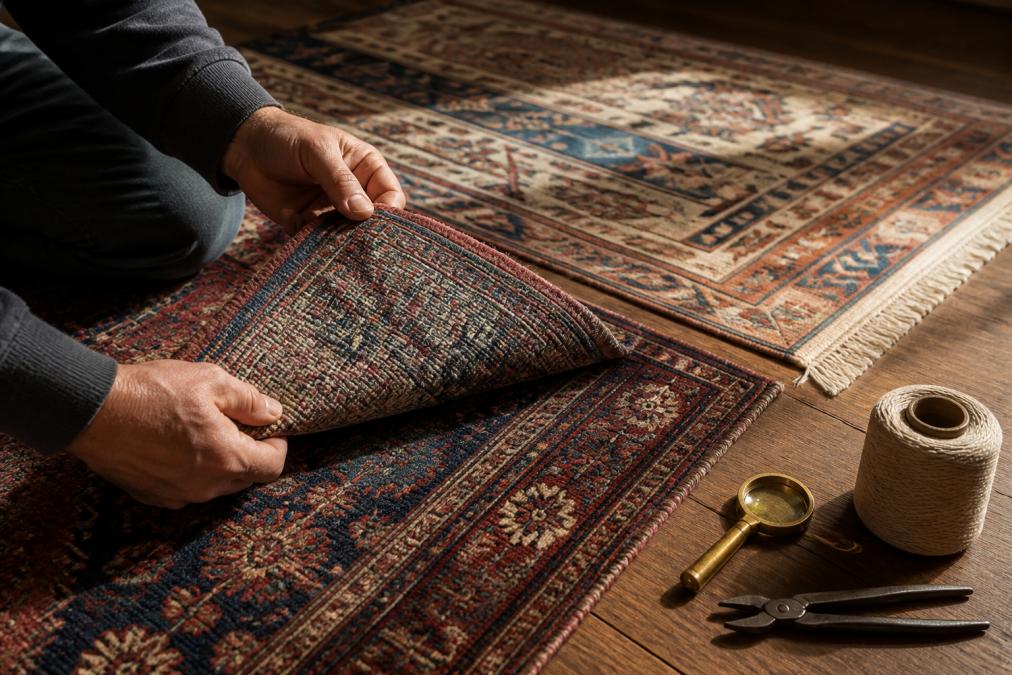
Work in raking light, a flashlight held at a low angle across the surface, not directly above it. Direct light flattens texture; angled light throws every knot and warp thread into relief.
- Find the warp and weft. On a hand-knotted rug, the warp threads run vertically (end to end) and the knots are tied around them in horizontal rows. You should see faint horizontal ridges where each row of knots sits.
- Look for knot irregularity. Hand-tied knots vary slightly in size, spacing, and tension. Machine-made rugs show a perfectly uniform grid, or a flat woven backing with no visible knots at all.
- Check the foundation color. On a hand-knotted wool rug, the cotton foundation is usually a consistent off-white or gray. A dyed or painted backing is often a sign of a machine-made piece hiding its construction.
- Trace the fringe to its source. On a hand-knotted rug, the fringe is the warp threads themselves continuing past the last row of knots. Pull gently, it should feel continuous with the body, not stitched on. A sewn or glued fringe is a strong machine-production signal.
The Touch Test: What Your Fingers Should Feel
Visual inspection catches most fakes, but touch catches the rest. Run your fingertips across the back in a slow S-pattern:
- Hand-knotted pile: You feel distinct, slightly raised knots with small valleys between them. The back has a soft, flexible give, it bends and drapes rather than cracking.
- Machine-made pile: The back feels flat, stiff, and uniform. It may have a latex or glued coating that feels slick or slightly tacky.
- Kilim (flatweave): No knots at all. You feel the horizontal weft ribs running across the width, like a tightly woven blanket. The back is essentially the same as the front, which is why kilims are reversible.
A useful cross-check: press your thumbnail gently into the surface. A pile rug compresses and springs back. A kilim has almost no compression, it is dense fabric, not tufted fiber.
Knot Count: How to Read Density Without a Magnifier
Knot count is expressed as knots per square inch (KPSI) (britannica.com). You do not need to count every knot, count along one inch in two directions and multiply. A common pattern is that coarser tribal and village rugs fall in the lower range, while fine city workshop rugs climb much higher, which is why density correlates with pattern detail rather than with age alone.
- Lower density: bolder geometric designs, thicker yarn, faster weave.
- Higher density: finer curvilinear and floral designs, thinner yarn, slower weave.
Do not treat a single number as a verdict. Density varies widely by region, era, and workshop. Use it as one signal among several, alongside knot irregularity, foundation color, and fringe construction.
Texture, Thickness, and Fringe: The Hands-On Tests
Three quick physical checks separate the two types without any tools. First, thickness: a kilim has essentially none beyond the weave itself, while a pile rug has measurable tuft height. Second, texture: a kilim feels like a dense woven blanket, and a pile rug feels plush and slightly springy underfoot. Third, fringe: on a hand-knotted rug, the fringe is the continuation of the warp threads that run through the body of the rug, so it is integral to the structure. On many kilims, the fringe is woven in as part of the weft or finished differently. A glued or sewn-on fringe is a strong sign of machine production.
- Flat and reversible: kilim
- Raised and one-sided: pile rug
- Fringe continuous with the rug body: hand-knotted
- Fringe sewn or glued on: machine-made
Design Differences: Geometric Patterns vs Floral Motifs
Kilims traditionally feature bold geometric patterns and tribal designs, built from flat blocks of color because the flatweave technique does not easily render fine curves. Pile rugs, especially Persian and city workshop pieces, often carry floral motifs, medallions, and curvilinear designs that require the precision of individual knots. Color tells a story too. Many older kilims and oriental rugs use natural dyes derived from plants and minerals, which fade and shift gracefully with age, while synthetic dyes tend to hold a flatter, more uniform tone (si.edu). When you compare a geometric kilim against a floral pile rug side by side, the design language alone often confirms which is which.
Durability, Maintenance, and Room-Specific Suitability
Durability depends on construction and fiber content, not on which type is "better." But the practical differences show up most clearly in two places most guides skip entirely: how each type is repaired when it fails, and which rooms actually suit each construction.
Repair and Restoration: Flatweave vs. Pile
This is the gap no top-ranking guide covers, and it matters most to owners facing damage.
Kilim (flatweave) repair. Because a kilim has no pile, damage is structural, not cosmetic. A worn spot means the weft or warp threads have broken. Repair is done by reweaving, a restorer rebuilds the missing section thread by thread, matching the original weave density and color. Slits and tears along the weft lines are common and can be rewoven. The upside: a kilim is reversible, so a restorer can sometimes rotate the rug to hide wear, and flatweave repair is generally less invasive than pile restoration. The downside: color matching is harder on older kilims because natural dyes have faded unevenly.
Pile rug repair. Pile damage is usually localized, a worn traffic path, a moth hole, or a pulled knot. Repair means re-knotting the missing tufts into the existing foundation, then shearing the new pile to match the surrounding height. If the foundation itself is compromised, a restorer may need to reweave the warp and weft before re-knotting. This is more labor-intensive than flatweave repair, which is why pile restoration costs more per square inch. Fringe repair is a separate job: on a hand-knotted rug, the fringe is the warp, so a broken fringe can mean the foundation is failing and should be secured before it spreads.
Room-Specific Suitability Matrix
Match construction to traffic and furniture, not to style alone.
| Room | Better Choice | Why |
|---|---|---|
| Hallway / entry | Kilim | Flat surface handles foot traffic, no pile to crush, easy to vacuum, reversible for even wear |
| Living room (formal) | Pile rug | Cushioning, hides footprints and vacuum marks, anchors furniture |
| Bedroom | Pile rug | Soft underfoot, quieter, warmer |
| Dining room | Pile rug (low pile) | Chairs slide without catching, hides crumbs less than flatweave |
| Kids' playroom | Kilim | Durable, washable-adjacent, no pile to trap debris |
| High-traffic stairs | Pile rug | Better grip and cushioning; kilims can shift on stairs |
Maintenance Basics That Actually Differ
Both types need rotation, gentle vacuuming, and immediate spill response, but the mechanics differ:
- Kilims: Vacuum with suction only, no beater bar. Because there is no pile, debris sits on the surface and lifts easily. Spot-clean with a mild wool-safe solution and blot, never scrub, which can distort the weave. Reverse periodically to even out sun fade and wear.
- Pile rugs: Vacuum with a beater bar on durable wool, but switch to suction-only on delicate or antique pieces. Deep-clean professionally every few years to protect the foundation. Address spills immediately, pile traps liquid against the foundation, where it can cause rot or dye bleed.
For a mid-century or rustic space, a flatweave such as our Turkish Kilim Pillow Cover in beige shows how the same weaving tradition translates into smaller textiles. For a formal room, the Hand-Knotted Persian Wool Rug, 10'7" x 7' with its floral design and natural vegetable dyes fits a traditional layout. Matching the construction to the room is the decision that matters most.


Frequently Asked Questions
How can I tell a real kilim rug from a pile oriental rug?
Flip the rug over. A kilim is a flatweave with no pile, so the back shows the same pattern as the front in reverse, with visible weft threads and no knots. An oriental rug has a pile surface and the back reveals individual knots tied around warp threads. Run your hand across the surface: a kilim feels flat and slightly ribbed, while a pile rug has a soft, raised texture. The fringe on a kilim is often part of the warp threads, not sewn on separately.
Are kilim rugs considered oriental rugs?
Yes, kilims fall under the broad category of oriental rugs, which refers to handwoven rugs from regions including Turkey, Persia, the Caucasus, and Central Asia. The key distinction is construction: kilims are flatwoven without pile, while what most people call oriental rugs are pile rugs with hand-knotted tufts. So a kilim is an oriental rug in origin and style, but not a pile rug. Both can be handmade, and both carry cultural and collectible value.
What is the difference between hand knotted vs machine made rugs when I inspect the back?
On a hand-knotted rug, the back shows an irregular, slightly bumpy surface where each knot was tied by hand. You may see slight variations in knot size and spacing. A machine-made rug has a perfectly uniform, flat back with no visible knots, often with a latex or canvas backing. Hand-knotted rugs also have fringe that is part of the warp threads, while machine-made fringe is usually sewn on. These differences affect durability and value significantly.
How do I determine the age and origin of my kilim or oriental rug?
Start with the dyes. Natural dyes, common in older pieces, fade unevenly and have a muted, organic tone. Synthetic dyes, introduced in the late 19th century, tend to be brighter and more uniform. Check the selvage and fringe for wear patterns that suggest age. Geometric tribal designs often point to Turkish or Caucasian kilims, while floral motifs suggest Persian city rugs. For a definitive assessment, a rug specialist can examine knot count, wool quality, and weave density.


