

Table of Contents
- The Fringe Test: Attached vs. Sewn-on
- The Back Test: Knots and Weave Uniformity
- Signs of a Hand-Knotted Rug
- Machine-Made vs. Handmade Rug Identification
- How to Check Rug Knot Density
- Material Quality and Natural Dyes
- Provenance and Origin Verification
- Conclusion
Last Updated: August 5, 2026
The Fringe Test: Attached vs. Sewn-on
The easiest way to spot a fake Persian rug starts at the edges. Authentic handmade Persian rugs have fringes that are an integral part of the weave, not an afterthought glued or sewn onto the back.
When weavers create a hand-knotted rug on a loom, the warp yarns (the vertical threads that form the foundation) extend beyond the knotted pile at both ends. These warp yarns naturally become the fringe. On genuine pieces, the fringe emerges directly from the weave structure itself. You can trace each fringe thread back into the body of the rug without any visible seam or adhesive line.
Machine-made and lower-quality reproductions often have fringes that are sewn or glued on after manufacturing. Run your fingers along the base where fringe meets rug. On authentic handmade pieces, you'll feel a smooth transition. On fakes, you'll detect a seam, stitching, or a ridge where the fringe was attached separately.
The fringe should also show natural wear patterns consistent with the rug's age. Older Persian rugs often have frayed or partially worn fringes that reflect decades of use. Newer reproductions typically have uniform, pristine fringes that look manufactured.
The Back Test: Knots and Weave Uniformity
Flip the rug over. The back reveals the truth about construction quality and authenticity.
On a hand-knotted Persian rug, the back displays a clear pattern of knots. Each knot is a tiny loop of yarn tied around warp yarns. When you examine the back closely, you'll see the symmetrical or asymmetrical knot structure depending on the regional weaving tradition. The knots should be consistent in size and spacing, though minor variations are normal and actually indicate handmade work.

Machine-made rugs show a distinctly different pattern on the back. The weave is uniform to the point of appearing mechanical. There's no variation, no slight irregularities, no human touch. The backing often looks like a printed or stamped pattern rather than individually tied knots.
Press your finger against the back of the rug. On authentic hand-knotted pieces, you'll feel individual knots, small bumps and texture. Machine-made rugs feel smoother and more uniform because the backing is woven rather than knotted.
Look for color consistency on the back. Handmade rugs often show slight color variations in the backing due to natural dye inconsistencies and the way different dye batches were used throughout the weaving process. Machine-made pieces typically have uniform, consistent coloring that suggests synthetic dyes and industrial processing.
Signs of a Hand-Knotted Rug
Hand-knotted construction creates specific visual and tactile markers that machine-made rugs cannot replicate.
The most obvious sign is the presence of knots themselves. A hand-knotted rug is created by tying individual knots around warp yarns. This process is labor-intensive and time-consuming, which is why authentic Persian rugs command premium prices. Each knot is tied by hand, one at a time, row by row. This method has been used for centuries in Persian weaving traditions.
Examine the pile (the visible surface of the rug). On hand-knotted pieces, the pile grows from individual knots. When you push your fingers into the pile and look at the base, you'll see the knot structure clearly. The pile should feel natural, with slight variations in height and density.
Hand-knotted rugs exhibit imperfections that are actually signs of authenticity. Slight color variations, minor pattern deviations, and uneven pile height are hallmarks of handmade work. Weavers are human; they don't create perfect uniformity. These small irregularities prove the rug was made by hand, not a machine.
The selvage (the reinforced edge of the rug where the weft wraps around the outermost warp yarns) should be hand-finished on authentic pieces. You'll see individual wrapping of yarn around the edge, often with slight variations in tension and spacing. This edge reinforcement prevents the rug from unraveling.
Machine-Made vs. Handmade Rug Identification
Understanding the fundamental differences between machine-made and handmade construction helps you identify authentic pieces quickly.
Machine-made rugs are woven on industrial looms using automated processes. The pattern is programmed into the loom, and yarn is woven according to that program. This method is fast, efficient, and produces consistent results. However, the consistency itself is a giveaway. Machine-made rugs lack the subtle variations that characterize handmade work.
The weaving technique differs fundamentally. Machine-made rugs use a weft-faced weave where the horizontal threads (weft) are visible on the back, creating a smooth, uniform appearance. Hand-knotted rugs use individual knots tied around warp yarns, creating the distinctive knot pattern visible on the back.
Examine the pile density. Machine-made rugs have uniform pile height and density across the entire surface. Hand-knotted rugs naturally show slight variations because each knot is tied individually by a weaver working at different speeds and with varying tension.
The pattern consistency is another key difference. Machine-made rugs repeat patterns with mechanical precision. Hand-knotted rugs, especially older or semi-antique pieces, show pattern variations and slight asymmetries. Weavers working from memory or traditional designs create minor deviations that prove handmade origin.
Production time is a practical indicator. A machine-made rug can be completed in days or weeks. Hand-knotted rugs require months or years depending on size and complexity. A 10' × 8' hand-knotted Persian rug typically takes 6-12 months to complete. This time investment is reflected in the price.

| Characteristic | Hand-Knotted | Machine-Made |
|---|---|---|
| Knot Structure | Individual, visible knots on back | Uniform woven pattern |
| Pile Texture | Natural variation in height | Uniform, consistent height |
| Pattern Precision | Minor asymmetries and variations | Mechanical precision |
| Edge Finishing | Hand-wrapped selvage | Machine-finished edge |
| Production Time | 6-24 months | Days to weeks |
| Back Appearance | Bumpy, textured knot pattern | Smooth, printed appearance |
How to Check Rug Knot Density
Knot density is a technical measure of quality and authenticity. It's calculated by counting the number of knots per square inch.
To check knot density yourself, you'll need a magnifying glass and patience. Count the knots in a one-inch square section on the back of the rug. Count both the horizontal and vertical knots, then multiply them together. A knot density of 100-200 knots per square inch is common for traditional Persian rugs. Higher-quality pieces, particularly those from Tabriz or Nain regions, often have densities of 300-400 knots per square inch or higher.
Regional standards vary significantly. Tabriz rugs typically feature higher knot densities (200-400 per square inch) due to the fine detail in their patterns. Heriz rugs generally have lower densities (80-150 per square inch) because of their bold geometric designs. Understanding regional expectations helps you evaluate whether a rug's density is appropriate for its claimed origin.
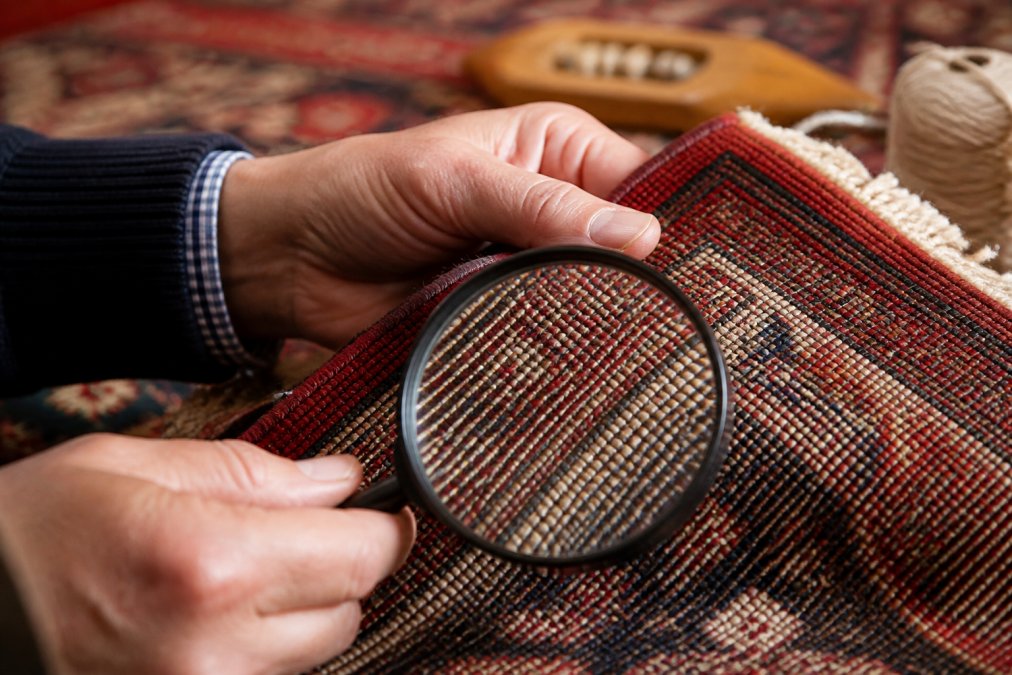
Knot density correlates with price and durability. Higher knot density generally means finer detail, greater durability, and higher value. However, knot density alone doesn't determine authenticity. A machine-made rug could theoretically have a high knot count programmed into it. Use knot density as one data point among many, not the sole test.
The knot shape also matters. Persian rugs use either symmetrical knots (Turkish knots) or asymmetrical knots (Persian knots). The weaving tradition of the region determines which knot type is used. Tabriz weavers traditionally use asymmetrical knots, while some other regions prefer symmetrical ones. This detail requires close examination but provides another authenticity marker.
Inconsistency in knot density across the rug can indicate machine-made construction or poor-quality handmade work. Authentic hand-knotted Persian rugs maintain relatively consistent knot density throughout, though minor variations are normal.
Material Quality and Natural Dyes
The materials used in a Persian rug, the fibers and dyes, reveal much about its authenticity and value.
Authentic hand-knotted Persian rugs are traditionally made from natural materials. Wool is the primary fiber for the pile (the visible surface). The foundation (warp and weft) is typically made from wool, cotton, or silk. High-quality pieces use wool pile with a cotton foundation, which provides durability and structure.
Silk rugs are rarer and significantly more expensive. A silk Persian rug can cost several times more than a wool piece of comparable size and design. Silk creates a lustrous appearance and allows for finer detail due to the fiber's thinness. Authentic silk rugs are hand-knotted and come primarily from regions known for silk production.
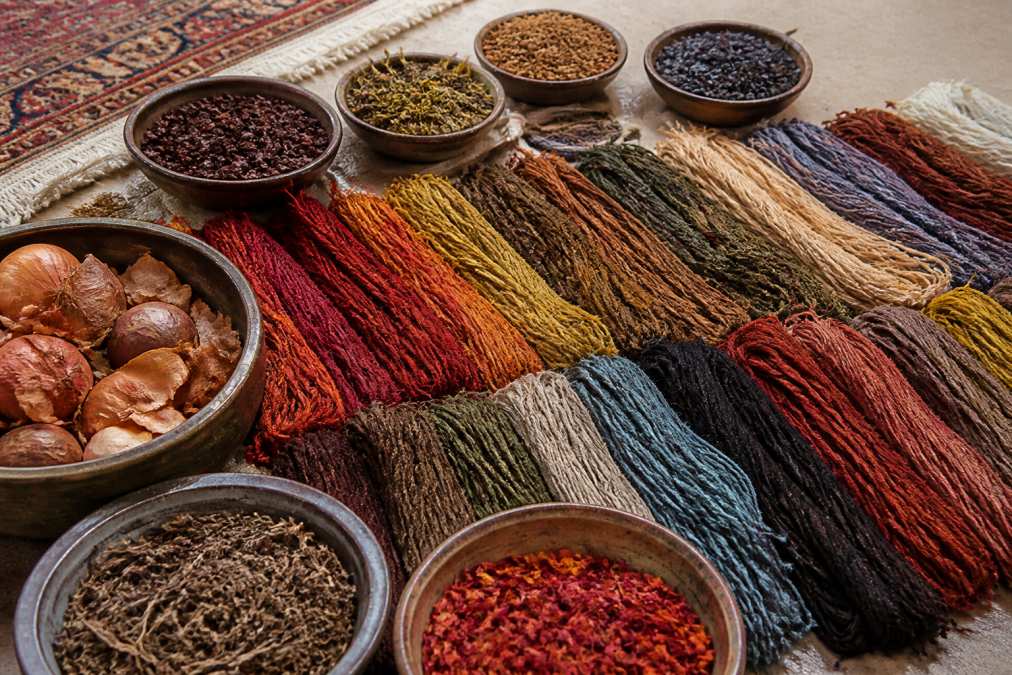
Natural dyes are a hallmark of authentic vintage and antique Persian rugs. Before synthetic dyes became available in the late 19th century, all Persian rugs were dyed with plant-based, mineral-based, or insect-based colorants. Madder root produces red tones. Indigo creates blues. Pomegranate skin yields yellows. These natural dyes create subtle color variations and develop a patina over time.
Synthetic dyes produce uniform, consistent colors that don't age the same way natural dyes do. Machine-made reproductions almost always use synthetic dyes because they're cheaper and faster. When examining a rug claimed to be antique or semi-antique, look for color variations that suggest natural dye use. Older rugs often show slight color bleeding or migration where dyes have subtly shifted over decades.
The presence of natural dyes adds significant value to a rug. A hand-knotted Persian rug made with natural dyes and traditional materials commands premium pricing because of the time, skill, and materials invested in its creation.
ABC Rugs Kilims & Jewelry offers a curated collection of exquisite handmade rugs, Kilims, Persian antique pieces, Gemstones, jewelry, and vintage treasures. Their collection includes pieces like the Persian Antique Hand Knotted Persian Tabriz Rug, which features traditional floral patterns in wool and cotton with natural dyes.
Provenance and Origin Verification
Provenance, the documented history and origin of a rug, is critical for authentication and valuation.
Authentic Persian rugs should come with documentation or information about their origin. Reputable sellers provide details about where the rug was made, when it was woven, and what region or city produced it. This information affects both authenticity assessment and market value.
The region of origin matters tremendously. Tabriz, Nain, Isfahan, and Heriz are among the most respected weaving centers in Persia (Iran). Each region has distinctive design characteristics, knot densities, and color palettes. A genuine Tabriz rug has specific structural and design qualities that differ from a Heriz or Nain rug. Knowing these regional differences helps you verify claimed origins.

Ask the seller for documentation. Legitimate dealers maintain records of their inventory sources. If a seller claims a rug is a 50-year-old Tabriz but can't provide any documentation or provenance information, that's a red flag.
Certificates of authenticity can be helpful, but they're only valuable if issued by reputable appraisers or dealers. Anyone can print a certificate. The source matters. Look for certifications from recognized rug appraisers or established dealers with verifiable track records.
Age claims require scrutiny. Distinguishing between a 50-year-old rug and a 100-year-old rug requires expertise. The color patina, fiber condition, and wear patterns all contribute to age assessment. If a dealer claims a rug is significantly older than it appears, ask for supporting evidence.
According to the American Rug Appraisers Association, proper documentation and provenance verification are essential for establishing authenticity and fair market value. When acquiring high-value pieces, request detailed provenance information and consider professional appraisal.
Buying from established dealers reduces risk. Reputable sellers have reputations to protect and maintain documented sourcing practices. They're more likely to stand behind their claims and provide accurate information about origin and construction.
Identifying authentic hand-knotted Persian rugs requires attention to multiple details: fringe construction, back texture, knot structure, material quality, and provenance. The combination of these factors creates a reliable authentication framework. When shopping for genuine Persian rugs, prioritize dealers who provide detailed documentation, maintain transparent sourcing practices, and stand behind their inventory with verifiable authenticity claims.
ABC Rugs Kilims & Jewelry offers a curated collection of authenticated hand-knotted Persian rugs with documented provenance and natural dye construction. Browse their hand-knotted Persian Tabriz collection to find museum-quality pieces backed by expert authentication and detailed sourcing information.
Frequently Asked Questions
How can I tell if a Persian rug is handmade versus machine-made?
The most reliable way to identify a handmade Persian rug is to examine the back. Handmade rugs show irregular knot patterns, slight asymmetries, and visible warp and weft yarns. Machine-made rugs display perfectly uniform rows and symmetrical knots. Check the fringe attachment, handmade rugs have fringe that extends directly from the warp yarns, while machine-made rugs have sewn-on fringe. Also inspect the knot density; handmade Persian rugs typically feature 100-300+ knots per square inch, varying slightly due to hand-knotting, whereas machine-made versions show identical, perfectly regular knot spacing.
What is knot density and why does it matter for authenticity?
Knot density refers to the number of knots per square inch in a rug's pile. Authentic handmade Persian rugs typically have 100-300+ knots per square inch, depending on the region and weaving tradition. To check rug knot density, count the knots along one inch of the rug's back in both directions, then multiply the two numbers. Higher knot density generally indicates finer craftsmanship and durability. Machine-made rugs have perfectly uniform, lower knot densities. Regional standards vary, Tabriz rugs often have higher densities than Kilims, so understanding the expected range for your rug's origin helps verify authenticity.
How do I verify a Persian rug's provenance and origin?
Authentic Persian rugs should come with documentation that includes the region of origin (Tabriz, Mashad, Isfahan, etc.), weaving date or era, materials used, and ideally the artisan or workshop name. Request detailed provenance information from your seller, including photographs of the rug's front and back, knot density count, and any restoration history. Natural vegetable dyes and specific weaving techniques vary by region, so matching these characteristics to the claimed origin is essential. ABC Rugs Kilims & Jewelry provides comprehensive documentation for each piece, including verified origin details and material composition, which is a key indicator of trustworthy sourcing.
What are the signs of a machine-made rug I should avoid?
Machine-made rugs display several telltale signs: perfectly uniform knots with no variation, symmetrical patterns that repeat identically, sewn-on fringe rather than fringe extending from the foundation, and a backing that shows no irregularities. The back of a machine-made rug appears almost printed, with identical knot spacing throughout. Machine-made rugs also typically have lower knot density with synthetic fibers that lack the natural color variation of authentic vegetable dyes. The pile often feels uniform and plastic-like rather than having the subtle texture variations of hand-knotted wool or silk. If the price seems unusually low for a claimed handmade Persian rug, that's often a red flag for machine-made construction.
This article was written using GrandRanker


