

Table of Contents
- Understanding Antique Kilim Damage and Foundation Assessment
- DIY vs. Professional Restoration: When to Call a Specialist
- Cleaning and Maintenance Best Practices
- Professional Restoration Techniques: Reweaving and Reknotting Methods
- Edge Binding and Fringe Repair for Antique Kilims
- Best Tools for Textile Restoration
- Kilim Rug Repair Cost and Budget Planning
- Preventative Care for Antique Textiles and Long-Term Storage
- Frequently Asked Questions
Last Updated: October 3, 2026
Understanding Antique Kilim Damage and Foundation Assessment
Antique kilim rug restoration begins with proper assessment to identify whether damage is cosmetic or structural. At ABC Rugs Kilims & Jewelry, we help collectors preserve treasured pieces by starting with thorough damage evaluation.
Kilims are hand-woven flat-weave textiles where warp and weft threads interlock to form geometric patterns without pile. This construction makes them vulnerable to specific wear patterns. Understanding the difference between surface damage and foundation compromise is critical before restoration.
Identifying Common Damage in Antique Kilims
Common damage includes fraying edges from loosened selvage threads, color fading from light exposure or moisture, and warp/weft separation creating holes or thin spots.
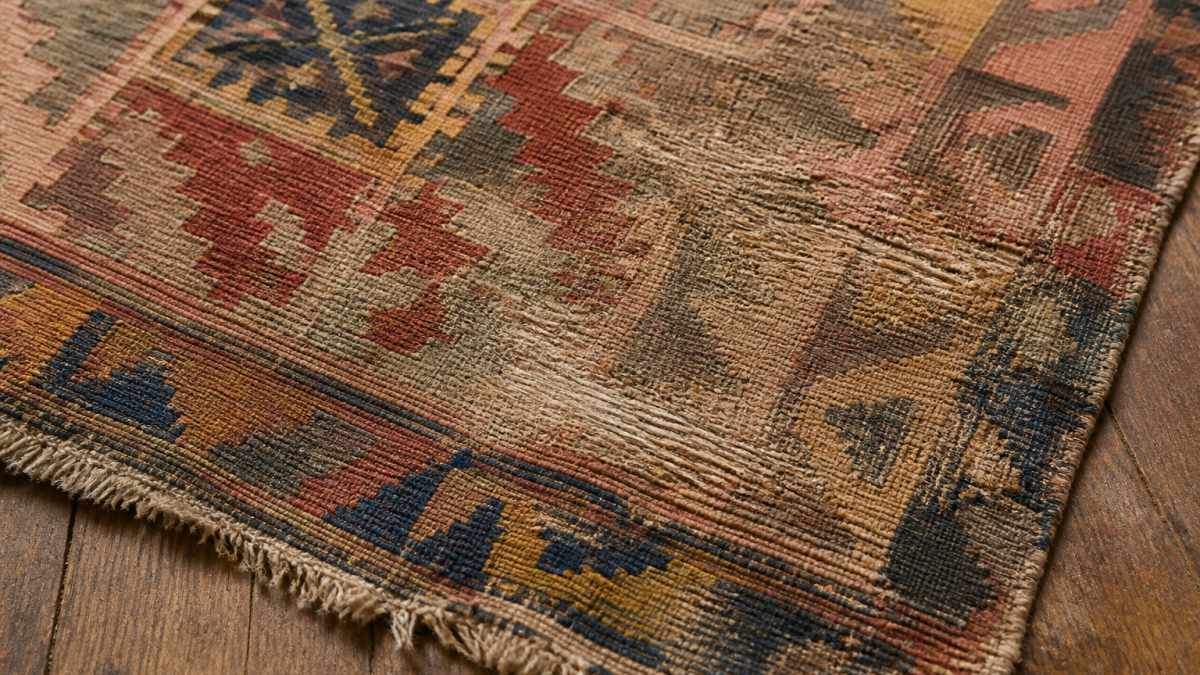
Look for these specific issues when inspecting your kilim:
- Moth damage: Small holes scattered across the surface, often clustered in dark corners
- Dry rot: Brittle, crumbling fibers that break easily when touched
- Separation: Warp and weft threads pulling apart, creating visible gaps
- Staining: Discoloration from water, spills, or age-related oxidation
- Pile loss: Thinning areas where the weave shows through (less common in flat-weave kilims)
Material affects damage response: wool kilims are more resilient than cotton or silk, and natural dyes hold color better than synthetic dyes over time.
Assessing Structural Integrity
Before restoration, assess foundation soundness by running your hand across the back. The weave should feel tight and consistent; soft, spongy areas indicate moisture damage or fiber degradation.
Check warp tension by gently pulling lengthwise, it should resist slightly. Loose or stretchy tension indicates foundation compromise requiring professional intervention.
Inspect the selvage (finished edge where weft wraps outer warp threads). Intact, tight selvage protects the structural perimeter; loose or missing selvage exposes warp threads to unraveling.
DIY vs. Professional Restoration: When to Call a Specialist
Some antique kilim rug restoration techniques are safe for homeowners; others require professional training. Knowing the difference prevents costly mistakes.
Handle these yourself:
- Light surface cleaning with a soft brush
- Vacuuming with a screen overlay to prevent fiber pull
- Spot treatment of minor stains with diluted water
- Fringe combing and detangling
Call a professional for:
- Structural repairs to warp or weft
- Reweaving missing sections
- Reknotting or restabilization
- Dye color matching and restoration
- Water damage or mold treatment
- Antique pieces over 50 years old with visible damage
Professional restoration costs can vary widely, from a few hundred dollars for minor repairs to several thousand for extensive work. For pieces with significant sentimental or monetary value, professional intervention is the safer choice.
Cleaning and Maintenance Best Practices
Regular maintenance prevents damage escalation and extends kilim lifespan by decades.
Vacuum monthly using low suction with a screen overlay to prevent fiber pull. Work along weft threads and never use a beater bar, which damages textiles.
For spot cleaning, use cool water with mild pH-neutral soap (test on hidden corner first). Blot gently; never rub. Rinse thoroughly and dry flat away from heat or sunlight.
Rotate your kilim every 6-12 months to distribute wear evenly and prevent uneven fading. Keep away from direct sunlight or use UV-protective curtains.
Monthly maintenance checklist:
- Vacuum with screen overlay
- Check for new stains or damage
- Brush fringe gently with a soft comb
- Inspect edges for fraying
Quarterly tasks:
- Rotate the rug 180 degrees
- Check moisture levels in storage areas
- Ensure no pests have nested underneath
Professional Restoration Techniques: Reweaving and Reknotting Methods
Reweaving Damaged Sections
Reweaving is a common antique kilim rug restoration technique for flat-weave pieces, with specialists reconstructing missing sections by hand while matching original tension and color.
The restorer stabilizes the damaged area, secures loose threads, then hand-weaves new threads through existing warp, matching original pattern and color.
Color matching is most challenging since natural dyes age and shift over decades. Skilled restorers use period-appropriate dyes to blend repairs seamlessly, making successful reweaving undetectable.
Reweaving can be effective for holes and sections under 6 inches; larger areas may require additional stabilization and staged work.
Reknotting and Pile Restoration
Reknotting applies to hand-knotted rugs, though many antique pieces combine both techniques. Restorers carefully remove and retie damaged knots using matching materials and tension.
Pile restoration rebuilds worn areas by adding new knots in original pattern and color, row by row, to restore pile height and texture.
This technique demands exceptional skill to match original knot density (often 100+ knots per square inch) and maintain consistent tension.
Edge Binding and Fringe Repair for Antique Kilims
Fraying edges and damaged fringe are common in antique kilim rug restoration. Edge binding protects the selvage and prevents warp thread unraveling.
When fringe is damaged beyond repair, restorers remove the damaged section and reattach new fringe using original materials when possible, hand-tied to match original style and thickness.
Edge binding wraps thread around outer warp threads to create a finished edge, preventing unraveling and protecting structural integrity. Professional binding can be invisible from the front and extend kilim lifespan.
Best Tools for Textile Restoration
Professional restorers use specialized tools for delicate work; many are available to homeowners for basic maintenance.
Essential tools:
- Soft-bristled brush for dusting
- Fine-tooth comb for fringe detangling
- Vacuum with HEPA filter and screen overlay
- Spray bottle for light misting
- Soft white towels (never colored)
- pH-neutral cleaning solution
- Wooden or plastic beaters (never metal)
Professional-grade tools:
- Weaving looms for reweaving sections
- Magnifying glasses for detail work
- Specialized dyes matched to original colors
- Tension gauges for even restoration
- Humidity monitors for storage
Invest in quality tools for regular maintenance. A good HEPA-filter vacuum with adjustable suction can protect your investment.
One Of The Kind Hand Knotted Persian Rug 12'8" x 9'4" →
Kilim Rug Repair Cost and Budget Planning
Understanding kilim restoration pricing helps you evaluate estimates and prioritize repairs. Many professionals use one of three pricing frameworks based on damage severity, materials, labor, and expertise.
How Restoration Pricing Works
Square-inch pricing is most common for reweaving and structural repairs, ranging from $15-$50 per square inch depending on complexity and experience.
Square-inch pricing can be effective for clearly defined damage but may underestimate repairs requiring extensive color matching.
Labor-hour pricing ($50-$150/hour) is used when scope is uncertain or extensive stabilization is needed.
Labor-hour pricing can be transparent and protect against hidden costs but requires a detailed written estimate with an expected hour range.
Flat-rate pricing applies to standardized repairs: edge binding ($300-$1,200) and fringe replacement ($200-$800 for standard 8-10 foot kilims).
Typical Repair Costs by Scope
Minor repairs (basic maintenance and small damage):
- Fringe repair or replacement: $200-$800
- Edge binding (full perimeter): $300-$1,200
- Small hole reweaving (under 4 inches): $400-$1,500
- Spot stain removal: $100-$400
Moderate repairs (structural damage requiring skilled work):
- Medium section reweaving (4-12 inches): $1,500-$5,000
- Warp or weft stabilization: $800-$2,500
- Color restoration on faded sections: $1,000-$3,500
- Water damage treatment and drying: $500-$2,000
Extensive restoration (severe damage or full restoration):
- Large section reweaving (12+ inches): $3,000-$10,000+
- Full restoration of severely damaged kilim: $5,000-$15,000+
- Structural reconstruction (multiple damaged areas): $8,000-$20,000+
Ranges assume 6'×9' to 10'×14' kilims. Smaller pieces cost 30-50% less; larger pieces cost 50-100% more. Rare antiques or historically significant dyes command premium pricing.
Factors That Increase Restoration Cost
Pattern complexity: Intricate geometric patterns require more time to match and reconstruct than simple striped kilims.
Natural dye matching: Kilims with natural dyes cost more to restore since restorers must source period-appropriate dyes.
Structural compromise: Weakened foundations require full stabilization before cosmetic repairs, adding 20-40% to total cost.
Regional rarity: Kilims from specific regions have different techniques and standards. Specialists in particular regional styles charge more but produce more authentic results.
Previous repairs: Poorly repaired kilims cost more to fix since restorers must remove old repairs and stabilize underlying damage. Budget an additional 15-30%.
Getting Accurate Estimates
Get written estimates from at least two certified textile conservators. A professional estimate should include:
- Detailed description of all damage (with photos)
- Proposed repair method for each damaged area
- Materials to be used (dye type, thread source, etc.)
- Expected timeline (in weeks or months)
- Total cost broken down by repair type
- Warranty or guarantee on the work
The cheapest estimate isn't always best. Compare experience, color-matching approach, and timeline. A restorer charging $40/sq inch with authentic dyes and careful work may deliver better results than one charging $20/sq inch with synthetic dyes.
Cost-Benefit Analysis
Before committing to expensive restoration, consider the kilim's value and your attachment. Family heirlooms and rare antiques justify restoration as cultural preservation. Decorative pieces worth $300-$500 may not justify $3,000+ restoration unless you plan to keep it for decades.
If restoration costs exceed 50% of replacement value and it's not sentimental, reconsider repair. However, kilims with cultural significance or irreplaceable materials justify restoration as preservation investment.
Preventative Care for Antique Textiles and Long-Term Storage
The best restoration is prevention through proper care and storage.
Store kilims in cool, dry environments with stable humidity (40-60%). Fluctuating moisture weakens weaves; avoid damp basements and temperature-prone attics.
Roll kilims rather than fold them to avoid permanent creases and stress. Use acid-free tissue paper between rug and container; never use plastic, which traps moisture.
Keep kilims away from direct sunlight, heat sources, and high-traffic areas. UV rays fade dyes; heat dries and brittles fibers; traffic accelerates wear.
Pest Prevention and Environmental Control
Moths and carpet beetles are primary pests threatening antique textiles, laying eggs in wool and causing damage as larvae feed.
Prevent infestations by vacuuming regularly with HEPA filter, storing in sealed containers with cedar or lavender, maintaining temperatures below 70°F, monitoring humidity, and inspecting monthly.
If you discover an infestation, isolate the kilim immediately and consult a professional conservator.
Environmental control is essential for long-term preservation. Stable temperature and humidity prevent mold, mildew, and fiber degradation.
Antique kilim rug restoration preserves cultural heritage and protects your investment.
Frequently Asked Questions
How much does it typically cost to restore an antique kilim rug?
Restoration costs vary widely based on damage severity and rug size. Minor repairs like edge binding or fringe repair may range from $200 to $500, while extensive reweaving or reknotting can cost $1,500 to $5,000 or more. A restoration specialist will assess the foundation's structural integrity and fiber degradation to provide an accurate estimate. Hand-knotted pieces like those offered at ABC Rugs Kilims require expert evaluation to determine the best restoration approach while preserving the rug's value and authenticity.
Can I repair a kilim rug myself, or do I need a professional?
Minor maintenance tasks like gentle vacuuming and spot cleaning can be done at home, but structural repairs require professional intervention. Reweaving, reknotting, and color matching demand specialized knowledge of warp and weft techniques, natural dyes, and hand-knotted construction. Attempting complex repairs yourself risks further fiber degradation and permanent damage. A restoration specialist can assess whether your antique kilim needs professional work or if preventative care is sufficient to extend its life for generations.
What are the most common signs of damage in antique kilims?
Watch for fraying edges, worn selvage, missing or damaged fringe, holes in the pile, color fading from natural dyes, and loose or broken warp and weft threads. Moth damage appears as small holes throughout the rug, while dry rot causes fiber brittleness and deterioration. Tension issues may show as rippling or buckling in the foundation. These signs indicate the structural integrity is compromised and professional assessment is needed to prevent further deterioration of the hand-woven textile.
How does professional restoration affect the value of an antique kilim?
Professional restoration done by textile conservation experts can preserve or increase value by stabilizing the rug and preventing further damage. However, the approach matters: minimally invasive techniques that respect the original weaving preserve authenticity better than extensive reweaving. Collectors value rugs with honest restoration that maintains the hand-knotted character and natural dye patina. Poor restoration or color mismatching can reduce value. Always work with specialists experienced in antique kilims to ensure restoration enhances rather than diminishes your piece's worth.


