

Table of Contents
- Why Dating Antique Jewelry Matters for Collectors
- 1. How to Identify Antique Jewelry Hallmarks
- 2. Analyzing Metal Purity and Composition
- 3. Dating by Design Style and Period Jewelry Eras
- 4. Examining Clasp Mechanisms and Hinge Evolution
- 5. Using Digital Tools and Professional Appraisals for Authentication
- How to Clean Vintage Antique Jewelry Safely
- Frequently Asked Questions
Last Updated: September 25, 2026
Why Dating Antique Jewelry Matters for Collectors
A piece of antique jewelry is often worth more than the sum of its metal and stones, and the difference usually comes down to a single question: when was it made? At ABC Rugs Kilims & Jewelry, we offer a curated collection of vintage treasures, and the first thing any serious collector or appraiser wants to know is the era. If you want to date antique jewelry accurately, you need more than a gut feeling. You need to examine five specific things: hallmarks, metal purity, design style, clasp construction, and professional authentication.
This guide breaks down the 5 best ways to date antique jewelry, from reading tiny stamps with a loupe to understanding why a hinge tells you more than a stone ever will. Get these five checks right and you can place most pieces within a decade or two. Skip them and you risk paying Edwardian prices for a 1980s reproduction.
1. How to Identify Antique Jewelry Hallmarks
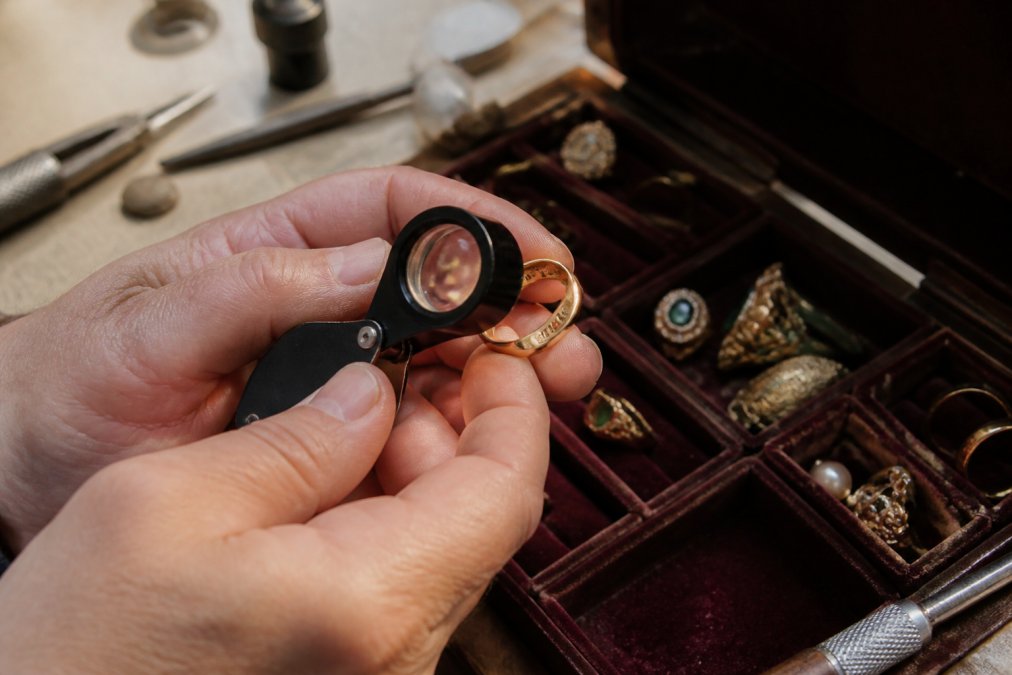
The fastest way to date antique jewelry is to find its hallmark. A hallmark is an official stamp struck into precious metal that records its purity, and often its maker and the year it was assayed. On gold, silver, and platinum pieces, these tiny marks are the closest thing to a birth certificate. You will need a 10x jeweler's loupe to read them clearly.
Reading Assay Marks and Maker's Marks
An assay mark confirms metal purity, while a maker's mark identifies the workshop or silversmith. Together they narrow a piece to a specific country and often a specific decade. Look on the inner band of rings, the clasp of necklaces, and the back of brooches. Marks are frequently worn down by polishing, so examine under good light before concluding a piece is unmarked.
Common Hallmark Systems by Country and Era
Different countries used different systems, and the system itself dates the piece. British silver, for example, carries a lion passant for sterling, a town mark, a date letter, and a maker's mark, a combination that lets experts pinpoint the exact year. American pieces often rely on maker's marks alone because there was no national assay system until the 20th century. French and German pieces use their own purity stamps. When the mark style matches the design, you have strong evidence.
2. Analyzing Metal Purity and Composition
Metal purity gives you a rough age bracket before you ever look at design. Sterling silver is 92.5 percent silver, a standard that has been consistent for centuries, so the stamp alone will not date a piece. What dates it is how the metal behaves. Older pieces show a soft, uneven patina and hand-finished edges, while modern reproductions look uniformly bright.
Gold tells a more useful story. Karat marks like 10K, 14K, and 18K became common in different periods, and white gold only appeared commercially in the 20th century. Platinum was rarely used in jewelry before the early 1900s because it was too hard to work with the tools of the day. Check for plating damage on costume pieces, where the base metal shows through worn areas, a strong sign of a later, mass-produced item.
3. Dating by Design Style and Period Jewelry Eras
Design style is the single most useful dating tool once you know the major periods. Each period jewelry era left a distinct signature, and trained eyes can place a piece within a decade just by looking at its silhouette.
| Era | Typical Years | Signature Features |
|---|---|---|
| Victorian | 1837-1901 | Black enamel, cameos, sentimental motifs, seed pearls |
| Edwardian | 1901-1915 | Platinum, delicate filigree, millegrain detailing, lace-like settings |
| Art Deco | 1920-1939 | Geometric lines, bold color contrast, gemstone cut symmetry |
| Retro | 1939-1950 | Chunky gold, oversized clips, patriotic and floral themes |
Victorian, Edwardian, Art Deco, and Retro Signatures
Victorian pieces lean romantic and heavy on symbolism, from lockets to mourning brooches. Edwardian work is airy and light, made possible by the strength of platinum. Art Deco broke from that softness with sharp angles and contrasting stones. Retro pieces respond to wartime metal shortages with bold, sculptural gold. Match the design to the era, then confirm with the hallmark and construction.
4. Examining Clasp Mechanisms and Hinge Evolution
Clasp and hinge design is the detail most guides skip, and it is often the most reliable dating clue of all. Clasp mechanisms evolved on a fixed timeline, so the type of clasp on a necklace or bracelet narrows the date fast. A simple hook-and-eye closure points to the 19th century. A box clasp with a safety catch is a 20th-century development. A spring-ring clasp with a smooth, machined body suggests a later date than a hand-forged one.
Hinges tell the same story. Early brooch hinges were hand-made and slightly irregular. By the Art Deco period, hinges were machine-cut and precise. Examine the setting style as well: older settings were built to hold a stone by hand, while modern settings are stamped out in uniform shapes.
Sterling Silver Rhodium-plated A Date →
5. Using Digital Tools and Professional Appraisals for Authentication
No amount of home inspection replaces a professional appraisal when money is on the line. A certified appraiser combines the five checks above with testing equipment and market records to give you a defensible valuation. This matters for insurance, resale, and estate planning.
Digital tools have made the early stages easier. Reverse image searches can match a piece to auction archives. Online hallmark databases let you look up a maker's mark in seconds. High-resolution phone photos capture fine details for remote review. Use these tools to build a case, then hand the piece to an expert for final authentication.
ABC Rugs Kilims & Jewelry can arrange GIA certification and verification for vintage jewelry, diamonds, and gemstones. The cost of GIA certification ranges from $350 to $1,500, depending on the item and the services requested. All GIA certification fees are paid directly to GIA. For pieces that need a formal paper trail, that step is worth taking before you buy or sell.
How to Clean Vintage Antique Jewelry Safely
Cleaning an antique piece is where collectors do the most damage. The safe approach is to clean less, not more. Harsh chemicals strip patina, loosen stones, and can eat into plating damage on costume pieces. For most estate jewelry, warm water, a drop of mild soap, and a soft brush are enough.
- Identify the metal and any gemstones before cleaning
- Use warm water and mild dish soap only
- Brush gently with a soft-bristled toothbrush
- Rinse and pat dry with a lint-free cloth
- Avoid ultrasonic cleaners on fragile or glued settings
- Never use acid or abrasive polish on plated pieces
For silver, a gentle silver cloth restores shine without removing metal. For gold, skip the polish and let a soft cloth do the work. If a piece has loose stones or a fragile filigree setting, leave the cleaning to a professional. Proper jewelry preservation keeps value intact and protects the very details that prove the piece's age.
When you are ready to add authenticated antique jewelry to your collection, ABC Rugs Kilims & Jewelry offers a curated selection of vintage treasures, gemstones, and fine pieces, each reviewed and trusted.
Frequently Asked Questions
What are the most common hallmarks used to date antique jewelry?
Common hallmarks include assay office marks, maker's marks, and purity stamps like '925' for sterling silver or '18K' for gold. British pieces often carry a date letter that changes annually, while American jewelry may show maker's marks from companies like Tiffany & Co. Learning to read these stamps is one of the most reliable ways to date antique jewelry accurately.
How can I tell the difference between vintage and antique jewelry?
Antique jewelry is generally defined as pieces over 100 years old, while vintage refers to items at least 20 years old but not yet antique. A Victorian brooch from the 1890s is antique; a 1970s pendant is vintage. This distinction affects value, insurance, and how you approach authentication and appraisal.
What role do metal types play in dating antique jewelry?
Metal composition provides strong dating clues. Platinum became popular in the Edwardian era, white gold emerged in the 1920s, and sterling silver was widely used in Victorian and Art Deco pieces. Testing metal purity with a jeweler's loupe or professional assay helps confirm whether a piece matches its claimed era and supports accurate jewelry valuation.
How do I clean vintage antique jewelry safely without damaging it?
Use a soft-bristle brush and lukewarm water with mild dish soap for most metals and gemstones. Avoid ultrasonic cleaners on fragile settings, pearls, or opals. Patina on sterling silver and antique pieces adds character and value, so never polish it away aggressively. Dry thoroughly with a soft cloth and store pieces separately to prevent scratches.
Are there specific jewelry settings that indicate a certain era?
Yes. Bezel settings dominated the Georgian and early Victorian periods, while prong and pavé settings became common in Edwardian and Art Deco designs. Halo settings around a central stone are typical of Art Deco and Retro pieces. Filigree and millegrain detailing often point to Edwardian or Art Deco craftsmanship, helping narrow down production dates.


