

Table of Contents
- What Are Natural Dyes and Why They Matter in Antique Kilims
- Natural vs Synthetic Rug Dyes: Key Differences
- Common Natural Dye Sources in Traditional Weaving
- The Abrash Effect in Antique Kilims: What It Reveals
- How to Spot Chemical Dyes in Rugs: Visual and Physical Signs
- Testing Methods for Identifying Natural Dyes
- Aging, Fading, and Patina: Reading the History in Natural Dyes
- Frequently Asked Questions
Last Updated: September 27, 2026
What Are Natural Dyes and Why They Matter in Antique Kilims
Natural dyes, derived from plants, insects, and minerals, are a direct window into a kilim's age, origin, and authenticity. Understanding them is essential for identifying natural dyes in antique kilims versus modern reproductions.
Natural dyes indicate hand-spun wool, traditional weaving methods, and pre-synthetic production. They fade, shift, and develop patina in predictable ways that synthetic alternatives cannot replicate.
Natural dyes create color variations called abrash, prized by collectors as proof of authenticity. Uniform color across a kilim's surface raises red flags; genuine antique pieces show tonal shifts and organic mellowing from age and exposure.
Natural vs Synthetic Rug Dyes: Key Differences
Synthetic dyes produce uniform color saturation that remains virtually unchanged for decades. Natural dyes interact with wool fibers differently, creating subtle variations that intensify with time.
Synthetic aniline dyes produce overly bright, uniform colors that don't fade organically. Neon or unnaturally vibrant kilims indicate synthetic dyes. Natural dyes create earthy tones with depth and complexity that synthetics cannot match.
Natural dyes fade gradually and unevenly, creating abrash. Synthetic dyes fade uniformly or resist fading. Natural dyes migrate between colors when exposed to moisture; synthetic dyes maintain crisp borders.
Hand-spun wool with natural dyes develops soft patina and luster over time, gaining the "mellow" quality that indicates genuine age. Synthetic dyes on wool remain relatively unchanged, lacking the subtle shifts that indicate authenticity.
Common Natural Dye Sources in Traditional Weaving
Madder root produces the stable reds and oranges dominating traditional Persian and Turkish kilims. A deep, warm red in an antique kilim typically indicates madder root.
Indigo creates blues ranging from pale to deep navy. It fades slightly over time, creating softer blues in antique pieces that look distinctly different from modern synthetic indigo.
Cochineal (scale insects) produces crimsons and purples, less common but present in some Turkish and Persian pieces.
Pomegranate skins and plant-based sources create yellows and browns that fade noticeably. In antique kilims, yellows often mellow to pale cream or tan.
Mineral pigments like ochre create stable earth tones and browns that resist fading.
The combination of multiple dye sources creates the nuanced palette distinguishing authentic antique pieces. Modern reproductions often use fewer sources or synthetics, resulting in limited, uniform color ranges.
The Abrash Effect in Antique Kilims: What It Reveals
Abrash is the subtle horizontal striping or color variation visible in antique kilims, and it's one of the most reliable indicators of natural dyes and authentic age. The term refers to the slight shifts in color tone that occur as dye batches change during the weaving process.
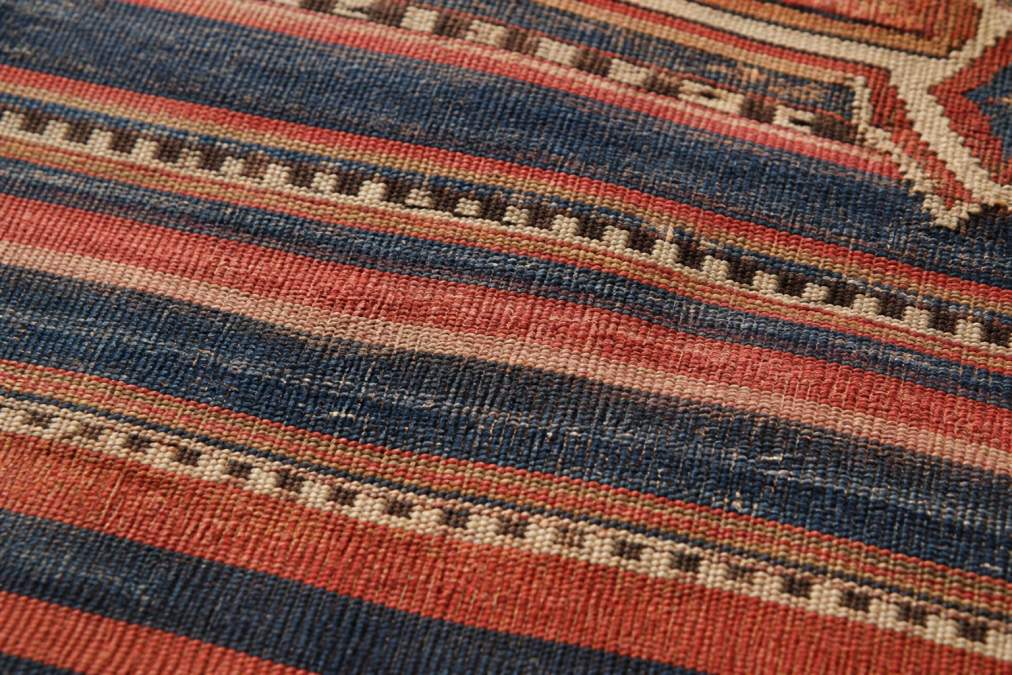
Traditional dyers mixed small batches. When exhausted, new batches varied slightly in color, creating horizontal bands of subtly different tones. In authentic antique kilims, abrash appears organic with gradual transitions that integrate naturally with the design.
Abrash occurs because natural dyes depend on numerous variables: plant material, harvest season, water chemistry, mordant application, temperature, and duration. Modern reproductions often create artificial abrash with obvious, exaggerated striping. Distinguishing these subtle, organic shifts from the crude uniformity of synthetic pigments requires a discerning eye, much like the process of detecting artificial dyes in mineral specimens.
Abrash in multiple colors with different patterns and intensities indicates authentic natural dyes. Synthetic dyes don't create abrash because they're manufactured to precise specifications.
Abrash reveals the weaver's skill and production timeline. Fine, subtle abrash indicates methodical work over time; dramatic abrash suggests faster work. For collectors, abrash is a feature to celebrate.
One Of The Kind Turkish Hand-Knotted →
How to Spot Chemical Dyes in Rugs: Visual and Physical Signs
Identifying synthetic aniline dyes requires attention to color characteristics that natural dyes simply don't produce. Modern chemical dyes create distinct visual signatures that become obvious once you know what to look for.
Unnaturally bright or fluorescent colors are the most obvious sign of synthetic dyes. If a kilim's reds look almost neon, its blues appear electric, or its yellows seem to glow, synthetic dyes are almost certainly responsible. Natural dyes create deeper, more muted tones. The reds are warm but not aggressive. The blues are rich but not luminous. The yellows are golden but not bright.
Perfect color uniformity across large areas indicates synthetic dyes. Natural dyes create subtle variation, slight shifts in saturation, gentle abrash, and organic color transitions. If every square inch of a color field looks identical, you're likely looking at synthetic dyes applied to modern wool using industrial processes.
Colors that don't fade appropriately reveal synthetic origins. Examine the back and sides of a kilim. In authentic antique pieces with natural dyes, you'll see noticeably lighter colors on the back, the side exposed to less light. The sides, which face the wall, will be lighter than the front. Synthetic dyes fade more uniformly or resist fading altogether, so the back and front look nearly identical.
Lack of color migration at boundaries between different colors suggests synthetic dyes. Natural dyes can bleed slightly when exposed to moisture over decades. You might see a faint halo where a red meets a yellow, or a subtle blue tint bleeding into a cream field. Synthetic dyes maintain crisp borders because they don't migrate.
Texture and sheen inconsistencies can indicate synthetic dyes on wool that wasn't traditionally processed. Hand-spun wool develops a specific character over time. Synthetic dyes on modern machine-spun wool create a different visual and tactile quality. The wool may feel slightly waxy or uniform in sheen, whereas naturally dyed hand-spun wool develops variable luster.
Testing Methods for Identifying Natural Dyes
Beyond visual inspection, several scientific approaches can definitively identify natural versus synthetic dyes. These methods range from simple physical tests to advanced laboratory analysis.
Microscopic fiber analysis involves examining wool fibers under magnification to assess their condition and any dye residue. Natural dyes penetrate wool fibers differently than synthetic dyes. Under magnification, naturally dyed fibers show subtle color variation within individual fibers, while synthetically dyed fibers often show more uniform color throughout. This requires a quality magnifying glass or low-power microscope and trained observation, but it provides concrete evidence.
UV light examination reveals differences in how dyes fluoresce. When exposed to ultraviolet light, natural dyes and synthetic dyes respond distinctly. Some synthetic aniline dyes fluoresce brightly under UV light, while natural dyes typically show little to no fluorescence. A portable UV light (available inexpensively) can be used to test small sections of a kilim.
Chemical testing involves applying specific reagents to dyed wool samples to identify dye types. This is more invasive than visual inspection, it requires taking a small sample, but it provides definitive results. Professional textile conservators and authenticators use these tests. Common tests include:
- Spot testing with acids or bases to see how dyes react
- Chromatography to separate and identify specific dye compounds
- Spectrophotometry to measure light absorption patterns
Fading pattern analysis compares color intensity in areas exposed to light versus protected areas. Photograph the front, back, and sides of a kilim under consistent lighting. In naturally dyed pieces, you'll see a clear gradient from front (lighter) to back (darker), with sides showing intermediate values. Create a simple documentation by photographing these areas side-by-side.
Wet testing (use cautiously) involves applying a small amount of distilled water to an inconspicuous area and observing whether dye bleeds. Natural dyes, especially reds and yellows, may show slight color transfer to the water. Synthetic dyes typically show no bleeding. This test is invasive and should only be performed on pieces you own.
The most reliable approach combines multiple methods. Visual inspection catches obvious synthetic dyes. Microscopic analysis provides evidence of fiber-level dye behavior. UV testing reveals fluorescence patterns.
Aging, Fading, and Patina: Reading the History in Natural Dyes
The way a kilim ages tells its story. Natural dyes create predictable, observable changes over decades and centuries. Understanding these patterns allows you to assess authenticity and appreciate the genuine history embedded in the piece.
Frequently Asked Questions
How can you tell if a rug uses natural or synthetic dyes?
Natural dyes in antique kilims show irregular color saturation, tonal variation within the same hue, and softer, more earthy tones compared to synthetic dyes. Synthetic colorants produce uniform, vivid color throughout. Under UV light, natural dyes typically show less fluorescence. Hand-spun wool with natural dyes also feels different, softer and less uniform, than wool dyed with aniline dyes. Examine the warp and weft threads closely; inconsistent coloring across fibers indicates natural dyes from traditional weaving methods.
What role does abrash play in identifying natural dyes in antique kilims?
Abrash, the subtle color variations and striping visible in antique kilims, is a hallmark of natural dyes. It occurs because dye lots varied when weavers hand-mixed vegetable dyes like madder root, cochineal, or indigo. These variations prove the piece was colored with organic materials rather than synthetic aniline dyes, which produce uniform, consistent color. The presence of abrash indicates hand-tied, traditional weaving techniques and adds authenticity and value to antique pieces.
What are the most common natural dye sources for antique kilims?
Traditional weavers relied on plant, insect, and mineral pigments. Madder root produced reds and oranges; cochineal created deep crimsons; indigo yielded blues; pomegranate skins gave yellows and browns; and mineral pigments like ochre provided earthy tones. These organic materials created the nuanced palette characteristic of pre-1870s kilims. Understanding these sources helps you recognize authentic natural dyes versus modern synthetic alternatives when evaluating antique pieces.
Can you test for natural dyes at home?
Yes, basic visual inspection and simple tests work without professional equipment. Examine color uniformity under natural and UV light, natural dyes show variation and minimal fluorescence. Check for abrash striping and color migration where weft threads overlap. Rub a damp white cloth on an inconspicuous area; natural dyes may bleed slightly, while synthetic dyes typically show more pronounced color transfer.


