

Table of Contents
- What Over-Restoration Means in Vintage Jewelry
- Signs of Over-Polished Jewelry
- Detecting Replaced Stones in Vintage Rings
- Assessing Metal Purity and Assay Marks
- Evaluating Hallmarks and Maker's Marks
- The Impact of Re-Plating on Vintage Jewelry Value
- Chemical and Microscopic Indicators of Over-Restoration
- How to Evaluate Patina and Natural Wear Patterns
Last Updated: August 14, 2026
What Over-Restoration Means in Vintage Jewelry
Over-restored vintage jewelry is a piece that has been excessively cleaned, polished, refinished, or altered beyond what's necessary to preserve its original character and value. Over-restoration destroys authenticity by removing evidence of age, wear, and provenance that collectors and appraisers rely on to evaluate quality.
A gently cleaned vintage ring that retains its original patina, maker's marks, and natural wear patterns tells a story. An aggressively polished version loses that narrative. It may look shinier, but it's worth significantly less to serious collectors.
Understanding the threshold between necessary maintenance and destructive over-restoration is essential before you hand your piece to anyone.
Over-restoration typically falls into three categories: mechanical damage from aggressive polishing and resizing, chemical alteration from harsh cleaning or re-plating, and structural changes from replacing original components.
Signs of Over-Polished Jewelry
Loss of Original Surface Detail
Aggressive polishing removes the top layers of metal, erasing the surface details that define the piece's character. Maker's marks, designer signatures, and copyright marks become faint or disappear entirely. Fine engraving work softens and blurs. Delicate texturing flattens.
Run your finger across the surface of a vintage ring. Original surfaces have subtle texture variation from hand-finishing and natural wear. An over-polished piece feels uniformly smooth, almost sterile.
Look closely at any engraved text or design elements. Original engraving has crisp edges and consistent depth. Over-polishing rounds those edges and shallow the depth. This is irreversible damage.
Examine the bottom of the ring and recessed areas. These sections should show less wear than the top surfaces simply because they get handled less frequently. If the entire piece gleams with identical uniformity, that's a red flag.
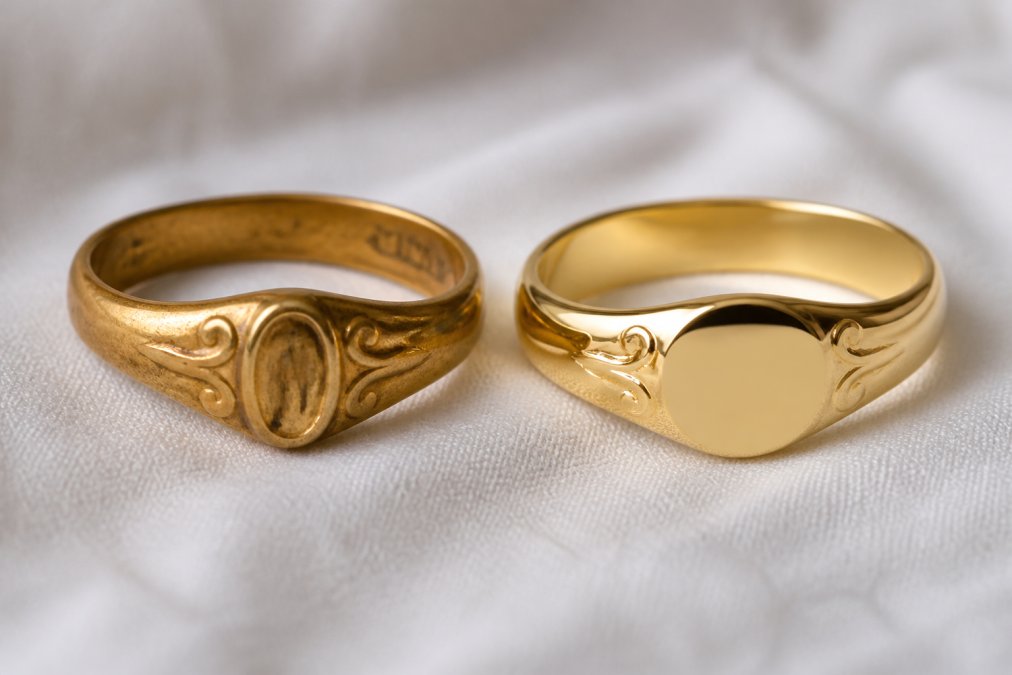
Unnatural Shine and Uniformity
Vintage jewelry should have a warm, slightly muted luster. That soft glow comes from the combination of the metal's natural patina, the piece's age, and gentle wear.
Over-polished pieces have a harsh, almost artificial brightness. The shine is too uniform, too perfect. Real age creates variation in how light reflects across a surface based on wear patterns and hand-finishing marks.
Run the piece under different lighting conditions. An over-polished piece will maintain that aggressive shine regardless of lighting. An authentically aged piece will shift slightly, the patina will show more or less depending on the angle and light source.
Detecting Replaced Stones in Vintage Rings
Examining the Setting for Wear Inconsistencies
The setting, the metal framework that holds the stone, tells you whether the stone is original. Original stones sit in settings that show matching wear patterns. The prongs that hold the stone, the gallery work around the setting, and the metal immediately adjacent to the stone should all display similar levels of patina and wear.
If the stone looks pristine but the setting is aged, the stone was replaced. Check the prongs themselves. Original prongs will show wear marks from the stone's facets pressing into them over decades. Replacement stones sit in re-tightened prongs that look newer and smoother.
Look at the underside of the setting. If the metal underneath the stone looks bright and newly finished while the rest of the ring is aged, the stone was removed and replaced. Examine any solder joints around the setting. Fresh solder indicates re-soldering has occurred, which typically means the stone was removed.
Using UV Light for Gemstone Identification
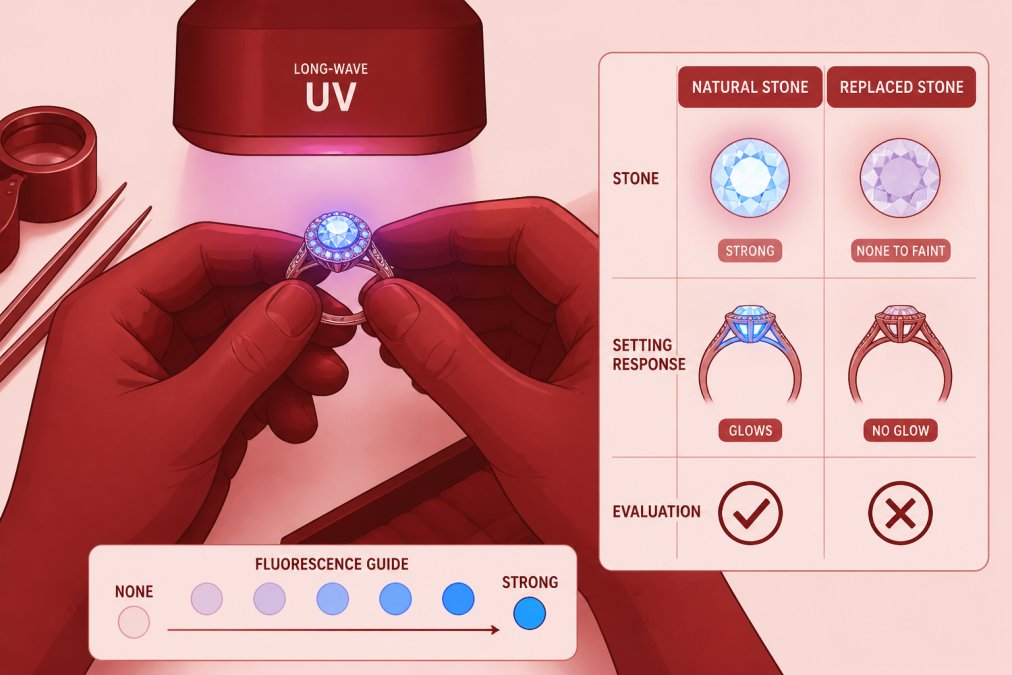
Ultraviolet light reveals what the human eye cannot. Different gemstones fluoresce differently under UV light, helping identify whether a stone is original.
Diamonds typically show blue or yellow fluorescence under long-wave UV light, though some show no fluorescence. Rubies and sapphires show red or inert fluorescence respectively. Synthetic or heat-treated stones often show different fluorescence patterns than natural stones.
The most telling sign is inconsistency within the piece. If the center stone shows one fluorescence pattern and the surrounding accent stones show a different pattern, the stones don't match. Vintage pieces were designed with coordinated stones.
Assessing Metal Purity and Assay Marks
The assay marks stamped into vintage jewelry tell you the metal's purity. 14K means 58.3% gold, 18K means 75%. Over-restoration sometimes damages or obscures these marks, creating authentication problems.
Look for the assay mark inside the band of a ring, on the back of a brooch, or on the clasp of a necklace. These marks should be crisp and clearly legible. If they're faint, determine whether that's natural wear or the result of aggressive polishing.
Compare the assay mark's depth and clarity to other stamps on the piece, like the maker's mark. If the maker's mark is sharp but the assay mark is faint, polishing may have targeted one area more aggressively.
The color of the metal itself provides clues about purity. 18K appears warmer and more saturated than 14K. If the metal's color doesn't match the assay mark's stated purity, the piece may have been re-plated.
Evaluating Hallmarks and Maker's Marks
Hallmarks and maker's marks are the signatures of authenticity. They tell you who made the piece, where it was made, and when it was assayed. Over-polishing threatens these marks by literally removing the metal where they're stamped.
A legitimate maker's mark should be crisp, properly aligned, and consistent in depth with other stamps on the piece. If you can barely read the maker's mark but other stamps are sharp, polishing has been excessive.
Designer signatures should be legible without magnification on pieces made after the mid-20th century. If a signature is so faint it requires a loupe to read, and the rest of the piece is brightly polished, over-restoration has occurred.
Copyright marks and date marks, when present, prove the piece's age and origin. Faint or missing copyright marks suggest the piece has been polished beyond safe limits.
The Impact of Re-Plating on Vintage Jewelry Value
Re-plating is one of the most common forms of over-restoration and one of the most damaging to value. Many vintage pieces were finished with rhodium plating, a thin layer applied over white gold or platinum to enhance whiteness and protect the underlying metal.
Original rhodium plating develops a specific patina over decades. It becomes slightly warm in tone, loses some of its mirror brightness, and shows subtle wear patterns. When a jeweler re-plates a vintage piece, they remove the original plating entirely and apply fresh rhodium. The result looks brand new, and collectors recognize this immediately. Value drops accordingly.
Examine the plating at the edges and in recessed areas. Original plating wears away gradually at stress points. You'll see the base metal showing through in tiny spots. Re-plated pieces have uniform, complete coverage everywhere.
Look at the color consistency. Original rhodium plating on older pieces often has a slightly warmer tone than modern plating. Modern plating is often whiter and more uniform.
Chemical and Microscopic Indicators of Over-Restoration
Surface scratches tell a story. Under magnification, original surfaces show scratches in random patterns, the natural result of decades of wear. Over-polished surfaces show scratches in organized patterns, following the direction of the polishing wheel.
Metal grain structure changes with aggressive polishing. Excessive heat can alter the crystalline structure of the metal, creating a different appearance under magnification.
Solder residue and flux marks indicate whether the piece has been re-soldered. Original solder joints show oxidation and patina consistent with age. Fresh solder joints stand out immediately under magnification.
Plating thickness can be measured using X-ray fluorescence (XRF) analysis, a non-destructive testing method. Original plating typically measures 2-5 microns thick. Modern re-plating is often 10-25 microns thick.
How to Evaluate Patina and Natural Wear Patterns
Patina is the enemy of aggressive restoration, but it's the friend of authenticity. Patina is the subtle discoloration and surface texture that develops on metal over decades of exposure to air, skin oils, and environmental conditions.
Authentic patina on gold develops as a warm, slightly muted surface. The color shifts subtly across the piece based on exposure and handling patterns. High-wear areas show slightly different patina than protected areas.
Wear patterns should be logical. The top of a ring shows more wear than the bottom. The outer surfaces of a brooch show more wear than the reverse. If wear is uniform across all surfaces, the piece has been over-polished.
Examine the piece under different angles and lighting. Tilt it slowly under a bright light and watch how the surface reflects light. Natural wear creates subtle variations. Over-polished pieces reflect light uniformly, like a mirror.
Feel the surface with your fingertip. Original surfaces have texture. You can feel subtle irregularities from hand-finishing and age. Over-polished surfaces feel smooth and uniform.
| Indicator | Original Piece | Over-Restored Piece |
|---|---|---|
| Surface texture | Subtle irregularities, hand-finishing marks visible | Uniformly smooth, mirror-like |
| Hallmarks and maker's marks | Crisp, clearly legible | Faint or partially worn away |
| Patina | Warm, muted, with color variation | Bright, uniform, artificial shine |
| Wear patterns | Logical, more on exposed areas | Uniform across all surfaces |
| Plating appearance | Slightly warm tone, worn at stress points | Bright white, uniform coverage |
| Gemstone setting consistency | Setting and stone show matching age | Setting looks newer than stone |
| Metal grain (under magnification) | Random scratch patterns | Organized patterns from polishing wheel |
When evaluating vintage jewelry for purchase or authentication, these indicators work together. No single sign proves over-restoration, but a pattern of signs confirms it. A piece with faint hallmarks, uniform polish, and bright re-plating has definitely been over-restored. A piece with crisp marks, subtle patina, logical wear patterns, and original plating retains its authenticity.
Before you commission restoration work, consult with a jeweler who specializes in vintage pieces. Ask specifically what work is necessary and what work is optional. Request that they preserve original patina and avoid aggressive polishing. Get a written estimate that details exactly what will be done.
ABC Rugs Kilims & Jewelry specializes in curated vintage and antique jewelry pieces where authenticity and provenance matter. When you source from a trusted dealer who understands the distinction between restoration and over-restoration, you're investing in pieces that retain their value and their story.
Frequently Asked Questions
What is the difference between restoration and over-restoration in jewelry?
Restoration addresses damage and wear to preserve the piece's integrity and function. Over-restoration removes original material, patina, and surface characteristics that define the piece's age and authenticity. A restored ring might have a replaced stone in an original setting; an over-restored ring has been re-plated, aggressively polished, and refinished so extensively that its historical value is diminished. The threshold lies in whether the work preserves or erases the jewelry's provenance and period-correct appearance.
Does over-restoration decrease the value of vintage jewelry?
Yes, significantly. Collectors and appraisers value original patina, hallmarks, maker's marks, and authentic wear patterns. Aggressive polishing removes surface detail, re-plating obscures original metal composition, and replacing stones destroys the piece's historical integrity. A vintage ring that retains its original setting, natural oxidation, and maker's marks is worth substantially more than an identical piece that has been refinished or re-plated. The loss of authenticity directly translates to lower resale value and reduced collector appeal.
How can you tell if a gemstone has been replaced in a vintage setting?
Examine the setting for wear inconsistencies: a replaced stone often sits in a setting that shows different levels of patina and oxidation around the prongs or bezel. Look for fresh solder lines or laser welding marks that differ from the setting's age. Use UV light to check for fluorescence patterns that don't match historical records for the original stone. Microscopic inspection may reveal scratches or marks on the setting that indicate the stone was removed and reset. A jewelry appraiser can perform a detailed examination to confirm whether the stone is original to the piece.
What are the signs of aggressive polishing on vintage jewelry?
Aggressively polished vintage jewelry exhibits an unnaturally uniform, mirror-like shine that lacks the subtle variations of authentic aged metal. Original patina and tarnish are completely absent, and fine surface details like designer signatures, copyright marks, and engraving become shallow or disappear entirely. The metal may appear thinner in high-wear areas because polishing has removed layers. Compare the piece to documented examples of the same maker or era: if the polish is too perfect and the surface lacks character, it has likely been over-polished and lost significant historical value.
This article was written using GrandRanker


