

Table of Contents
- Is Buying Vintage Jewelry a Good Investment? The Honest Answer
- Vintage Jewelry Market Trends Shaping Value in 2026
- Best Vintage Jewelry to Invest In: Eras, Styles, and Metals
- How to Tell If Vintage Jewelry Is Valuable: Authentication Red Flags
- Vintage Jewelry Appraisal: How to Get an Accurate Valuation
- Storage, Insurance, and Exit Strategy for Vintage Jewelry Investors
- Investment Risks Every Vintage Jewelry Buyer Should Understand
- Is Buying Vintage Jewelry a Good Investment for You? A Decision Framework
Last Updated: August 2, 2026
So many collectors ask: is buying vintage jewelry a good investment, or is it just an expensive hobby dressed up in financial language? The honest answer is that it can be both, depending on how you approach it. At ABC Rugs Kilims & Jewelry, we work closely with collectors and discerning buyers who want pieces that hold their value and tell a story. Below, we'll show you exactly how to evaluate vintage jewelry as an asset, what to look for, and where most buyers go wrong.
The thing most guides miss is this: vintage jewelry is not a passive investment like a stock. It rewards knowledge. The buyers who do well understand authentication, provenance, and exit strategy before they spend a dollar.
Is Buying Vintage Jewelry a Good Investment? The Honest Answer
Vintage jewelry is a legitimate alternative asset class, but it requires a different mental model than traditional investing. Unlike gold bullion or equities, resale value is shaped by intrinsic value, historical significance, and collectability. All three must align for meaningful appreciation.
The case for vintage jewelry as a wearable investment is strong: precious metals and gemstones carry intrinsic value that does not go to zero. Pieces from recognized periods command premiums that often outpace inflation over long holding periods. Unlike most collectibles, jewelry can be worn, adding utility that pure financial assets cannot offer.
That said, the market is illiquid compared to stocks or bonds. Selling quickly almost always means accepting a discount. Anyone approaching vintage jewelry purely as a short-term trade will likely be disappointed.
Intrinsic Value vs. Collectability: What Actually Drives Price
Two separate forces determine what a vintage piece is worth, and conflating them is the most common mistake new buyers make.
Intrinsic value is the floor: the melt value of precious metals plus assessed gemstone quality. A Victorian gold brooch will always be worth at least its gold content.
Collectability is the ceiling: the premium assigned based on rarity, provenance, craftsmanship, and collector demand. A signed Art Deco platinum ring from a recognized atelier can trade at many multiples of its intrinsic value.
The gap between floor and ceiling is where investment-grade vintage jewelry lives. Pieces with strong intrinsic value and high collectability offer the most downside protection and upside potential.
Vintage Jewelry Market Trends Shaping Value in 2026
Demand for pre-owned and estate jewelry has been climbing steadily, driven by a generational shift toward sustainable luxury and away from mass-produced goods. According to The Knot's annual jewelry trend report, vintage and antique engagement rings now account for a growing share of bridal purchases, with younger buyers specifically seeking pieces with documented history and unique craftsmanship.
Major auction houses report consistent year-over-year growth in estate jewelry categories. The second-hand market for fine jewelry has matured to the point where authentication infrastructure, appraisal standards, and resale channels are far more developed than a decade ago.
Gold and Precious Metal Price Influence
Gold prices are foundational to any vintage jewelry investment thesis. When gold bullion prices rise, the floor value of gold jewelry rises with it, providing a natural hedge against inflation. Platinum and silver follow their own market dynamics, though gold remains the most widely tracked benchmark.
A piece with high gold content and strong collectability benefits from two appreciation drivers. If gold prices fall, collectability can still support value. If collector demand softens, metal content provides a floor. This dual-driver structure is one of the clearest arguments for investment-grade vintage jewelry.
The Rise of Sustainable Luxury and Ethical Sourcing
Ethical sourcing has moved from niche concern to mainstream purchasing criterion. Buying pre-owned pieces means no new mining, no new supply chain concerns, and no environmental costs of extraction. For a growing segment of US buyers, this is a hard requirement.
This shift has a direct market effect: pieces with clear provenance and documented ownership history command premiums that did not exist five years ago. Collectors who bought estate jewelry for purely financial reasons are now benefiting from a demographic tailwind they did not anticipate.
Best Vintage Jewelry to Invest In: Eras, Styles, and Metals
Not all vintage jewelry appreciates at the same rate. Era, style, metal composition, and gemstone quality all influence long-term investment performance.
Investment-Grade Periods: Art Deco, Victorian, and Mid-Century
Three eras dominate the investment-grade conversation:
- Victorian era (1837-1901): Characterized by intricate goldwork, mourning jewelry, and natural motifs. Pieces in excellent, unrestored condition are increasingly rare. Hallmarks from this period are well-documented and straightforward to authenticate.
- Art Deco (1920s-1930s): The most consistently sought-after period among serious collectors. Geometric designs, platinum settings, and high-quality diamonds define the era. Signed pieces from recognized ateliers command the highest premiums.
- Mid-Century Modern (1940s-1960s): Growing collector interest, still relatively accessible in price compared to Art Deco. Retro and atomic-age designs in yellow gold are particularly strong performers.
Gemstone Quality and Rarity as Value Drivers
Gemstone quality is assessed using the four Cs: cut, color, clarity, and carat weight. For vintage pieces, a fifth factor matters: the cut style itself. Old European cuts and rose cuts are prized by collectors precisely because they are no longer produced. A modern brilliant-cut diamond is replaceable; a well-preserved Old European cut from a Victorian setting is not.
Natural rubies, emeralds, and sapphires with no heat treatment command significant premiums over treated stones. Lab certification from recognized gemological bodies is essential for any colored stone investment.
| Era | Signature Style | Primary Metal | Collector Demand |
|---|---|---|---|
| Victorian | Intricate goldwork, mourning motifs | Yellow gold | High for unrestored pieces |
| Edwardian | Lace-like filigree, delicate settings | Platinum, white gold | Moderate to high |
| Art Deco | Geometric, bold contrast | Platinum | Very high |
| Retro/Mid-Century | Large, sculptural, color-forward | Yellow gold | Growing |
| Mid-Century Modern | Clean lines, minimal settings | Gold, silver | Moderate, rising |
How to Tell If Vintage Jewelry Is Valuable: Authentication Red Flags
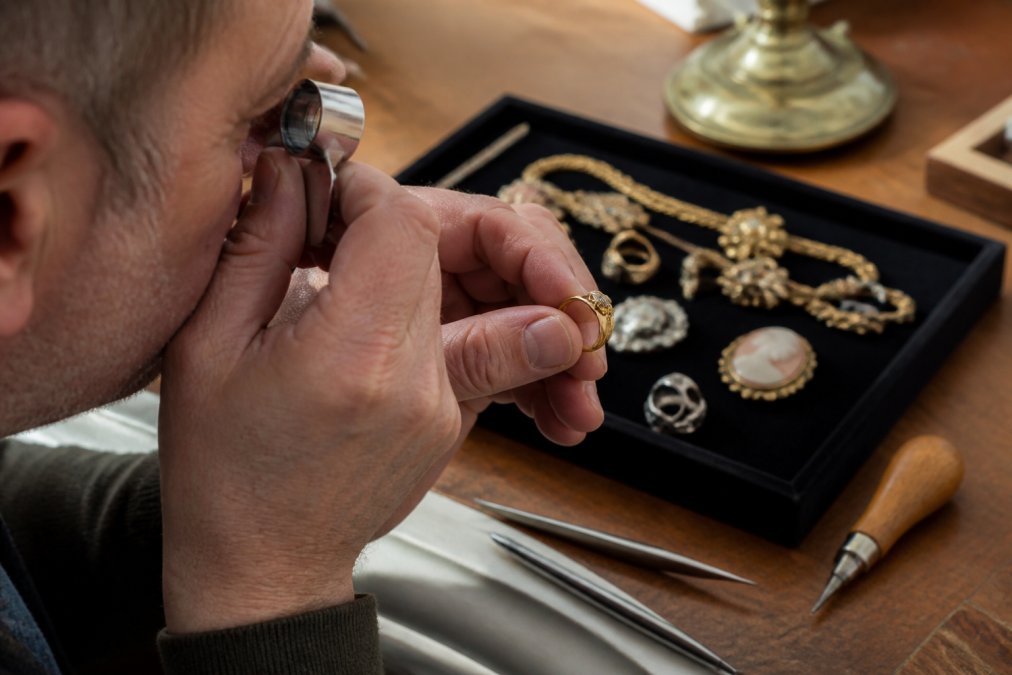
Knowing how to tell if vintage jewelry is valuable starts with physical examination. The two most common ways buyers overpay are: purchasing pieces misrepresented as older than they are, and buying over-restored pieces whose market value has been compromised by heavy-handed repair work.
Reading Hallmarks and Provenance Documentation
Hallmarks are the starting point for authentication. In the US, gold jewelry is typically stamped with a karat mark (10K, 14K, 18K) and often a maker's mark. Pre-1980s pieces may carry additional assay marks depending on their country of origin. According to the Gemological Institute of America's education resources, hallmark reading requires knowledge of both domestic and international marking systems, since much estate jewelry circulating in the US market was originally made in Europe.
Provenance documentation adds a second layer of authentication. Original receipts, insurance appraisals, family records, or auction house certificates all strengthen a piece's verified history.
Signs of Over-Restoration or Misrepresentation
Over-restoration is the hidden killer of vintage jewelry value. A piece that has been re-plated, re-polished, or had its settings replaced loses a significant portion of its collectability premium. Specific red flags include:
- Prong tips that are too uniform and sharp (indicate recent replacement)
- Surface that is too bright and scratch-free for the stated age
- Solder marks in unexpected places suggesting structural repairs
- Stones that sit too perfectly in settings (may indicate re-setting)
Vintage Jewelry Appraisal: How to Get an Accurate Valuation
A vintage jewelry appraisal is a formal written assessment of a piece's market value, conducted by a credentialed professional. Appraisals serve three distinct purposes: insurance coverage, estate planning, and resale pricing.
For insurance purposes, appraisals typically reflect replacement value, which is higher than resale value. For investment tracking and exit planning, you need a fair market value appraisal, which reflects what a willing buyer would pay a willing seller in the current market.
The credential to look for in the US is the GIA Graduate Gemologist designation or membership in the American Society of Jewelry Appraisers. These professionals follow standardized methodologies and carry professional liability. Avoid appraisals from dealers who also want to purchase the piece.
Get appraisals updated every three to five years, or any time precious metal prices shift significantly.
Storage, Insurance, and Exit Strategy for Vintage Jewelry Investors
Owning investment-grade vintage jewelry without a storage, insurance, and exit plan is the equivalent of buying a rental property with no maintenance budget and no idea how to find tenants.
Protecting Your Asset: Storage and Insurance Requirements
Physical storage requirements for fine vintage jewelry are demanding. The primary risks are theft, fire, humidity, and physical damage. Best practices:
- Store pieces individually in soft pouches or compartmentalized trays to prevent scratching
- Keep in a fireproof safe bolted to your home, or in a bank safe deposit box for high-value items
- Maintain stable humidity; extreme fluctuations affect organic materials like pearls, coral, and jet
- Document every piece with high-resolution photographs
Standard homeowner's insurance typically provides limited jewelry coverage, often capped below investment-grade values. A scheduled personal property endorsement or standalone jewelry floater policy from a specialty insurer provides proper coverage. According to the Insurance Information Institute's guidance on jewelry coverage, a current appraisal is required to obtain full replacement value coverage.
Planning Your Exit: Resale Channels and Liquidity Considerations
Liquidity is the honest limitation of vintage jewelry as an investment. Selling quickly almost always means selling at a discount. Planning your exit before you buy protects your returns.
The main resale channels in the US, in rough order of price realization:
- Specialized auction houses (Christie's, Sotheby's, Bonhams): Best price realization for investment-grade pieces, but require consignment periods and charge seller's fees
- Estate jewelry dealers: Faster transactions, but expect wholesale-adjacent pricing
- Online platforms (1stDibs, Worthy for diamonds): Growing market, good for mid-range pieces
- Private sale: Best net return if you have access to a collector network
Investment Risks Every Vintage Jewelry Buyer Should Understand
The vintage jewelry market carries distinct risks from traditional asset classes.
Market volatility: Collector demand for specific eras and styles shifts. Art Deco has been consistently strong, but other periods go in and out of fashion.
Authentication risk: Pieces are regularly dated earlier than manufacture, enhanced with later additions, or assembled from multiple pieces. Without professional authentication, this risk falls entirely on the buyer.
Condition sensitivity: Unlike gold bullion, vintage jewelry is highly condition-sensitive. A chip in a significant stone or improperly repaired clasp can reduce value substantially.
Concentration risk: Holding a large portion of investable assets in any single alternative asset class introduces concentration risk. Most financial advisors treat collectibles as a portfolio complement, not a core holding.
According to the Federal Trade Commission's guidance on buying jewelry, consumers should always request documentation of metal content and gemstone quality in writing before completing any jewelry purchase.
Is Buying Vintage Jewelry a Good Investment for You? A Decision Framework
Whether buying vintage jewelry is a good investment ultimately comes down to your specific situation.
Use this framework to assess your fit:
| Factor | Favorable Signal | Caution Signal |
|---|---|---|
| Knowledge base | Can read hallmarks, assess condition | Relying entirely on seller descriptions |
| Time horizon | 5+ years | Under 3 years |
| Liquidity needs | Capital not needed on short notice | May need funds quickly |
| Authentication access | Independent appraiser relationship | No verification process |
| Storage and insurance | Proper infrastructure in place | No plan yet |
| Portfolio role | Diversification complement | Primary investment vehicle |
Vintage jewelry rewards buyers who treat it as a long-term hold, invest in knowledge before capital, and build the infrastructure that protects the asset. For collectors who approach it this way, the combination of intrinsic value, historical significance, and sustainable luxury positioning makes it a genuinely compelling asset class.
For buyers who expect quick liquidity or passive appreciation without active management, the risks outlined above will likely outweigh the rewards.
ABC Rugs Kilims & Jewelry curates authenticated vintage jewelry alongside Persian antique pieces and handmade textiles, serving collectors and discerning buyers who want verified provenance and genuine craftsmanship rather than guesswork. If you are building a collection with an eye on long-term value, the starting point is always the same: buy authenticated pieces with documented history from sources you trust.
Frequently Asked Questions
What kind of vintage jewelry is a good investment?
Pieces from historically significant eras such as Art Deco, Victorian, and Edwardian periods tend to hold strong collectability and resale value. Investment-grade vintage jewelry typically combines high-quality precious metals, certified gemstones, clear provenance, and documented hallmarks. Estate jewelry from recognized makers or design houses commands a premium in the pre-owned market. Condition, rarity, and authentication are the deciding factors regardless of era, so prioritize pieces with verifiable history over aesthetic appeal alone.
How do you know if vintage jewelry is valuable?
Start by examining hallmarks stamped inside rings or on clasps, which indicate metal purity and sometimes the maker. Provenance documentation, original boxes, or receipts add measurable value. A professional vintage jewelry appraisal from a GIA-credentialed appraiser or an American Society of Jewelry Appraisers member gives you a defensible market value. Watch for red flags like replaced stones, resized shanks that distort original proportions, or missing maker's marks, as these reduce both authenticity and resale value significantly.
Is vintage gold jewelry a good investment?
Vintage gold jewelry carries a dual value: the intrinsic value of the gold itself tied to spot market prices, plus the collectability premium of its age, craftsmanship, and historical significance. Unlike gold bullion, a well-chosen antique gold piece can appreciate beyond raw metal value when demand for that era or style rises. The trade-off is lower liquidity compared to bullion. For a vintage jewelry investment to outperform raw gold, authentication, condition, and rarity must all be strong.
What era of jewelry is most valuable?
Art Deco pieces from the 1920s and 1930s consistently rank among the most sought-after in the estate jewelry market due to their geometric precision, use of platinum, and high gemstone quality. Victorian and Edwardian pieces also command strong prices for their craftsmanship and historical significance. Mid-century modern jewelry from the 1940s through 1960s is gaining traction with younger collectors. Value ultimately depends on maker, condition, and provenance rather than era alone, so a professional appraisal is always recommended.
How do I protect a vintage jewelry investment through insurance?
Standard homeowners or renters insurance policies in the United States typically cover jewelry only up to a low scheduled limit, often $1,000 to $2,500, which is rarely enough for investment-grade pieces. A standalone jewelry floater or a specialized fine arts and collectibles policy through an insurer familiar with the antique jewelry market provides broader coverage. You will need a current, written vintage jewelry appraisal to establish replacement value. Reappraise every two to three years as market values shift.
Where can I resell vintage jewelry in the United States?
The main exit channels for vintage jewelry investors in the US include established auction houses, reputable estate jewelry dealers, online marketplaces focused on pre-owned luxury goods, and private collector networks. Auction houses offer broad exposure but charge seller commissions that reduce net proceeds. Selling directly to a dealer is faster but typically yields a lower price than auction. Whichever channel you choose, a current appraisal and clear authentication documentation will directly improve your negotiating position and final sale price.
Building a vintage jewelry portfolio takes patience, knowledge, and access to pieces with verifiable provenance. ABC Rugs Kilims & Jewelry offers a curated selection of authentic vintage jewelry and gemstones, reviewed and trusted by collectors across the US. Explore the collection to find investment-grade pieces with the historical significance and craftsmanship that hold value over time.
This article was written using GrandRanker


