

Table of Contents
- How to Spot Authentic Antique Kilims Before You Buy
- Buyer Verification Checklist for Antique Kilims
-
Top Antique Kilim Dealers in the USA
- 1. ABC Rugs Kilims & Jewelry, Best for Wholesale, Retail, and Appraisals
- 2. Matt Camron Rugs & Tapestries, Best for Rare, Globally Sourced Kilims
- 3. Kilim Couture New York, Best for Guaranteed Authentic Anatolian Pieces
- 4. Landry & Arcari, Best for Certified Appraisals and Established Trust
- 5. The Persian Knot Gallery, Best for Transparent Pricing and Free Shipping
- 6. Claremont Rug Company, Best for Investment-Grade Fine Art Carpets
- 7. Realm Rugs, Best for Vintage Kilims at Accessible Price Points
- Kilim Rug Appraisal: Pricing Factors and Investment Value
- Ethical Sourcing, Provenance, and Cultural Heritage
- Care and Maintenance for Antique Kilims
- Which Dealer Should You Choose?
- Conclusion
Last Updated: July 31, 2026
Knowing where to buy authentic antique kilims is harder than it looks. The market is flooded with machine-made reproductions sold as "vintage," artificially aged pieces passed off as genuine antiques, and vague provenance claims that fall apart under scrutiny. At ABC Rugs Kilims & Jewelry, we work with collectors, interior designers, and homeowners who arrive with the same question: how do I know I'm getting the real thing? Below, we'll show you exactly how to identify authentic hand-woven kilims, which US dealers you can trust in 2026, and what to look for before you spend a dollar.
Most guides focus entirely on where to shop and skip the part that actually matters: how to verify what you're looking at. Start with identification skills, then apply them to the dealers we've vetted below.
How to Spot Authentic Antique Kilims Before You Buy
A kilim is a flat-woven textile produced by tightly interweaving the warp and weft threads without a pile, creating a reversible, durable textile with geometric patterns that carry deep cultural meaning. The fastest way to separate genuine antique kilims from modern reproductions is to examine the back. On an authentic hand-woven kilim, the reverse side is nearly identical to the front because the flatwoven structure is the same on both faces. Machine-made versions show a uniform, mechanical backing that looks almost printed.
Hand-Woven vs. Machine-Made: The Fastest Tell
Turn the kilim over. On a genuine hand-woven piece, you'll find slight irregularities in weave density, small variations in weft thread tension, and imperfect edges that reflect the human hand. Machine-made kilims are perfectly uniform, perfection is a red flag. Look for slight color variation within a single dye lot, uneven warp spacing, hand-finished selvedge edges, and natural patina from age and use, not chemical washing.
Materials, Natural Dyes, and Fiber Content
Authentic antique kilims are woven from hand-spun wool, mohair, or cotton. Hand-spun wool has a slightly irregular diameter along its length, creating characteristic texture. Synthetic fibers are perfectly uniform and feel slick.
Natural dyes from madder root, indigo, pomegranate rind, and walnut husks soften and deepen with age. According to the Textile Museum's collection and research resources, natural dye identification is one of the most reliable indicators of a kilim's age and origin. Synthetic aniline dyes fade unevenly and produce hues that look slightly "off" compared to rich, complex vegetable dye tones.
Regional Origins: Anatolian, Turkish, and Tribal Kilims
Regional origin shapes everything: motifs, color palette, weave structure, and cultural significance. Anatolian kilims from central Turkey feature bold geometric patterns and symbolic motifs referencing nomadic life, protection, and fertility. Tribal kilims produced by Kurdish, Shahsavan, or Qashqai weavers carry rawer, more spontaneous energy, with no two pieces identical. Turkish Sarkoy kilims from the Thrace region are distinctive for their finer weave and structured compositions. Understanding regional origin directly affects value, authenticity verification, and the piece's place within textile history.
Buyer Verification Checklist for Antique Kilims
Before committing to any purchase, run through this checklist:
- Request provenance documentation, including country of origin, approximate date of manufacture, and prior ownership history
- Examine the reverse side for weave consistency and hand-finishing
- Check fiber content by feel: hand-spun wool has slight irregularity; synthetic fibers do not
- Assess colorfastness: complex, varied dye colors versus flat, uniform ones
- Look for natural patina: age-related color softening at wear points, not uniformly across the surface
- Ask whether the piece has been restored and to what extent
- Request a certified appraisal from a credentialed dealer
- Verify the dealer's return policy and written authenticity guarantees
Condition Grading Standards to Know
Antique kilim condition is typically graded from mint or excellent down to poor or distressed. Excellent/Mint: No repairs, no fading, structure intact, colors vibrant. Very Good: Minor wear consistent with age, possibly small professional repairs. Good: Moderate wear, some restoration evident, colors may show natural fading. Fair: Significant wear, multiple repairs, or structural issues. Distressed/Vintage Distressed: Heavy wear intentionally preserved as part of the piece's character. According to the American Textile History Museum's educational resources, condition grading in antique textiles requires both technical knowledge and understanding of how specific weaving traditions age over time.
Top Antique Kilim Dealers in the USA
The US market for authentic antique kilims is served by a relatively small number of dealers who combine sourcing expertise with genuine authentication standards.
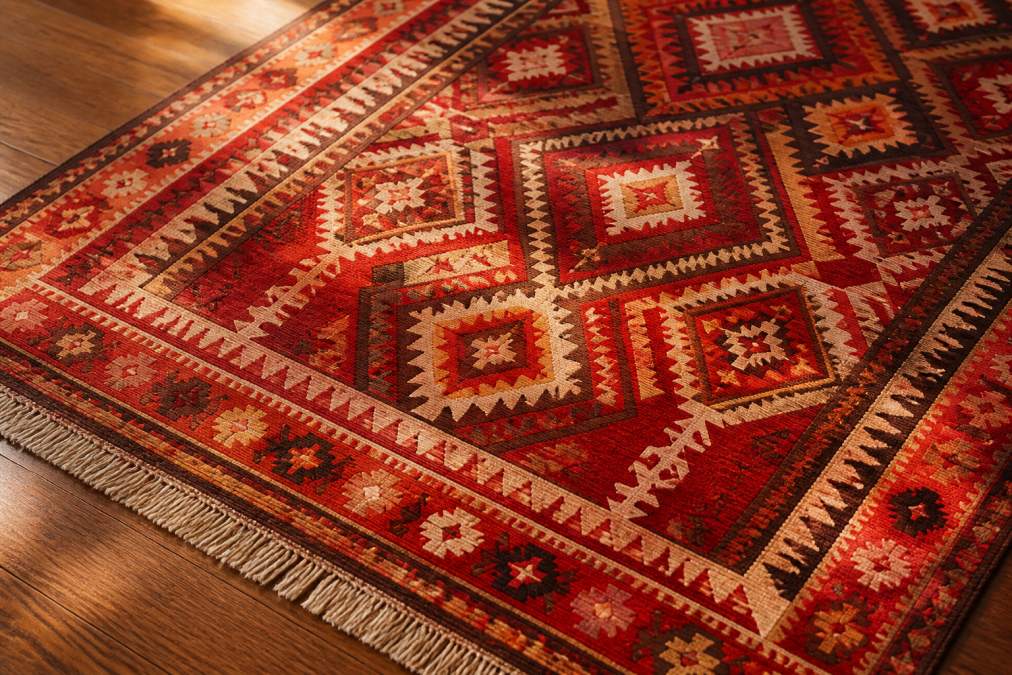
1. ABC Rugs Kilims & Jewelry - Best for Wholesale, Retail, and Appraisals
ABC Rugs Kilims & Jewelry is a choice for buyers who want a single source covering authentic kilims, Persian antique pieces, and appraisal services. The collection spans handmade rugs, kilims, tapestries, and vintage pieces, with wholesale and retail options suited to individual collectors and boutique store owners. For pricing, visit abcrugskilims.com directly.
Best for: Collectors, interior designers, wholesale buyers, and anyone needing appraisals.
2. Matt Camron Rugs & Tapestries - Best for Rare, Globally Sourced Kilims
Matt Camron houses one of the largest vintage kilim collections in the United States. Their sourcing team travels globally to acquire pieces, making the collection evolve constantly with rare, mint-condition kilims and vintage distressed examples difficult to find elsewhere. The specialization spans Turkish, Moroccan, Afghan, and other regional traditions with showrooms available for in-person viewing.
Best for: Serious collectors who prioritize rare sourcing and want to view pieces in person.
3. Kilim Couture New York - Best for Guaranteed Authentic Anatolian Pieces
Kilim Couture New York focuses on high-end, hand-knotted antique and vintage kilims from Turkey, with concentration on well-preserved Anatolian rugs from the mid-20th century. Direct sourcing relationships with Turkish artisans and markets are the key differentiator. Their guarantee against stain-free rugs and artificial aging techniques is notable. Free and fast delivery is included on all US orders.
Best for: Buyers seeking authenticated Anatolian kilims with explicit guarantees against artificial aging.
4. Landry & Arcari - Best for Certified Appraisals and Established Trust
Family-owned since 1938, Landry & Arcari brings institutional credibility. They are certified by the Oriental Rug Retailers of America to appraise rugs, meaning their appraisals carry weight with insurers and estate attorneys. The collection includes antique kilims, flatweaves, and Dhurrie rugs with free shipping on handmade rugs.
Best for: Buyers prioritizing institutional credibility and needing appraisals that hold up with banks or insurers.
5. The Persian Knot Gallery - Best for Transparent Pricing and Free Shipping
The Persian Knot Gallery stands out for pricing transparency. Online listings include detailed descriptions covering dimensions, date of manufacture, origin, material, and condition, with price range filters. The collection covers Persian, Turkish, and Caucasian kilims, along with Soumak flatweaves. Complimentary US shipping and insurance on all orders is meaningful when moving fragile antique textiles.
Best for: Buyers who want to research and compare pricing independently.
6. Claremont Rug Company - Best for Investment-Grade Fine Art Carpets
Claremont Rug Company in California operates at the top tier of the antique rug market, specializing in investment-level fine art carpets and rare Oriental and Persian pieces. For serious collectors treating antique textiles as an asset class, Claremont's expert consultation and museum-quality inventory represent a category of their own.
Best for: Established collectors and investors seeking museum-quality pieces as fine art holdings.
7. Realm Rugs - Best for Vintage Kilims at Accessible Price Points
Realm Rugs offers vintage Turkish Sarkoy and Moroccan tribal kilims with regular sale pricing, clear return policies, and detailed product information. Accessible price points make Realm Rugs a reasonable starting point for first-time buyers.
Best for: First-time buyers seeking vintage kilims at accessible price points.
Kilim Rug Appraisal: Pricing Factors and Investment Value
| Dealer | Best For | Free Shipping | Appraisal Services | In-Person Viewing |
|---|---|---|---|---|
| ABC Rugs Kilims & Jewelry | Wholesale, retail, appraisals | Contact for details | Yes, certified | Contact dealer |
| Matt Camron | Rare global sourcing | Contact for details | No | Yes, showrooms |
| Kilim Couture New York | Anatolian authenticity | Yes, all US orders | No | No |
| Landry & Arcari | Certified appraisals | Yes, handmade rugs | Yes, ORRA certified | Yes |
| The Persian Knot Gallery | Transparent pricing | Yes, with insurance | No | No |
| Claremont Rug Company | Investment-grade pieces | Contact for details | Yes, expert consult | Yes |
| Realm Rugs | Accessible price points | Contact for details | No | No |
What Drives the Value of an Antique Kilim
Antique kilim valuation is determined by factors that interact in ways that can surprise unfamiliar buyers. Age alone does not determine value. A 19th-century kilim in poor condition may be worth less than a mid-20th-century piece in excellent condition with documented provenance.
The primary value drivers are: Age and documented provenance (pieces with clear ownership history command premiums), regional origin and rarity (certain weaving traditions are significantly rarer), condition (unrestored pieces in excellent condition are far more valuable), weave density and technical quality, and natural dye quality (pieces with complex, well-preserved color palettes are consistently more valuable).
Are Antique Kilims a Good Investment?
Antique kilims can function as an asset class, but the investment case requires realistic framing. The market is illiquid compared to financial assets. Museum-quality antique kilims from documented sources have historically held value well over long time horizons, and rare pieces have appreciated meaningfully. The key distinction is between investment-grade pieces and decorative vintage kilims.
Ethical Sourcing, Provenance, and Cultural Heritage
Kilims are carriers of cultural heritage, nomadic weaving traditions, and symbolic systems passed down across generations of Anatolian, Persian, and Central Asian communities. Ethical sourcing means purchasing pieces that entered the market through legal channels with clear documentation of export compliance. According to the US Customs and Border Protection guidance on cultural property, certain antique textiles are subject to import restrictions under bilateral cultural property agreements. Reputable dealers maintain documentation demonstrating legal importation. Beyond legal compliance, ethical sourcing involves supporting dealers who work directly with source communities and are transparent about sourcing chains.
Care and Maintenance for Antique Kilims
Antique kilim maintenance is where new owners often make costly mistakes. Rotation: Rotate your kilim 180 degrees every six to twelve months to distribute wear evenly. Vacuuming: Vacuum gently with low suction and no beater bar, running in the direction of weft threads. Spot cleaning: Blot spills immediately with a clean, dry cloth. For deeper cleaning, use cold water and mild, pH-neutral soap. Professional cleaning: Antique kilims should be professionally cleaned by a specialist in antique textiles. Storage: Roll kilims around an acid-free tube, wrap in acid-free tissue, and store in climate-controlled environments away from direct light. Padding: Always use a rug pad under kilims on hard flooring to prevent shifting and edge wear.
Which Dealer Should You Choose?
The right dealer depends on what you're trying to accomplish. If you need a single source covering authenticated kilims, Persian antique pieces, certified appraisals, and wholesale options, ABC Rugs Kilims & Jewelry is a strong all-around choice. If you're building a serious collection focused on rare regional pieces, Matt Camron's depth is hard to match. For institutional credibility for insurance or estate purposes, Landry & Arcari's ORRA certification is the differentiator. For first-time buyers, Realm Rugs provides a lower-risk entry point.
Regardless of dealer, request provenance documentation, ask about condition grade and restoration history, and get a certified appraisal before making a significant purchase.
Finding where to buy authentic antique kilims in a market full of reproductions requires both the right knowledge and the right dealer relationships. ABC Rugs Kilims & Jewelry addresses both sides of that challenge, offering a curated collection of authenticated handmade rugs, kilims, and Persian antique pieces alongside certified appraisal services and wholesale options that serve collectors and design professionals alike. Visit abcrugskilims.com to explore current inventory, request an appraisal, or discuss your specific collection goals with the team.
Frequently Asked Questions
How can you tell if a kilim rug is authentic?
Authentic antique kilims show irregular warp and weft patterns visible from the back, natural dye color variations called abrash, and hand-spun wool with slight inconsistencies in weave density. Flip the rug over, a genuine hand-woven piece looks nearly identical on both sides. Machine-made reproductions have perfectly uniform rows and a stiff backing. Checking for a patina consistent with age, along with provenance documentation from a reputable dealer, adds further confidence when buying authentic antique kilims.
What is the difference between a vintage and an antique kilim?
In the antique textile trade, a kilim is generally considered antique if it is 100 or more years old, and vintage if it falls roughly between 20 and 99 years old. Antique kilims typically command higher prices at rug appraisal due to rarity, historical significance, and natural dye colorfastness developed over decades. Vintage kilims offer a middle ground, authentic craftsmanship and nomadic weaving traditions at a somewhat more accessible price point for US buyers.
What should I look for when buying an antique kilim from a US dealer?
When sourcing authentic antique kilims, prioritize dealers who provide written provenance documentation, disclose fiber content and regional origin, and offer certified rug appraisals. Confirm whether the kilim uses vegetable or natural dyes versus synthetic dyes, and ask about any restoration work. Reputable antique kilim dealers in the USA will also clearly grade condition, noting wear, repairs, or re-weaving, and offer transparent return or exchange policies so you can buy with confidence.
Are kilim rugs a good investment?
Antique kilims with documented provenance, rare tribal motifs, and authentic craftsmanship have historically held or appreciated in value, particularly investment-grade pieces from recognized Anatolian or Persian weaving traditions. However, like any antique textile, value depends on condition, rarity, and market demand. A professional kilim rug appraisal from a certified dealer is the best first step before treating any piece as a financial asset. Kilims with strong cultural heritage stories tend to attract the most serious collector interest.
How do I find a specific regional kilim, such as an Anatolian or tribal piece?
The best approach is to contact dealers who specialize in authentic kilim rug identification by origin, many reputable US dealers allow you to filter inventory by region, era, and weaving tradition. Dealers like ABC Rugs Kilims & Jewelry offer curated collections of Persian antique and vintage pieces and can assist with specific sourcing requests. Describing the geometric patterns, color palette, and approximate age you are seeking helps specialists match you with one-of-a-kind pieces from their current or incoming inventory.
This article was written using GrandRanker


