

Table of Contents
- Why Vintage Rugs Are Defining 2026 Interior Trends
- How to Style Vintage Rugs in Modern and Minimalist Rooms
- How to Choose Rug Size for Your Living Room
- Vintage Rug Layering Techniques That Actually Work
- Material Guide: Wool, Silk, Hand-Knotted, and Distressed Finishes
- Sustainability, Sourcing, and Rug Pad Technology: What Competitors Skip
- Best Vintage Rug Cleaning Practices to Protect Your Investment
- Conclusion: Building a Floor Style That Lasts Beyond 2026
Last Updated: August 3, 2026
Vintage rugs are defining American interiors in 2026, and this guide from ABC Rugs Kilims & Jewelry covers every practical angle: choosing the right size, layering technique, sourcing sustainably, and protecting your investment long-term. A well-placed heritage piece is the structural foundation of a room, not the finishing touch.
Why Vintage Rugs Are Defining 2026 Interior Trends
Vintage rugs offer something new construction cannot replicate: organic texture, authentic patina, and visual weight that grounds a space without competing with it. According to the American Society of Interior Designers trend outlook, homeowners are moving decisively away from synthetic, mass-produced textiles toward handmade pieces with documented craft heritage. The appetite for tactile, meaningful objects has reshaped what interior designers specify on their project boards.
Oushak, Beni Ourain, and Kilim: The Styles Leading the Charge
Three rug families dominate 2026 interiors: Oushak, Beni Ourain, and Kilim.
Oushak rugs, woven in western Turkey, carry low-sheen wool pile with tonal variations that read as sun-faded. They're ideal for minimalist rooms where high-contrast would feel jarring. Beni Ourain rugs from Morocco feature thick, creamy wool with geometric black linework, pairing naturally with contemporary sofas in linen or boucle. Kilims are flat-weave pieces with bold, graphic patterns and no pile, making them versatile for layering and high-traffic areas.
Color Palettes: Muted, Earthy, and Sun-Faded Tones for Modern Homes
The dominant palette for vintage rugs in 2026 skews toward terracotta, clay tones, dusty rose, and warm ivory. These muted tones don't demand attention and create a neutral base that lets furniture, lighting, and art breathe. Sun-faded pieces carry a softness that new rugs can't fake convincingly.
The practical rule: pull one color from the rug into a throw, cushion, or wall treatment to make the rug feel intentional rather than incidental.
How to Style Vintage Rugs in Modern and Minimalist Rooms
The biggest mistake with vintage rugs in modern interiors is underscaling. A vintage rug needs to be large enough to anchor the furniture grouping, not just decorate the floor beneath the coffee table.
Pairing heritage pieces with contemporary sofas works best when there's textural contrast. A smooth, tight-weave Kilim under a chunky linen sofa creates visual dialogue. A high-pile Beni Ourain under a sleek leather sectional does the same in reverse.
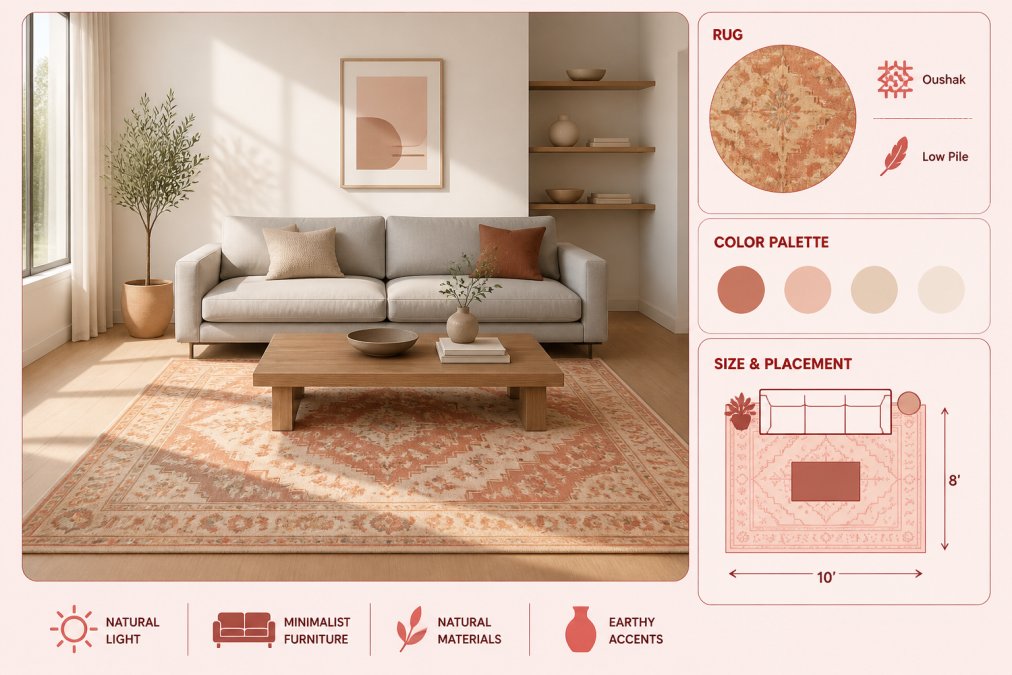
Pairing Heritage Pieces with Contemporary Sofas and Neutral Bases
When a room's walls, furniture, and cabinetry are intentionally quiet, the vintage rug becomes the primary statement. The pairing formula that works consistently: contemporary sofa in solid neutral, vintage rug with tonal variations, one accent color echoed in a single accessory.
Placement Tips: Under Furniture vs. Open Floor Styling
Under-furniture placement creates a defined conversation zone. The front legs of a sofa and chairs sit on the rug, with the edge extending at least 12 to 18 inches beyond furniture legs on each side.
Open floor styling works best for Kilims and flat-weave pieces in hallways, entryways, or studios. Anchor it visually with a plant, low stool, or stack of books to prevent it from looking like it's waiting for furniture.
How to Choose Rug Size for Your Living Room
Choose rug size based on the furniture grouping, not the room. The rug should be large enough that the front legs of every major seat sit on it.
| Room Configuration | Recommended Rug Size | Placement Style |
|---|---|---|
| Small seating area (under 10x10 ft) | 5x8 ft | Front legs on rug only |
| Mid-size living room (12x14 ft) | 8x10 ft | All front legs on rug |
| Large open-plan space (15x18 ft+) | 9x12 ft or 10x14 ft | Full furniture grouping on rug |
| Hallway or entryway | 2.5x8 ft runner | Open floor, centered |
| Bedroom (queen bed) | 8x10 ft | Extends 24 in beyond bed sides |
A rug that's too small creates spatial imbalance. A rug that's too large for the furniture grouping but appropriately scaled to the room can work beautifully in open-plan spaces where it defines a zone.
Vintage Rug Layering Techniques That Actually Work
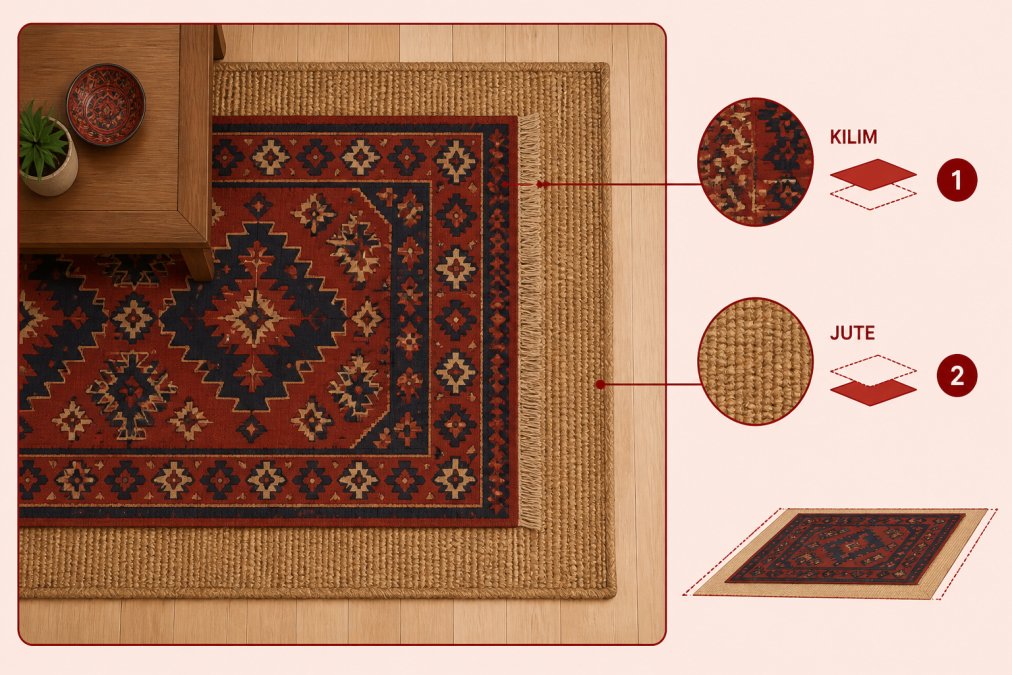
Layering vintage rugs requires a simple system: one base, one statement. The base rug should be large, low-profile, and neutral. Natural fiber options like jute or sisal work well because their organic textures don't compete visually. The statement rug, typically a Kilim or smaller vintage piece, sits centered on the base, revealing the base rug's border on at least two sides.
Rules that prevent layering from looking accidental:
- The top rug should be at least 18 inches smaller on each dimension than the base rug
- Flat-weave pieces layer better than high-pile rugs, which create tripping hazards
- Limit combinations to two rugs. Three layers read as clutter.
- Ensure color families are related. A terracotta Kilim on warm jute works. A cool-toned Persian on the same base creates friction.
Material Guide: Wool, Silk, Hand-Knotted, and Distressed Finishes
Wool pile is the workhorse of vintage rugs. Hand-knotted wool from Turkey, Iran, and Afghanistan carries the antique aesthetic that defines the category. Wool is naturally soil-resistant, resilient under foot traffic, and develops richer patina over time. It's ideal for living rooms, dining rooms, and bedrooms.
Silk rugs carry luminous low-sheen that shifts with light. They're not suited for high-traffic areas. Reserve silk pieces for low-traffic bedrooms, formal sitting rooms, or wall display.
Hand-knotted construction is the quality marker separating investment-grade pieces from decorative imports. Knot count per square inch indicates weaving density and time invested. Higher knot counts correlate with finer pattern detail and longer structural lifespan.
Distressed finishes on newer vintage-style rugs are achieved through chemical washing or mechanical treatment. The result is visually convincing but structurally different from authentic aged wool. Genuine antique rugs carry tonal variations from actual dye aging, producing depth that distressed finishes approximate but rarely match.
As documented in Smithsonian's textile conservation resources, hand-knotted wool rugs, when properly maintained, can exceed a century of functional use.
Sustainability, Sourcing, and Rug Pad Technology: What Competitors Skip
Vintage and antique rugs are the most sustainable textile option available. A rug hand-knotted 40 or 80 years ago required no new raw material extraction, no synthetic dye production, and no factory energy consumption to produce today. Choosing an authentic vintage piece is genuinely low-impact compared to purchasing new machine-made rugs.
According to the Environmental Protection Agency's overview of sustainable consumption, extending the life of existing goods is among the most effective individual-level environmental choices available.
Budget-Friendly Finds vs. Investment-Grade Antique Pieces
The vintage rug market spans an enormous range. Decorative pieces with distressed finishes offer the aesthetic of aged wool at accessible price points. Documented antique pieces with verified provenance represent genuine long-term investments that can appreciate over time.
For most buyers, the distinction comes down to intended use and timeline. For rentals, first homes, or spaces you expect to redesign in five years, a well-made decorative vintage-style rug is sensible. For homes you intend to keep or collections you're building, authentic hand-knotted pieces carry both aesthetic and financial value that compounds over time.
ABC Rugs Kilims & Jewelry serves both ends of this spectrum, with a curated inventory including authentic Persian antique pieces alongside accessible vintage finds, reviewed and trusted across retail and wholesale markets.
Pricing for authentic vintage and antique rugs depends on origin, age, condition, knot count, and size. Visit the ABC Rugs Kilims & Jewelry website for current inventory and pricing.
Rug Pads, Pet Households, and High-Traffic Realities
A rug pad is not optional. It prevents slipping on hard floors, cushions the rug's foundation from foot traffic abrasion, and allows air circulation that prevents moisture accumulation beneath the rug. Felt and natural rubber pads are standard for hardwood and tile. Avoid PVC pads on hardwood; they can transfer plasticizers to the floor finish.
For pet households, wool rugs handle pet hair and occasional accidents better than silk. Flat-weave Kilims are easiest to clean and dry quickly. High-pile wool rugs in pet-active homes need more frequent professional cleaning to prevent odor retention.
High-traffic areas like entryways, hallways, and dining rooms suit durable hand-knotted wool pieces with denser knot counts. Reserve silk and fragile antique pieces for lower-traffic zones.
Best Vintage Rug Cleaning Practices to Protect Your Investment
Best vintage rug cleaning practices start with one principle: the less intervention, the better. Antique and vintage rugs are not designed for aggressive cleaning.
Routine maintenance:
- Vacuum weekly on the lowest suction setting, moving with the pile direction
- Rotate the rug every six to twelve months to distribute foot traffic and light exposure evenly
- Address spills immediately by blotting with a clean white cloth
- Allow dry soil to dry completely before vacuuming
- Avoid steam cleaning at home. High heat and moisture can shrink wool foundations and bleed vegetable dyes.
Professional cleaning should be done by a specialist in hand-knotted textiles, not a general carpet cleaning service. Ask specifically about hand-washing and flat-drying methods before committing.
Many buyers who inherit vintage rugs ask whether they need immediate professional cleaning. The answer is usually no. A gentle vacuum, visual inspection for active moth damage or structural weakness, and a proper rug pad are the right first steps.
For guidance specific to pieces you purchase, the team at ABC Rugs Kilims & Jewelry can provide recommendations based on the rug's origin, age, and construction.
Conclusion: Building a Floor Style That Lasts Beyond 2026
The throughline of every decision in this guide is the same: vintage rugs reward intentionality. The right size, material, placement, and care protocol transform a textile into a room's defining element, one that improves with age rather than dating itself.
Knowing how to style vintage rugs in 2026 means understanding that these pieces are not trends. Oushaks, Kilims, and hand-knotted Persian antiques were relevant decades before 2026 and will remain relevant decades after.
For deeper context on how textile heritage shapes contemporary interiors, the Textile Society of America's educational resources provide authoritative information on craft traditions that inform today's most sought-after pieces.
Finding authentic vintage rugs that are both beautiful and verifiably genuine is the real challenge most buyers face. ABC Rugs Kilims & Jewelry addresses that challenge directly with a curated collection of handmade rugs, Kilims, and Persian antique pieces reviewed and trusted across both retail and wholesale markets. Whether you're sourcing a single statement piece for a living room or building a wholesale inventory for a design practice, explore the current collection at ABC Rugs Kilims & Jewelry and find a piece that earns its place on your floor for decades.
Frequently Asked Questions
Are vintage rugs still in style for 2026?
Vintage rugs are very much in style for 2026. The trend toward organic textures, muted palettes, and timeless design has pushed hand-knotted pieces like Oushak, Beni Ourain, and Kilim rugs to the forefront of modern home decor. Their distressed finishes and tonal variations add gravitas to minimalist rooms in a way that machine-made reproductions simply cannot replicate. Authenticity and craftsmanship are the dominant themes driving interior styling decisions this year.
How do I choose the right size vintage rug for my living room?
For most living rooms, the rug should be large enough so that the front legs of all major seating pieces rest on it. A common approach is to leave 12 to 18 inches of bare floor between the rug's edge and the wall. In smaller rooms, a rug that fits entirely under the coffee table still works if it maintains spatial balance. Always measure your seating arrangement first, then shop for size. Vintage rugs are one-of-a-kind, so knowing your minimum dimensions before browsing saves significant time.
Can you layer vintage rugs over wall-to-wall carpet?
Yes, layering vintage rugs over wall-to-wall carpet is a practical and visually effective technique. Choose a flat-weave style like a kilim as the top layer since it lies flatter and is less likely to bunch. A non-slip rug pad placed between the two layers adds grip and prevents shifting. Keep the top rug smaller than the carpet beneath it so the layered effect reads as intentional. This approach works especially well in rental homes where replacing existing carpet is not an option.
How do you clean and maintain vintage rugs at home?
For routine care, shake the rug outdoors and vacuum on the lowest suction setting, always going with the pile rather than against it. Rotate the rug every six to twelve months to distribute foot traffic and sun exposure evenly. For spills, blot immediately with a clean white cloth and cold water. Avoid harsh chemical cleaners on wool or silk pile. For deep cleaning, professional rug washing is strongly recommended for antique or hand-knotted pieces. ABC Rugs Kilims and Jewelry provides care guidance with every purchase.
What is the difference between an antique rug and a vintage rug?
The standard distinction in the US rug trade is that antique rugs are at least 100 years old, while vintage rugs are generally 20 to 99 years old. Both categories include hand-knotted pieces with genuine heritage value, but antique rugs typically command higher prices due to their rarity and provenance. Vintage rugs offer much of the same antique aesthetic and organic character at a broader range of price points, making them the more accessible entry point for homeowners and interior designers alike.
What color palettes work best with vintage rugs in 2026?
The dominant palettes for 2026 pair well with vintage rugs' natural tonal variations. Terracotta, clay tones, warm ivory, and dusty sage are especially compatible with sun-faded Oushak and Persian pieces. These muted, earthy hues complement neutral base walls and let the rug serve as the room's primary accent. Avoid pairing highly saturated, bold wall colors directly with a busy vintage rug pattern since the two will compete for visual weight rather than creating the spatial balance that defines good interior styling.
This article was written using GrandRanker


